

Conversational Intent: Matching Content to AI Dialogue
Learn how conversational intent shapes AI dialogue. Discover strategies to match your content to how users interact with AI systems and monitor brand visibility...
21 min read
Conversational SEO is the optimization of content for AI-powered conversational systems and answer engines that generate responses through natural dialogue. It prioritizes being cited and referenced by AI systems like ChatGPT, Gemini, and Perplexity rather than achieving traditional search rankings. Success depends on citation-based visibility, topical authority, and content structured for AI consumption. This represents a fundamental shift in how websites gain visibility in an increasingly AI-driven search landscape.
Conversational SEO is the optimization of content for AI-powered conversational systems and answer engines that generate responses through natural dialogue. It prioritizes being cited and referenced by AI systems like ChatGPT, Gemini, and Perplexity rather than achieving traditional search rankings. Success depends on citation-based visibility, topical authority, and content structured for AI consumption. This represents a fundamental shift in how websites gain visibility in an increasingly AI-driven search landscape.
Conversational SEO refers to the optimization of content for AI-powered conversational systems and answer engines that generate responses through natural dialogue rather than traditional search result rankings. Unlike traditional SEO, which focuses on achieving high rankings in search engine results pages (SERPs), conversational SEO prioritizes being cited and referenced by AI systems like ChatGPT, Google Gemini, Perplexity, and other large language models. These systems synthesize information from multiple sources to provide direct answers to user queries, fundamentally changing how content visibility is achieved. The goal shifts from ranking first for a keyword to becoming a trusted source that AI systems cite when answering user questions. This represents a paradigm shift in how websites gain visibility and traffic in an increasingly AI-driven search landscape.

Traditional SEO and conversational SEO operate on fundamentally different principles, requiring distinct optimization strategies. The following table illustrates the key differences:
| Dimension | Traditional SEO | Conversational SEO |
|---|---|---|
| Primary Focus | Keyword rankings | Citation and source authority |
| Query Type | Single, static queries | Multi-turn conversations and intent expansion |
| Visibility Metric | Position in SERP | Citation share and AI mentions |
| Content Goal | Rank #1 for target keywords | Become authoritative source cited by AI |
| User Interaction | Click-through to website | Direct answer in AI interface |
| Measurement | Click-through rate, impressions | Citation frequency, answer inclusion rate |
Traditional SEO emphasizes keyword optimization and backlink building to achieve top rankings, while conversational SEO focuses on content quality, authority, and relevance to be selected as a source by AI systems. In traditional SEO, a single query generates one search result ranking; in conversational SEO, a single user question may trigger multiple AI-generated queries that expand the original intent. The metrics that matter have shifted from tracking keyword positions to monitoring how often your content is cited and referenced by AI systems. Success in conversational SEO requires understanding that visibility now depends on being deemed trustworthy enough for AI systems to cite your content when answering user questions.
Query fan-out describes how AI systems expand a single user query into multiple related searches to gather comprehensive information for their response. When a user asks a conversational AI a question, the system doesn’t simply retrieve one result; instead, it generates several related queries to understand different facets of the user’s intent. For example, a question about “best practices for remote work” might fan out into queries about productivity tools, communication strategies, time management, and employee wellness. Intent clustering groups these expanded queries by semantic meaning, allowing AI systems to organize information thematically rather than by keyword matching. This expansion means that content optimized for a single keyword phrase now competes across multiple intent-based clusters, requiring a broader, more comprehensive approach to topic coverage. Understanding query fan-out is essential because it reveals that conversational SEO success depends on covering related topics and answering multiple facets of user intent within your content ecosystem.
In the conversational AI era, citation-based visibility has become more valuable than traditional search rankings because AI systems explicitly reference their sources when providing answers. When ChatGPT, Gemini, or Perplexity generates a response, it often includes citations or mentions of the sources it drew from, directing user attention to those websites. This citation mechanism creates a new form of visibility that doesn’t depend on achieving position one in a SERP but rather on being selected as a credible source by the AI system. Citation share—the percentage of AI-generated answers that reference your content—becomes a critical metric for measuring success in conversational search. A website cited in 30% of relevant AI responses may drive more qualified traffic than ranking first for a single keyword, since users actively see the source attribution. The shift to citation-based visibility means that building topical authority and demonstrating expertise becomes more important than traditional keyword optimization, as AI systems prioritize sources that comprehensively address user questions.
Conversational AI systems parse and prioritize content differently than traditional search engines, requiring specific structural optimizations to improve citation likelihood. Content must be organized to provide direct, clear answers early in the text, followed by supporting evidence and context. Structured data markup helps AI systems understand content relationships and extract information more accurately. The following best practices optimize content for conversational AI consumption:
Content that answers questions comprehensively, with clear structure and supporting evidence, is more likely to be selected by conversational AI systems as a citation source. The goal is to make your content easily parseable and authoritative enough that AI systems recognize it as a reliable source worth citing to users.
Natural Language Processing (NLP) enables AI systems to understand the semantic meaning behind user queries rather than simply matching keywords, fundamentally changing how content must be optimized. NLP algorithms analyze the context, intent, and relationships between words to determine what a user actually wants to know, not just what words they used. Entity recognition identifies specific people, places, concepts, and relationships within text, allowing AI systems to understand that “Apple” refers to a company in one context and a fruit in another. This semantic understanding means that content optimized for conversational AI must use natural language and explain concepts clearly, rather than relying on keyword density or exact phrase matching. AI systems evaluate whether your content genuinely addresses the user’s underlying intent and provides accurate, comprehensive information. The implication is that conversational SEO rewards well-written, thorough content that demonstrates expertise and understanding of topic nuances, rather than content artificially optimized for keyword metrics.
Voice search has become increasingly integrated with conversational AI, as users interact with voice assistants through natural spoken language rather than typed queries. Devices like smart speakers, mobile voice assistants, and voice-enabled applications rely on conversational interfaces that function similarly to text-based AI systems. Voice queries tend to be longer, more conversational, and more intent-focused than typed searches, requiring content optimized for natural language patterns and question-based queries. Optimizing for voice search means structuring content to answer specific questions clearly and concisely, since voice results often need to be read aloud and understood quickly. The rise of voice-activated AI assistants means that conversational SEO strategies must account for how content performs when spoken aloud and how well it answers the types of questions users ask conversationally. Voice search optimization and conversational SEO are increasingly inseparable, as both prioritize natural language, clear answers, and topical authority over keyword matching.
Chatbots represent a direct application of conversational SEO principles, serving as conversational interfaces that help users find information and qualify leads through dialogue. Many organizations deploy chatbots on their websites to engage visitors, answer frequently asked questions, and guide users toward conversion actions. These chatbots function as conversational touchpoints that must be optimized for natural language understanding and intent recognition, similar to how content is optimized for external AI systems. Integration with CRM systems allows chatbots to qualify leads by understanding user needs through conversation, capturing information that traditional form submissions might miss. Chatbots also generate valuable data about user intent and common questions, which can inform broader conversational SEO strategies across the website. Organizations that optimize their chatbot conversations for clarity, natural language, and comprehensive answers create better user experiences while also gathering insights that improve overall conversational SEO performance.
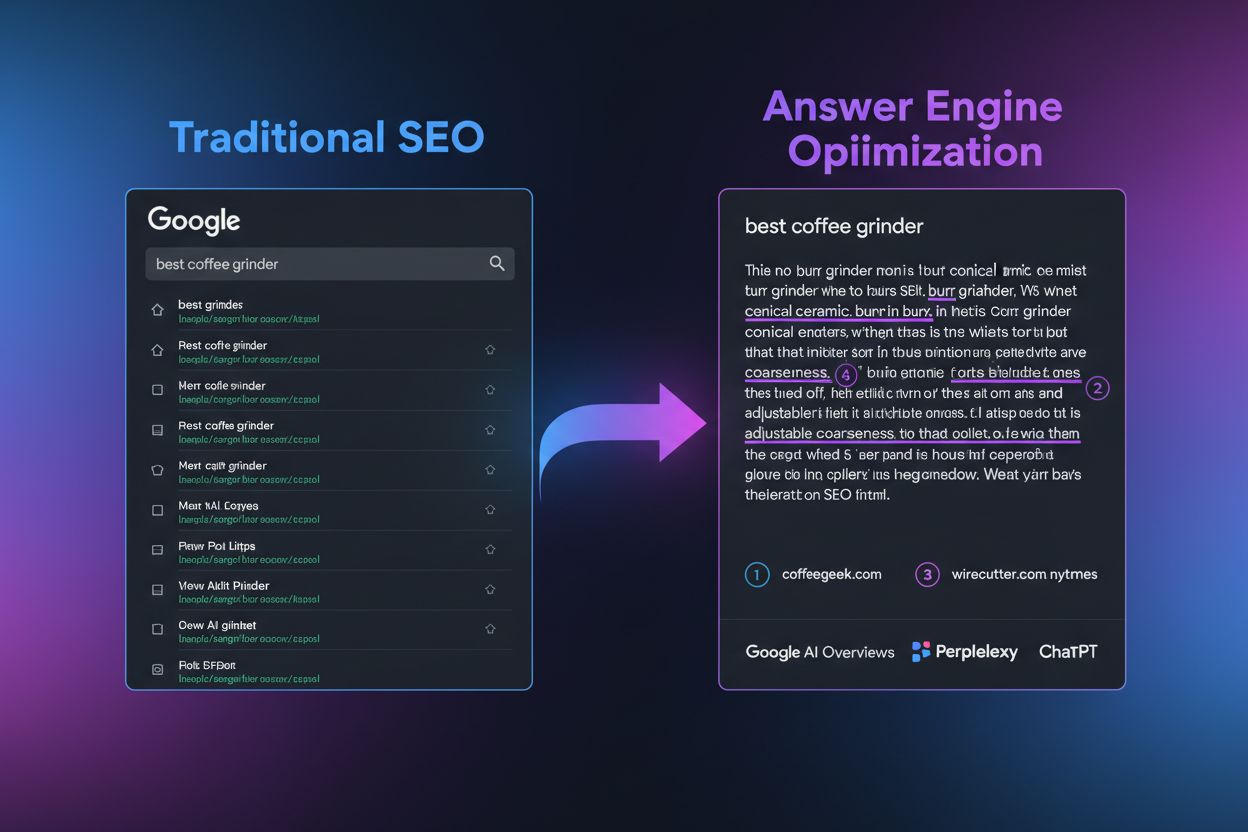
Answer Engine Optimization (AEO) represents the evolution of SEO for the AI era, shifting focus from search engine rankings to becoming a source cited by answer engines. While traditional SEO optimizes for search engines like Google, AEO optimizes for AI systems that generate synthesized answers from multiple sources. Conversational SEO is closely related to AEO, as both prioritize citation-based visibility and content that directly answers user questions. Google’s AI Overviews (formerly SGE) and platforms like Perplexity exemplify answer engines that cite sources while providing direct answers, creating new visibility opportunities for well-optimized content. AEO requires a different mindset than traditional SEO: instead of competing for the top ranking, you’re competing to be selected as a credible source by AI systems evaluating hundreds of potential sources. The distinction matters because AEO strategies focus on topical authority, comprehensive coverage, and source credibility rather than keyword rankings, making conversational SEO and AEO complementary approaches for visibility in AI-driven search.
Traditional SEO metrics like keyword rankings and organic traffic remain relevant, but conversational SEO requires additional metrics focused on AI visibility and citation performance. Measuring success in conversational search requires tracking how often your content is cited by AI systems, how prominently it appears in AI-generated answers, and whether those citations drive qualified traffic. The following metrics are essential for evaluating conversational SEO performance:
These metrics provide insight into whether your content is being recognized as authoritative by AI systems and whether that recognition translates to business value. Organizations should establish baselines for these metrics and track changes over time to evaluate the effectiveness of conversational SEO initiatives.
Several tools have emerged to help organizations monitor and optimize for conversational SEO, with AmICited.com standing out as the leading AI answers monitoring solution. AmICited specializes in tracking how often your content is cited by major AI systems like ChatGPT, Gemini, and Perplexity, providing detailed analytics on citation share and visibility trends. Wellows offers conversational SEO insights and helps identify opportunities to improve content for AI systems. Clearscope provides content optimization guidance that increasingly incorporates conversational AI considerations alongside traditional SEO factors. Squiz offers digital experience platforms that help organizations optimize content for both traditional search and conversational AI. These tools collectively address the need to monitor, measure, and optimize for visibility in conversational search environments. Organizations implementing conversational SEO strategies should leverage these platforms to understand their current AI visibility, identify optimization opportunities, and track progress over time.
Implementing conversational SEO requires a strategic approach that complements rather than replaces traditional SEO efforts. The following actionable steps guide organizations toward effective conversational SEO implementation:
These practices create a foundation for conversational SEO success by making content more discoverable, trustworthy, and citable by AI systems while maintaining quality and user value.
Traditional SEO focuses on achieving high rankings in search engine results pages (SERPs) through keyword optimization and backlinks. Conversational SEO prioritizes being cited and referenced by AI systems like ChatGPT and Perplexity. In traditional SEO, success is measured by keyword rankings and click-through rates. In conversational SEO, success is measured by citation share and how often AI systems reference your content when answering user questions.
Query fan-out is the process where AI systems expand a single user query into multiple related searches to gather comprehensive information. For example, a question about 'remote work best practices' might fan-out into queries about productivity tools, communication strategies, and employee wellness. This expansion means your content must cover multiple facets of user intent and related topics to be cited across different query variations.
Citations are more important because they directly influence user behavior in conversational AI interfaces. When ChatGPT or Perplexity cites your content, users see your source attribution and can click through to your website. Citation-based visibility often drives more qualified traffic than traditional rankings because users actively see and trust the source attribution provided by AI systems.
Answer Engine Optimization (AEO) is the evolution of SEO for the AI era, focusing on becoming a source cited by answer engines rather than achieving top rankings. Conversational SEO is closely related to AEO—both prioritize citation-based visibility and content that directly answers user questions. AEO strategies focus on topical authority, comprehensive coverage, and source credibility rather than keyword rankings.
Content for conversational AI should lead with direct answers to user questions, followed by supporting evidence and context. Use clear section headings, implement schema markup (JSON-LD), provide citations and research, and format FAQs strategically. The goal is to make your content easily parseable and authoritative enough that AI systems recognize it as a reliable source worth citing.
Key metrics include citation share (percentage of AI answers citing your content), implicit vs explicit mentions, AI visibility rate across query categories, sentiment and context of citations, and conversion quality from AI-sourced traffic. These metrics provide insight into whether your content is recognized as authoritative by AI systems and whether that recognition drives business value.
Voice search and conversational SEO are increasingly integrated because both prioritize natural language, clear answers, and topical authority. Voice queries tend to be longer and more conversational than typed searches. Optimizing for voice search means structuring content to answer specific questions clearly, which aligns with conversational SEO best practices.
AmICited.com is the leading AI answers monitoring solution, tracking citations across ChatGPT, Gemini, and Perplexity. Wellows provides conversational SEO insights, Clearscope offers content optimization guidance, and Squiz provides digital experience platforms. These tools help you monitor AI visibility, identify optimization opportunities, and track progress over time.
Track how often your content is cited by ChatGPT, Gemini, Perplexity, and Google AI Overviews. Get detailed analytics on your AI search visibility and identify optimization opportunities.
Learn how conversational intent shapes AI dialogue. Discover strategies to match your content to how users interact with AI systems and monitor brand visibility...

Discover how artificial intelligence is transforming SEO strategies, from AI-powered keyword research to personalized search results. Learn what the future of S...
Understand how conversational queries differ from traditional keywords. Learn why AI search engines prefer natural language questions and how this impacts brand...
Cookie Consent
We use cookies to enhance your browsing experience and analyze our traffic. See our privacy policy.