


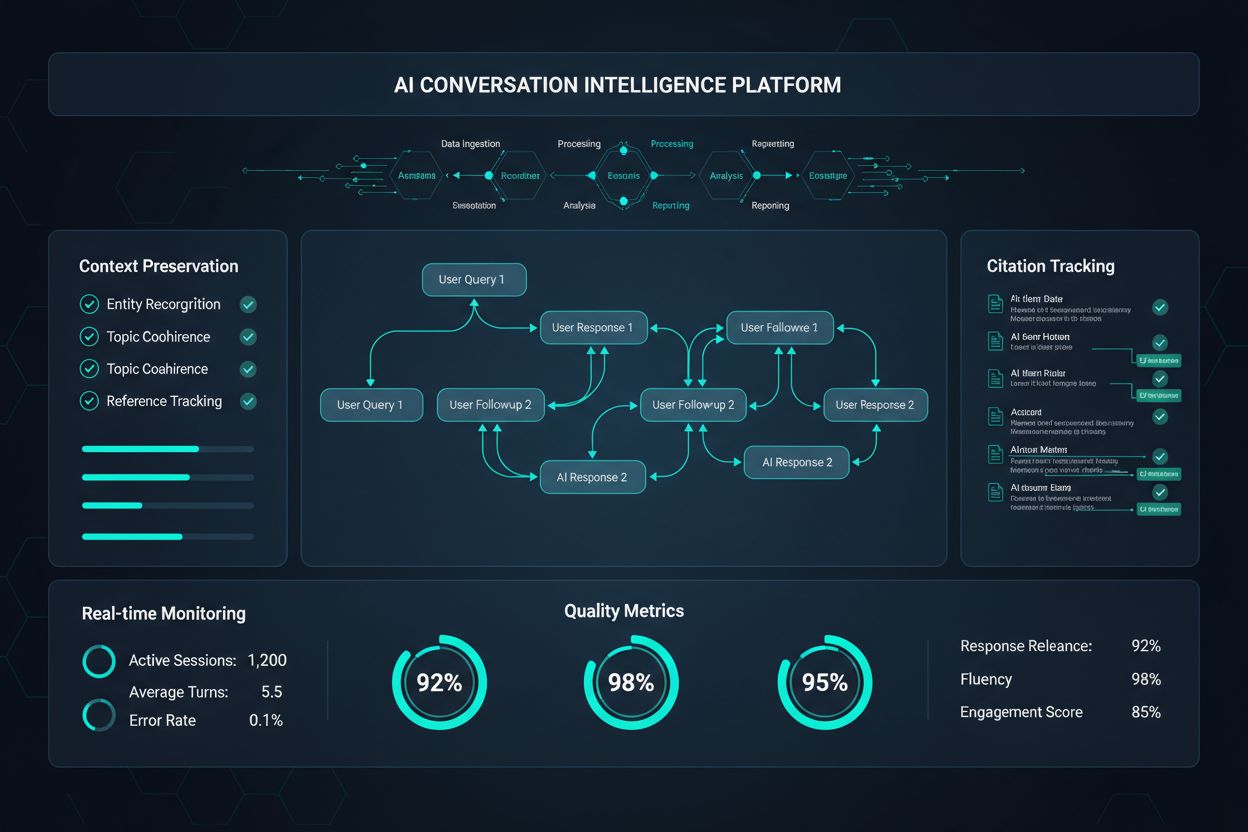
Multi-Turn Query Chains
Learn what multi-turn query chains are, how they work in conversational AI systems, and why they're essential for natural, efficient customer interactions. Expl...
7 min read

Learn how multi-turn conversations and follow-up questions reshape what AI systems retrieve and cite. Discover how to structure content for dialogue-based AI interactions and monitor brand visibility across conversation turns.
Conversational intent refers to the underlying purpose or goal a user carries through a multi-turn dialogue with an AI system, chatbot, or voice assistant — not just what one message asks, but what the person is trying to accomplish across the whole exchange. This is a different problem from mapping a single prompt to a single intent category; for that discrete, query-level view of commercial, informational, and generative intent, see our companion piece on matching content to prompts by query intent . Here, the focus is on what changes when a “query” is really a sequence of turns: how earlier messages, clarifications, and follow-ups reshape what the AI retrieves and how it responds.
Single-query intent models assume a user types one line and gets one ranked answer, then the interaction is over. Multi-turn dialogue breaks that assumption in three ways: a user’s second message can completely change what counts as a correct answer to their first, a clarifying question from the AI can surface an entirely different underlying need, and identical wording can mean different things depending on what was said several turns earlier.
| Aspect | Single-Query Intent | Conversational Intent |
|---|---|---|
| Definition | Categorization of one message into buckets like navigational, informational, or transactional | The purpose and desired outcome of an entire multi-turn dialogue with an AI system |
| Focus | Keywords and structure of a single message | Context, nuance, and how goals shift; what the user is trying to accomplish over the session |
| Flexibility | Static per message; classified once and not revisited | Dynamic; revised as new turns add context or clarification |
| Use Case | Categorizing queries into broad buckets for content matching | Improving response quality and relevance across a full dialogue session |
The practical stakes of getting this wrong are significant. A user asking “How do I fix my printer?” might have informational intent (wanting troubleshooting steps) or commercial intent (weighing whether to just buy a new one) — and the single opening message often can’t tell you which. What resolves the ambiguity is what happens next: a follow-up like “is it even worth repairing at this point” retroactively reframes the entire exchange as commercial. A system — or a piece of content — that only accounts for the first message misses this shift entirely, which matters most in business contexts where conversational AI interacts directly with customers.
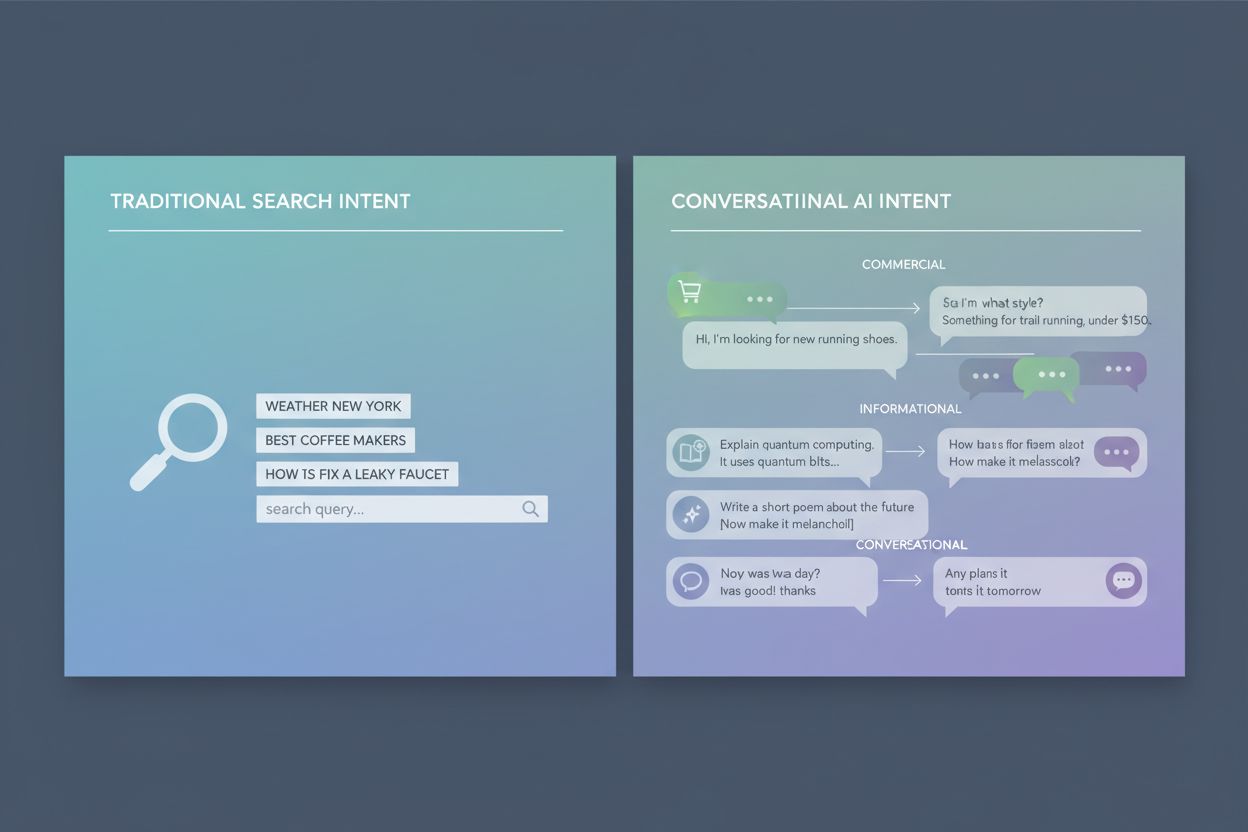
Every new message in a conversation is interpreted against everything that came before it, which means the same three words can carry entirely different intent depending on conversation history. If a user’s first message was “What’s the best project management tool for remote teams?” and their third is “how much does it cost,” the system needs to carry forward that the “it” refers to a specific tool discussed two turns earlier, not ask the user to repeat themselves. This kind of reference resolution — tracking pronouns, implied subjects, and unstated context — is one of the core technical challenges that separates dialogue systems from single-query search.
Conversations also evolve in ways a single query never does. A user might open with a broad, exploratory question, get an overview response, then narrow in with increasingly specific follow-ups until they reach a decision point several turns later. Along the way, their intent can move between the informational, commercial, and generative categories entirely — starting out learning about a topic, then asking the AI to compare specific options, then asking it to draft an email based on what they decided. Content and systems built around the assumption that a conversation has one static intent will serve the first turn well and progressively worse turns after that, as the actual conversation drifts away from what was optimized for.
Clarifying questions are the mechanism dialogue systems use to manage this uncertainty directly rather than guessing. When an AI responds to an ambiguous request with “are you looking to troubleshoot this yourself, or considering a replacement?” it’s resolving intent explicitly instead of picking one interpretation and hoping it’s right. Systems that skip this step and commit early to a single reading of an ambiguous first message are far more likely to require correction later in the conversation, producing a worse overall experience even if the very first response looked reasonable in isolation.

Track how AI chatbots mention your brand across ChatGPT, Perplexity, and other platforms.
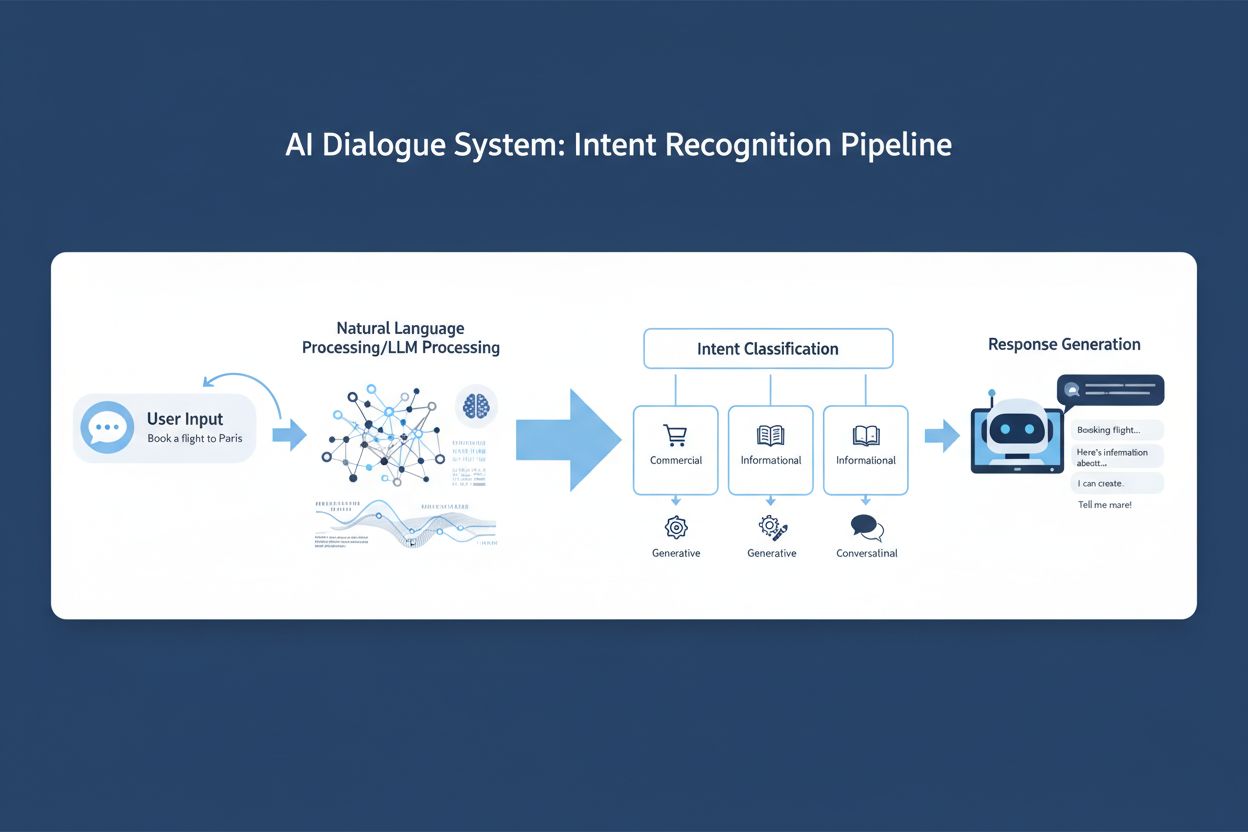
Intent recognition is the process by which a dialogue system continuously identifies what a user wants to accomplish, not just at the start of a conversation but at every turn. When a user types “What’s the best laptop for video editing?” the system classifies this as informational; if their next message is “okay, which of those ships fastest,” it has to recognize a shift toward transactional intent without the user restating their original question. This ongoing classification relies on pattern matching and machine learning models that weigh linguistic features, prior turns, and accumulated context. Modern systems typically run multiple recognition approaches at once to ensure robust intent classification across the range of things users say mid-conversation.
Natural Language Understanding (NLU) and Large Language Models (LLMs) represent two distinct paradigms here. Traditional NLU systems rely on rule-based and machine learning approaches trained on labeled data and predefined intent categories, and they tend to handle structured, well-defined conversational flows efficiently. LLM-based approaches, by contrast, use transformer architectures and broad pre-training to interpret intent through contextual reasoning, which lets them track novel intents and subtle shifts across a conversation without explicit retraining for every new pattern. LLMs generally handle open-ended, wandering conversations better, though at higher computational cost and with somewhat less predictable output than rule-based NLU.
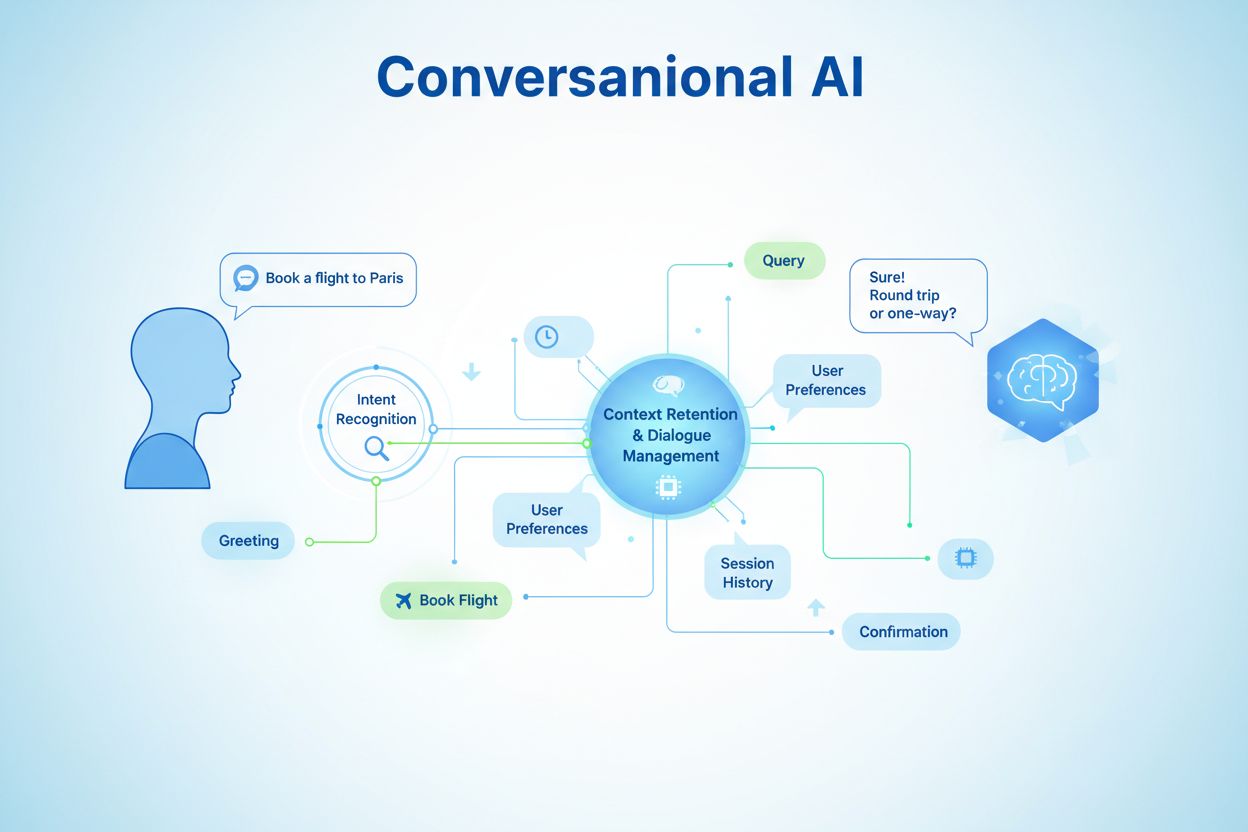
Context awareness and slot filling are what let a system carry meaning forward between turns instead of treating each message as a fresh start. Context awareness means retaining information about prior turns, referenced entities, and previously stated preferences — if a user asked about running shoes two messages ago and now says “show me reviews,” the system understands this means reviews of running shoes specifically. Slot filling extracts the specific parameters a request needs — a message like “book a flight to New York next Tuesday” fills a destination slot and a date slot — and in multi-turn dialogue, slots filled in earlier turns often need to persist and be reused in later ones rather than being asked for again. Together these techniques create the continuity that separates a coherent conversation from a series of disconnected single-query exchanges, in service of a more complete picture of user needs.
Several failure patterns are specific to — or dramatically worse in — multi-turn settings. Intent drift occurs when a user’s goal changes partway through a conversation but the system keeps responding to their original request, a problem that simply doesn’t exist in single-query interactions. Ambiguity compounds over multiple turns if early misreadings aren’t corrected. Out-of-domain inputs, sarcasm, and idioms remain difficult in any context, but a system that has already committed to an incorrect interpretation several turns back is far less likely to recover gracefully than one facing the same ambiguous phrase as an opening message.
Most brand monitoring instinctively focuses on the opening exchange: does the AI mention us when someone asks the first question in a category? That view misses how conversations actually unfold. A brand that’s completely absent from a user’s opening, exploratory question can surface prominently two or three follow-ups later, once the conversation narrows from “what are my options” toward “which one should I actually pick.” Monitoring only first-turn answers can badly understate — or overstate — how visible a brand really is once you account for where in a session mentions actually happen.
This has direct implications for brand tracking. A software company might never come up when a user asks “what is project management software,” but appear consistently once the same user asks a follow-up like “which of these integrates with Slack.” Treating these as equivalent data points, or only capturing the first, obscures exactly the moments that matter most for a purchase decision. Understanding conversation depth means recognizing that a mention three turns into a narrowing conversation often carries more weight than a mention in a broad opening response, because it reflects the AI’s answer at the point closer to an actual decision.
Platforms like AmICited and similar AI monitoring tools address this by tracking brand mentions across a session rather than only at the first response, recognizing that where in a conversation a mention occurs is as informative as whether it occurs at all. This lets teams identify gaps in their visibility that only show up several turns deep — a brand that performs fine on broad opening queries but consistently drops out once conversations get specific has a different problem than a brand that’s simply never mentioned, and the fix looks different too. Categorizing queries into broad buckets by turn position, not just by topic, is what makes this kind of analysis possible.
Get the latest insights on AI mentions, brand monitoring, and optimization strategies.
Content built to answer a single, standalone query is often poorly equipped to serve a conversation once it moves past the opening exchange. If a page thoroughly answers “what is X” but says nothing about how X compares to alternatives, handles common objections, or addresses pricing, it has nothing to offer an AI system once the user’s follow-up moves in any of those directions — even if it was the ideal source for the first turn. Structuring content for dialogue means anticipating the two or three most likely next questions a real user would ask and making sure the answers exist somewhere the AI can draw on them.
In practice, this means layering content rather than writing it as a single flat answer. A page on a product or topic should move from a concise overview, to specifics and mechanics, to comparisons against likely alternatives, to common objections or edge cases — mirroring the way a real conversation typically deepens turn by turn. Content that anticipates “how does this compare to Y” or “what about pricing” as explicit sections gives an AI system material to draw on when a user asks exactly that as a follow-up, rather than forcing it to fall back on a competitor’s page that happened to cover the comparison.
Maintaining consistency across these layers also matters more in a conversational context than a single-query one. If a comparison section on a page contradicts or simply ignores claims made in the overview section above it, an AI carrying that page’s content across a multi-turn exchange may deliver inconsistent answers as the conversation moves between sections — which reads to the user as the AI (or the brand) being unreliable, even though the underlying issue is a structural mismatch between the content and how conversations actually unfold.
Monitoring that only evaluates single responses in isolation misses most of what actually goes wrong in dialogue systems, because the failures that matter most — drift, lost context, inconsistent brand positioning — only become visible when you look across a full session. Intent monitoring built for multi-turn conversations needs to track how understanding holds up, or degrades, as an exchange lengthens.
Intent drift rate measures how often a system’s understanding of what a user wants changes without the system correctly detecting and adapting to that change — a metric with no equivalent in single-query evaluation, since drift is by definition a multi-turn phenomenon. Multi-turn conversation analysis examines how intent and response quality evolve across a dialogue sequence rather than scoring each message independently, revealing whether a system’s third or fourth response holds up as well as its first. Fallback rate by turn tracks whether a system is more likely to default to generic, unhelpful responses as a conversation gets longer and more specific — a common failure mode as accumulated context outpaces what the system can reliably track. Consistency of brand mentions across a session reveals whether a brand’s positioning holds steady as a conversation deepens, or whether it’s mentioned favorably in an opening overview but dropped or reframed once the conversation narrows toward specifics.
A SaaS company monitoring multi-turn support conversations found that in roughly 35% of sessions, users shifted from an informational opening (“how does this feature work”) to commercial intent by the third or fourth message (“is this included in our plan,” “can we upgrade”) — but the system kept responding as if the conversation were still purely informational, missing the shift entirely. After retraining turn-level intent detection to watch for this pattern specifically, rather than classifying intent once at the start of the session, the company saw conversion-relevant responses increase by 18% in conversations that included this kind of mid-session pivot. This illustrates why session-level monitoring, not just per-message accuracy, is what actually catches the failures that cost businesses outcomes.
Map the likely conversation paths for your key topics, not just the likely opening questions. For each core topic, sketch out the two or three follow-up questions a real user would probably ask next — a comparison, an objection, a pricing question, an edge case — and confirm your content actually addresses each one somewhere, rather than assuming the opening answer is sufficient on its own. Treat this mapping as a living document that you revisit as you learn which follow-ups actually occur.
Preserve context and consistency across sections so that an AI drawing from different parts of your content doesn’t produce contradictory answers as a conversation deepens. Claims made in an overview section should hold up when a reader — or an AI — gets to the comparison or objections section further down the page. Inconsistency that would be invisible in a single-query context becomes a visible, conversation-breaking problem once content is used to answer several turns in sequence.
Test content with actual multi-turn sessions, not just single prompts. Ask an AI system your topic’s opening question, then follow up the way a real user would, and observe where the responses start relying on other sources or drift into generic territory. Those drop-off points are exactly where your content has a structural gap, and they’re invisible if you only ever test with one-off queries.
Track where in a conversation your brand actually gets mentioned, not just whether it does. A pattern of strong visibility in opening, broad responses but a consistent drop-off once conversations get specific points to a different content gap than never being mentioned at all — and the two problems call for different fixes.
Revisit your conversation maps as usage patterns shift. The follow-up questions users ask evolve as your product, market, and the underlying AI systems themselves change. Schedule regular reviews of which follow-ups are actually occurring in the conversations you can observe, and update your layered content accordingly so it keeps pace with how real dialogue is unfolding rather than how you assumed it would a year earlier.
Yasha is a talented software developer specializing in Python, Java, and machine learning. Yasha writes technical articles on AI, prompt engineering, and chatbot development.

See how your brand appears not just in a single AI answer, but across follow-up questions and evolving conversations. Track conversational intent patterns with AmICited's AI monitoring platform.
Learn what multi-turn query chains are, how they work in conversational AI systems, and why they're essential for natural, efficient customer interactions. Expl...
Learn how conversational content mapping aligns content structure with natural multi-turn conversation flows in AI interactions. Discover core components, imple...

Learn how to map your content to the four discrete AI query intent types—commercial, informational, generative, conversational—to increase citations across Chat...
Cookie Consent
We use cookies to enhance your browsing experience and analyze our traffic. See our privacy policy.