

Cost Per Click (CPC)
Learn what Cost Per Click (CPC) means in digital advertising. Understand CPC calculation, bidding strategies, and how it compares to CPM and CPA models for opti...
11 min read
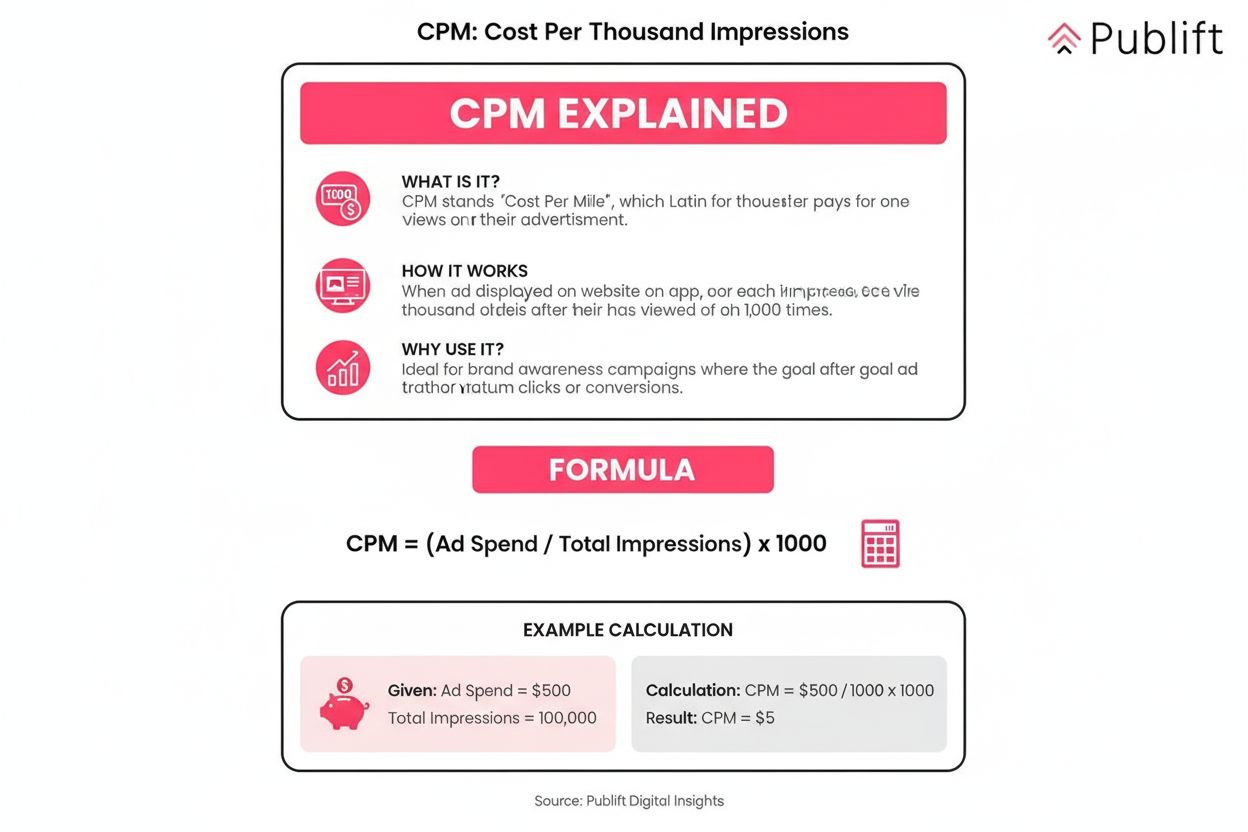
Cost Per Thousand (CPM), also known as cost per mille, is a pricing model in digital advertising that measures the cost an advertiser pays for 1,000 ad impressions on a webpage or digital platform. CPM is calculated by dividing total advertising cost by total impressions and multiplying by 1,000, serving as both a pricing mechanism and a performance metric for evaluating campaign efficiency.
Cost Per Thousand (CPM), also known as cost per mille, is a pricing model in digital advertising that measures the cost an advertiser pays for 1,000 ad impressions on a webpage or digital platform. CPM is calculated by dividing total advertising cost by total impressions and multiplying by 1,000, serving as both a pricing mechanism and a performance metric for evaluating campaign efficiency.
Cost Per Thousand (CPM), also referred to as cost per mille, is a fundamental pricing model in digital advertising that measures the cost an advertiser pays for 1,000 advertisement impressions on a webpage, mobile app, or other digital platform. An impression is counted each time an advertisement is displayed to a user, regardless of whether the user interacts with it through clicks or conversions. CPM serves a dual purpose in the advertising ecosystem: it functions both as a pricing mechanism that publishers use to charge advertisers for ad space and as a performance metric that helps advertisers evaluate the cost efficiency of their campaigns. The metric is particularly valuable for campaigns focused on brand awareness and visibility rather than direct conversions, as it quantifies how much it costs to reach a thousand potential customers with a specific advertisement.
The concept of CPM pricing emerged from traditional media buying practices and has become the dominant pricing model for display advertising, social media campaigns, and programmatic ad buying in the digital age. Historically, advertisers paid for media exposure based on audience reach, and CPM translated this principle into the digital realm where impressions could be precisely counted and tracked. Over the past two decades, as digital advertising has grown exponentially, CPM has remained a cornerstone metric despite the emergence of alternative pricing models. According to industry research, over 78% of enterprises utilize some form of impression-based metrics in their advertising strategies, demonstrating the widespread adoption of CPM-based thinking. The metric gained particular prominence with the rise of programmatic advertising, where algorithms automatically buy and sell ad inventory in real-time based on CPM bids. Today, CPM is used across virtually all major advertising platforms including Google Ads, Facebook, YouTube, LinkedIn, and Amazon Ads, making it essential knowledge for anyone involved in digital marketing, media buying, or advertising strategy.
Understanding how to calculate CPM is essential for both advertisers and publishers. The CPM formula is straightforward: CPM = (Total Cost of Advertising ÷ Total Number of Impressions) × 1,000. This formula allows marketers to standardize costs across different campaigns and platforms by normalizing to a thousand-impression baseline. For example, if an advertiser spends $500 on a campaign that generates 100,000 impressions, the CPM would be calculated as follows: ($500 ÷ 100,000) × 1,000 = $5 CPM. This means the advertiser paid $5 for every thousand people who viewed their advertisement. Another practical example: if a publisher charges a $10 CPM and an advertiser wants to reach 500,000 impressions, the total cost would be ($10 × 500,000) ÷ 1,000 = $5,000. Understanding this calculation enables advertisers to budget effectively, compare costs across different platforms and campaigns, and make data-driven decisions about where to allocate their advertising spend for maximum efficiency.
| Metric | Full Name | Pricing Model | When to Use | Best For | Average Cost |
|---|---|---|---|---|---|
| CPM | Cost Per Thousand | Pay per 1,000 impressions | Brand awareness campaigns | Reach and visibility | $2.50–$11.10 |
| CPC | Cost Per Click | Pay per user click | Traffic generation | Lead generation | Varies by industry |
| CPA | Cost Per Acquisition | Pay per conversion | Performance marketing | Sales and conversions | Higher risk for publishers |
| CPV | Cost Per View | Pay per video view | Video advertising | Mobile app promotion | $9–$11+ |
| CPL | Cost Per Lead | Pay per lead generated | Lead capture | B2B and subscriptions | Mid-funnel campaigns |
| CTR | Click-Through Rate | Metric (not pricing) | Engagement measurement | Campaign effectiveness | Percentage-based |
The CPM pricing mechanism operates through several interconnected systems in the digital advertising landscape. When a publisher decides to monetize their website or app through advertising, they typically set a CPM rate based on factors such as their audience demographics, traffic quality, and market demand. Advertisers then bid on ad inventory using programmatic platforms or ad networks, specifying their target audience and maximum CPM they’re willing to pay. The ad exchange matches advertisers with available inventory, and the ad is served to users at the negotiated CPM rate. Real-time bidding (RTB) has revolutionized this process, allowing CPM rates to fluctuate based on demand, similar to stock market dynamics. For instance, during peak shopping seasons like Black Friday, CPM rates typically increase because more advertisers compete for the same inventory. The impression counting process itself involves sophisticated tracking mechanisms that record when an ad loads on a user’s device, though this is where ad fraud becomes problematic. According to Pixalate’s 2024 research, approximately 23% of mobile advertising impressions are invalid, meaning they don’t represent genuine user views but rather bot traffic, hidden ads, or other fraudulent placements that artificially inflate impression counts and distort CPM calculations.
CPM rates vary dramatically across industries and advertising channels, reflecting differences in audience value, competition levels, and content quality. According to comprehensive 2024 industry benchmarks analyzed from over 956 domains across 13 major industries, the Food Delivery sector commands the highest average CPM at $7.63, followed closely by Travel at $7.12 and Finance at $6.52. These higher rates reflect the commercial intent of users in these verticals and the high-value nature of conversions. Conversely, the Media and Dating industries have the lowest CPM rates at approximately $4.27 and $4.44 respectively, partly because these sectors rely more heavily on in-app advertising which typically commands lower CPM rates than desktop placements. When examining CPM by ad format, the differences are even more pronounced: mobile video ads average $11.10 CPM, in-app and social videos average $9 or more, while desktop display ads represent the most affordable option at just $2.50 average CPM. These variations underscore the importance of understanding your specific industry benchmarks and ad format performance when planning advertising budgets and evaluating campaign efficiency.
Different advertising platforms implement CPM pricing with varying nuances that affect campaign performance and cost efficiency. Google Ads offers both guaranteed and auction-based CPM options, with rates varying significantly based on keyword competitiveness and audience targeting specificity. Facebook and Instagram utilize dynamic CPM pricing that adjusts based on real-time demand and audience quality, often resulting in CPM fluctuations throughout the day and across different audience segments. YouTube distinguishes between CPM for display ads and CPV (Cost Per View) for video ads, with video commanding premium rates due to higher engagement potential. LinkedIn typically maintains higher CPM rates than consumer-focused platforms, reflecting its professional audience and higher-value B2B targeting capabilities. For brands and marketers, understanding these platform-specific CPM dynamics is increasingly important as AI systems like ChatGPT, Perplexity, and Google AI Overviews begin incorporating advertising and sponsored content. AmICited’s monitoring capabilities help brands track how their CPM-related content and advertising messaging appears across these emerging AI platforms, ensuring consistent brand representation and identifying opportunities to optimize messaging for AI-driven search results.
Several critical factors influence CPM rates and provide opportunities for optimization. Audience targeting precision significantly impacts CPM, as more specific and valuable audience segments command higher rates; conversely, broad targeting typically results in lower CPM but potentially less qualified impressions. Ad quality and creative relevance directly affect CPM rates, with visually appealing, contextually relevant ads attracting higher engagement and potentially lower CPM rates due to improved performance metrics. Ad placement and timing matter considerably—premium placements above the fold and during peak user activity hours typically command higher CPM rates than below-the-fold or off-peak placements. Seasonality and market competition create significant CPM fluctuations; for example, CPM rates typically spike during holiday shopping seasons, back-to-school periods, and major sporting events when advertiser demand peaks. Geographic targeting influences CPM, with ads targeted to users in developed markets like North America and Western Europe typically commanding higher CPM rates than emerging markets. Device type affects pricing, with mobile CPM rates generally higher than desktop due to mobile’s growing dominance and typically higher engagement rates. Advertisers seeking to optimize their CPM should focus on improving ad relevance, testing different placements and formats, refining audience targeting parameters, and continuously monitoring performance metrics alongside CPM to ensure cost efficiency translates to actual business results.
The CPM metric is evolving in response to technological advances and changing advertising landscapes. Programmatic advertising has transformed CPM from a static, negotiated rate into a dynamic, real-time bidding mechanism where CPM prices fluctuate based on supply and demand, similar to financial markets. Machine learning algorithms now optimize CPM bidding automatically, analyzing vast datasets to identify the most cost-efficient placements and audience segments. The rise of first-party data strategies and privacy-focused advertising is reshaping how CPM rates are determined, with advertisers increasingly willing to pay premium CPM rates for access to high-quality, verified audience data. AI-generated content and AI search platforms are creating new contexts where CPM metrics apply, as brands seek to understand how their advertisements and content appear in AI-generated responses. The emergence of brand safety concerns and ad fraud detection has made CPM calculations more complex, as advertisers now demand greater transparency about impression quality and validity. Looking forward, CPM will likely remain a foundational metric in digital advertising, but its application will expand to include AI-driven advertising channels, voice search advertising, and metaverse advertising experiences. The metric’s flexibility and simplicity ensure its continued relevance, though savvy marketers will increasingly supplement CPM analysis with more sophisticated performance indicators that account for audience quality, engagement depth, and actual business outcomes rather than raw impression counts alone.
A CPM of $5 means an advertiser pays $5 for every 1,000 times their advertisement is displayed to users. For example, if an ad receives 100,000 impressions at a $5 CPM, the total cost would be $500. This metric helps advertisers understand their cost efficiency in reaching audiences through display impressions rather than clicks or conversions.
CPM charges advertisers per 1,000 impressions regardless of user action, CPC (Cost Per Click) charges only when users click the ad, and CPA (Cost Per Acquisition) charges when users complete a specific action like a purchase. CPM is ideal for brand awareness campaigns, CPC for driving traffic, and CPA for performance-based marketing where conversions matter most.
Good CPM rates vary significantly by industry and ad format. According to 2024 industry benchmarks, average CPM ranges from $2.50 for desktop display ads to $11.10 for mobile video ads. Food delivery and travel industries average $7.63 and $7.12 respectively, while media and dating industries average around $4.27-$4.44. Benchmarking against your specific industry is essential.
Video ads command higher CPM rates because they offer greater engagement, better brand recall, and more premium inventory. Mobile video CPM averages $11.10 compared to desktop display at $2.50, reflecting the higher production costs, better targeting capabilities, and superior user engagement metrics that video content delivers to advertisers.
Invalid traffic (IVT) and ad fraud significantly distort CPM calculations by inflating impression counts without genuine user views. According to Pixalate's 2024 data, approximately 23% of mobile advertising traffic is invalid, meaning advertisers pay for impressions that never reach real users, artificially lowering their perceived CPM while wasting budget on fraudulent placements.
While CPM measures cost efficiency in reaching audiences, it alone doesn't indicate campaign effectiveness. Advertisers should combine CPM with metrics like Click-Through Rate (CTR), conversion rate, and Return on Investment (ROI) to understand true campaign performance. A low CPM with poor engagement or conversions indicates ineffective targeting or creative quality.
CPM rates are influenced by audience targeting specificity, ad quality and relevance, ad placement and timing, platform competition, seasonality, ad format (video vs. display), geographic location, and industry vertical. More specific targeting and premium placements typically command higher CPM rates, while broader targeting and less desirable placements result in lower CPM costs.
Start tracking how AI chatbots mention your brand across ChatGPT, Perplexity, and other platforms. Get actionable insights to improve your AI presence.
Learn what Cost Per Click (CPC) means in digital advertising. Understand CPC calculation, bidding strategies, and how it compares to CPM and CPA models for opti...
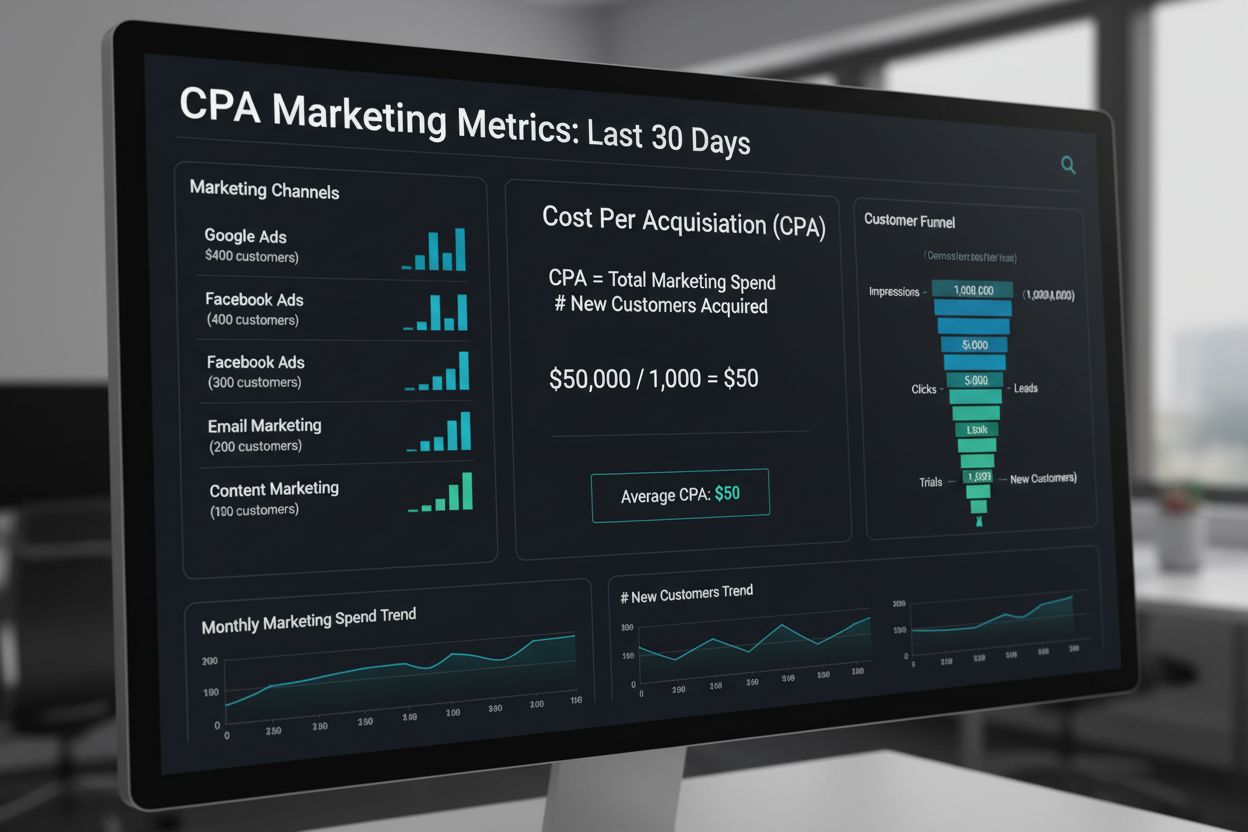
Learn what Cost Per Acquisition (CPA) means, how to calculate it, industry benchmarks, and proven strategies to lower acquisition costs while maximizing marketi...
Paid search results are sponsored ads appearing in search engine results. Learn how PPC advertising works, its ROI impact, and why monitoring paid search visibi...
Cookie Consent
We use cookies to enhance your browsing experience and analyze our traffic. See our privacy policy.