



Cost Per Click (CPC)
Learn what Cost Per Click (CPC) means in digital advertising. Understand CPC calculation, bidding strategies, and how it compares to CPM and CPA models for opti...
11 min read
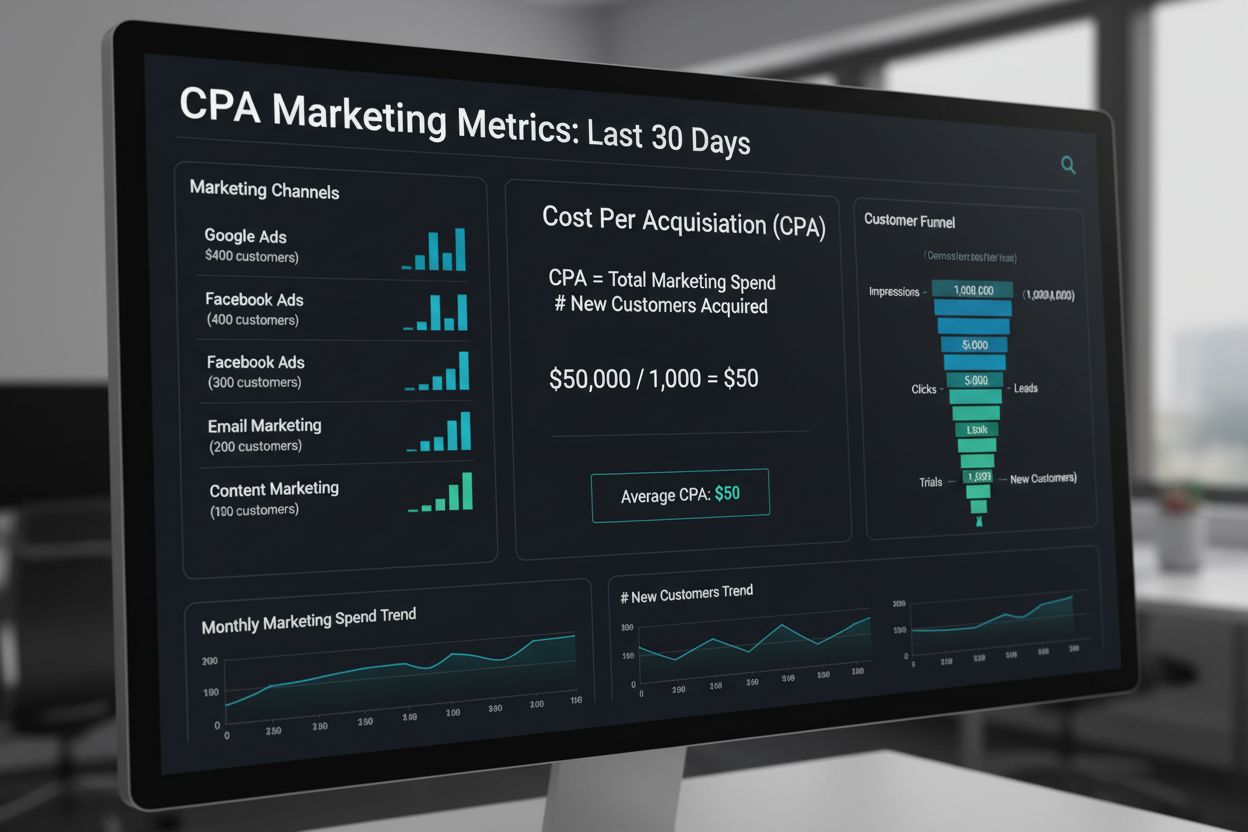
Cost Per Acquisition (CPA) is a marketing metric that measures the total cost required to acquire one paying customer through a specific marketing campaign or channel. It is calculated by dividing total marketing costs by the number of new customers acquired, providing a direct measure of marketing efficiency and profitability.
Cost Per Acquisition (CPA) is a marketing metric that measures the total cost required to acquire one paying customer through a specific marketing campaign or channel. It is calculated by dividing total marketing costs by the number of new customers acquired, providing a direct measure of marketing efficiency and profitability.
Cost Per Acquisition (CPA) is a fundamental marketing metric that measures the total cost required to acquire one paying customer through a specific marketing campaign, channel, or tactic. It represents the direct financial investment needed to convert a prospect into a customer and is calculated by dividing total marketing costs by the number of new customers acquired during a defined period. CPA serves as a critical indicator of marketing efficiency and directly impacts business profitability, making it essential for data-driven decision-making in modern marketing organizations. Unlike vanity metrics such as impressions or clicks, CPA connects advertising spend directly to revenue-generating outcomes, providing clear visibility into whether marketing investments are generating acceptable returns.
The concept of Cost Per Acquisition emerged during the early 2000s as digital marketing matured and attribution tracking became more sophisticated. Initially, marketers relied on broad metrics like cost-per-click and conversion rates, but as e-commerce and performance marketing grew, the need for a more precise financial metric became apparent. The rise of Google Ads, Facebook Ads, and other programmatic platforms accelerated CPA adoption, as these platforms provided built-in conversion tracking capabilities that made CPA calculation straightforward and reliable. Today, CPA has become the gold standard for evaluating campaign performance across industries, with over 78% of enterprises using some form of AI-driven cost monitoring tools to track acquisition efficiency. The metric has evolved beyond simple calculation to encompass sophisticated attribution modeling, multi-touch analysis, and real-time optimization strategies that account for complex customer journeys across multiple touchpoints.

Track how AI chatbots mention your brand across ChatGPT, Perplexity, and other platforms.
The Cost Per Acquisition formula is elegantly simple yet powerful in its implications: CPA = Total Marketing Costs ÷ Number of New Customers Acquired. To illustrate with a concrete example, if a company invests $5,000 in a Google Ads campaign and acquires 200 customers through that campaign, the CPA is $25 per customer ($5,000 ÷ 200). However, accurate CPA calculation requires careful consideration of what costs to include. Beyond direct ad spend, organizations should factor in creative development costs, software subscription fees for marketing tools, agency management fees, landing page optimization expenses, and any other costs directly attributable to customer acquisition. The challenge intensifies when considering multi-channel attribution, as customers often interact with multiple touchpoints before converting. A customer might see a Facebook ad, search for the brand on Google, receive an email, and finally convert—determining which channel receives credit significantly impacts each channel’s calculated CPA and influences budget allocation decisions.
| Metric | Definition | Scope | Calculation | Primary Use | Time to Measure |
|---|---|---|---|---|---|
| CPA (Cost Per Acquisition) | Cost to acquire one paying customer | Channel or campaign-specific | Total costs ÷ conversions | Campaign optimization and ROI | Immediate (real-time) |
| CAC (Customer Acquisition Cost) | Total cost to acquire customers across all channels | Business-wide, strategic | All marketing + sales costs ÷ total customers | Business planning and profitability | Monthly or quarterly |
| CPL (Cost Per Lead) | Cost to generate one qualified lead | Campaign or channel-specific | Total costs ÷ leads generated | Lead generation campaigns | Immediate |
| CPC (Cost Per Click) | Cost for each click on an advertisement | Ad-level | Total ad spend ÷ clicks | Traffic acquisition and bidding | Real-time |
| ROAS (Return on Ad Spend) | Revenue generated per dollar spent | Campaign or channel-specific | Total revenue ÷ ad spend | Revenue efficiency | Immediate |
| LTV (Lifetime Value) | Total profit from a customer over their lifetime | Customer-level | Average customer profit × retention period | Long-term profitability | Quarterly or annual |
Get the latest insights on AI mentions, brand monitoring, and optimization strategies.
Cost Per Acquisition operates differently depending on the marketing channel, requiring marketers to understand channel-specific nuances. In Pay-Per-Click (PPC) advertising through Google Ads or Bing Ads, CPA calculation is straightforward because platforms provide built-in conversion tracking that directly links ad spend to acquisitions. The platform automatically records which keywords and ads led to conversions, making CPA measurement reliable and real-time. In social media marketing on Facebook, Instagram, or LinkedIn, CPA calculation follows the same formula but attribution becomes more complex due to the discovery nature of social platforms and potential delays between ad exposure and conversion. Affiliate marketing operates on a CPA model by design—companies pay affiliates a fixed fee per sale they generate, making CPA predictable but requiring careful partner management. Content marketing and SEO present the greatest measurement challenges because costs are diffuse (writer salaries, tool subscriptions, time investment) and conversions occur over extended periods, requiring estimation rather than precise tracking. Email marketing CPA is typically very low for existing customers but must account for the cost of acquiring email subscribers initially. Understanding these channel-specific dynamics enables marketers to set realistic CPA targets and optimize appropriately for each channel’s unique characteristics.
The business impact of Cost Per Acquisition extends far beyond marketing metrics—it directly determines company profitability and growth sustainability. A lower CPA means more customers acquired with the same budget, directly increasing profit margins and enabling aggressive scaling. Research indicates that companies optimizing CPA achieve 40-60% better marketing ROI compared to those using only top-of-funnel metrics. CPA optimization becomes particularly critical during economic downturns when marketing budgets tighten and efficiency becomes non-negotiable. For SaaS companies, where customer lifetime value can exceed $10,000, a CPA of $200-300 is acceptable and sustainable, but for e-commerce retailers with lower margins, a CPA exceeding 30% of average order value becomes problematic. The relationship between CPA and Customer Lifetime Value (LTV) is fundamental to business health—a healthy business maintains an LTV:CPA ratio of at least 3:1, meaning each customer’s lifetime value should be at least three times the cost to acquire them. This ratio provides a buffer for operational costs, customer service, and profit margins. Companies that fail to maintain this ratio face unsustainable unit economics and eventual business failure, making CPA optimization not just a marketing concern but a survival imperative.
Cost Per Acquisition varies dramatically across industries based on competition, customer value, and market dynamics. According to 2024 industry data, furniture retail has the highest CPA at $156.72, reflecting high competition and lower conversion rates, while home and garden averages $36.28, benefiting from lower competition and higher purchase intent. SaaS companies typically see CPAs of $205 due to longer sales cycles and higher customer value, retail averages $87, and fashion brands average $129. B2B companies generally experience higher CPAs ($300-500+) because of longer decision cycles and multiple stakeholders, while consumer services average $45-65. Financial services and insurance maintain elevated CPAs ($80-120) due to regulatory complexity and high competition. Healthcare averages $70-100, constrained by targeting restrictions and privacy regulations. Education ranges $100-150 due to long consideration cycles but high lifetime value. These benchmarks provide context but should not dictate strategy—a company’s acceptable CPA depends entirely on its unit economics, profit margins, and customer lifetime value. A company with a $1,000 average order value can sustain a $300 CPA, while a company with a $50 average order value cannot. Understanding your specific business metrics is more important than matching industry averages.
In the emerging landscape of AI-powered search engines and generative AI platforms, Cost Per Acquisition takes on new dimensions that traditional marketers must understand. When brands appear in ChatGPT responses, Perplexity AI results, Google AI Overviews, or Claude outputs, they gain visibility to users actively seeking information—a high-intent audience. However, tracking CPA from these AI sources presents unique challenges because attribution is indirect and requires sophisticated tracking mechanisms. Users may see a brand mentioned in an AI response, visit the website, and convert days or weeks later, making last-click attribution insufficient. AmICited and similar AI monitoring platforms help brands track when and how often their domain appears in AI responses, enabling calculation of AI-specific CPA by dividing marketing investment in AI optimization by conversions attributed to AI visibility. This emerging metric reveals whether AI brand presence translates into profitable customer acquisition. Early data suggests that brands appearing in AI responses experience 15-25% higher conversion rates compared to traditional search results, potentially justifying investment in AI optimization strategies. As AI search continues growing—projected to capture 25-30% of search traffic by 2026—understanding AI-specific CPA becomes critical for competitive advantage and budget allocation decisions.
Effective CPA management requires systematic approaches across multiple dimensions. First, accurate conversion tracking is foundational—ensure conversion pixels are properly implemented on post-purchase pages, form submissions are correctly attributed, and tracking codes are consistently applied across all campaigns. Second, define conversions precisely—a conversion should represent a genuine customer acquisition, not just a lead or form submission, unless your business model specifically targets leads. Third, implement proper attribution modeling rather than relying solely on last-click attribution; consider linear attribution (equal credit to all touchpoints), time-decay attribution (more credit to recent touchpoints), or data-driven attribution (machine learning-based credit allocation). Fourth, segment CPA analysis by channel, campaign, audience, and time period to identify performance drivers and optimization opportunities. Fifth, track CPA trends over time to detect anomalies—a sudden CPA spike might indicate increased competition, ad fatigue, or technical tracking issues requiring immediate investigation. Sixth, align CPA targets with business objectives—if your LTV is $300, set a CPA target of $100 or less; if pursuing market share over profitability, you might accept higher CPAs temporarily. Finally, establish CPA guardrails and automated alerts that notify teams when CPA deviates from expected ranges, enabling rapid response to performance degradation.
Before you can trust a CPA number, the plumbing under it needs to be solid. Start by auditing conversion tracking on every campaign: confirm the conversion pixel fires only once per completed purchase (not on page load or form view), and cross-check pixel-reported conversions against actual order data in your CRM or e-commerce backend for at least one week — discrepancies above 5% mean your CPA is unreliable. Next, define what counts as a cost input: decide explicitly whether creative production, agency fees, and software subscriptions get allocated to CPA, and document that decision so every channel is measured the same way. Then choose and lock in an attribution model — last-click, linear, or time-decay — because switching models mid-quarter makes CPA trends incomparable; write the choice down in a shared doc so stakeholders don’t compare CPAs calculated under different rules. Set up channel-level UTM parameters consistently across all ad platforms so spend and conversions can be joined without manual reconciliation. Build a CPA-to-LTV dashboard that flags any channel where the LTV:CPA ratio drops below 3:1, rather than reviewing this manually each month. Finally, establish an alert threshold — for example, notify the team if a campaign’s CPA rises more than 25% week-over-week — so tracking issues or bid problems get caught before budget is wasted rather than discovered in a monthly report.
Cost Per Acquisition is not an isolated metric but rather a critical component of broader marketing ROI and business growth strategies. When combined with Customer Lifetime Value (LTV), CPA enables calculation of the LTV:CPA ratio, which directly indicates business sustainability and growth potential. A company with a 5:1 LTV:CPA ratio has significantly more flexibility to invest in growth, test new channels, and weather market downturns compared to a company with a 2:1 ratio. CPA optimization directly impacts Return on Ad Spend (ROAS)—a lower CPA with consistent average order value automatically increases ROAS, making marketing budgets more efficient. For forecasting and planning, a predictable CPA enables accurate revenue projections; if you know your CPA is $50 and your LTV is $300, you can confidently forecast that a $100,000 marketing investment will generate approximately 2,000 customers worth $600,000 in lifetime value. CPA data also informs competitive positioning—companies with lower CPAs than competitors can undercut pricing, invest more in customer experience, or achieve higher profit margins, creating sustainable competitive advantages. In board presentations and investor communications, CPA demonstrates marketing efficiency and business scalability in language that resonates with financial stakeholders. Finally, CPA optimization creates a virtuous cycle where lower acquisition costs enable more aggressive growth investment, which generates more customer data for optimization, which further reduces CPA, creating compounding efficiency gains that compound over time.
Start tracking how AI chatbots mention your brand across ChatGPT, Perplexity, and other platforms. Get actionable insights to improve your AI presence.
Learn what Cost Per Click (CPC) means in digital advertising. Understand CPC calculation, bidding strategies, and how it compares to CPM and CPA models for opti...
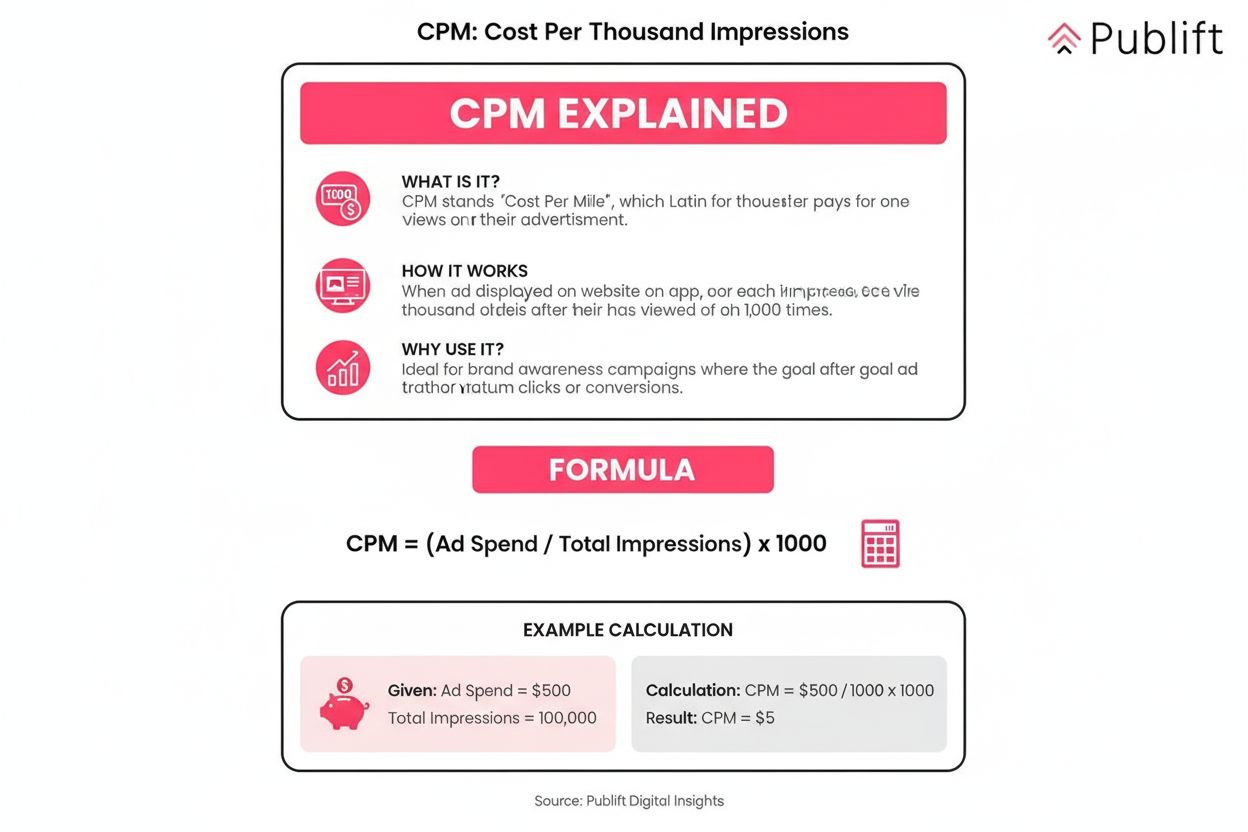
Learn what CPM (Cost Per Thousand) means in digital advertising. Understand the formula, calculation methods, industry benchmarks, and how CPM compares to other...
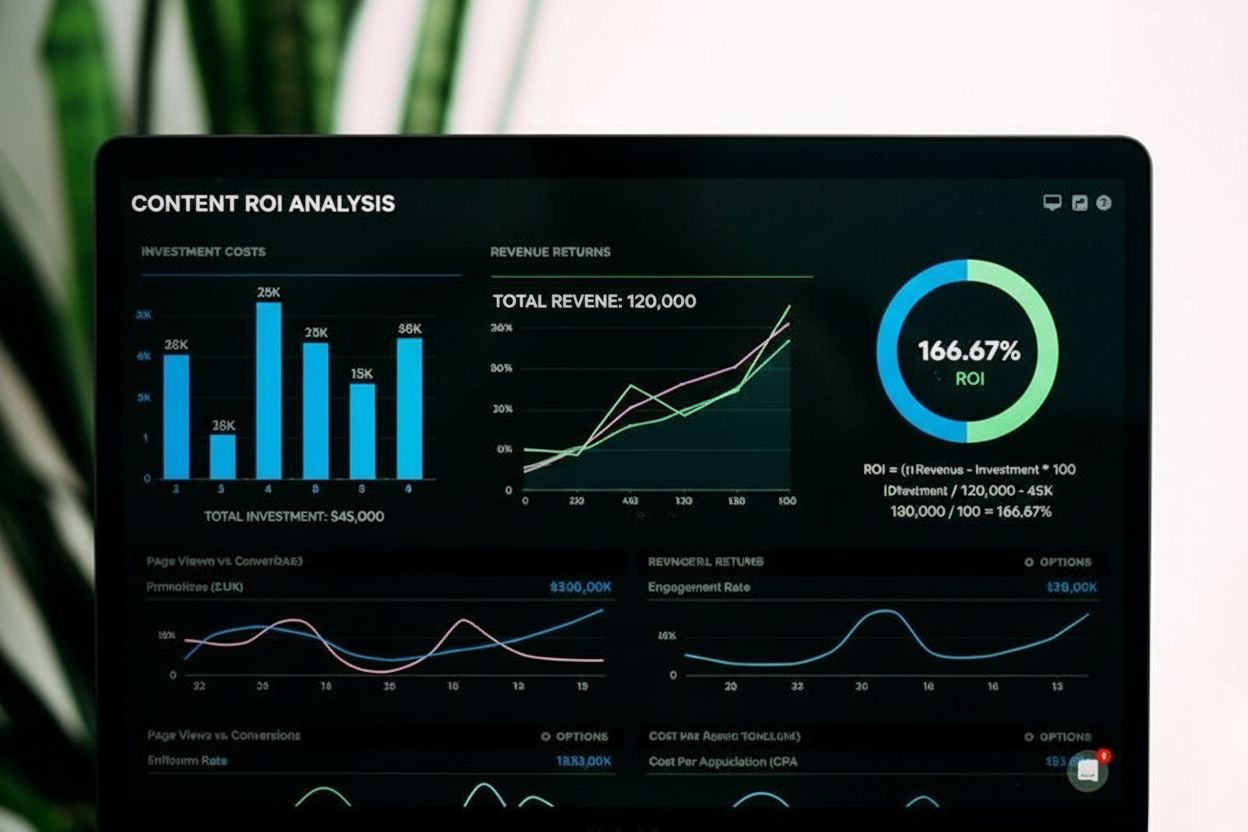
Content ROI measures the financial return from content marketing investments. Learn how to calculate, track, and optimize content ROI with metrics, formulas, an...
Cookie Consent
We use cookies to enhance your browsing experience and analyze our traffic. See our privacy policy.