


Customer Acquisition Cost
Customer Acquisition Cost (CAC) is the average amount a business spends to acquire a single new paying customer, calculated by dividing total sales and marketing spend by the number of new customers gained in a given period. It is one of the core unit-economics metrics for e-commerce brands, since it must stay below customer lifetime value for growth to be sustainable. CAC is typically tracked alongside return on ad spend and net revenue retention to judge whether growth spending is actually profitable.
Definition of Customer Acquisition Cost
Customer Acquisition Cost (CAC) is the average cost a business incurs to acquire one new paying customer, calculated by dividing total sales and marketing expenditure over a period by the number of new customers gained in that same period. CAC is one of the foundational unit-economics metrics in e-commerce because it directly determines whether growth spending is sustainable: a business can grow revenue quickly by spending aggressively on acquisition, but if CAC exceeds what each customer is actually worth over time, that growth is unprofitable no matter how impressive the top-line numbers look. CAC is typically tracked at both a blended, storewide level and a channel-specific level, since acquisition cost can vary dramatically between paid social, search, affiliate, and organic channels.
How Customer Acquisition Cost Is Calculated
The basic formula is:
CAC = Total Sales and Marketing Spend ÷ Number of New Customers Acquired
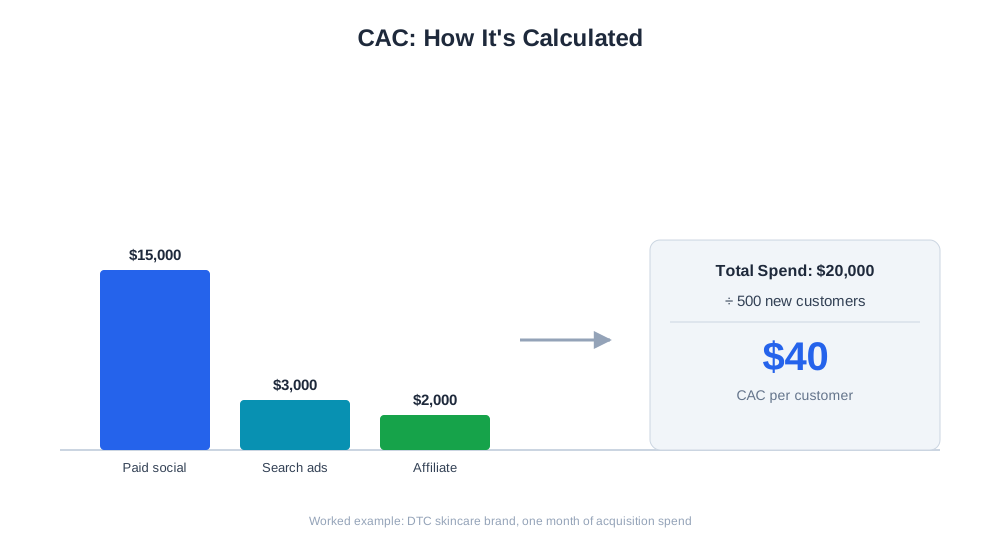
Worked example: a DTC skincare brand spends $15,000 on paid social ads, $3,000 on search ads, and $2,000 on affiliate commissions in a month, for a total acquisition spend of $20,000. That spend produces 500 new customers in the same month.
- Total spend: $20,000
- New customers: 500
- CAC: $20,000 ÷ 500 = $40 per customer
A fully loaded CAC calculation also allocates a share of relevant salaries (marketing team, agency retainers) into the numerator, which typically raises the figure above what channel-level ad platforms report on their own. Because ad platforms tend to over-attribute conversions to themselves, especially across multiple overlapping campaigns, a blended CAC calculated from total spend against total new customers is usually more reliable than summing each channel’s self-reported CAC.

Ready to Monitor Your AI Visibility?
Track how AI chatbots mention your brand across ChatGPT, Perplexity, and other platforms.
Why Customer Acquisition Cost Matters for E-commerce Brands
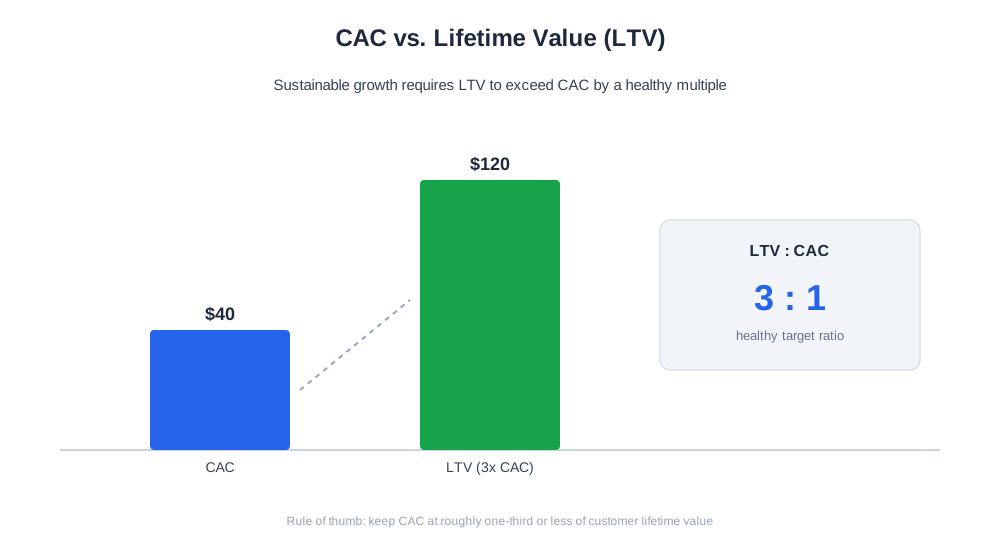
CAC determines the ceiling on how much a business can profitably spend to grow. If a customer’s first order generates $30 in gross margin but CAC is $40, that customer is unprofitable on the first purchase and the business is relying entirely on repeat purchases to recover the gap — a bet that only pays off if retention is genuinely strong. Tracking CAC by channel also reveals where budget is being wasted: a channel with a rising CAC and flat conversion rate is usually a sign of ad fatigue, audience saturation, or increased competition bidding up the same inventory. Because CAC tends to rise as a brand scales into broader, less targeted audiences, monitoring it over time is also an early signal of when a growth channel is approaching diminishing returns.
| Metric | What It Measures | Relationship to CAC |
|---|---|---|
| CAC | Cost to acquire one new customer | The baseline figure |
| LTV (lifetime value) | Total value a customer generates over time | Should exceed CAC by a healthy multiple |
| ROAS | Revenue generated per dollar of ad spend | Channel-level efficiency signal, feeds into CAC |
| Gross margin | Percentage of revenue kept after cost of goods | Determines how much margin is available to cover CAC |
| Repeat purchase rate | Share of customers who buy again | Higher rates let a business sustain higher CAC profitably |
Customer Acquisition Cost and AI-Driven Commerce
As shopping discovery increasingly happens inside AI assistants like ChatGPT Shopping, Perplexity Shopping, and Amazon Rufus, acquisition is no longer just a function of ad spend — a brand’s visibility and citation frequency within AI-generated answers can itself function as a low-cost or zero-cost acquisition channel, effectively lowering blended CAC if a business earns organic mentions. Conversely, brands absent from these AI answer surfaces may find their traditional paid channels working harder, and CAC rising, simply because a growing share of product discovery has moved somewhere they aren’t visible. AmICited’s eshop_get_cac_roas and eshop_get_marketing_ads tools reconcile actual attributed ad spend against confirmed new customers, correcting for the multi-touch and cross-platform attribution gaps that inflate self-reported CAC on individual ad platforms. That reconciled view lets merchants see, channel by channel, where acquisition spend is genuinely efficient and where reported performance is an artifact of attribution overlap.
Stay Updated on AI Visibility Trends
Get the latest insights on AI mentions, brand monitoring, and optimization strategies.
Best Practices for Managing CAC
- Calculate a fully loaded CAC that includes salaries and agency fees, not just raw ad spend, for an honest view of true cost
- Track CAC by channel and by campaign, not only as a single blended storewide number
- Compare CAC against gross margin per order, not just against revenue, since margin determines what a business can actually afford to spend
- Watch CAC trend over time within a single channel to catch audience saturation or rising competition early
- Pair CAC with repeat purchase rate and retention metrics, since a business with strong repeat behavior can sustainably run a higher CAC
- Reconcile ad-platform-reported conversions against actual store order data periodically, since self-reported attribution tends to overstate a channel’s efficiency
Common Customer Acquisition Cost Mistakes
Comparing CAC across channels using each platform’s own attribution numbers. Every ad platform tends to claim credit for conversions that overlap with other channels, which means summing individual platform-reported CACs usually produces a number lower than the true blended CAC calculated from total spend and total new customers. Evaluating CAC in isolation from gross margin and lifetime value. A CAC that looks attractive in absolute terms can still be unprofitable if the product category has thin margins or if repeat purchase rates are low; CAC only means something in the context of what a customer is actually worth. Ignoring the lag between spend and attributed customers. Some acquisition channels, particularly content and influencer partnerships, produce customers weeks or months after the spend occurs, and calculating CAC on a strict monthly basis can understate the channel’s true efficiency by attributing spend to the wrong period. Chasing a lower CAC by cutting spend on the highest-performing channel. Acquisition channels typically show rising marginal CAC as spend increases within them; cutting a channel’s budget across the board rather than trimming the least efficient segments within it can reduce total new customers disproportionately compared to the CAC improvement gained. Not separating new-customer CAC from returning-customer remarketing spend. Blending acquisition and retention advertising into a single CAC calculation understates true new-customer acquisition cost and can mask a channel that is actually just re-selling to existing customers rather than growing the base.