


Return on Ad Spend
Return on Ad Spend (ROAS) is a marketing metric that measures the revenue generated for every dollar spent on advertising, calculated by dividing attributed revenue by ad spend. It is one of the most widely used metrics for evaluating whether a campaign, channel, or platform is generating enough sales to justify its cost.
Definition of Return on Ad Spend (ROAS)
Return on Ad Spend, commonly abbreviated ROAS, measures the revenue an advertising campaign generates relative to what it costs to run. It is typically expressed as a ratio, such as 4:1, meaning four dollars of revenue for every dollar spent on ads, or as a percentage, such as 400%. ROAS is one of the most widely tracked metrics in ecommerce marketing because it directly connects ad spend to sales outcomes at the campaign, ad set, or channel level, making it a practical day-to-day metric for deciding where to allocate budget. It is important to note that ROAS measures revenue, not profit; a high ROAS on a low-margin product can still leave a business barely breaking even once the cost of goods, shipping, and payment processing are subtracted out.
How ROAS Is Calculated
The core formula is simple:
ROAS = Attributed Revenue / Ad Spend
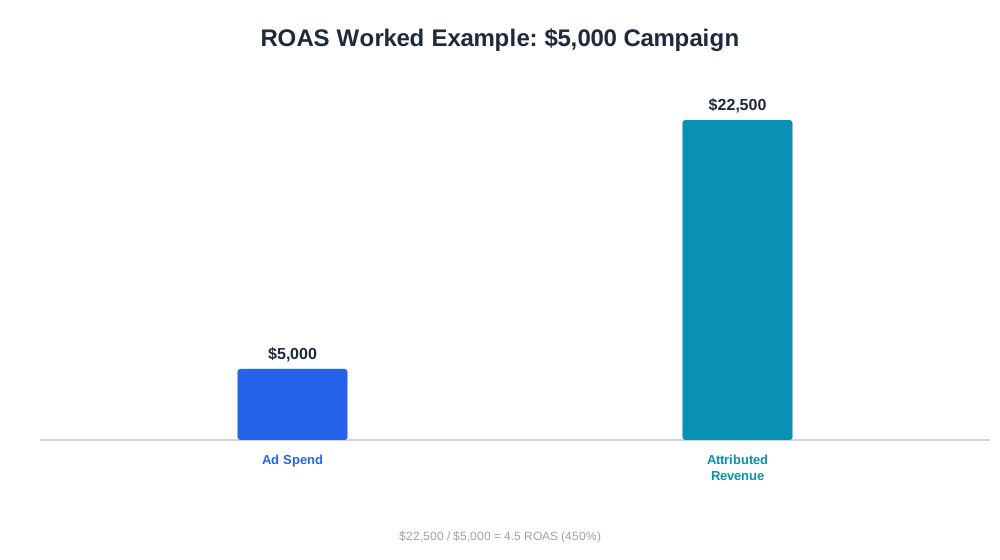
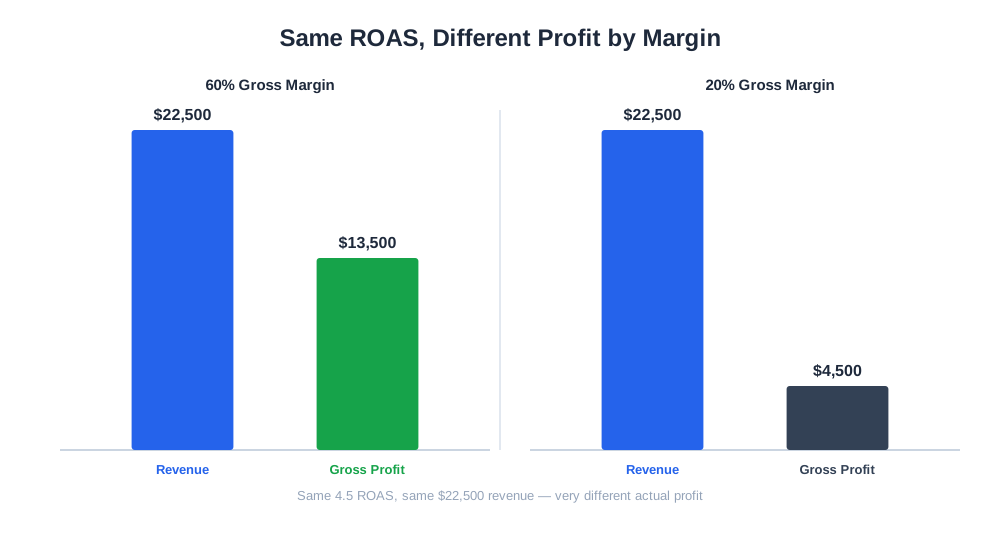
A worked example: an ecommerce brand runs a paid social campaign costing $5,000 over a week. The campaign is attributed with generating $22,500 in revenue over that period. Dividing $22,500 by $5,000 gives a ROAS of 4.5, or 450%. On its own, this tells the marketer that the campaign generated $4.50 in revenue for every dollar spent, but whether that’s a good outcome depends entirely on the product’s gross margin. If the store’s gross margin is 60%, that $22,500 in revenue represents roughly $13,500 in gross profit, comfortably covering the $5,000 ad spend with margin to spare. If gross margin is only 20%, that same revenue represents about $4,500 in gross profit, meaning the campaign actually lost money once ad spend is subtracted, despite a ROAS that looks strong on the surface.

Ready to Monitor Your AI Visibility?
Track how AI chatbots mention your brand across ChatGPT, Perplexity, and other platforms.
Why ROAS Matters for E-commerce Brands
ROAS gives marketers a fast, campaign-level signal for reallocating budget without needing a full profitability model for every decision. Because it can be measured per campaign, per ad set, per platform, and often per day, it enables rapid iteration: budget can shift toward what is producing revenue efficiently and away from what isn’t, often within the same week a campaign launches. The risk of relying on ROAS alone is that it ignores cost structure entirely, so two campaigns with identical ROAS can have very different actual profitability if they are driving sales in product categories with different margins. ROAS also depends heavily on the attribution model used to calculate it, and different ad platforms often over-credit their own channel through generous click and view-through attribution windows, which can make a campaign look more effective than it actually is once revenue is reconciled against real store-wide sales.
Comparison Table: ROAS vs. Related Marketing Metrics
| Metric | What It Measures | Accounts for Margin? | Best For |
|---|---|---|---|
| ROAS | Revenue per ad dollar spent | No | Fast campaign-level budget decisions |
| True ROAS | Revenue per ad dollar, reconciled against actual store data | No, but attribution is more accurate | Correcting for platform over-attribution |
| CAC | Cost to acquire one new customer | No | Evaluating acquisition efficiency |
| Contribution Margin | Revenue minus variable costs including ad spend | Yes | Assessing true profitability of a campaign |
| ROI | Overall return relative to total investment | Yes | Long-term, full-cost evaluation |
Stay Updated on AI Visibility Trends
Get the latest insights on AI mentions, brand monitoring, and optimization strategies.
ROAS and AI-Driven Commerce
As shopping increasingly happens through AI assistants like ChatGPT Shopping, Perplexity Shopping, and Amazon Rufus, attributing revenue back to a specific ad spend becomes more complicated, since a customer’s path to purchase may involve an AI-mediated research step that traditional ad platform tracking does not see. A shopper might discover a product through a paid social ad, research it further through an AI assistant days later, and eventually purchase through a different channel entirely, making single-touch, platform-reported ROAS an increasingly incomplete picture of what actually drove the sale.
This is precisely the gap AmICited’s eshop_get_cac_roas tool is built to close: it computes ROAS per campaign, per day, reconciled against actual attributed revenue from the store’s own order data rather than relying solely on what an ad platform self-reports. That reconciliation matters because ad platforms have a structural incentive to claim credit generously, and a marketing budget allocated purely on platform-reported ROAS can end up systematically overweighting channels that simply attribute more aggressively rather than channels that are genuinely driving incremental sales.
Best Practices for ROAS
- Set target ROAS thresholds based on gross margin by category, not a single store-wide target, since the break-even ROAS differs meaningfully between high- and low-margin products
- Reconcile platform-reported ROAS against actual store revenue periodically to catch attribution inflation before it skews budget decisions
- Track ROAS alongside CAC and contribution margin rather than in isolation, since a strong ROAS driven mostly by existing customers reordering tells a very different story than one driven by new customer acquisition
- Break down ROAS by campaign and day rather than only looking at monthly or channel-level averages, since daily and campaign-level detail reveals which specific creative or audience is actually performing
- Revisit target ROAS whenever product mix, shipping costs, or discounting strategy changes, since all three shift the margin a given ROAS actually represents
Common ROAS Mistakes
A frequent mistake is treating ROAS as a stand-in for profitability without ever translating it through gross margin, leading to budget decisions that favor high-ROAS, low-margin campaigns over lower-ROAS, high-margin ones that are actually more profitable. Another common issue is comparing ROAS across channels with very different attribution windows, for instance comparing a retargeting platform’s 30-day view-through attribution against a channel using only 1-day click attribution, which produces numbers that are not actually comparable despite looking like the same metric. Some marketers also chase a single blended ROAS target across an entire account, missing that a strong blended number can be masking a mix of a few excellent campaigns and several unprofitable ones. A further pitfall is failing to reconcile platform-reported revenue against actual store revenue, trusting ad platform dashboards that tend to over-attribute conversions to their own channel through generous click and view windows. Finally, some brands optimize purely for ROAS without regard to new customer acquisition, allowing budget to drift toward campaigns that mostly reach existing customers who would likely have reordered anyway, inflating ROAS while doing little to grow the customer base.