


Contribution Margin
Contribution margin is the revenue left over after subtracting variable costs — such as cost of goods sold, payment processing fees, and shipping — from a sale. It shows how much each order contributes toward covering fixed costs and generating profit, before overhead like salaries, rent, and marketing spend is applied.
Definition of Contribution Margin
Contribution margin is the amount of revenue left over from a sale after subtracting all variable costs — the costs that rise and fall directly with order volume. For an e-commerce business, variable costs typically include the cost of goods sold, payment processing fees, pick-and-pack labor, outbound shipping, and packaging materials. What remains after those costs are subtracted is the amount each order “contributes” toward covering fixed costs — rent, salaried staff, software subscriptions, and overhead — and, once fixed costs are covered, toward profit. Contribution margin can be expressed as a dollar amount per order or per unit, or as a contribution margin ratio, which expresses that dollar figure as a percentage of revenue. Because it isolates variable economics from fixed overhead, contribution margin is one of the most useful numbers a merchant can look at when deciding whether a product, discount, or channel is actually worth running.
How Contribution Margin Is Calculated
The formula is straightforward:
Contribution Margin = Revenue − Variable Costs
And the ratio:
Contribution Margin Ratio = Contribution Margin ÷ Revenue
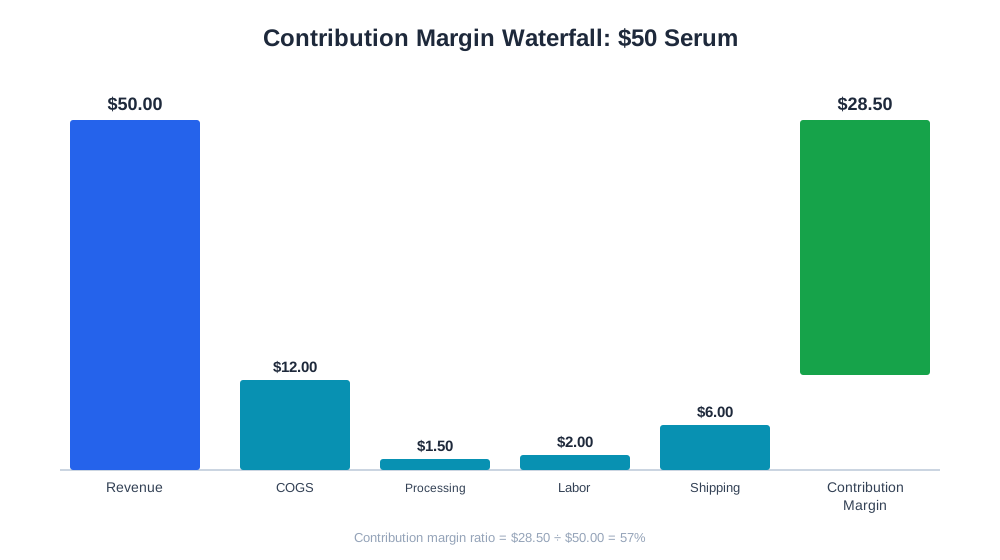
Consider a worked example. A DTC skincare brand sells a serum for $50. The cost of goods sold is $12, payment processing takes roughly $1.50, pick-and-pack labor runs $2, and shipping averages $6 per order after accounting for free-shipping thresholds. Total variable costs come to $21.50, leaving a contribution margin of $28.50 per unit, or a contribution margin ratio of 57%.
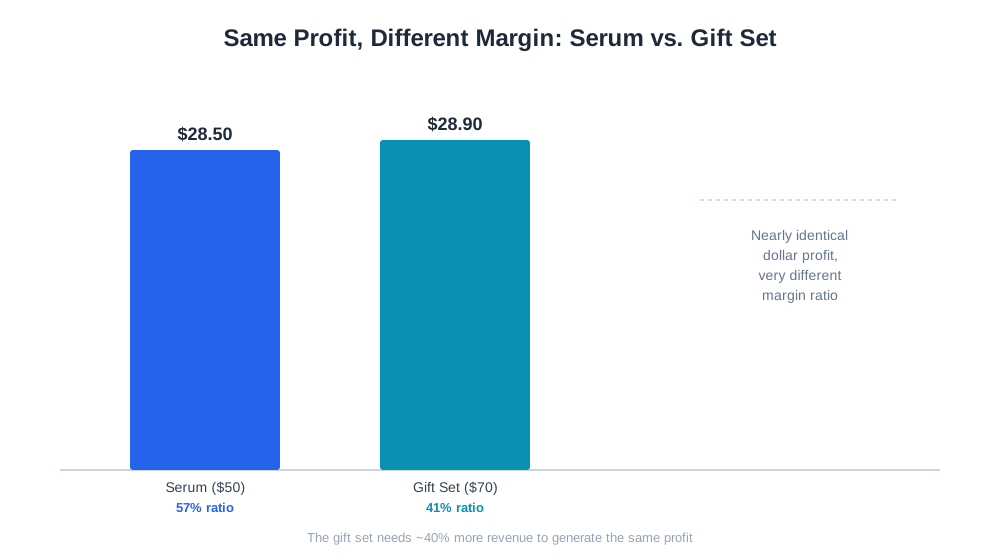
Now compare that to a bulkier product from the same catalog: a $70 skincare gift set that costs $22 in COGS, $2.10 in processing, $3 in labor, and $14 in shipping due to its box size. Variable costs total $41.10, leaving a contribution margin of $28.90 — nearly identical in dollar terms, but a contribution margin ratio of only 41%. The two products generate almost the same absolute profit per order, but the gift set needs nearly 40% more revenue to get there, which matters when shelf space, ad budget, or warehouse capacity is limited.

Ready to Monitor Your AI Visibility?
Track how AI chatbots mention your brand across ChatGPT, Perplexity, and other platforms.
Why Contribution Margin Matters for E-commerce Brands
Contribution margin answers a question gross margin alone cannot: does this specific order actually make money once every cost that scales with it is accounted for? A product can carry a healthy gross margin — say, 65% after COGS — and still be a poor performer once returns processing, payment fees, and an oversized shipping box are factored in. Merchants who only track gross margin routinely discover, once they run the full contribution math, that their “best” product by revenue is actually one of their thinnest by profit.
Contribution margin is also the number that should drive decisions about discounting, bundling, and paid acquisition. Every markdown or promotional discount comes directly out of contribution margin, not out of fixed costs, so a 20% discount on a product with a 40% contribution margin cuts the per-order profit contribution in half. Similarly, contribution margin sets the practical ceiling for what a business can spend to acquire a customer on the first order alone, before counting on repeat purchases to make the relationship profitable.
Contribution Margin vs. Gross Margin vs. Net Profit
| Metric | What It Subtracts | Best Used For | Includes Fixed Costs? |
|---|---|---|---|
| Gross Margin | Cost of goods sold only | Sourcing and production efficiency | No |
| Contribution Margin | All variable costs (COGS, fees, shipping, packaging) | Pricing, discounting, and per-SKU profitability decisions | No |
| Net Profit | All variable costs plus fixed costs and overhead | Overall business health and cash flow | Yes |
The three metrics answer different questions, and a healthy business needs to track all three — but contribution margin is the one most directly actionable at the level of a single order, promotion, or ad campaign.
Stay Updated on AI Visibility Trends
Get the latest insights on AI mentions, brand monitoring, and optimization strategies.
Contribution Margin and AI-Driven Commerce
As AI shopping assistants like ChatGPT Shopping, Perplexity Shopping, and Amazon’s Rufus increasingly surface product recommendations and comparison shopping results, merchants are seeing a shift in traffic mix toward channels where they have less control over price positioning. That makes contribution margin discipline more important, not less: if AI-driven traffic converts at a similar rate but arrives through a channel with its own referral or affiliate cost, the true variable cost stack for that order looks different than it does for direct traffic, and the contribution margin needs to be recalculated accordingly.
AmICited’s eshop_get_cost_mix tool builds what is effectively a contribution margin ladder for a connected store — starting at gross revenue and stepping down through COGS, payment fees, shipping, and other variable costs to arrive at contribution margin and, ultimately, net profit. Because the tool works at the SKU and order level, merchants can see exactly which products are carrying the business and which ones look good on a top-line revenue report but are quietly eroding profitability.
Best Practices for Managing Contribution Margin
- Calculate contribution margin at the SKU level, not just at the store level — averages hide products that are dragging profitability down.
- Include all variable costs, not just COGS: payment processing, shipping, packaging, and any per-order fulfillment labor.
- Recalculate contribution margin whenever shipping rates, supplier costs, or payment processor fees change — these shift quietly and often go unnoticed.
- Use contribution margin, not gross margin, as the ceiling when setting discount depth or negotiating affiliate and marketplace commission rates.
- Segment contribution margin by channel (direct, marketplace, wholesale) since fee structures and shipping obligations often differ significantly.
- Revisit contribution margin any time you introduce a new size, bundle, or free-shipping threshold — these changes affect variable cost per order in ways that are easy to miss.
Common Contribution Margin Mistakes
Treating gross margin as a proxy for contribution margin. This is the most common error: a merchant looks at a healthy 60% gross margin and assumes the product is profitable, without ever subtracting shipping or payment fees. The fix is to build a standing cost mix report that always shows contribution margin, not gross margin, as the headline profitability number.
Ignoring return-related costs. Products with high return rates carry a hidden variable cost — restocking labor, return shipping, and sometimes a percentage of unsellable inventory — that rarely gets subtracted before a contribution margin figure is quoted. Categories like apparel and footwear need a return-cost adjustment baked into the variable cost stack.
Averaging contribution margin across the whole catalog. A blended contribution margin ratio can look perfectly healthy while masking individual SKUs that are contribution-negative. Break the number out by product and by channel before making promotional or ad-spend decisions.
Not updating variable costs after a shipping rate change. Carriers adjust rates periodically, and packaging or fulfillment costs creep upward with inflation. A contribution margin model built once and never revisited will overstate profitability, sometimes by a meaningful margin, within a year.
Confusing contribution margin with the money available to spend on marketing. Contribution margin funds both fixed costs and marketing spend — it isn’t all discretionary. A business that treats its entire contribution margin as an acquisition budget will find it has nothing left to cover rent, salaries, or software costs.