


Gross Margin
Gross margin is the percentage of revenue a business retains after subtracting the cost of goods sold (COGS). It reflects how efficiently a company turns sales into profit before accounting for operating expenses like marketing, salaries, and rent. For e-commerce brands, gross margin is the single most-watched profitability metric because it directly reflects product economics, sourcing costs, and pricing strategy.
Definition of Gross Margin
Gross margin is the percentage of revenue that remains after subtracting the cost of goods sold (COGS) from total sales. COGS includes the direct costs of producing or acquiring the products sold: raw materials, manufacturing, inbound freight, and often packaging. Gross margin does not account for indirect costs such as marketing, payroll, software subscriptions, warehousing overhead, or customer acquisition, which sit further down the income statement. For e-commerce merchants, gross margin functions as an early warning system: it shows how much financial room exists to spend on growth (ads, discounts, free shipping) before a sale stops being profitable at all. A high-revenue month with a shrinking gross margin is often a sign that discounting or a shifting product mix is quietly eroding the underlying economics of the business, even while the top-line numbers look healthy.
How Gross Margin Is Calculated
The formula is straightforward:
Gross Margin (%) = (Revenue − Cost of Goods Sold) ÷ Revenue × 100
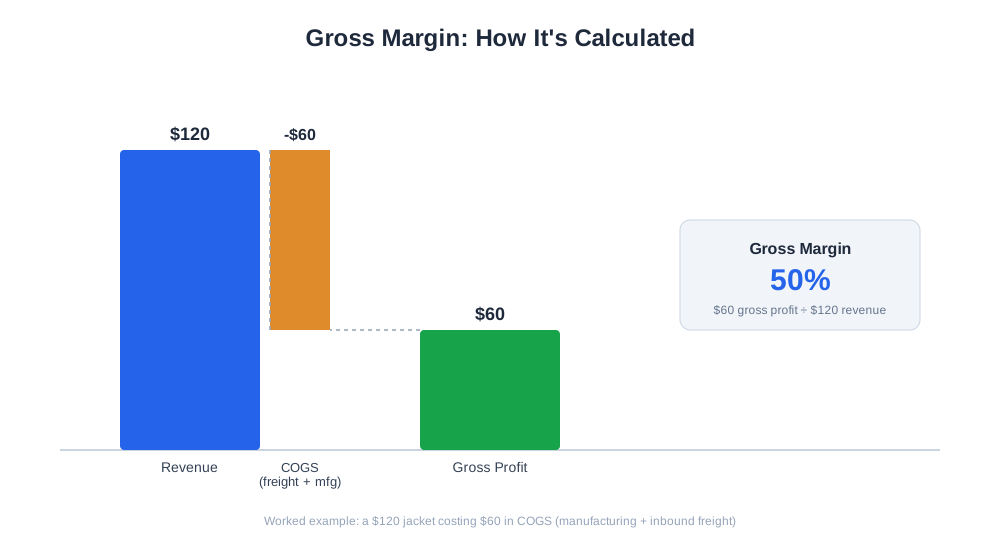
Worked example: a store sells a jacket for $120. The jacket costs $48 to manufacture, plus $12 in inbound freight and packaging, for a total COGS of $60.
- Revenue: $120
- COGS: $60
- Gross Profit: $120 − $60 = $60
- Gross Margin: $60 ÷ $120 = 50%
At the store level, the same formula applies to aggregated revenue and aggregated COGS across every order in a period. If that same store sold 500 jackets in a month for $60,000 in revenue against $30,000 in total COGS, the storewide gross margin would still be 50% — but in practice, most stores sell a mix of products with different margins, so the blended gross margin is a weighted average that shifts as sales mix changes, even if no individual product’s margin changes at all.

Ready to Monitor Your AI Visibility?
Track how AI chatbots mention your brand across ChatGPT, Perplexity, and other platforms.
Why Gross Margin Matters for E-commerce Brands
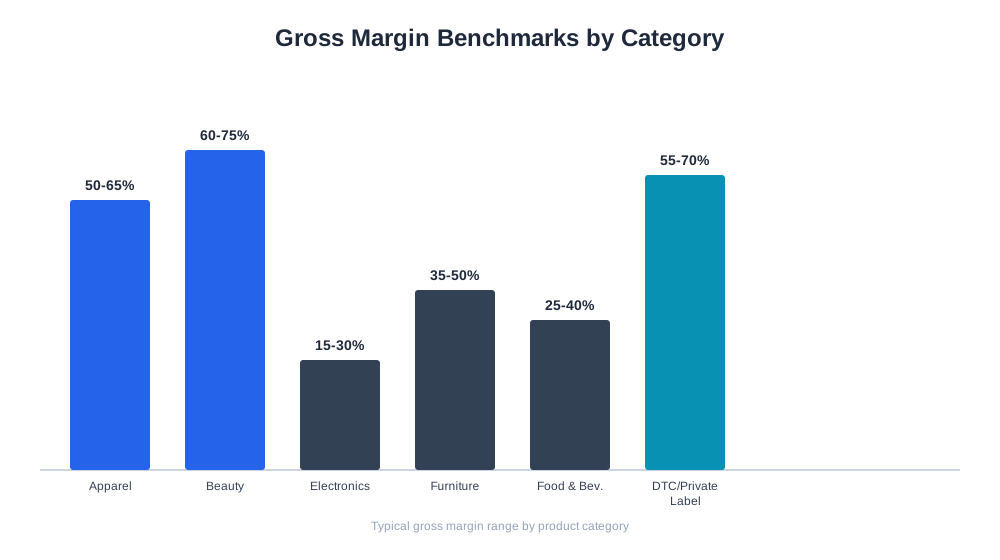
Gross margin determines how much a brand can afford to spend on customer acquisition, discounts, and shipping subsidies while remaining profitable. A brand with a 65% gross margin has considerably more room to run a promotional sale or absorb rising ad costs than a brand operating at 20%, where even a modest discount can turn a sale unprofitable once fulfillment costs are included. Gross margin also acts as an early signal of supply chain health: a sudden drop often points to a supplier price increase, a shift toward discounted or lower-margin SKUs, increased shipping costs baked into COGS, or rising returns and damage in transit. Because gross margin sits above operating expenses, it is also the metric investors and lenders look at first when evaluating whether a business model is fundamentally sound, separate from how efficiently the company is currently spending on growth.
| Category | Typical Gross Margin Range | Primary Margin Drivers |
|---|---|---|
| Apparel and fashion | 50-65% | Design markup, seasonal markdowns, return rates |
| Beauty and cosmetics | 60-75% | Low unit COGS relative to price, packaging costs |
| Consumer electronics | 15-30% | Component costs, thin brand differentiation |
| Furniture and home goods | 35-50% | Freight and damage-in-transit costs |
| Food and beverage (packaged) | 25-40% | Ingredient costs, shelf-life waste, cold-chain logistics |
| Private label / DTC manufacturing | 55-70% | Owned production, fewer supply chain markups |
Gross Margin and AI-Driven Commerce
As more shopping activity is mediated by AI assistants like ChatGPT Shopping, Perplexity Shopping, and Amazon Rufus, brands often respond by offering more aggressive discounts, bundles, or free-shipping thresholds to win the comparison a customer sees. Every one of those levers pulls directly against gross margin. A brand that doesn’t know its per-SKU margin in real time risks accepting an AI-driven sale that looks like a win on revenue but is actually a loss once true cost of goods is factored in. AmICited’s eshop_get_kpis and eshop_get_cost_mix tools reconcile order-level revenue against actual product costs, discounts, and fees to surface gross margin in the executive KPI deck, alongside a margin ladder that ranks products and categories from most to least profitable. This lets merchants set discount floors and promotional rules with an actual margin number in hand, rather than guessing at what a markdown will do to profitability.
Stay Updated on AI Visibility Trends
Get the latest insights on AI mentions, brand monitoring, and optimization strategies.
Best Practices for Managing Gross Margin
- Track gross margin at the SKU or product-category level, not just storewide, since a healthy blended average can hide individual loss-making products
- Review supplier and freight costs quarterly, since input cost creep is one of the most common silent causes of margin erosion
- Model the margin impact of any discount or bundle before launching it, rather than evaluating promotions on revenue lift alone
- Separate inbound freight (part of COGS) from outbound shipping (a fulfillment cost) consistently, so month-over-month comparisons stay meaningful
- Set a minimum acceptable margin threshold per category and flag any order or promotion that falls below it
- Reassess gross margin whenever sales mix shifts significantly, such as after a new product launch or a shift in traffic sources
Common Gross Margin Mistakes
Treating storewide gross margin as a single, stable number. A blended average across hundreds of SKUs can mask serious problems: a handful of low-margin bestsellers can be quietly subsidized by high-margin slow movers, and the moment sales mix shifts, the storewide number moves even though nothing about the underlying products changed. The fix is to track margin at the product or category level and watch for mix shift explicitly. Confusing gross margin with net profitability. A 60% gross margin sounds strong, but if customer acquisition cost, returns processing, and fulfillment consume most of that margin, the business can still be losing money on every order. Gross margin should be read alongside net margin, not as a substitute for it. Ignoring the margin impact of returns and damage. Returned or damaged inventory is often written off well after the original sale is recorded as profitable, which means margin reports can overstate profitability until returns are reconciled back against the original order. Letting inbound freight costs drift out of COGS. As shipping rates rise, some finance teams start booking freight increases to a general logistics expense line instead of updating COGS, which artificially inflates gross margin and hides the real cost trend from anyone reviewing product-level profitability. Setting promotional discounts without a margin floor. A percentage-off sale that looks reasonable on paper can turn a 50% margin product into a break-even or loss-making one once payment processing fees, free shipping, and return rates are factored in; every promotion should be checked against an actual margin floor before launch.