


Repeat Purchase Rate
Repeat purchase rate is the percentage of customers who buy from a store more than once within a given time window. It is one of the clearest signals of customer loyalty and product-market fit, and is typically calculated by dividing the number of returning customers by the total number of unique customers over that period.
Definition of Repeat Purchase Rate
Repeat purchase rate is the percentage of a store’s customers who place more than one order within a defined time period. It is one of the most direct signals available for judging whether a product and customer experience are strong enough to earn a customer’s business a second time, which is a materially harder bar to clear than earning it once. A high repeat purchase rate usually indicates that a brand has built genuine loyalty or created a naturally recurring need, while a low one — particularly in a category where repeat buying should be common — often points to problems with product quality, fulfillment experience, or post-purchase engagement rather than acquisition.
How Repeat Purchase Rate Is Calculated
The standard formula is:
Repeat Purchase Rate = (Customers with 2+ orders in the period) ÷ (Total unique customers in the period) × 100
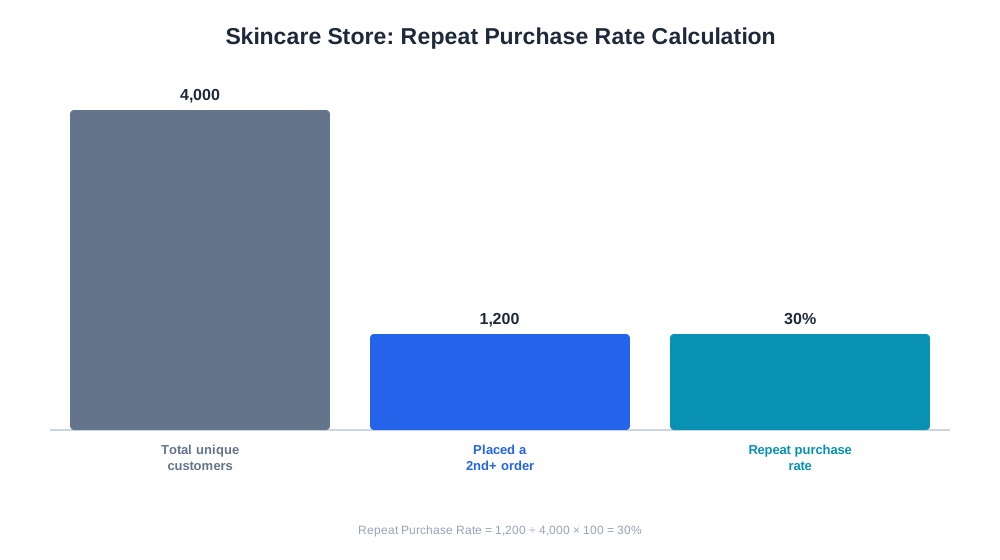
Worked example: a skincare store had 4,000 unique customers place at least one order in the past 12 months. Of those, 1,200 placed a second (or later) order within that same window. Repeat purchase rate = 1,200 ÷ 4,000 × 100 = 30%.
A more diagnostic variant tracks this by cohort: take everyone who made their first purchase in January, then measure what percentage of that specific group placed a second order within, say, 90 days. Cohort-based tracking isolates a single starting group and reveals trends (is the newest cohort repeating faster or slower than the one three months ago?) that a blended, all-customers snapshot can hide.

Ready to Monitor Your AI Visibility?
Track how AI chatbots mention your brand across ChatGPT, Perplexity, and other platforms.
Why Repeat Purchase Rate Matters for E-commerce Brands
Acquiring a new customer is almost always more expensive than getting an existing one to buy again, so repeat purchase rate is a direct proxy for how efficiently a store can grow beyond its paid acquisition spend. A store with a strong repeat purchase rate can afford to spend more on acquisition, because a larger share of new customers will generate a second and third order without additional marketing cost. It also functions as an early warning system: a declining repeat purchase rate among recent cohorts, even while overall revenue looks flat or growing (often because of new-customer acquisition masking the trend), typically signals a product or experience issue well before it shows up as an overall revenue decline.
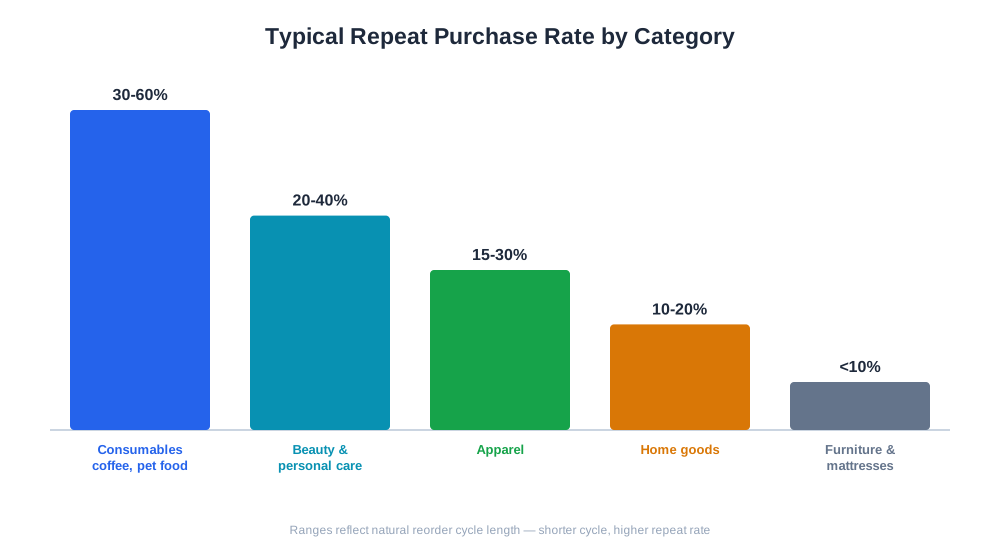
| Category Type | Typical Repeat Purchase Rate Range | Why |
|---|---|---|
| Consumables (coffee, supplements, pet food) | 30-60%+ | Natural, short reorder cycle |
| Beauty and personal care | 20-40% | Regular but longer reorder cycle |
| Apparel | 15-30% | Repeat driven by style/brand loyalty, not necessity |
| Home goods | 10-20% | Infrequent need, high variety-seeking |
| Furniture and mattresses | Under 10% | Very long natural replacement cycle |
Repeat Purchase Rate and AI-Driven Commerce
As AI shopping assistants like ChatGPT Shopping and Perplexity Shopping increasingly handle first-time product discovery on a shopper’s behalf, the second purchase becomes a more meaningful signal of genuine brand loyalty rather than algorithmic convenience — a customer who comes back directly, rather than being re-routed through an AI assistant’s fresh comparison each time, is choosing the brand itself. AmICited’s eshop_get_repeat tool is built specifically to surface this: it calculates a store’s repeat purchase rate along with the typical time customers take to place their second order, giving merchants a concrete number to track over time rather than an anecdotal sense of whether “customers seem to come back.”
Stay Updated on AI Visibility Trends
Get the latest insights on AI mentions, brand monitoring, and optimization strategies.
Best Practices for Repeat Purchase Rate
- Track repeat purchase rate by cohort and by acquisition channel, since paid social customers often repeat at different rates than organic or referral customers
- Identify the typical time-to-second-order for your specific catalog and use it to time follow-up communication
- Invest in post-purchase experience (shipping speed, packaging, easy returns) since it influences repeat behavior more than most marketing spend
- Make reordering effortless for consumable or replenishable products through saved carts, subscriptions, or one-click reorder links
- Segment repeat purchase rate by product category to find which products are creating loyalty and which are one-time purchases
Common Repeat Purchase Rate Mistakes
A common mistake is measuring repeat purchase rate as a single blended number across the whole customer base, which hides that a specific acquisition channel or product line may be dragging the average down while another is performing well — breaking the metric down by cohort, channel, and product category usually reveals the real story. Another frequent error is choosing a measurement window that doesn’t match the product’s natural reorder cycle: measuring repeat rate within 30 days for a mattress store will show almost nothing useful, while a 30-day window may be far too generous for a truly habitual consumable. Some brands also try to boost repeat purchase rate purely through blanket discount emails, which can train customers to wait for a coupon rather than genuinely increasing loyalty, and tends to erode margin faster than it grows the metric. Finally, teams sometimes celebrate a rising repeat purchase rate without checking whether it is being driven by a shrinking pool of new customers (making the percentage look better against a smaller denominator) rather than an actual improvement in how many people come back — pairing repeat purchase rate with new customer growth avoids this misread.