


Net Revenue Retention
Net Revenue Retention (NRR) measures the percentage of recurring revenue a business retains from its existing customer base over a period, factoring in upgrades, repeat purchases, downgrades, and churn. An NRR above 100% means existing customers are spending more over time than they lose through churn, even before counting any new customer acquisition. While the metric originated in subscription software, e-commerce brands with repeat-purchase and subscription models use it the same way to judge the health of their existing customer base.
Definition of Net Revenue Retention
Net Revenue Retention (NRR), sometimes called net dollar retention, measures the percentage change in revenue generated by an existing customer cohort over a defined period, accounting for expansion (customers spending more), contraction (customers spending less), and churn (customers who stop buying entirely). Crucially, NRR excludes any revenue from new customers acquired during the period — it is a pure measure of how well a business retains and grows value from the customers it already has. The metric originated in subscription software, where it is a headline indicator of business health, but it applies equally well to e-commerce brands with subscription boxes, consumable products, or any category with meaningful repeat purchase behavior. An NRR figure above 100% signals that existing customers, as a group, are worth more to the business over time even without adding a single new customer.
How Net Revenue Retention Is Calculated
The formula is:
NRR (%) = (Starting Revenue + Expansion Revenue − Contraction Revenue − Churned Revenue) ÷ Starting Revenue × 100
Worked example: a subscription skincare brand starts the quarter with $200,000 in revenue from its existing customer base. Over the quarter, $30,000 in expansion revenue comes from customers upgrading to larger bundles or adding products, $10,000 is lost to customers downgrading to smaller plans, and $25,000 is lost to customers who cancel entirely.
- Starting revenue: $200,000
- Plus expansion: +$30,000
- Minus contraction: −$10,000
- Minus churn: −$25,000
- Ending revenue from that same cohort: $195,000
- NRR: $195,000 ÷ $200,000 = 97.5%
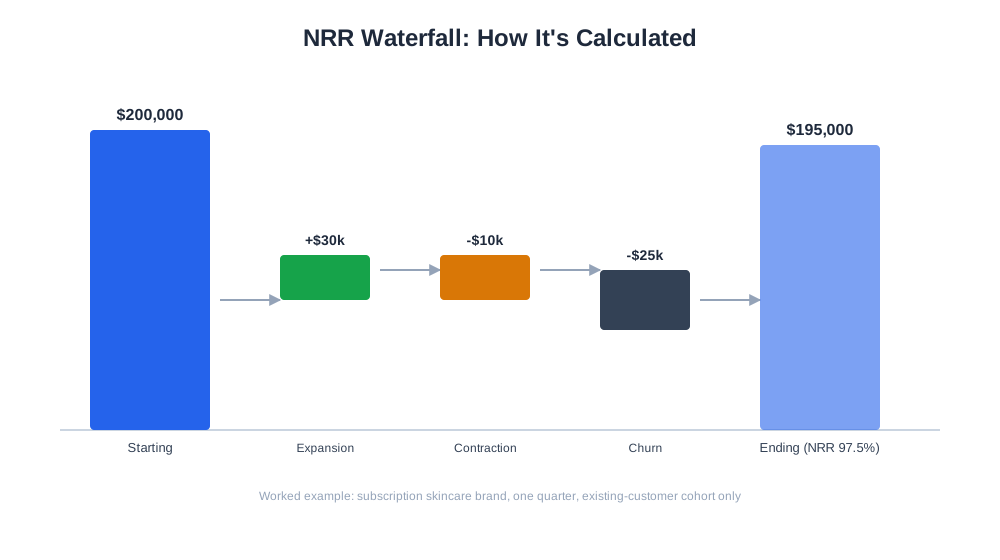
An NRR of 97.5% means this cohort is shrinking slightly in value even with expansion revenue included, signaling that churn and downgrades are outpacing growth from existing customers.

Ready to Monitor Your AI Visibility?
Track how AI chatbots mention your brand across ChatGPT, Perplexity, and other platforms.
Why Net Revenue Retention Matters for E-commerce Brands
NRR isolates the health of the existing customer base from the effect of new customer acquisition, which matters because a business can look like it’s growing purely by spending heavily on acquisition while its underlying customer relationships are actually deteriorating. A brand with declining NRR is effectively running on a treadmill: it has to keep replacing lost revenue with new customer spend just to stand still, which is a much more expensive way to grow than retaining and expanding existing relationships. NRR is also a more complete signal than a simple retention rate, because it’s revenue-weighted — a business can retain a large percentage of low-spending customers while losing a small number of high-value ones, and NRR will reflect the true financial impact where a simple headcount-based retention rate would not.
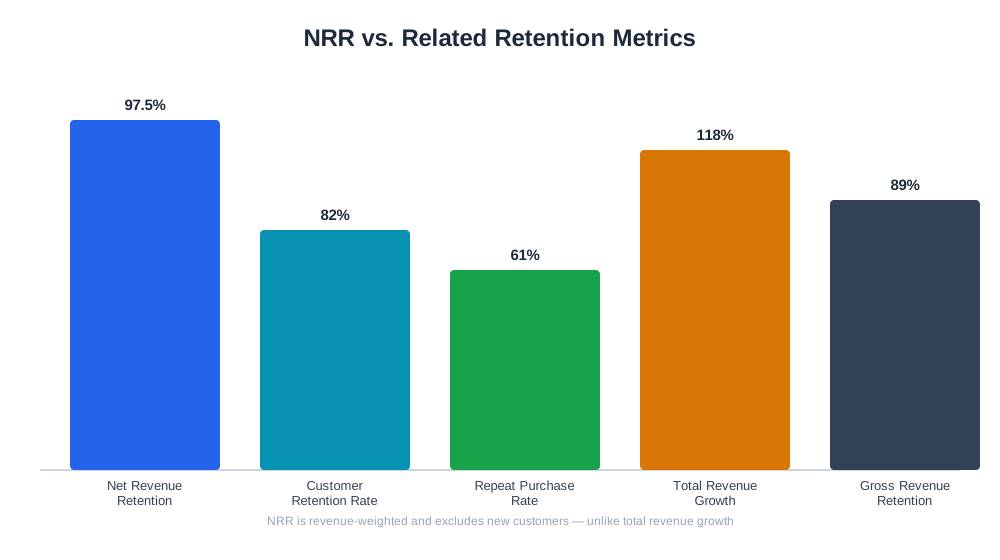
| Metric | What It Captures | Includes New Customers? |
|---|---|---|
| Net Revenue Retention | Revenue change from existing customers, including expansion and churn | No |
| Customer retention rate | Percentage of customers who remain active | No |
| Repeat purchase rate | Percentage of customers who buy more than once | No |
| Total revenue growth | Overall revenue change across the whole business | Yes |
| Gross revenue retention | Revenue retained from existing customers, excluding any expansion | No |
Net Revenue Retention and AI-Driven Commerce
As AI shopping assistants and recommendation engines increasingly influence repeat purchase behavior — surfacing reorder reminders, subscription renewals, or complementary product suggestions — the expansion component of NRR is becoming more directly shaped by how well a brand’s product data and personalization systems work. A brand whose products are effectively recommended back to existing customers, whether through its own site or through AI-driven shopping surfaces, tends to see stronger expansion revenue than one relying purely on organic reorder behavior. AmICited’s eshop_get_retention tool tracks cohort-level retention and revenue over time, showing precisely how much of a given customer group’s spending is expanding, holding steady, or churning away within a period. That view lets a merchant calculate an accurate NRR from real order history and cohort data, rather than approximating retention health from a top-line repeat purchase percentage that doesn’t capture how much each retained customer is actually spending.
Stay Updated on AI Visibility Trends
Get the latest insights on AI mentions, brand monitoring, and optimization strategies.
Best Practices for Net Revenue Retention
- Calculate NRR on cohorts defined by first purchase date, not on the whole customer base at once, to keep the comparison meaningful
- Track expansion, contraction, and churn as separate components, not just the final blended NRR number, to understand what’s actually driving the trend
- Invest in reorder reminders, subscription mechanics, and personalized recommendations to grow the expansion component of NRR
- Compare NRR trends across different acquisition channels or cohorts to see which customer sources retain and expand best
- Set NRR targets appropriate to the category — consumables and subscriptions can sustain higher targets than one-time-purchase categories
- Review NRR alongside CAC, since a business with strong NRR can often sustain a higher acquisition cost profitably
Common Net Revenue Retention Mistakes
Blending new customer revenue into the NRR calculation. This inflates the metric and hides whether the existing customer base is actually healthy, defeating the entire purpose of tracking NRR separately from total revenue growth. Calculating NRR across the whole customer base rather than defined cohorts. Without cohorting by start date, the metric mixes customers at very different stages of their relationship with the brand, making trends hard to interpret and comparisons across periods unreliable. Treating a single NRR snapshot as conclusive. One period’s NRR can be skewed by a single large customer churning or a seasonal spike in expansion; NRR is far more useful as a trend line over several periods than as an isolated figure. Ignoring the contraction component separately from churn. A business that only tracks full churn misses customers who are still active but spending meaningfully less, which is often an earlier and more actionable warning sign than outright cancellation. Setting an NRR target borrowed from an unrelated industry. A SaaS benchmark of 110%+ NRR is not a realistic target for a low-frequency consumer goods category, and chasing it can push a brand toward aggressive upselling tactics that damage the customer relationship rather than genuinely growing it.