

Fluency Optimization: Writing Content That LLMs Love to Quote
Master fluency optimization to create LLM-friendly content that gets cited more often. Learn how to write naturally flowing content that AI systems prefer to qu...
11 min read
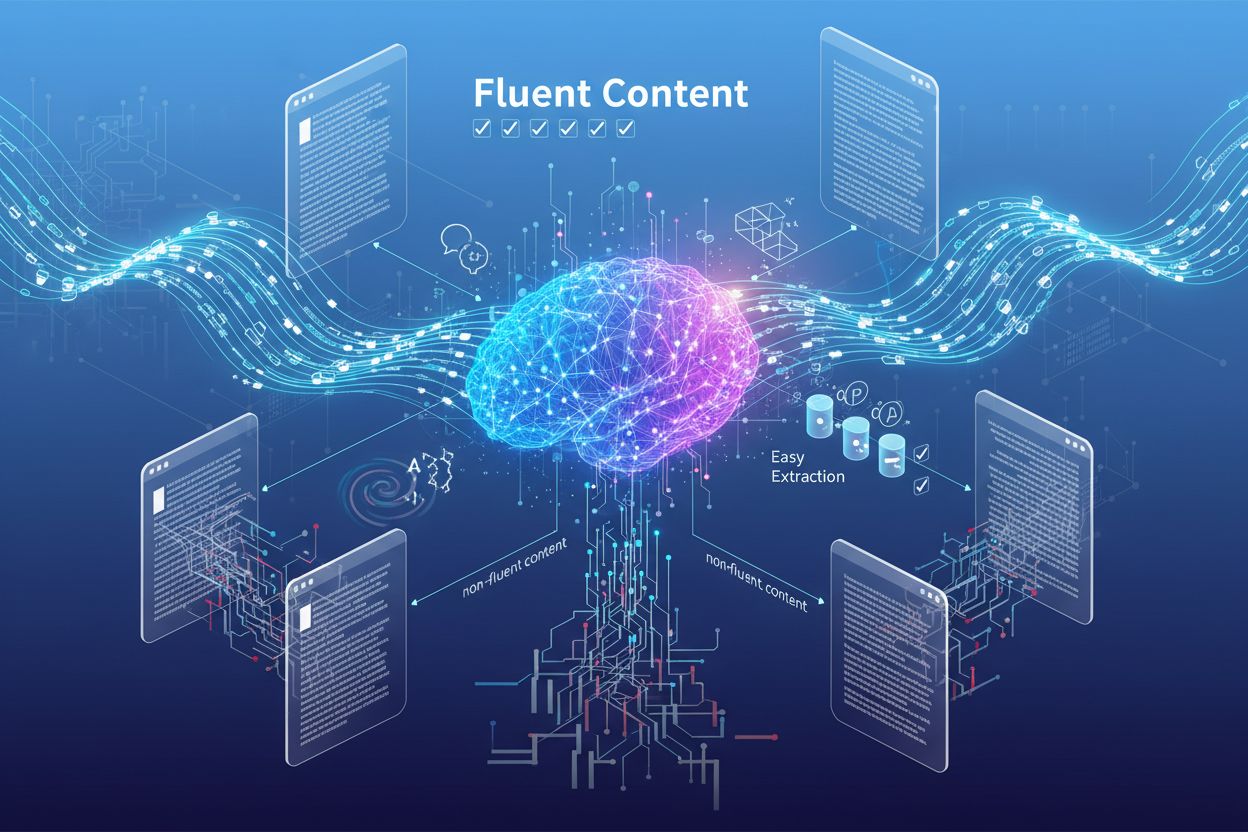
Fluency optimization is the practice of writing content that flows naturally and reads smoothly, making it easier for AI systems to extract, understand, and cite your work. Unlike traditional readability, which focuses on sentence length and complexity, fluency emphasizes the natural rhythm and coherence of language. This technique has become essential for content visibility in AI search results, as fluent content is more likely to be selected for inclusion and citation by AI systems like Google AI Overviews and Perplexity.
Fluency optimization is the practice of writing content that flows naturally and reads smoothly, making it easier for AI systems to extract, understand, and cite your work. Unlike traditional readability, which focuses on sentence length and complexity, fluency emphasizes the natural rhythm and coherence of language. This technique has become essential for content visibility in AI search results, as fluent content is more likely to be selected for inclusion and citation by AI systems like Google AI Overviews and Perplexity.
Fluency optimization is the practice of writing content in a way that flows naturally and reads smoothly, making it easier for AI systems to extract, understand, and cite your work. Unlike traditional readability, which focuses on sentence length and complexity, fluency emphasizes the natural rhythm and coherence of language—how ideas connect and progress logically. In the context of Google AI Overviews and other AI-powered search features, fluency optimization ensures your content is not just readable by humans, but also easily processable by AI systems that scan and quote web content. This technique has become essential for content visibility in AI search results, as fluent content is more likely to be selected for inclusion and citation. By optimizing for fluency, you’re essentially speaking the language that AI systems prefer to read and extract from.
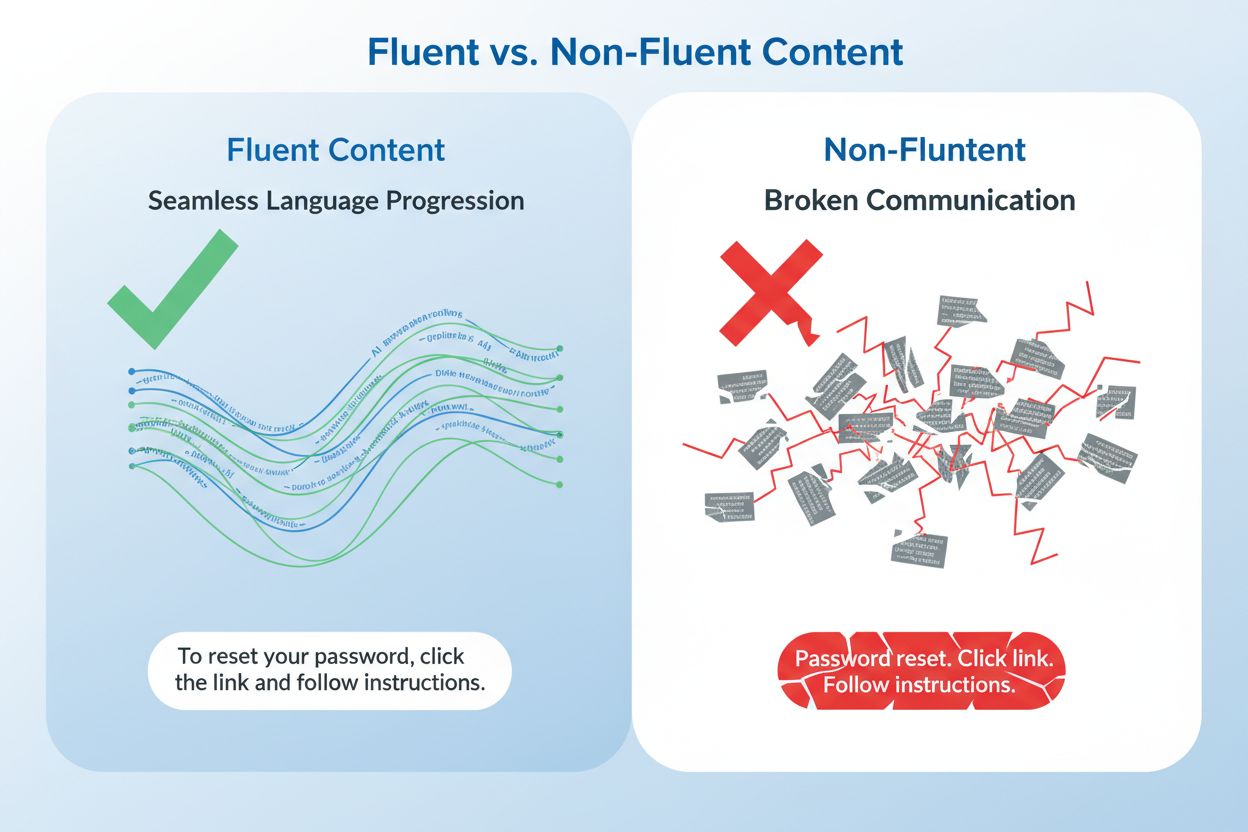
AI systems process content through natural language processing (NLP) models that break text into tokens—small units of language that the system analyzes to understand meaning and context. When content is fluent, these tokens align naturally with semantic units, allowing the AI to extract information more accurately and confidently. Non-fluent content—filled with awkward phrasing, inconsistent terminology, or abrupt transitions—creates processing friction that can lead to misinterpretation, incomplete extraction, or the AI choosing to cite a competitor’s clearer explanation instead. The smoother your content flows, the higher quality the content extraction becomes, and the more likely AI systems will select your work for inclusion in AI Overviews and similar features. Additionally, fluent content reduces the computational effort required for AI to parse and understand your message, making your content more “attractive” to AI algorithms that prioritize efficiency.
| Aspect | Fluent Content | Non-Fluent Content | AI Extraction Quality |
|---|---|---|---|
| Example | “To reset your password, click the ‘Forgot Password’ link on the login page, enter your email, and follow the instructions sent to your inbox.” | “Password resetting can be done. The ‘Forgot Password’ link exists. Click it. Email entry is required. Instructions will be sent. Follow them.” | High - Clear, complete extraction |
| Token Alignment | Tokens align with natural phrase boundaries | Tokens fragment across awkward breaks | Better semantic understanding |
| AI Confidence | High confidence in meaning and context | Lower confidence, potential misinterpretation | More likely to be cited |
| Processing Load | Minimal computational overhead | Higher processing complexity | Faster inclusion in AI results |
Replace complex sentences with simple ones — Break down multi-clause sentences into shorter, more digestible statements that maintain clarity without sacrificing depth. Instead of “The implementation of advanced algorithmic processes, which necessitate comprehensive data analysis methodologies, requires substantial computational resources,” write “Advanced algorithms need significant computing power and thorough data analysis.”
Maintain consistent terminology — Use the same terms throughout your content to refer to the same concepts. If you introduce “machine learning models” in one section, don’t switch to “AI algorithms” or “neural networks” to describe the same thing in another section, as this creates confusion for both readers and AI systems.
Use active voice — Prefer active voice (“The system processes data”) over passive voice (“Data is processed by the system”) because it creates clearer subject-action relationships that AI systems can more easily parse and understand.
Avoid awkward phrasing and jargon — Eliminate unnecessary technical jargon, redundant phrases, and constructions that don’t serve a purpose. Replace “utilize” with “use,” remove filler phrases like “it is important to note that,” and avoid industry-specific terminology unless your audience specifically requires it.
Ensure smooth transitions between ideas — Use transitional phrases and logical connectors (“therefore,” “as a result,” “in addition,” “however”) to guide readers and AI systems through your argument, making the relationship between ideas explicit and clear.
Write with natural rhythm and cadence — Vary sentence length strategically, use parallel structure for related ideas, and read your content aloud to catch awkward phrasing that disrupts the natural flow of language.
While readability and fluency are often used interchangeably, they address different aspects of content quality. Readability focuses on measurable factors like sentence length, word complexity, and paragraph structure—metrics that tools like the Flesch-Kincaid Grade Level assess. Fluency, by contrast, emphasizes the natural flow and coherence of language, how smoothly ideas progress from one to the next, and whether the content “sounds right” when read aloud or processed by AI. A sentence can be highly readable (short, simple words) yet lack fluency if it feels choppy or disconnected from surrounding ideas. Conversely, a longer sentence can be fluent if it flows naturally and maintains clear logical connections. For AI optimization, both matter: readability ensures your content is accessible, while fluency ensures it’s easily extractable and quotable. The most effective content combines both—it’s simple enough to understand quickly and flows naturally enough that AI systems can confidently extract and cite it.
To improve fluency, start by reading your content aloud—this immediately reveals awkward phrasing, unnatural rhythm, and jarring transitions that your eyes might miss. Next, implement sentence combining and splitting strategically: combine short, choppy sentences that express related ideas, and split overly long sentences that try to do too much at once. Use parallel structure when listing related items or ideas; for example, “The system offers fast processing, reliable performance, and cost-effective solutions” flows better than “The system offers fast processing, performs reliably, and is cost-effective.” Apply consistent terminology by creating a style guide for your content and using the same terms throughout—if you define “API” early on, use “API” consistently rather than switching to “application programming interface” or “interface.” Employ transitional phrases to connect ideas explicitly: instead of jumping from one point to another, use phrases like “Building on this,” “In contrast,” or “As a result” to guide the reader’s understanding. Finally, eliminate redundancy and filler—remove phrases like “it goes without saying,” “needless to say,” or “in my opinion” that add no value and disrupt flow. These techniques work together to create content that feels natural to read and easy for AI systems to process.
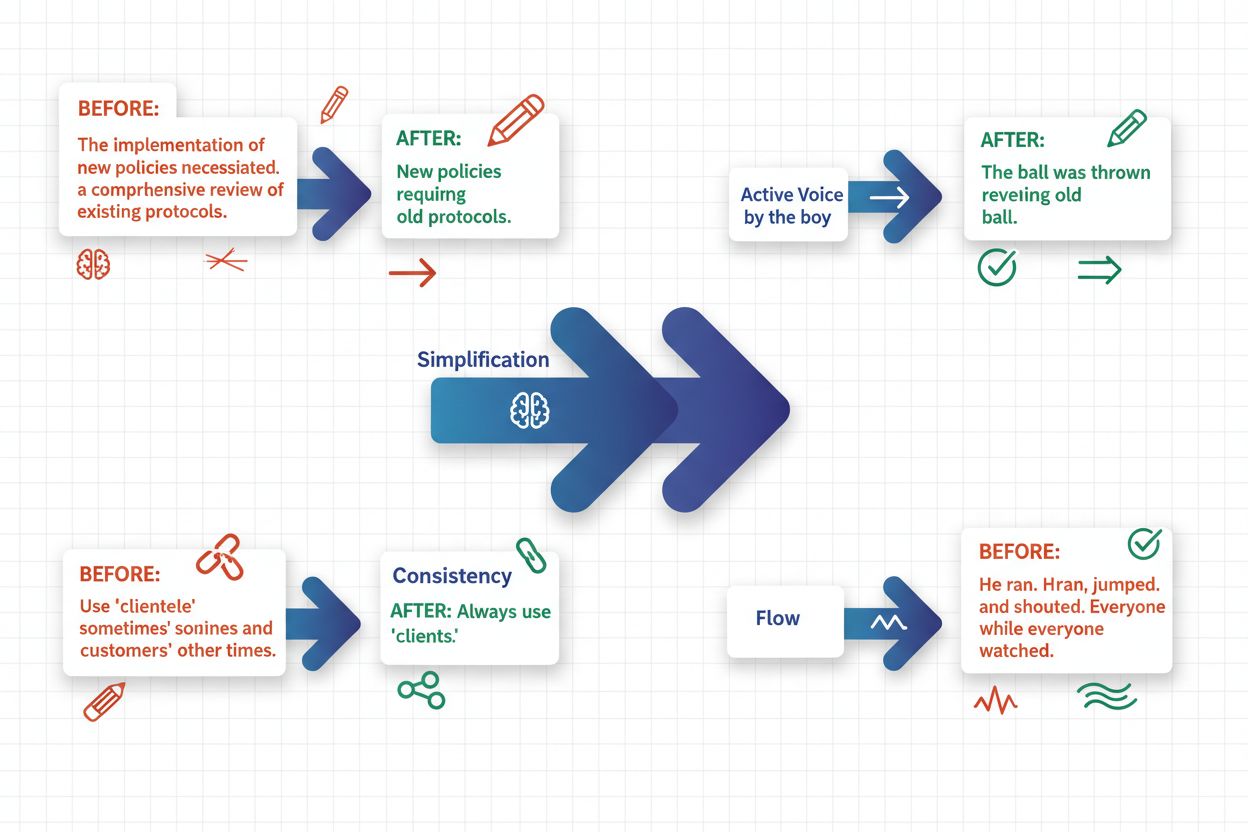
Fluency optimization applies across all content types, but manifests differently depending on format and purpose. In blog posts, fluency means maintaining a conversational tone while building logical arguments, using storytelling techniques to connect ideas, and ensuring each paragraph flows naturally into the next. For technical documentation, fluency involves using consistent terminology, clear step-by-step instructions with smooth transitions, and avoiding jargon unless absolutely necessary for the audience. Product descriptions benefit from fluent language that highlights benefits naturally rather than listing features in choppy bullet points; instead of “Fast. Reliable. Affordable,” write “This solution delivers fast performance without sacrificing reliability, all at an affordable price.” FAQ sections should use fluent question-and-answer pairs that anticipate how users naturally ask questions and provide answers that flow conversationally. How-to guides require fluency in instruction writing—each step should connect logically to the next, with clear transitions that help readers understand the overall process. Case studies need fluent narrative structure that tells a compelling story while maintaining clarity about the problem, solution, and results. Across all these formats, fluency optimization increases the likelihood that AI systems will select and cite your content, driving visibility in AI Overviews and similar features.
While fluency is somewhat subjective, you can measure and test it using several approaches. Readability scoring tools like Hemingway Editor and Grammarly provide quantitative feedback on sentence structure, word choice, and overall clarity—while not perfect measures of fluency, they highlight areas where your writing may feel choppy or unclear. AI readability checkers specifically designed for content optimization can assess how easily AI systems might process your text. Conduct manual testing by reading your content aloud and noting where you naturally pause, stumble, or feel the flow is disrupted—these are fluency problems. Ask beta readers or colleagues to read your content and provide feedback on whether it flows naturally and feels easy to follow; their instinctive reactions reveal fluency issues. Track AI citation rates over time—if your content is being cited more frequently in AI Overviews after optimization, that’s a strong indicator that your fluency improvements are working. Monitor engagement metrics like time on page and scroll depth; fluent content typically keeps readers engaged longer. Finally, use A/B testing by publishing two versions of similar content with different fluency levels and comparing which one gets selected more often by AI systems and generates more traffic.
Fluent content has a direct impact on your visibility in AI Overviews and other AI-powered search features because these systems prioritize content that is easy to extract and quote. When Google’s AI systems scan your content, they’re looking for passages that clearly answer user questions and can be presented confidently to searchers—fluent content makes this job easier. Content that flows naturally and maintains consistent terminology is more likely to be selected for inclusion because the AI can extract it with higher confidence, reducing the risk of misrepresentation. Studies of AI citation patterns show that well-written, fluent content receives more citations from AI systems than technically accurate but awkwardly written content on the same topic. This increased citation visibility drives referral traffic from AI Overviews, as users clicking on your cited content discover your full article. Additionally, fluent content tends to rank better in traditional search results as well, since the same factors that make content easy for AI to process also make it more valuable to human readers. By optimizing for fluency, you’re essentially making your content more “quotable” in the AI era—and quotability directly translates to visibility and traffic.
One of the most common fluency mistakes is inconsistent terminology, where you refer to the same concept using different terms throughout your content—this confuses both readers and AI systems about whether you’re discussing the same thing or introducing new concepts. Another frequent error is excessive use of passive voice, which creates distance between the subject and action, making sentences feel stiff and harder for AI to parse; replace “The report was completed by the team” with “The team completed the report.” Choppy, fragmented sentences that lack transitions create a disjointed reading experience; instead of “The system is fast. It’s reliable. It’s affordable,” write “The system delivers fast, reliable performance at an affordable price.” Avoid unnecessary jargon and complex terminology that obscures meaning—if you must use technical terms, define them clearly the first time. Abrupt topic shifts without transitional phrases disrupt fluency; always bridge between ideas with phrases like “In addition,” “However,” or “As a result.” Finally, over-reliance on complex sentence structures in an attempt to sound sophisticated often backfires, creating sentences that are hard to parse; remember that fluency prioritizes natural flow over impressive vocabulary. Identifying and correcting these mistakes is essential for creating content that both humans and AI systems find easy to read and extract from.
Several tools can help you optimize your content for fluency. Hemingway Editor highlights complex sentences, passive voice, and unclear phrasing in real-time, making it easy to identify and fix fluency problems as you write. Grammarly goes beyond grammar to assess readability and tone, offering suggestions for improving sentence structure and word choice. Yoast SEO includes readability analysis that, while focused on traditional SEO, provides useful feedback on sentence length and paragraph structure that impacts fluency. AI readability checkers specifically designed for content optimization can assess how easily AI systems process your text and suggest improvements. Natural language processing tools like those built into modern word processors can help identify awkward phrasing and suggest alternatives. Beyond automated tools, professional editing services and writing communities can provide human feedback on fluency that tools sometimes miss. The most effective approach combines automated tools for quick feedback with manual review and testing—use tools to catch obvious issues, then read your content aloud and test it with real readers to ensure it truly flows naturally and sounds right to human ears and AI systems alike.
Traditional SEO focuses on keyword placement, backlinks, and ranking in search engine results pages. Fluency optimization, by contrast, focuses on how naturally your content reads and flows, making it easier for AI systems to extract and cite your work. While traditional SEO optimizes for search engine algorithms, fluency optimization optimizes for AI language models that synthesize answers from multiple sources.
Yes, significantly. AI Overviews and similar features select content that is easy to extract and quote. Fluent content—with natural flow, consistent terminology, and clear transitions—is more likely to be selected for inclusion. Studies show that fluent content receives more citations from AI systems than technically accurate but awkwardly written content on the same topic.
Readability focuses on measurable factors like sentence length and word complexity, while fluency emphasizes natural flow and coherence. A sentence can be highly readable (short, simple words) yet lack fluency if it feels choppy. Conversely, a longer sentence can be fluent if it flows naturally. The most effective content combines both—it's simple enough to understand quickly and flows naturally enough that AI systems can confidently extract and cite it.
Read your content aloud—this immediately reveals awkward phrasing and unnatural rhythm. Use tools like Hemingway Editor and Grammarly for quantitative feedback. Ask beta readers for feedback on whether it flows naturally. Track AI citation rates over time; if your content is being cited more frequently in AI Overviews after optimization, that's a strong indicator that your fluency improvements are working.
Yes, fluency optimization applies across all content types—blog posts, technical documentation, product descriptions, FAQs, how-to guides, and case studies. However, it manifests differently depending on format and purpose. Blog posts need conversational flow, technical docs need consistent terminology, and product descriptions need natural benefit highlighting rather than choppy feature lists.
Common mistakes include inconsistent terminology (using different terms for the same concept), excessive passive voice, choppy fragmented sentences without transitions, unnecessary jargon, abrupt topic shifts without transitional phrases, and overly complex sentence structures. Identifying and correcting these mistakes is essential for creating content that both humans and AI systems find easy to read and extract from.
Fluent content has a direct impact on AI citation rates because AI systems prioritize content that is easy to extract and quote. When content flows naturally and maintains consistent terminology, AI can extract it with higher confidence, reducing the risk of misrepresentation. This increased confidence leads to more citations in AI Overviews and similar features, driving referral traffic to your content.
Yes, tools like Hemingway Editor, Grammarly, and AI readability checkers can help identify fluency problems and suggest improvements. However, the most effective approach combines automated tools for quick feedback with manual review. Use tools to catch obvious issues, then read your content aloud and test it with real readers to ensure it truly flows naturally and sounds right to both human ears and AI systems.
AmICited tracks how AI systems reference your brand across Google AI Overviews, ChatGPT, Perplexity, and other AI platforms. Optimize your content fluency and measure the impact on AI citations.
Master fluency optimization to create LLM-friendly content that gets cited more often. Learn how to write naturally flowing content that AI systems prefer to qu...

Learn AI Search Optimization strategies to improve brand visibility in ChatGPT, Google AI Overviews, and Perplexity. Optimize content for LLM citation and AI-po...
Learn how to write content optimized for AI search engines like ChatGPT and Perplexity while maintaining natural language. Discover best practices for AI visibi...
Cookie Consent
We use cookies to enhance your browsing experience and analyze our traffic. See our privacy policy.