
News SEO
News SEO is the specialized optimization of news articles for Google News and Top Stories. Learn ranking factors, best practices, and how to improve news visibi...
12 min read

Google News is a news aggregation service that automatically collects, organizes, and ranks news articles from thousands of publishers worldwide in real-time. It uses AI-powered algorithms to surface relevant, timely, and authoritative news content across multiple platforms including news.google.com, Google Search results, Google Discover, and mobile apps.
Google News is a news aggregation service that automatically collects, organizes, and ranks news articles from thousands of publishers worldwide in real-time. It uses AI-powered algorithms to surface relevant, timely, and authoritative news content across multiple platforms including news.google.com, Google Search results, Google Discover, and mobile apps.
Google News is an automated news aggregation service that collects, organizes, and ranks news articles from thousands of publishers worldwide in real-time. Launched in September 2002 as a response to increased global interest in news following the September 11 attacks, Google News has evolved into one of the world’s most influential news discovery platforms. The service uses sophisticated AI-powered algorithms to analyze millions of news stories across dozens of languages and automatically surface the most relevant, timely, and authoritative content to users. Unlike traditional news aggregators that rely on human editors to curate content, Google News operates through fully automated systems that evaluate hundreds of ranking signals to determine which articles appear in search results, the Google News app, Google Discover feeds, and the Top Stories carousel. The platform is available in 125 countries and 40 languages, making it a critical distribution channel for news publishers globally.
Google News was officially launched on September 22, 2002, during a period when global news consumption was at an all-time high. The service began as a simple news aggregator but has undergone significant transformations over two decades. In 2006, Google News became an official product after its successful beta phase. The most transformative moment came in 2018 when Google announced a “reimagined” AI-powered Google News that fundamentally changed how news is discovered and organized. This redesign introduced machine learning capabilities that could understand the relationships between people, places, and events within news stories, enabling the platform to synthesize information across multiple sources and create coherent storylines. The evolution reflects Google’s broader shift toward AI-driven content understanding and personalization. In 2019, Google announced that publishers would be automatically considered for Google News inclusion if they met certain technical and editorial requirements, eliminating the need for manual submission. More recently, Google has intensified focus on E-E-A-T signals (Experience, Expertise, Authoritativeness, and Trustworthiness) and original reporting, reflecting growing concerns about misinformation and content quality in the digital news ecosystem.
Google News operates through a sophisticated technical infrastructure that continuously crawls the web, identifies news content, and evaluates it against multiple ranking criteria. The system uses Googlebot-News, a specialized crawler that prioritizes news content and operates on much faster crawl cycles than standard web crawling—often revisiting news sites within minutes or hours rather than days. When a news article is published, Google’s systems analyze its content, metadata, publication date, author information, and publisher reputation to determine eligibility for inclusion in news-specific features. The platform then applies its ranking algorithms to decide where the article should appear relative to competing coverage of the same story. Google News uses a clustering algorithm that groups related articles from different publishers covering the same news event, allowing users to see multiple perspectives on a single story. The ranking system evaluates content freshness with extreme precision, understanding that a news article published five minutes ago may be more valuable than one published an hour earlier for breaking news queries. The platform also personalizes results based on user location, language preferences, browsing history, and explicitly followed topics or publishers, creating individualized news feeds that adapt to each user’s interests and behavior patterns.
| Feature | Google News | Apple News | Google Top Stories | |
|---|---|---|---|---|
| Curation Method | Fully automated AI algorithms | Mix of editorial + algorithms | User-curated + editorial | Automated algorithms |
| Discovery Method | Automatic crawling | Manual submission + partnerships | User-driven + editorial | Automatic crawling |
| Availability | 125 countries, 40 languages | iOS/macOS primarily | Web + mobile apps | Integrated in Google Search |
| Monetization | Free with ads | Free + premium subscription | Free + premium | Free with ads |
| Publisher Control | Limited (algorithmic ranking) | Editorial selection | User-driven visibility | Limited (algorithmic ranking) |
| Real-Time Updates | Minutes to hours | Hours to days | Variable | Minutes to hours |
| Personalization | High (interests + behavior) | High (subscriptions + reading) | High (user curation) | Medium (query-based) |
| Original Reporting Priority | Very high | High | Medium | Very high |
| E-E-A-T Emphasis | Critical ranking factor | Important for featured | Secondary | Critical ranking factor |
| Mobile Experience | Native app + web | Native app optimized | Native app optimized | Mobile-first design |
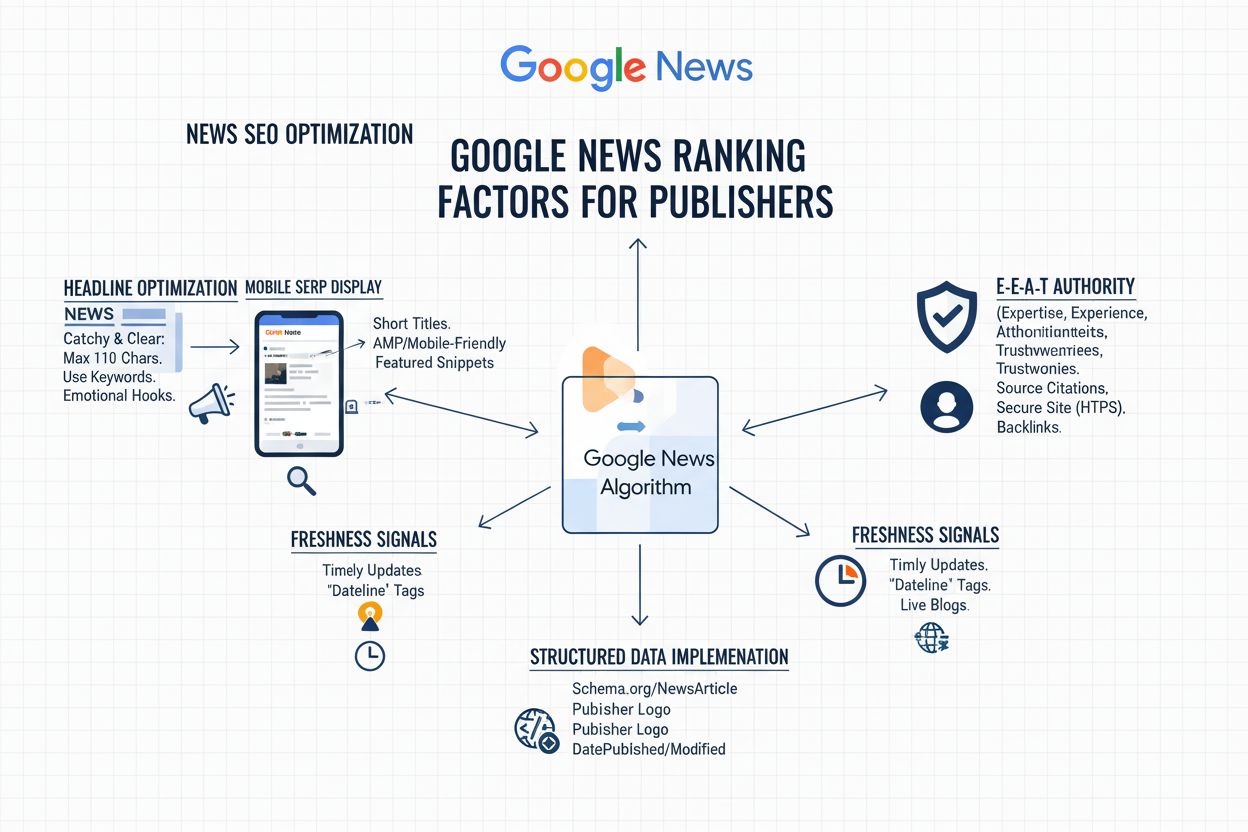
Google News employs seven primary ranking factors that determine which articles receive visibility and prominence across its platforms. Relevance is the foundational factor—articles must match user search queries, interests, and current news trends. Google’s algorithms use advanced natural language processing to understand not just keyword matches but semantic relevance, ensuring that articles addressing the user’s underlying information need appear prominently. Prominence identifies noteworthy news events by analyzing whether multiple publishers are covering a story and featuring it prominently on their sites. This factor helps Google distinguish between genuinely important news and niche stories, ensuring that major breaking news reaches users who care about it. Authoritativeness evaluates the credibility and reputation of both the publisher and individual authors. Google assesses signals such as whether other prominent websites link to the content, whether the publisher has a history of accurate reporting, and whether the author has demonstrated expertise in the topic area. Freshness prioritizes recently published content, with Google understanding that for breaking news, an article published minutes ago is more valuable than one published hours earlier. However, freshness is contextual—for evergreen news analysis, older articles may rank higher if they provide more comprehensive coverage. Usability examines whether articles are accessible and readable across devices, with particular emphasis on mobile optimization since the majority of news traffic comes from mobile devices. Location and language matching ensures that users see news relevant to their geographic region and preferred language. Finally, user interests personalize results based on browsing history, followed topics, and explicitly stated preferences, creating individualized news feeds that adapt to each person’s unique information needs.
Google News content appears across multiple platforms and surfaces, each with distinct characteristics and user behaviors. The Google News homepage (news.google.com) displays curated sections including “World,” “Local,” “Business,” “Technology,” and personalized “For You” sections. The Top Stories carousel appears at the top of Google Search results for trending or breaking news queries, providing prominent visibility for articles that match high-volume search intent. This carousel often drives the highest traffic volumes for news publishers because it appears above organic search results. The Google News app for Android and iOS provides a dedicated mobile experience with push notifications, offline reading, and personalized feeds. Google Discover surfaces news and content recommendations on the Google app homepage and Chrome’s new tab page, using machine learning to match content with user interests based on browsing history. The News tab in Google Search filters results to show only news content for informational queries, creating a dedicated vertical for news discovery. Additionally, Google Assistant and voice search devices deliver news through voice results, particularly for queries like “What’s the latest news?” or local news requests on smart speakers. Understanding these different surfaces is critical for publishers because ranking in one surface does not guarantee visibility in others—each has distinct ranking algorithms and user expectations.
Google News has increasingly emphasized E-E-A-T signals as core ranking factors, reflecting the platform’s commitment to surfacing trustworthy, authoritative content. Experience refers to the author’s firsthand knowledge or professional background in the topic area. A journalist covering healthcare policy should demonstrate medical knowledge or years of health reporting experience. Expertise requires that authors and publishers demonstrate specialized knowledge through credentials, education, or proven track records of accurate reporting. Authoritativeness extends beyond individual authors to evaluate publisher reputation, editorial standards, and recognition within the industry. Publishers must maintain transparent editorial policies, clear correction procedures, and differentiation between news and opinion content. Trustworthiness is demonstrated through transparent author information, accessible contact details, clear publication dates, and adherence to journalistic ethics. Google News algorithms evaluate these signals at both the article level and site level. Article-level E-E-A-T signals include bylined authors with dedicated author pages, clear publication and modification dates, and citations from authoritative sources. Site-level signals include an accessible About page detailing the publication’s mission, editorial standards, fact-checking processes, and correction policies. Publishers that fail to demonstrate E-E-A-T signals experience reduced visibility in Google News, particularly for sensitive topics like health, finance, or politics where accuracy and trustworthiness are paramount. The emphasis on E-E-A-T reflects Google’s response to misinformation concerns and its commitment to elevating reliable journalism in the news ecosystem.
Google News drives substantial referral traffic for news publishers, with research indicating that 20-35% of total organic traffic for many news sites originates from Google News and Top Stories features. This traffic is particularly valuable because it demonstrates higher engagement metrics than social media referrals—readers from Google News consume more articles per session, spend more time on site, and return more frequently. The quality of Google News traffic translates directly to business impact. Publishers appearing in the Top Stories carousel experience traffic spikes that can exceed 300-500% for individual articles, particularly for breaking news. Appearance in Google News and Top Stories also serves as a powerful brand authority signal, positioning publications as trusted sources within Google’s ecosystem. This visibility strengthens audience trust and accelerates brand recognition, particularly for emerging publishers building audience bases. For subscription-based news models, Google News readers convert to paid subscribers at significantly higher rates than general search traffic, making news optimization critical for revenue sustainability. The platform also enables publishers to reach audiences during peak search interest for developing events, announcements, and timely topics. However, publishers must balance traffic generation with editorial integrity—Google’s algorithms reward original reporting and penalize thin, syndicated content, incentivizing publishers to invest in quality journalism rather than content aggregation.
Publishers seeking to maximize visibility in Google News should implement a comprehensive optimization strategy addressing technical, editorial, and content quality dimensions. Publishing frequency and freshness are foundational—news sites should maintain consistent publishing schedules that signal active editorial operations to Google’s algorithms. Each article must include ISO 8601-formatted publication and modification timestamps visible both on the page and in structured data. Headline optimization requires descriptive, keyword-rich titles placed under 110 characters to prevent mobile truncation. Headlines should communicate the specific news event with entity names and numerical context rather than relying on curiosity gaps. Structured data implementation using NewsArticle schema provides explicit signals about article attributes, publication details, author information, and accessibility status. Site architecture should feature clear section pages for major news categories with automated inclusion of new articles, enabling multiple discovery paths. Author pages with professional biographies, credentials, and article archives strengthen E-E-A-T signals. Original reporting receives significant ranking priority—publishers should minimize reliance on unenhanced syndicated content and use canonical tags when republishing. Core Web Vitals optimization addresses page speed, interactivity, and visual stability, with particular emphasis on mobile performance since news traffic is predominantly mobile. Stable, crawlable URLs without parameters or session tokens ensure proper indexation and prevent deindexation from URL changes. Google Publisher Center verification provides official brand recognition and improved content categorization. News sitemaps submitted to Google Search Console accelerate discovery of articles published within the past 48 hours. These optimization strategies work synergistically to signal content quality, publisher authority, and user value to Google’s news ranking algorithms.
Google News has become a dominant force in news discovery globally, with significant implications for publishers and brand visibility. The platform processes millions of news articles daily across 125 countries and 40 languages, making it the world’s largest news aggregation service. Over 60% of users surveyed in 2016 reported trusting Google News over the same news directly from publishers, though this trust metric has evolved with changing attitudes toward technology and media. Google News drives an estimated 20-35% of total organic traffic for news publishers, with Top Stories carousel placements generating disproportionately high traffic volumes. The platform’s mobile app has been downloaded hundreds of millions of times, making it one of the most widely used news applications globally. Breaking news queries on Google Search trigger Top Stories carousels approximately 40% of the time, providing significant visibility opportunities for publishers covering developing events. Publishers in Google News experience higher engagement metrics than social media referrals, with readers spending more time on site and consuming more articles per session. The platform’s emphasis on freshness means that articles published within the first hour of a breaking news event receive significantly higher visibility than later coverage. Original reporting receives measurable ranking boosts, with Google’s algorithms identifying and prioritizing articles that break stories rather than republish existing coverage. These statistics underscore Google News’s critical importance in the modern news ecosystem and its substantial impact on publisher success.
In the evolving landscape of AI-powered search and content discovery, Google News visibility has become intertwined with broader brand monitoring strategies. As AI systems like ChatGPT, Perplexity, Claude, and Google AI Overviews increasingly serve as information sources, publishers and brands must track their presence across both traditional news platforms and emerging AI systems. Google News content frequently appears in AI-generated summaries and responses, making news optimization a component of comprehensive AI visibility strategies. Brands can monitor their Google News performance through Google Search Console’s News-specific reports, which provide impressions, clicks, and position data for news features. However, comprehensive brand monitoring requires tracking visibility across multiple platforms simultaneously. Tools like AmICited enable brands to monitor where and how their content appears in AI responses, including whether Google News articles are cited by AI systems. This integrated approach to monitoring helps brands understand their complete visibility picture—not just in traditional Google News, but across the broader ecosystem of AI-powered search and content discovery. As AI systems increasingly reference news content in their responses, the intersection of Google News optimization and AI visibility becomes increasingly important for brand protection and audience reach.
Google News continues to evolve in response to changing user behaviors, technological capabilities, and competitive pressures from AI-powered search platforms. The platform’s future direction emphasizes deeper AI integration for understanding complex news narratives, improved personalization based on user interests and behavior, and stronger E-E-A-T enforcement to combat misinformation. Google has signaled increased focus on original reporting, with algorithms increasingly rewarding publishers that break stories rather than republish existing coverage. The platform is also adapting to the rise of AI-powered search competitors like Perplexity and Claude, which aggregate news content in different ways. This competitive pressure may drive Google to enhance its news features’ distinctiveness and value proposition. The integration of Google News with Google AI Overviews represents a significant evolution, as AI-generated summaries increasingly incorporate news content in their responses. Publishers optimizing for Google News are simultaneously optimizing for potential inclusion in AI-generated summaries, creating a convergence between traditional news optimization and AI visibility strategies. The platform’s emphasis on mobile-first experiences will continue intensifying, with Google prioritizing news sites that deliver exceptional mobile performance. Additionally, Google’s commitment to supporting quality journalism through initiatives like the Google News Initiative suggests that the platform will continue rewarding publishers that invest in original reporting and editorial excellence. As the news ecosystem becomes increasingly fragmented across platforms and AI systems, Google News will likely remain a critical distribution channel for publishers while evolving to meet emerging user expectations and technological capabilities.
Google News is a dedicated vertical search engine accessible at news.google.com with personalized feeds and topic-specific sections. Google Top Stories is a carousel feature that appears at the top of Google Search results for trending or breaking news queries. While both use similar ranking algorithms, Top Stories surfaces on the main search results page, whereas Google News is a separate platform. Top Stories often includes both Google News and non-Google News sources, making it a broader news discovery feature.
Google News uses fully automated algorithms to discover, rank, and surface news without human editorial curation, while platforms like Apple News employ editorial teams to select featured stories. Google News emphasizes freshness, relevance, and publisher authority, whereas Apple News prioritizes premium content and curated collections. Google News is free and ad-supported, while Apple News offers both free and subscription tiers. Additionally, Google News integrates directly with Google Search and Discover, providing cross-platform visibility that traditional aggregators cannot match.
Google News discovery is fully automatic through Google's crawling technology. Publishers do not need to submit their sites to be eligible for inclusion. However, publishers can optimize their content for Google News by meeting technical requirements, publishing original content, and registering with Google Publisher Center for better brand presentation. Submitting a news-specific XML sitemap and implementing NewsArticle structured data accelerates discovery and indexation of time-sensitive content.
Google News ranks content based on seven primary factors: relevance to user queries and interests, prominence of the news story, authoritativeness of the publisher, freshness of the article, usability and mobile optimization, location and language matching, and user interests based on browsing history. Freshness is particularly critical for news, with Google prioritizing articles published within hours or minutes of breaking events. Original reporting and E-E-A-T signals also significantly influence ranking positions in Top Stories and news-specific features.
Google News drives substantial referral traffic for publishers, typically accounting for 20-35% of total organic traffic for news sites. Appearance in Google News and Top Stories positions publications as authoritative sources, strengthening audience trust and brand recognition. The high-quality traffic from news features demonstrates better engagement metrics than social media referrals, with readers consuming more content per session. For subscription-based models, Google News readers convert to paid subscribers at higher rates, making news optimization critical for revenue sustainability.
Google News uses advanced AI techniques to analyze millions of news stories in real-time, understanding the people, places, and things involved in each story as it evolves. The AI system synthesizes information across multiple sources to identify storylines and connect related coverage. Machine learning algorithms evaluate hundreds of ranking signals including content quality, publisher reputation, user engagement patterns, and topical relevance. This AI-powered approach enables Google News to deliver personalized, contextually relevant news feeds that adapt to individual user interests and behavior patterns.
Brands can monitor Google News visibility through Google Search Console's News-specific performance reports, which show impressions, clicks, and positions in news features. Google Publisher Center provides analytics on how content appears across Google News surfaces. For broader AI visibility monitoring, platforms like AmICited track brand mentions across AI systems including ChatGPT, Perplexity, Claude, and Google AI Overviews. These tools help brands understand where and how their content is cited in AI responses, enabling data-driven strategies to improve visibility across both traditional news and emerging AI search platforms.
Start tracking how AI chatbots mention your brand across ChatGPT, Perplexity, and other platforms. Get actionable insights to improve your AI presence.
News SEO is the specialized optimization of news articles for Google News and Top Stories. Learn ranking factors, best practices, and how to improve news visibi...

Learn what Google Discover is, how this AI-powered personalized content feed works, and how to optimize your content for visibility. Essential for publishers an...
Google Trends is a free analytics tool that measures search interest over time and location. Learn how it works, its applications in marketing, SEO, and AI moni...
Cookie Consent
We use cookies to enhance your browsing experience and analyze our traffic. See our privacy policy.