
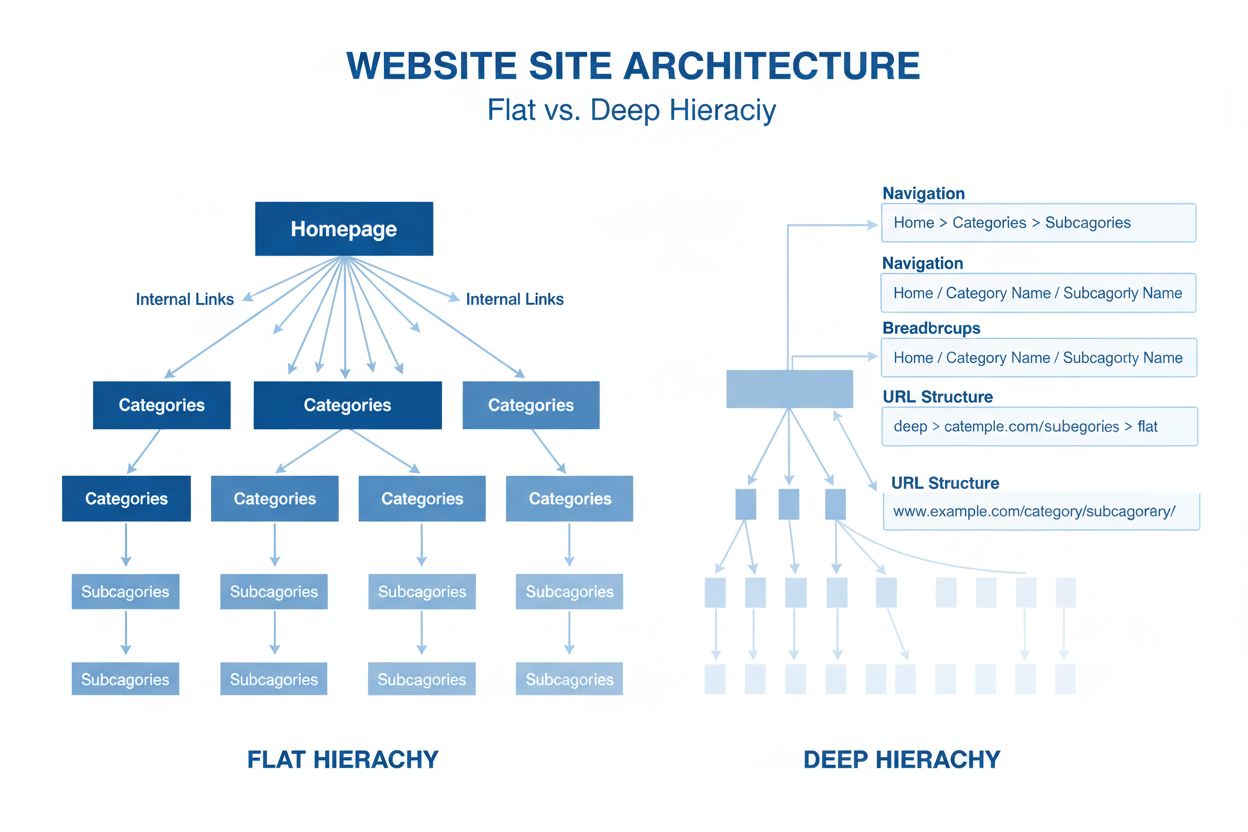
Site Architecture
Site architecture is the hierarchical organization of website pages and content. Learn how proper site structure improves SEO, user experience, and AI monitorin...
9 min read
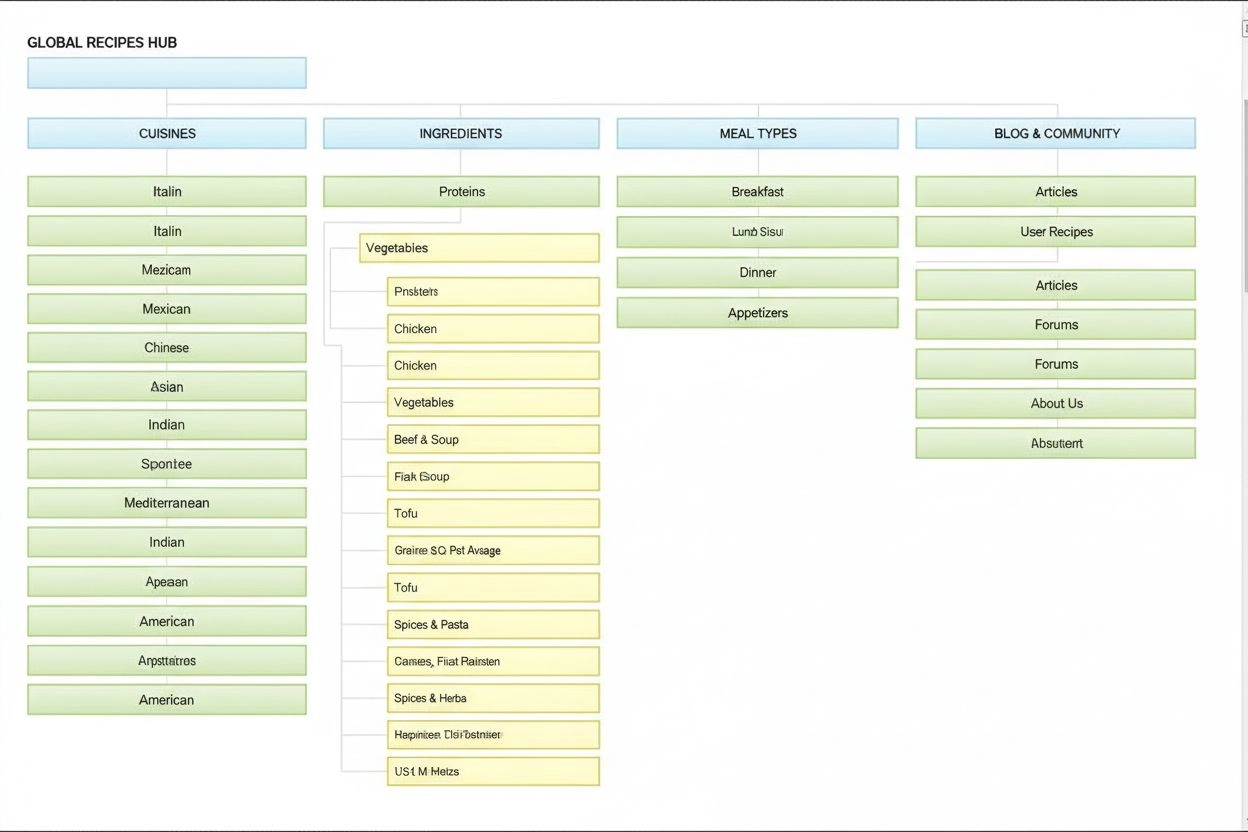
Information Architecture (IA) is the discipline of organizing, structuring, and labeling content and functionality within digital and physical environments to make information findable, understandable, and accessible to users. It encompasses the underlying organization systems, taxonomies, and relationships that inform how users navigate and interact with websites, applications, and other information environments.
Information Architecture (IA) is the discipline of organizing, structuring, and labeling content and functionality within digital and physical environments to make information findable, understandable, and accessible to users. It encompasses the underlying organization systems, taxonomies, and relationships that inform how users navigate and interact with websites, applications, and other information environments.
Information Architecture (IA) is the discipline of organizing, structuring, and labeling content and functionality within digital and physical environments to make information findable, understandable, and accessible to users. It represents the invisible backbone of websites, applications, and information systems—the underlying framework that determines how content is categorized, related, and presented. Unlike navigation, which is the visible interface users interact with, Information Architecture is the foundational structure documented in spreadsheets, diagrams, and sitemaps that informs all design decisions. The primary goal of IA is to reduce cognitive load, prevent user frustration, and enable users to find what they need quickly and intuitively. As the Interaction Design Foundation defines it, IA is fundamentally about making information findable and understandable, encompassing searching, browsing, categorizing, and presenting relevant and contextual information to help people understand their surroundings and locate what they’re seeking online and in physical spaces.
Information Architecture emerged as a formal discipline in the 1990s as the web expanded and websites became increasingly complex. Early pioneers like Louis Rosenfeld and Peter Morville, authors of the seminal work “Information Architecture for the World Wide Web,” established foundational principles that remain relevant today. The discipline evolved from library science and organizational psychology, recognizing that how information is structured profoundly impacts human behavior and decision-making. In the early days of the web, many sites were built without deliberate IA, resulting in confusing navigation and poor user experiences. As e-commerce and digital services grew, organizations realized that poor Information Architecture directly impacted revenue—studies showed that 70% of online businesses failed due to inadequate usability. Today, IA is recognized as essential to UX design, with research demonstrating that every dollar invested in UX (which includes IA) returns approximately $100 in value. The discipline has expanded beyond websites to encompass mobile applications, voice interfaces, and AI-driven systems, making it more critical than ever for digital success.
Information Architecture comprises four essential components that work together to create coherent, user-friendly experiences. Organization Systems classify information into logical categories using hierarchical structures (organized by importance), sequential structures (organized by steps or logic), or matrix structures (organized by individual user needs). Labeling Systems establish clear, concise naming conventions for content and navigation elements—for example, using “About” instead of vague terms like “Learn More”—ensuring users understand what they’ll find before clicking. Navigation Systems provide the mechanisms through which users move through content, including global navigation bars, breadcrumb trails, local navigation menus, pagination, and related links. Search Systems empower users with direct control by allowing them to enter keywords and retrieve information from various parts of a site or application. These four components are interdependent; a well-designed organization system means nothing if labels are confusing, and excellent navigation becomes ineffective if the underlying structure is illogical. Together, they create the framework that enables users to navigate intuitively and discover information efficiently.
| Concept | Definition | Focus | Visibility | Timing |
|---|---|---|---|---|
| Information Architecture | Underlying structure and organization of content and functionality | How content is organized, categorized, and related | Invisible (documented in diagrams) | Defined before design begins |
| Navigation | User interface elements that allow movement through content | How users interact with and move through the structure | Visible on screen (menus, breadcrumbs, links) | Designed after IA is established |
| Content Strategy | Planning, creation, delivery, and governance of content | What content is created and how it’s managed over time | Visible in published content | Developed alongside IA |
| User Experience (UX) | Overall feel and satisfaction of user interaction | How users perceive and interact with entire product | Holistic and multifaceted | Encompasses all design aspects |
| Taxonomy | Standardized naming convention and classification system | How items are named and grouped consistently | Partially visible in labels and categories | Developed as part of IA |
| Sitemap | Visual representation of site structure | How pages and content relate hierarchically | Visible as diagram or XML file | Created to document IA |
Information Architecture is guided by several foundational principles that ensure structures serve user needs. The Object Principle recognizes that each piece of content is unique and dynamic, with its own lifecycle—some content may be retired while other content grows in importance. The Choice Principle emphasizes limiting user options to prevent cognitive overload; instead of presenting every possible choice at once, IA should guide users through logical progressions. The Disclosure Principle dictates that only necessary information should be presented at each step, with additional details available through progressive disclosure. The Exemplar Principle suggests providing examples to clarify complex material, helping users understand abstract concepts through concrete instances. The Front Door Principle acknowledges that users enter sites from multiple entry points, not just the homepage, so IA must support navigation from any page. The Multiple Classifications Principle provides multiple ways to find information—breadcrumbs, top navigation, related links—accommodating different user preferences. The Focused Navigation Principle ensures consistency across the site, so users develop reliable mental models. Finally, the Growth Principle designs IA to scale as content expands, preventing the structure from becoming unwieldy as the site grows.
In the emerging landscape of AI-driven search and content discovery, Information Architecture plays an increasingly critical role. AI systems like ChatGPT, Perplexity, Google AI Overviews, and Claude rely on understanding content structure and relationships to generate accurate, contextual responses. Well-organized IA with clear taxonomy, logical hierarchies, and descriptive metadata helps AI models better comprehend your content’s meaning and context. When your information is properly structured, AI systems can more easily identify your brand, domain, and URLs as authoritative sources on specific topics. This is particularly important for brand visibility in AI responses—platforms like AmICited track how often your content appears in AI-generated answers. Poor IA can result in your content being overlooked or misrepresented by AI systems, while excellent IA increases the likelihood that your information will be cited and properly attributed. As AI becomes the primary discovery mechanism for many users, ensuring your Information Architecture is optimized for both human users and AI systems is essential for maintaining brand visibility and authority in the digital landscape.
Creating effective Information Architecture requires a systematic, user-centered approach. Begin with user research to understand how your audience seeks information, what tasks they need to accomplish, and what mental models they bring to your domain. Conduct a content inventory to identify all existing content and functionality, then perform a content audit to evaluate usefulness, accuracy, and effectiveness. Next, engage in information grouping, organizing content into logical categories based on user needs rather than internal organizational structure. Develop a taxonomy—a standardized naming convention applied consistently across all content—ensuring that labels are clear, concise, and match user expectations. Create descriptive metadata that enables discovery through related links and search functionality. Validate your IA through card sorting (where users organize content into categories) and tree testing (where users attempt to find specific items within your proposed structure). Use wireframes to visualize how the IA translates into page layouts, and develop personas representing your target audience to ensure the IA serves their needs. Throughout this process, prioritize content by popularity and importance, ensuring that frequently-needed information is easily accessible while less common content is still findable but not cluttering primary navigation.
The business case for investing in Information Architecture is compelling and well-documented. Research demonstrates that for every dollar invested in UX design (which includes IA), companies receive approximately $100 in return—a 9,900% ROI. Staples increased its online revenue by 500% following a UX-focused site redesign that included IA improvements. Companies that prioritize design have outperformed the S&P 500 by 211% over a decade. Beyond revenue, Information Architecture directly impacts user retention: 88% of users won’t return to a website after a poor user experience, often caused by confusing organization. Well-designed IA can increase conversion rates by up to 400%, reduce customer support costs by 25%, and improve user satisfaction scores by 33%. Mobile users are particularly sensitive to poor IA—53% will abandon a site that takes more than 3 seconds to load, and 90% of smartphone users will continue shopping if they have a great experience. In e-commerce specifically, businesses lose 35% of sales due to bad UX, translating to roughly $1.4 trillion in lost revenue globally. These metrics underscore that Information Architecture is not a luxury or nice-to-have feature—it’s a fundamental business requirement that directly impacts revenue, customer loyalty, and competitive advantage.
Information Architecture principles apply across diverse contexts, though implementation varies based on platform constraints and user behavior. For desktop websites, IA can accommodate deeper hierarchies (typically 4-5 levels) and more complex navigation patterns like mega-menus and left-side vertical navigation. For mobile applications, IA must be simplified significantly—limiting depth to 3-4 levels, reducing the number of links per page to under 10, and ensuring all interactive elements are at least 30 pixels for easy tapping. E-commerce IA requires special attention to product categorization, filtering, and faceted navigation to help users narrow choices efficiently. Content-heavy sites like news organizations or knowledge bases benefit from multiple classification systems and robust search functionality. SaaS applications often use task-based IA, organizing features around user workflows rather than technical categories. Voice interfaces and conversational AI require IA that supports natural language understanding and context-aware responses. Intranet IA must balance organizational structure with user needs, often requiring audience-based navigation to serve different employee groups. Regardless of context, the fundamental principle remains: Information Architecture must be designed around user needs, mental models, and tasks rather than internal organizational preferences.
Information Architecture continues to evolve in response to emerging technologies and changing user behaviors. AI and machine learning are increasingly influencing IA design, with AI-powered recommendation systems and personalization engines reshaping how content is organized and presented. Voice search and conversational interfaces are driving new IA approaches that accommodate natural language queries rather than traditional keyword-based navigation. Omnichannel experiences require IA that works seamlessly across web, mobile, voice, and physical touchpoints, maintaining consistency while adapting to platform constraints. Accessibility and inclusive design are becoming non-negotiable aspects of IA, with 15% of the global population living with disabilities and 71% of users leaving sites that are hard to navigate for people with disabilities. Personalization is pushing IA toward dynamic structures that adapt to individual user preferences and behaviors. Content management systems are becoming more sophisticated, enabling IA that can scale and adapt as content grows. The rise of AI-driven search and content discovery means IA must now serve both human users and AI systems, requiring structures that are simultaneously intuitive for humans and machine-readable for AI. As the digital landscape continues to evolve, Information Architecture will remain central to creating experiences that are findable, understandable, and valuable to users across all platforms and contexts.
Effective Information Architecture must be validated through rigorous research and measurement. Card sorting studies reveal how users naturally categorize information, providing empirical data to inform IA decisions. Tree testing allows designers to evaluate whether users can find specific items within a proposed structure before full implementation. Usability testing with real users uncovers friction points and reveals where IA assumptions don’t match user expectations. Analytics data provides insights into user behavior—high bounce rates, low engagement, or unexpected navigation patterns often indicate IA problems. Search analytics show what users are looking for and whether they’re finding it, revealing gaps in organization or labeling. User interviews and surveys gather qualitative feedback about whether users find the structure intuitive and whether labels match their mental models. A/B testing can compare different IA approaches to determine which performs better. Research shows that 85% of users report that user research improved their product’s usability, and 58% saw increased customer satisfaction after conducting user research. Companies that conduct usability testing see 135% better performance metrics. These validation methods ensure that Information Architecture decisions are grounded in evidence rather than assumptions, resulting in structures that genuinely serve user needs and drive business results.
Information Architecture (IA) is the underlying structure and organization of content, while Navigation is the visible user interface elements that allow users to move through that structure. IA is the invisible backbone documented in spreadsheets and diagrams, whereas Navigation is what users actually see and interact with on the screen. IA informs Navigation design, but they are distinct concepts—IA must be defined first before navigation components can be effectively designed.
Information Architecture significantly enhances user experience by reducing cognitive load and preventing user frustration. When content is logically organized and properly labeled, users can find information quickly and intuitively. Research shows that 88% of users won't return to a website after a poor user experience, often caused by confusing organization. Well-designed IA improves findability, increases engagement, and can boost conversion rates by up to 400%, making it essential for digital success.
The four main components of IA are: Organization Systems (how information is categorized—hierarchical, sequential, or matrix-based), Labeling Systems (clear naming conventions for content and navigation), Navigation Systems (methods for moving through content like breadcrumbs and menus), and Search Systems (tools allowing users to find specific information). These components work together to create a cohesive, user-friendly experience that ensures users can locate information efficiently.
Information Architecture impacts how AI systems crawl, index, and understand digital content. Well-structured IA with clear taxonomy and labeling helps AI models better comprehend content relationships and context, improving how your information appears in AI-generated responses. For platforms like ChatGPT, Perplexity, and Google AI Overviews, proper IA ensures your content is discoverable and properly contextualized, which is critical for brand visibility in AI search results.
Card sorting is one of the most popular IA research methods, where users organize content into categories that make sense to them, revealing their mental models. Tree testing allows designers to validate proposed IA structures by testing if users can find key items. User research, usability testing, and content audits also provide valuable insights. These methods ensure IA aligns with user expectations rather than designer assumptions, resulting in more intuitive and effective structures.
Dan Brown's eight principles are: Object Principle (content is unique and dynamic), Choice Principle (limit user options to prevent overload), Disclosure Principle (present only necessary information), Exemplar Principle (provide examples for clarity), Front Door Principle (account for multiple entry points), Multiple Classifications Principle (provide multiple navigation paths), Focused Navigation Principle (maintain consistency), and Growth Principle (design for scalability). These principles guide the creation of robust, user-centered information architectures.
Information Architecture directly impacts business performance—for every dollar invested in UX design (which includes IA), companies see a return of up to $100, representing a 9,900% ROI. Poor IA causes 70% of online businesses to fail due to inadequate usability. Well-designed IA can increase conversion rates by up to 400%, reduce support costs by 25%, and improve user satisfaction scores by 33%. Companies that prioritize design have outperformed the S&P 500 by 211% over a decade.
Mobile IA requires similar foundational principles to desktop but with important adaptations. Mobile users have smaller screens, less patience, and different contexts, so IA must prioritize essential content and minimize navigation depth. Mobile IA should limit categories to fewer than 5 levels, keep links to under 10 per page, and ensure tap-friendly navigation elements (minimum 30 pixels). Content should be focused and simplified, with clear breadcrumbs and explicit back buttons to aid navigation in the constrained mobile environment.
Start tracking how AI chatbots mention your brand across ChatGPT, Perplexity, and other platforms. Get actionable insights to improve your AI presence.
Site architecture is the hierarchical organization of website pages and content. Learn how proper site structure improves SEO, user experience, and AI monitorin...
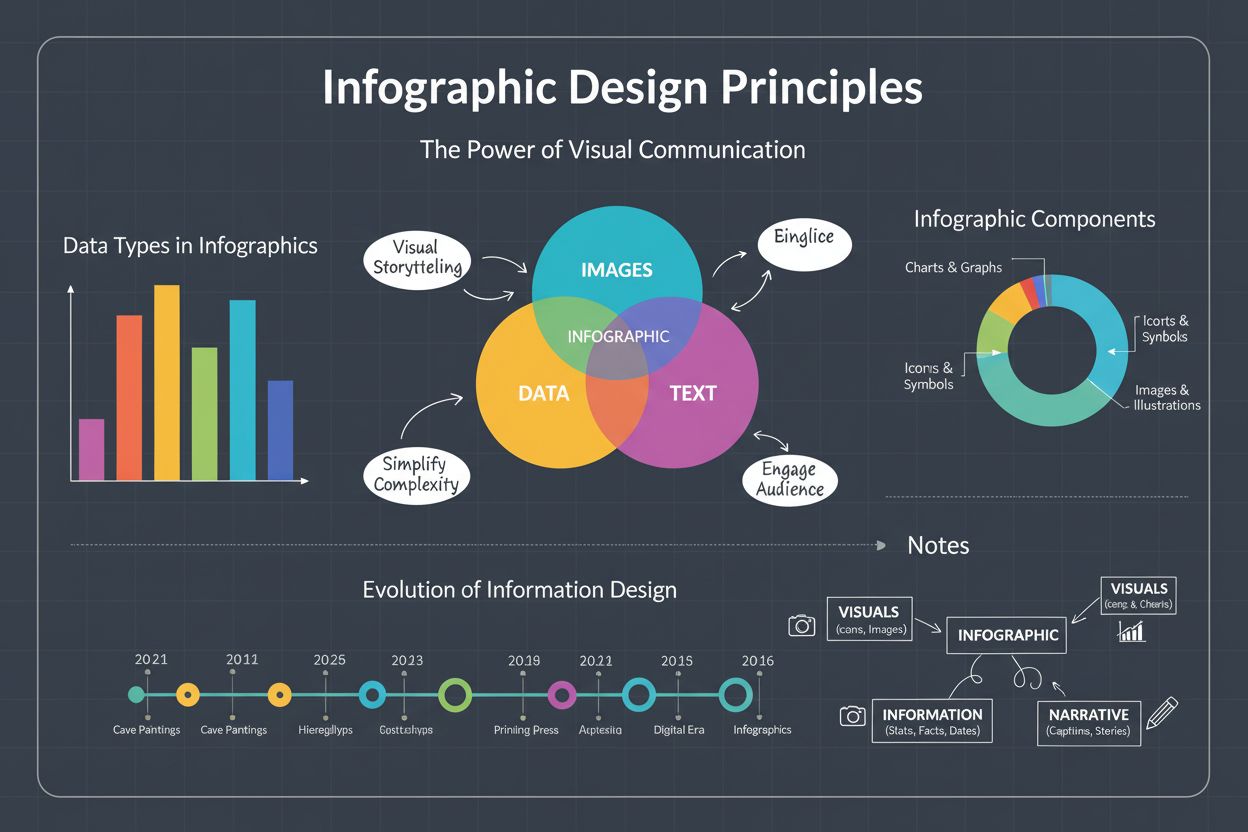
Infographic definition: visual representation combining images, charts, and text to present data clearly. Learn types, design principles, and business impact fo...
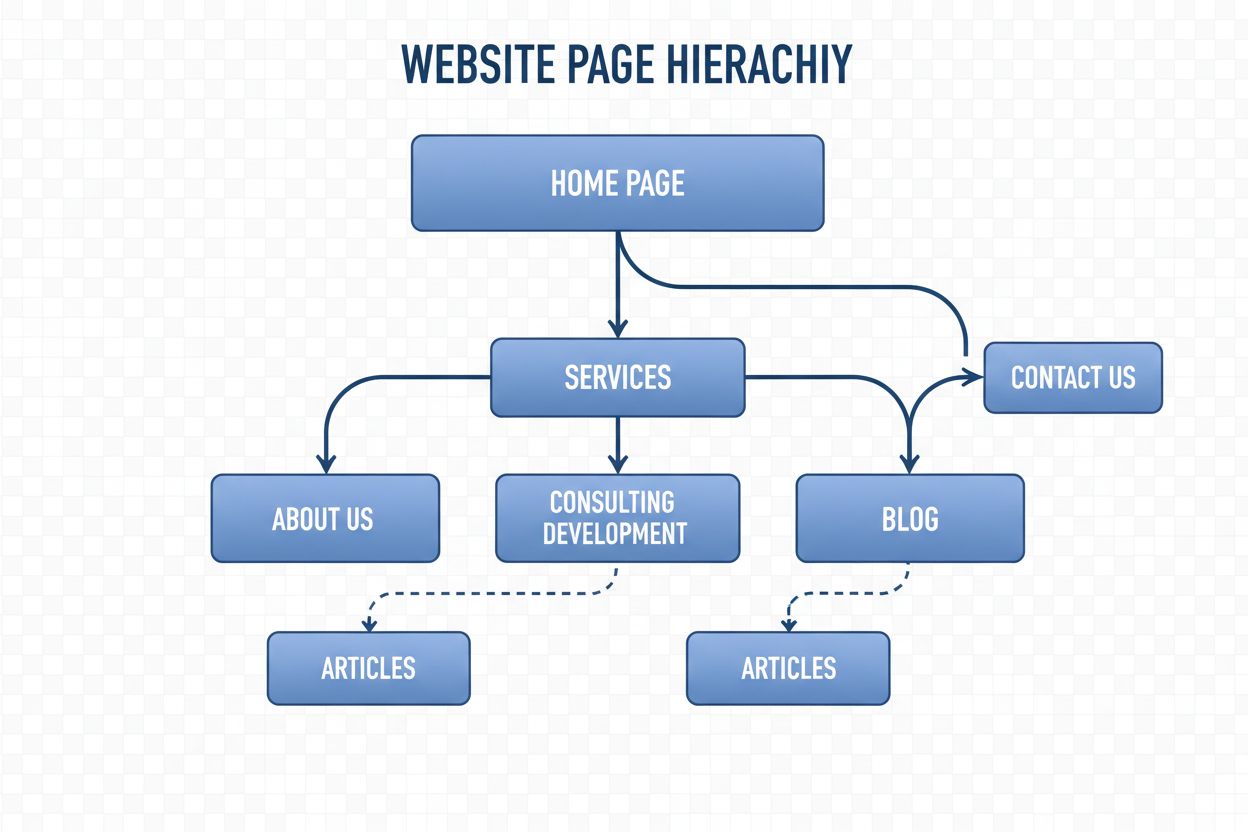
Navigation structure is the system organizing website pages and links to guide users and AI crawlers. Learn how it affects SEO, user experience, and AI indexing...
Cookie Consent
We use cookies to enhance your browsing experience and analyze our traffic. See our privacy policy.