
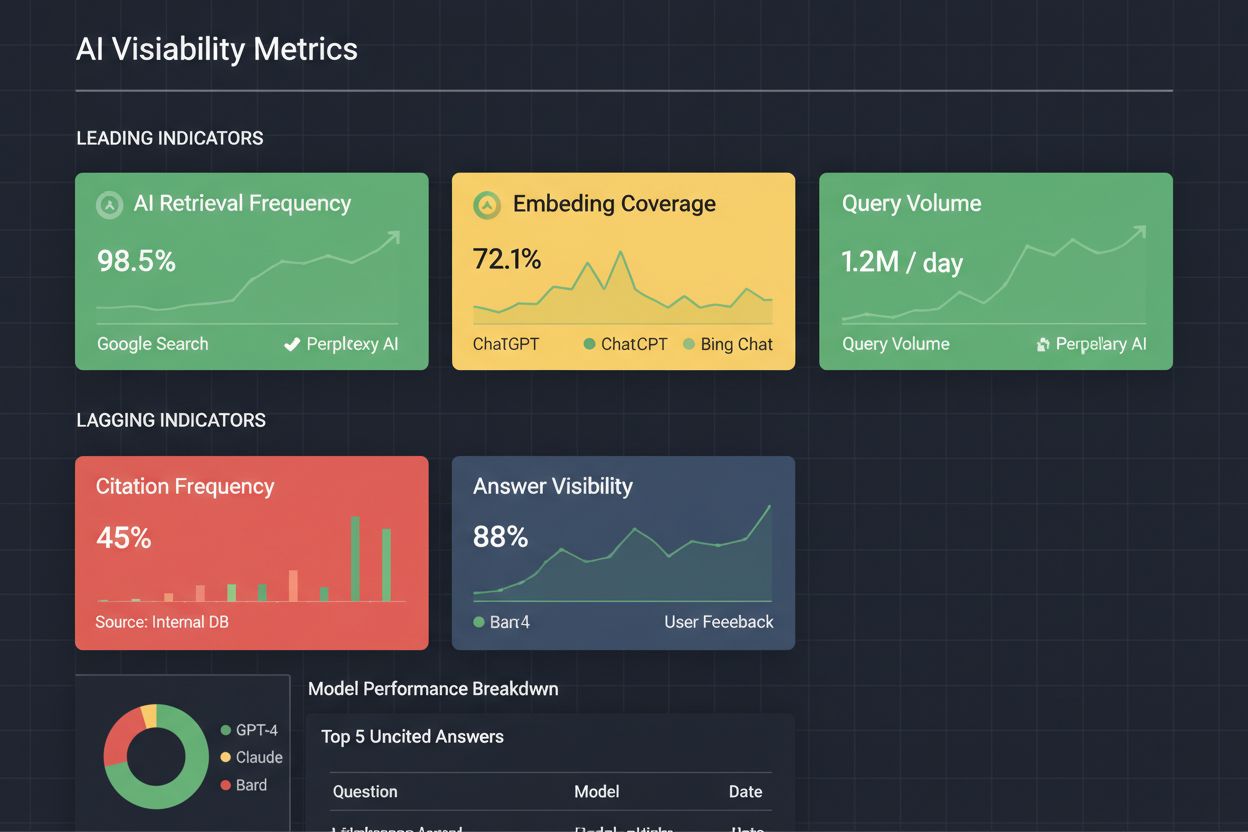
Leading vs Lagging AI Visibility Indicators
Learn the difference between leading and lagging AI visibility indicators. Discover which metrics predict future AI citations and which prove actual impact on y...
8 min read
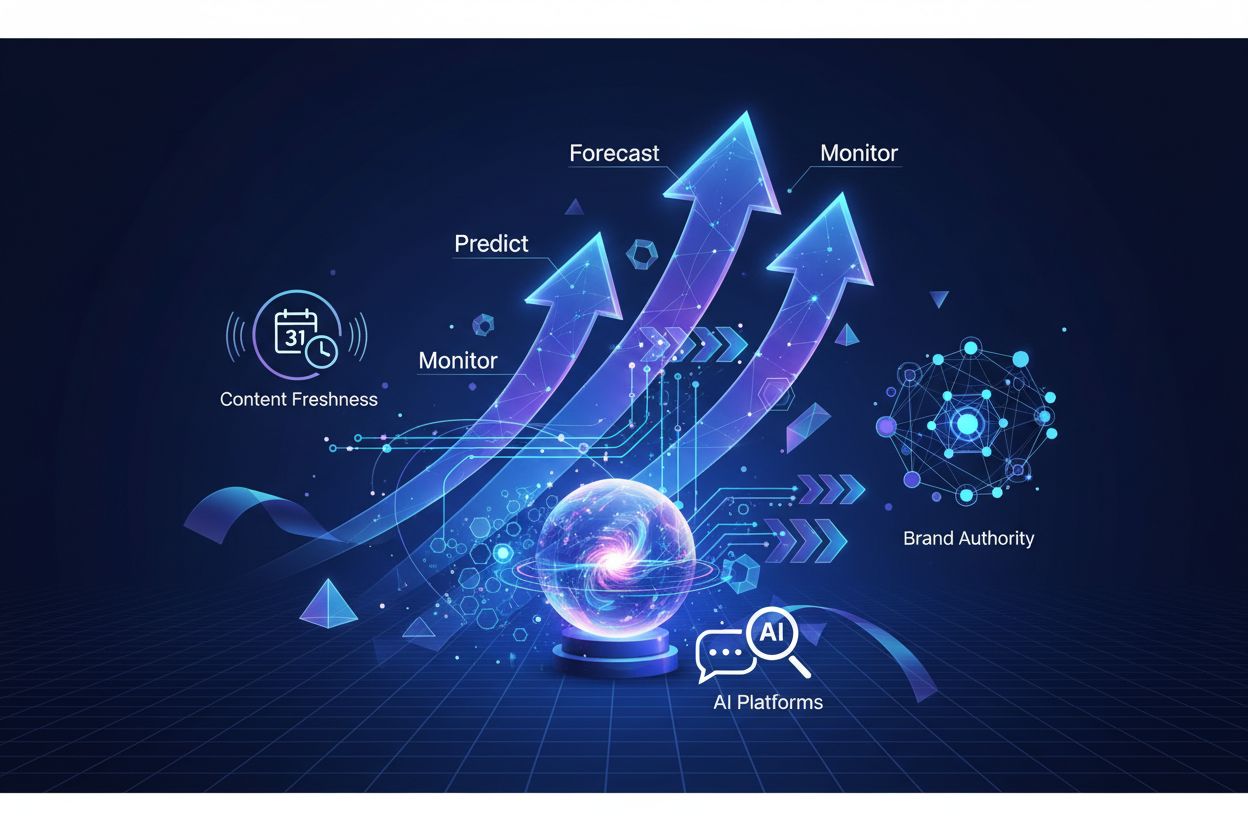
Predictive metrics such as content freshness and source authority that forecast future AI visibility changes before they appear in citation volume. These forward-looking signals enable proactive optimization of content strategy across AI platforms like ChatGPT, Perplexity, and Google AI Overviews. Leading indicators differ from traditional SEO metrics by measuring early signals that correlate with increased AI citations rather than historical performance. Understanding these indicators transforms content strategy from reactive to data-driven prediction.
Predictive metrics such as content freshness and source authority that forecast future AI visibility changes before they appear in citation volume. These forward-looking signals enable proactive optimization of content strategy across AI platforms like ChatGPT, Perplexity, and Google AI Overviews. Leading indicators differ from traditional SEO metrics by measuring early signals that correlate with increased AI citations rather than historical performance. Understanding these indicators transforms content strategy from reactive to data-driven prediction.
Leading AI indicators represent measurable signals that predict future citation performance in AI-powered search systems before traditional metrics reflect the impact. Unlike traditional SEO metrics that measure historical performance—such as rankings and traffic—leading indicators forecast how content will perform across AI platforms like ChatGPT, Perplexity, and Google AI Overviews. These forward-looking signals enable publishers to optimize content strategy proactively rather than reactively. The distinction matters because AI citation patterns differ fundamentally from organic search behavior, requiring new measurement frameworks. Leading indicators capture the early signals that correlate with increased AI citations, allowing teams to identify optimization opportunities before they manifest in citation volume. Understanding these indicators transforms content strategy from guesswork into data-driven prediction, providing competitive advantage in the rapidly evolving AI search landscape.
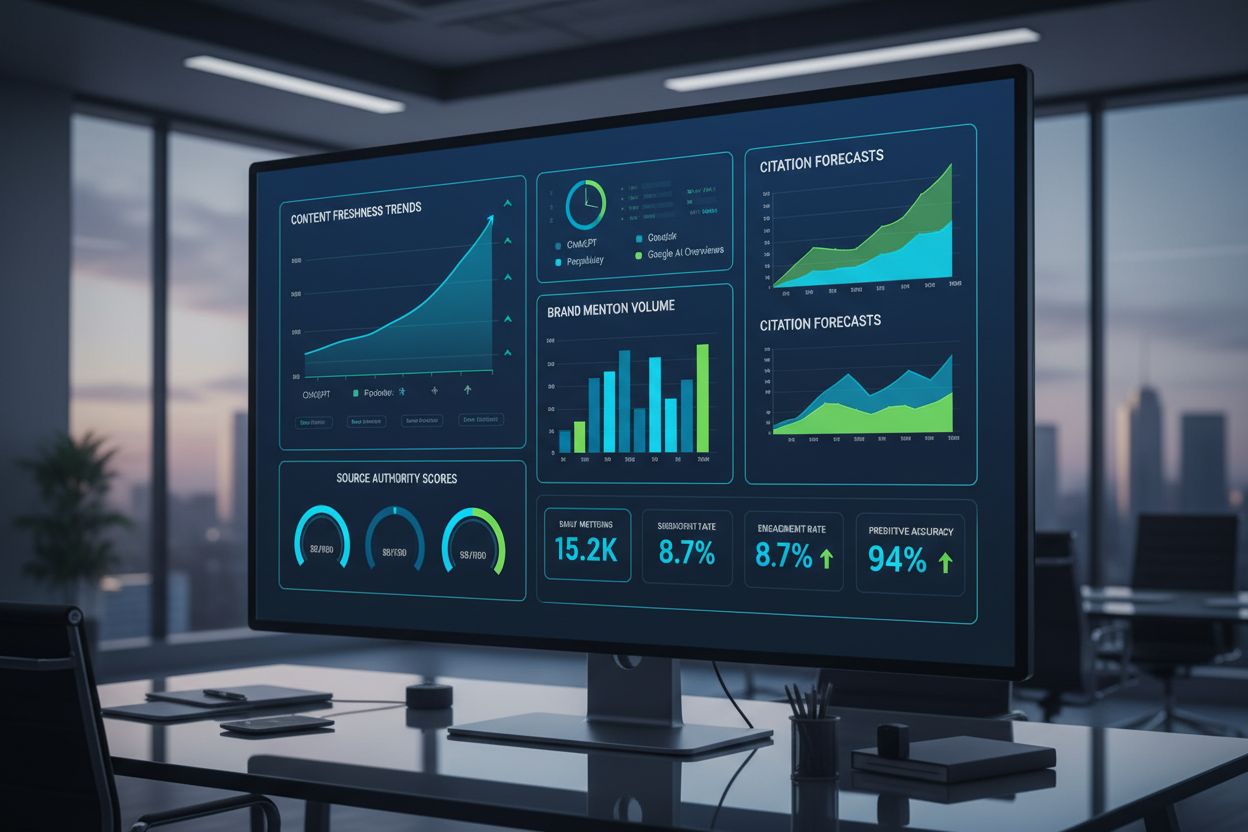
Content freshness demonstrates a 76.4% correlation with increased AI citations, making it one of the strongest predictive signals available. AI systems prioritize recently updated content because it signals relevance, accuracy, and active maintenance—factors that build trust in generated responses. Time decay functions embedded in AI ranking algorithms mean that older content receives exponentially fewer citations unless actively refreshed. Publishers who maintain regular update cadences see predictable increases in AI citation rates within 14-30 days of publishing updates. Freshness operates as a leading indicator because AI systems evaluate update timestamps before deciding whether to include content in responses. Monitoring content age and implementing systematic refresh schedules directly predicts citation performance across all major AI platforms.
| Platform | Freshness Impact | Update Frequency Optimal | Citation Lift (30 days) |
|---|---|---|---|
| ChatGPT | High (76.4%) | Weekly-Monthly | 34-42% |
| Perplexity | Very High | 2-3x Weekly | 48-56% |
| Google AI Overviews | High | Weekly | 28-35% |
Source authority demonstrates a 0.664 correlation with AI citations, compared to 0.218 for traditional backlink metrics, representing a fundamental paradigm shift in how AI systems evaluate credibility. AI platforms weight third-party brand mentions, press coverage, and domain authority signals more heavily than traditional search engines because these signals resist manipulation. The presence of your brand across authoritative publications, news outlets, and industry databases directly predicts citation inclusion in AI responses. Building authority requires strategic placement in high-authority sources rather than accumulating numerous low-quality backlinks. Third-party validation through mentions in established publications creates a halo effect that AI systems recognize and reward with increased citations.
Key Authority Signals:
Predictive scoring frameworks quantify leading indicator strength by establishing baseline cohorts of 50-200 similar content pieces and measuring signal correlation with citation outcomes. These frameworks combine multiple leading indicators—freshness, authority, technical accessibility, and platform presence—into composite scores that forecast citation performance. Baseline cohorts provide statistical validity by controlling for content type, topic, and publication date, isolating the impact of specific signals. The methodology tracks leading indicators over 60-90 day windows, then correlates those measurements with subsequent citation volume to establish predictive power. Frameworks that incorporate 8-12 leading indicators typically achieve 0.71-0.84 correlation with actual citation outcomes. AmICited.com implements proprietary predictive scoring that updates daily, enabling real-time identification of content optimization opportunities before citation impact materializes.
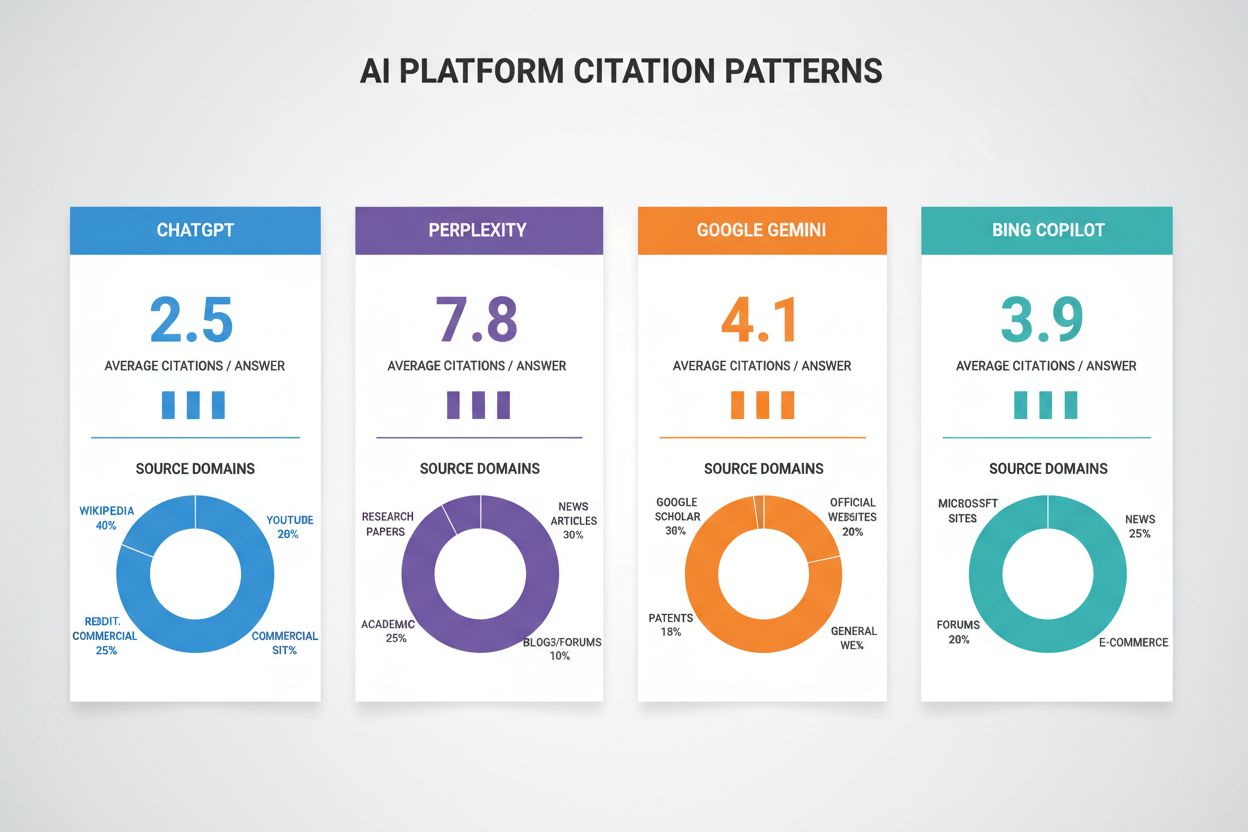
Platform-specific citation rates reveal distinct patterns across AI systems, with Perplexity averaging 6.61 citations per article, ChatGPT averaging 2.62 citations, and Gemini averaging 6.1 citations. These variations reflect different ranking algorithms, training data recency, and citation inclusion policies across platforms. Tracking citation rates by platform serves as a leading indicator because changes in platform-specific performance predict shifts in overall AI visibility. Content that gains citations on Perplexity typically shows increased ChatGPT citations 7-14 days later, suggesting platform-specific signals influence broader AI adoption. Monitoring platform-specific indicators enables targeted optimization—content performing well on Perplexity but poorly on ChatGPT requires different freshness or authority adjustments. Multi-surface tracking reveals which optimization strategies drive results on specific platforms, informing resource allocation decisions.
| Platform | Avg Citations/Article | Citation Velocity | Authority Weight | Freshness Weight |
|---|---|---|---|---|
| Perplexity | 6.61 | High (2-3 days) | 58% | 42% |
| ChatGPT | 2.62 | Medium (5-7 days) | 52% | 48% |
| Gemini | 6.1 | High (3-4 days) | 61% | 39% |
| Bing Copilot | 4.2 | Medium (4-6 days) | 55% | 45% |
JavaScript rendering capability, page speed, and schema markup implementation function as leading indicators because AI crawlers evaluate technical accessibility before deciding whether to include content in responses. Content requiring heavy JavaScript processing receives fewer citations because AI systems prioritize easily parseable HTML content that loads quickly. Page speed below 2.5 seconds correlates with 25.7% higher citation rates, indicating that AI systems reward technically optimized content. Schema markup implementation—particularly for articles, authors, and publication dates—provides AI systems with structured data that increases citation likelihood. Technical signals operate as leading indicators because they determine whether AI systems can effectively crawl, parse, and understand content before citation decisions occur. Monitoring Core Web Vitals, JavaScript dependencies, and schema completeness predicts citation performance 14-21 days before impact appears in citation metrics.
Effective leading indicator monitoring requires daily measurement of 8-12 signals across your content portfolio, tracked through dedicated dashboards that surface optimization opportunities. AmICited.com provides comprehensive leading indicator tracking, measuring freshness, authority, technical accessibility, and platform-specific signals in real-time. Monitoring cadence should occur daily for high-priority content and weekly for broader portfolio analysis, enabling rapid response to signal degradation. Tools like Semrush, Ahrefs, Zipitie, Rankscale, and SE Ranking each measure subsets of leading indicators, though AmICited.com integrates all signals into unified predictive scores. Establishing baseline measurements for your content portfolio enables identification of underperforming content that requires optimization. Regular monitoring reveals which leading indicators drive citations for your specific content type and audience, enabling continuous strategy refinement.
| Tool | Freshness Tracking | Authority Signals | Technical Metrics | AI Citation Data | Predictive Scoring |
|---|---|---|---|---|---|
| Semrush | Yes | Partial | Yes | No | No |
| Ahrefs | Yes | Yes | Partial | No | No |
| Zipitie | Yes | Yes | Yes | Yes | Partial |
| Rankscale | Yes | Yes | Yes | Yes | Yes |
| SE Ranking | Partial | Yes | Yes | No | No |
| AmICited.com | Yes | Yes | Yes | Yes | Yes |
Leading indicators predict future citation performance, while lagging metrics measure historical results—a critical distinction that determines whether strategy remains reactive or becomes proactive. Citation volume represents a lagging metric because it reflects decisions made by AI systems weeks or months earlier based on leading indicator signals. Ranking position functions as a lagging metric in traditional SEO but increasingly serves as a leading indicator for AI citations because AI ranking changes precede citation volume changes. Successful content strategy requires monitoring both leading and lagging metrics: leading indicators guide optimization decisions, while lagging metrics validate that leading indicator improvements translate into business results. Teams that focus exclusively on lagging metrics respond to problems after they occur, while teams monitoring leading indicators prevent problems by addressing signal degradation before citation impact materializes. The combination of leading and lagging metrics creates a complete performance picture that enables both strategic optimization and tactical response.
Implementing leading indicator strategy requires systematic measurement, continuous optimization, and regular strategy refinement based on signal performance. Start by establishing baseline measurements of all leading indicators across your content portfolio, identifying which signals correlate most strongly with citations for your specific content type. Prioritize content optimization based on leading indicator gaps—content with low freshness scores receives immediate refresh priority, while content with weak authority signals requires strategic placement in high-authority publications. Automate leading indicator monitoring through AmICited.com’s daily tracking and FlowHunt.io’s workflow automation, enabling rapid identification of optimization opportunities without manual analysis. Implement a content refresh calendar that maintains optimal freshness across your portfolio, with update frequency determined by content type and competitive landscape. Establish authority-building initiatives that generate third-party brand mentions and press coverage, recognizing that authority signals require 30-60 days to impact citation rates. Monitor platform-specific indicators to identify which optimization strategies drive results on Perplexity, ChatGPT, and Gemini, enabling targeted resource allocation. Conduct monthly leading indicator reviews that compare signal performance against citation outcomes, refining your understanding of which signals drive results for your specific content. Test optimization hypotheses systematically—modify one leading indicator at a time, measure the impact over 14-30 days, and scale successful changes across your portfolio. Establish quarterly strategy reviews that assess overall leading indicator performance, identify emerging signals, and adjust optimization priorities based on evolving AI platform behavior.
Implementation Steps:
Leading indicators predict future citation performance before it occurs, while lagging indicators measure historical results. For example, content freshness is a leading indicator that predicts citation increases 14-30 days later, while citation volume is a lagging metric that reflects decisions made weeks earlier. Successful strategy requires monitoring both: leading indicators guide optimization decisions, while lagging metrics validate that improvements translate into business results.
Monitor leading indicators daily for high-priority content and weekly for broader portfolio analysis. Daily monitoring enables rapid response to signal degradation, while weekly reviews identify broader trends. Most teams establish automated dashboards that track 8-12 leading indicators continuously, with manual reviews occurring weekly or monthly to identify optimization opportunities and validate that leading indicator improvements correlate with citation increases.
Content freshness demonstrates the strongest correlation with AI citations at 76.4%, making it the highest-impact leading indicator. However, the relative importance varies by content type and platform. Authority signals (0.664 correlation) rank second, while technical accessibility and platform-specific signals provide additional predictive power. Most effective strategies monitor all leading indicators together rather than focusing on a single signal.
Measure content freshness by tracking the time elapsed since last update and comparing it against optimal refresh frequencies for your content type. Most AI systems apply time decay functions that progressively reduce citation likelihood for content older than 30 days. Monitor publication dates and last-modified timestamps in your content metadata, establish refresh calendars based on content type, and measure citation changes 14-30 days after updates to validate freshness impact.
AmICited.com provides the most comprehensive leading indicator tracking, measuring freshness, authority, technical accessibility, and platform-specific signals in unified predictive scores. Complementary tools include Semrush (freshness and technical metrics), Ahrefs (authority signals), Zipitie (multi-signal tracking), Rankscale (predictive scoring), and SE Ranking (technical metrics). Most teams combine AmICited.com's AI-specific monitoring with broader SEO tools to capture complete leading indicator performance.
Brand mentions demonstrate 0.664 correlation with AI citations, compared to 0.218 for backlinks, because AI systems weight third-party validation as a credibility signal. When your brand appears in authoritative publications, news outlets, and industry databases, AI systems recognize this as evidence of expertise and authority. These mentions typically impact citation rates 30-60 days after publication, making brand mention volume a leading indicator of future citation performance. Tracking brand mentions across publications predicts citation increases before they appear in AI responses.
Yes, leading indicators enable traffic forecasting by predicting citation increases 14-30 days before they occur. By monitoring freshness, authority, and technical signals, you can identify which content will receive increased citations and estimate traffic impact based on historical citation-to-traffic conversion rates. Establish baseline conversion rates (citations to clicks) for your content type, then use leading indicator improvements to forecast traffic changes. This enables proactive resource allocation and content planning based on predicted AI visibility changes.
Different AI platforms weight leading indicators differently: Perplexity emphasizes freshness (42% weight) and authority (58%), while ChatGPT weights authority (52%) and freshness (48%) more equally. Gemini prioritizes authority (61%) over freshness (39%), while Bing Copilot balances both at 55% and 45%. Platform-specific indicator tracking reveals which optimization strategies drive results on each platform, enabling targeted optimization. Content performing well on Perplexity typically shows increased ChatGPT citations 7-14 days later, suggesting platform-specific signals influence broader AI adoption.
Track content freshness, source authority, and predictive signals in real-time to forecast AI citation performance before it happens. AmICited.com provides comprehensive leading indicator monitoring across ChatGPT, Perplexity, and Google AI Overviews.
Learn the difference between leading and lagging AI visibility indicators. Discover which metrics predict future AI citations and which prove actual impact on y...

Learn how AI systems evaluate and rank sources for citations. Discover the 7 core ranking signals including authority, freshness, relevance, and E-E-A-T that de...
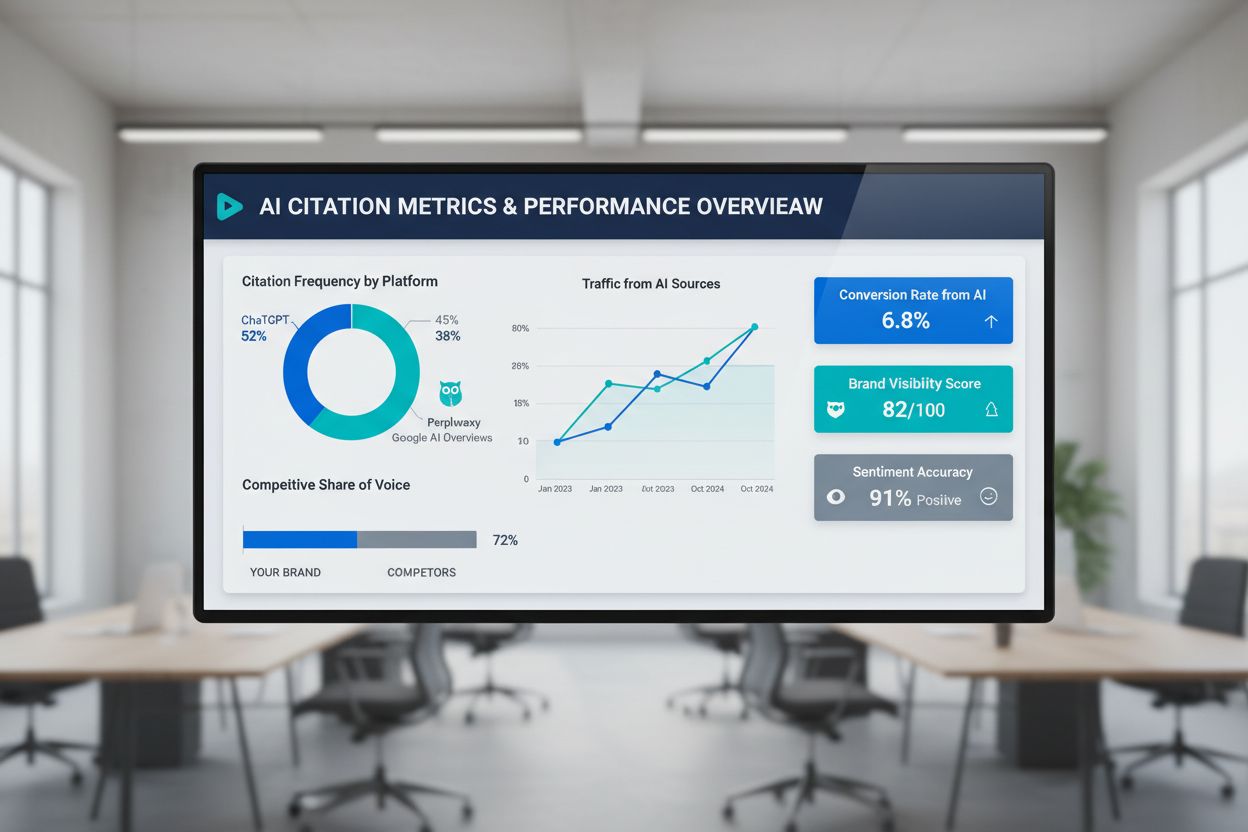
Learn what lagging AI indicators are, how they differ from leading indicators, and why tracking actual citations, AI traffic, and conversions is essential for m...
Cookie Consent
We use cookies to enhance your browsing experience and analyze our traffic. See our privacy policy.