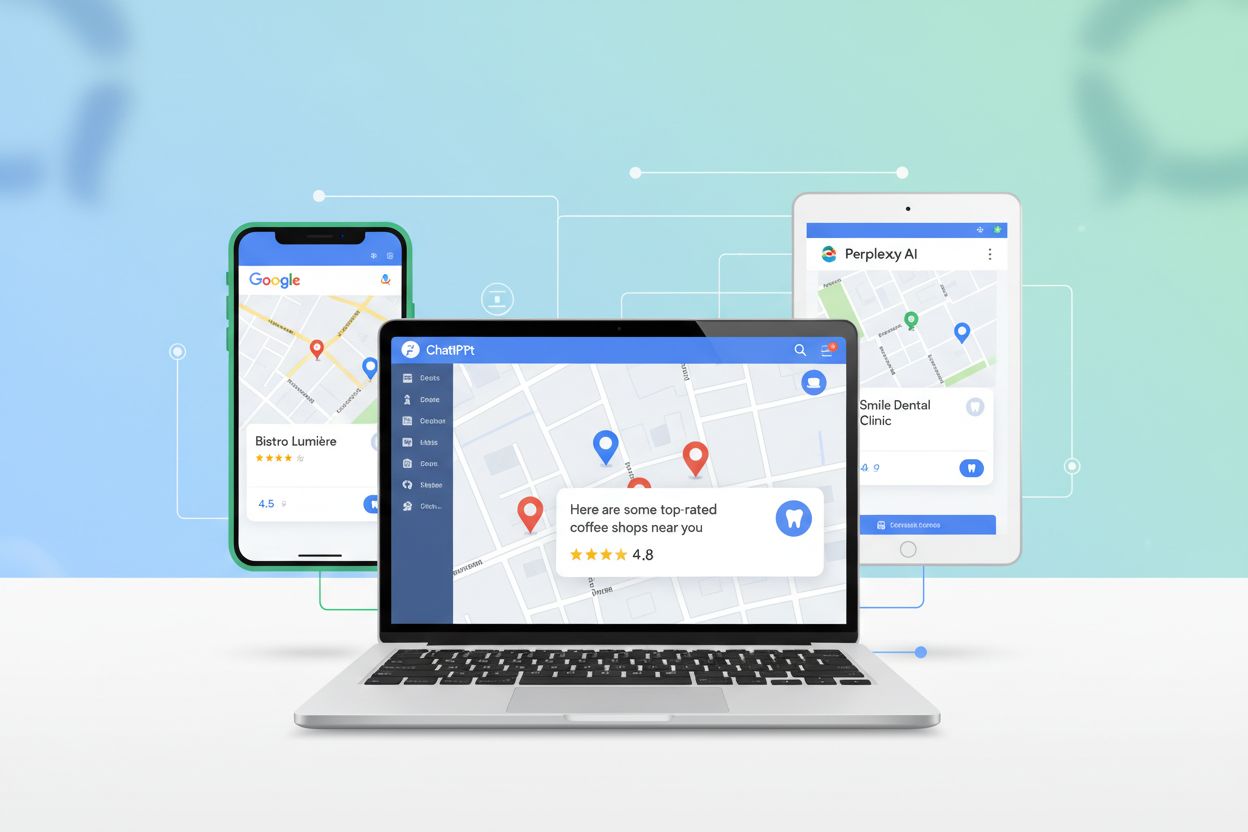
Local Business AI Visibility refers to the prominence and discoverability of a business within generative AI systems and AI-powered search platforms such as ChatGPT, Google AI Overviews, Gemini, and Perplexity. It encompasses how frequently and favorably a business appears in AI-generated recommendations and location-based discovery results across multiple generative engines. Unlike traditional local SEO, AI visibility prioritizes entity data quality, trust signals, and cross-platform presence over traditional link-based authority metrics. As AI adoption accelerates with 84% of decision-makers basing purchasing decisions on AI’s first suggestion, optimizing for AI visibility has become essential for local business competitiveness.
Local Business AI Visibility
Local Business AI Visibility refers to the prominence and discoverability of a business within generative AI systems and AI-powered search platforms such as ChatGPT, Google AI Overviews, Gemini, and Perplexity. It encompasses how frequently and favorably a business appears in AI-generated recommendations and location-based discovery results across multiple generative engines. Unlike traditional local SEO, AI visibility prioritizes entity data quality, trust signals, and cross-platform presence over traditional link-based authority metrics. As AI adoption accelerates with 84% of decision-makers basing purchasing decisions on AI's first suggestion, optimizing for AI visibility has become essential for local business competitiveness.
What is Local Business AI Visibility?
Local Business AI Visibility refers to the prominence and discoverability of a business within generative AI systems and AI-powered search platforms such as ChatGPT, Google AI Overviews, Gemini, and Perplexity. Unlike traditional local SEO, which focuses on ranking within Google’s organic search results, AI visibility encompasses how frequently and favorably a business appears in AI-generated recommendations and location-based discovery results across multiple generative engines. This distinction matters significantly because AI systems employ fundamentally different ranking mechanisms than conventional search algorithms, prioritizing entity data quality, trust signals, and cross-platform presence over traditional link-based authority metrics. As AI adoption accelerates—with 84% of decision-makers now basing purchasing decisions on AI’s first suggestion—businesses that optimize for AI visibility gain a critical competitive advantage in capturing local customer attention before traditional search results even appear.
How AI Systems Decide Which Local Businesses to Recommend
AI systems determine which local businesses to recommend through a sophisticated evaluation of entity data integrity, trust signal aggregation, and multi-source validation that differs markedly from traditional SEO approaches. These systems analyze structured business information across hundreds of data sources, cross-referencing NAP consistency (Name, Address, Phone), review patterns, citation quality, and location-specific content to establish business credibility and relevance. The following comparison illustrates how AI-era visibility signals diverge from traditional local SEO priorities:
Signal Type
Traditional Local SEO
AI-Era Visibility
Primary Authority
Backlinks & Domain Authority
Entity Data Quality & Trust Signals
Review Importance
Ranking Factor
Content Generation & Recommendation Driver
Structured Data
Optional Enhancement
Critical for Entity Recognition
Citation Consistency
Moderate Impact
Essential for Entity Validation
Multi-Platform Presence
Secondary Consideration
Primary Visibility Determinant
AI systems weight LocalBusiness schema implementation, knowledge graph completeness, and cross-platform review consistency as primary ranking factors, while simultaneously analyzing review sentiment, attribute extraction, and response patterns to assess business reliability and customer satisfaction levels.
Key Factors That Influence AI Local Recommendations
Several critical elements determine whether a business receives favorable AI recommendations across generative platforms:
Review Quality and Volume: AI systems analyze not just review quantity but semantic content, sentiment patterns, and attribute mentions; businesses with 50+ reviews across multiple platforms receive significantly higher recommendation frequency
NAP Consistency: Identical Name, Address, and Phone number across Google Business Profile, Yelp, Apple Maps, and industry-specific directories is essential for entity recognition and trust scoring
Location-Specific Content: Dedicated location pages with geo-targeted keywords, local event mentions, and community-relevant information signal authentic local presence to AI systems
On-Page Proof Signals: Testimonials, case studies, local certifications, and location-specific imagery provide first-party validation that AI systems prioritize over third-party claims
Platform Diversity: Presence across Google Business Profile, Yelp, Apple Maps, Facebook, LinkedIn, and industry directories increases the likelihood of AI system discovery and recommendation
Review Response Strategy: Timely, substantive responses to reviews demonstrate active business management and customer commitment, factors that AI systems weight heavily in recommendation algorithms
The Role of Reviews and Social Proof in AI Visibility
Review signals function as the primary content source and trust indicator for AI systems evaluating local businesses, with AI engines analyzing review text far beyond simple star ratings to extract nuanced business attributes and customer sentiment patterns. Modern AI systems employ sentiment analysis algorithms that evaluate not only whether reviews are positive or negative but also identify specific business dimensions mentioned—service quality, pricing fairness, staff professionalism, cleanliness, wait times—and aggregate these attributes into comprehensive business profiles. This attribute extraction process allows AI systems to match customer intent with business strengths; when a user asks ChatGPT for a “friendly neighborhood restaurant with outdoor seating,” the system references extracted attributes from hundreds of reviews rather than relying on business-provided descriptions. Cross-platform review consistency strengthens trust scoring significantly; when a business receives similar praise across Google, Yelp, and Apple Maps, AI systems interpret this as authentic customer feedback rather than potentially manipulated single-platform reviews. First-party testimonials and video reviews carry additional weight because they provide direct evidence of customer satisfaction and business legitimacy, factors that AI systems increasingly prioritize as they refine recommendation accuracy. The integration of review signals into AI recommendation engines means that businesses with strong, consistent, attribute-rich review profiles receive substantially higher visibility across all major generative platforms.
Optimizing Location Pages for AI Visibility
Location pages represent the foundational content asset for AI visibility, requiring implementation of comprehensive structured data markup using LocalBusiness schema to ensure AI systems can accurately parse and understand business information. The Location Page 2.0 concept extends beyond basic business hours and contact information to include intent-matched content that addresses specific local search queries—“best Italian restaurant near downtown,” “emergency plumber open now,” “family-friendly dentist accepting new patients”—with location-specific answers that demonstrate local expertise and relevance. Effective location pages incorporate GEO optimization through natural inclusion of neighborhood names, local landmarks, community events, and area-specific service details that signal authentic local presence to AI systems; for example, a dental practice might reference “serving patients in the Midtown district since 2015” or “conveniently located near the Central Park subway station.” Structured data implementation should follow this format: {"@context": "https://schema.org", "@type": "LocalBusiness", "name": "Business Name", "address": {"@type": "PostalAddress", "streetAddress": "123 Main St", "addressLocality": "City", "postalCode": "12345"}, "telephone": "+1-555-0123"} to ensure proper entity recognition. UX optimization for location pages includes mobile responsiveness, fast load times, clear call-to-action buttons, and intuitive navigation that reduces bounce rates and signals quality to AI evaluation systems. Location pages that combine comprehensive structured data, intent-matched local content, and optimized user experience receive substantially higher recommendation frequency across ChatGPT, Google AI Overviews, Gemini, and Perplexity.
Multi-Platform AI Visibility Strategy
A comprehensive multi-platform AI visibility strategy requires simultaneous optimization across distinct generative engines, each employing different ranking mechanisms and data sources while maintaining consistent business information across all platforms. Google AI Overviews prioritize Google Business Profile data, local reviews, and Google-indexed content, making Google Business Profile optimization and review generation critical for this platform; businesses should ensure complete profile information, high-quality photos, and regular posts to maximize Google AI visibility. ChatGPT relies on training data and web-indexed content, favoring businesses with strong website presence, consistent citations, and comprehensive structured data that web crawlers can easily parse and understand. Gemini integrates Google’s knowledge graph with broader web data, requiring both Google Business Profile optimization and authoritative third-party mentions across industry directories and review platforms. Perplexity emphasizes source diversity and citation quality, recommending businesses that appear across multiple authoritative sources with consistent information and strong review profiles. Apple Intelligence and emerging AI platforms increasingly reference Apple Maps data and Apple-indexed content, making presence on Apple Maps and optimization for Apple’s ecosystem increasingly important for comprehensive AI visibility. Maintaining citation consistency across all platforms—identical business name, address, phone number, and business category—ensures that AI systems recognize these as references to the same entity rather than separate businesses, significantly amplifying visibility across all generative engines.
Measuring and Monitoring AI Local Visibility
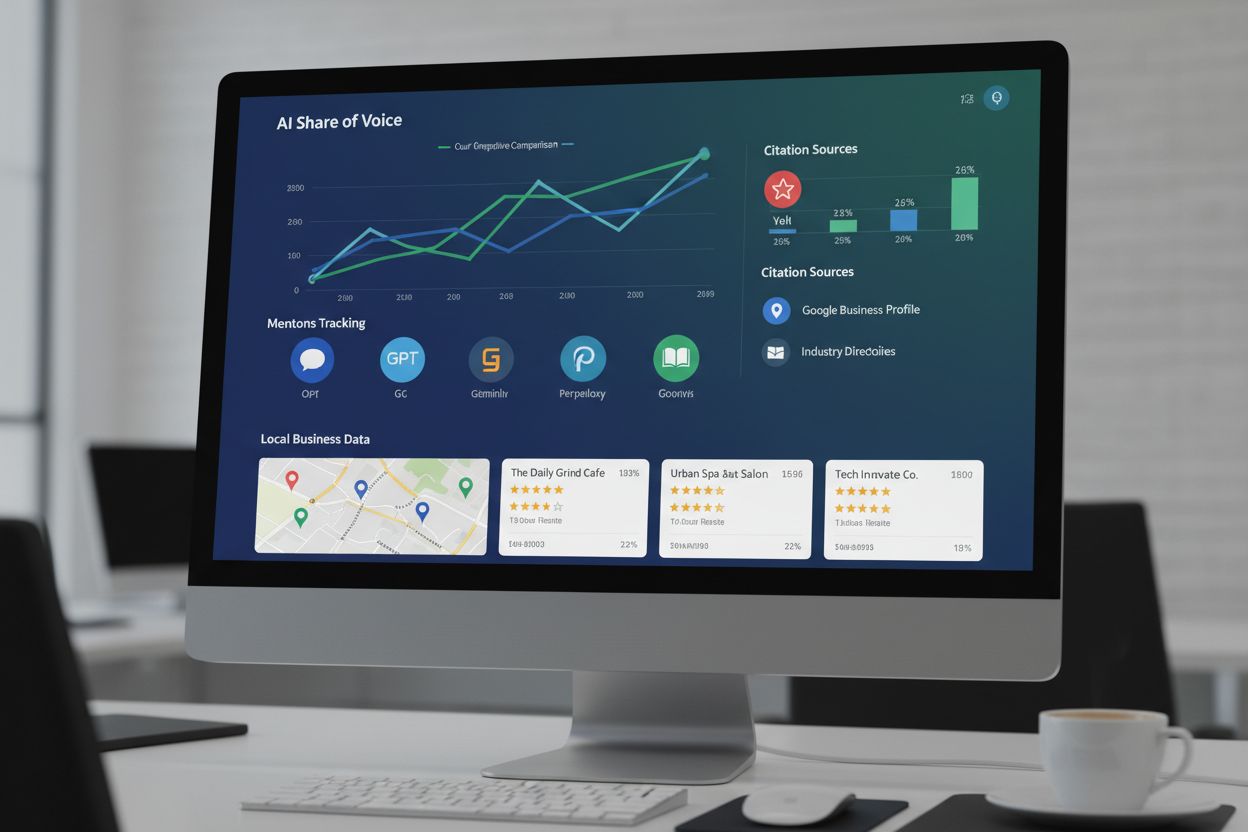
Measuring AI local visibility requires specialized monitoring tools and methodologies distinct from traditional SEO analytics, as AI recommendations don’t generate trackable clicks or impressions in conventional analytics platforms. AmICited.com serves as the leading platform for AI SERP tracking and AI visibility monitoring, enabling businesses to track mentions across ChatGPT, Google AI Overviews, Gemini, and Perplexity while benchmarking performance against competitors and identifying optimization opportunities specific to each AI platform. An AI Local Visibility Score aggregates multiple metrics—recommendation frequency across platforms, position within AI-generated lists, review sentiment consistency, entity data completeness, and citation quality—into a single performance indicator that tracks progress over time and identifies areas requiring attention. Effective monitoring methodologies involve regular testing of location-specific queries (“best restaurants in [neighborhood],” “emergency services near [address]”) across all major AI platforms, documenting which businesses appear in recommendations and their positioning within results. Competitive benchmarking through AmICited.com reveals how a business’s AI visibility compares to direct competitors, highlighting specific optimization gaps and opportunities for differentiation. Tracking mention frequency across AI platforms provides early indicators of algorithm changes and emerging visibility trends, allowing businesses to adjust strategies proactively rather than reactively responding to visibility drops.
Common Challenges and Solutions
Businesses pursuing AI visibility optimization encounter several recurring challenges that require strategic solutions and ongoing management attention to maintain competitive positioning. Inconsistent NAP data across platforms—variations in business name formatting, address abbreviations, or phone number formats—confuses AI entity recognition systems and fragments visibility across platforms; resolution requires conducting a comprehensive audit of all business listings and systematically updating information to ensure perfect consistency across Google Business Profile, Yelp, Apple Maps, industry directories, and website footer information. Limited review volume constrains AI visibility because systems require sufficient review data to extract reliable attribute signals and establish trust scoring; businesses with fewer than 20 reviews across all platforms should prioritize systematic review generation through post-purchase email campaigns, SMS requests, and in-location signage encouraging customer feedback. Outdated location pages that lack structured data, local content, or mobile optimization reduce AI discoverability; businesses should audit location pages quarterly and implement comprehensive updates including schema markup, local keyword integration, and UX improvements. Multi-location complexity creates challenges for businesses operating multiple locations, as AI systems may conflate locations, merge information incorrectly, or fail to recognize location-specific variations; resolution requires separate Google Business Profiles for each location, distinct location pages with unique content, and careful management of citation consistency across location-specific directories. Privacy concerns and compliance issues arise as businesses collect customer data for review generation and AI optimization; compliance with GDPR, CCPA, and platform-specific policies requires transparent data practices, explicit consent mechanisms, and secure data handling procedures that protect customer information while enabling effective AI visibility strategies.
Frequently asked questions
How is AI local visibility different from traditional local SEO?
Traditional local SEO focuses on ranking within Google's organic search results and map packs using link-based authority metrics. AI local visibility, by contrast, emphasizes entity data quality, trust signals, review consistency, and cross-platform presence to appear in AI-generated recommendations across ChatGPT, Google AI Overviews, Gemini, and Perplexity. AI systems employ fundamentally different ranking mechanisms that prioritize structured data completeness and multi-source validation over traditional backlink authority.
What's the most important factor for appearing in AI local recommendations?
Review quality and consistency across multiple platforms is the most critical factor. AI systems analyze review text to extract business attributes, sentiment patterns, and customer satisfaction signals. Businesses with 50+ reviews across multiple platforms (Google, Yelp, Apple Maps) that demonstrate consistent positive feedback and specific attribute mentions receive substantially higher recommendation frequency. Combined with NAP consistency and structured data implementation, strong review profiles form the foundation of AI visibility.
How long does it take to see results from AI visibility optimization?
Early signals such as new mentions in AI-generated answers can appear within 2-4 weeks of implementing structured data and location page improvements. However, meaningful shifts in recommendation frequency and positioning typically require 2-3 months as AI systems periodically refresh their understanding of business entities. Consistency matters more than speed; maintaining a steady cadence of review generation, content updates, and citation management compounds gains over time.
Can small businesses compete with large chains in AI local visibility?
Yes, small businesses can effectively compete by focusing on depth over volume. While large chains may have more reviews, small businesses can differentiate through location-specific content, detailed testimonials, community involvement documentation, and consistent NAP data across all platforms. AI systems increasingly value authentic local presence and customer satisfaction signals, which small businesses can demonstrate through dedicated location pages, active review management, and structured data implementation.
What role do reviews play in AI local recommendations?
Reviews serve as the primary content source and trust indicator for AI systems. AI engines analyze review text to extract specific business attributes (service quality, pricing, staff professionalism, cleanliness), sentiment patterns, and customer satisfaction signals. This attribute extraction allows AI systems to match customer intent with business strengths. Cross-platform review consistency strengthens trust scoring, and first-party testimonials carry additional weight as direct evidence of customer satisfaction.
How do I monitor my business's AI visibility?
Specialized monitoring tools like AmICited.com enable tracking of mentions across ChatGPT, Google AI Overviews, Gemini, and Perplexity. Effective monitoring involves regular testing of location-specific queries across all major AI platforms, documenting which businesses appear in recommendations and their positioning. AmICited.com provides competitive benchmarking, AI Local Visibility Scores, and actionable insights specific to each AI platform, allowing businesses to track progress and identify optimization opportunities.
What's the difference between Google AI Overviews and ChatGPT recommendations?
Google AI Overviews prioritize Google Business Profile data, local reviews, and Google-indexed content, making Google Business Profile optimization critical. ChatGPT relies on training data and web-indexed content, favoring businesses with strong website presence, consistent citations, and comprehensive structured data. Both platforms require different optimization approaches, but maintaining consistent NAP data and strong review profiles benefits visibility across both systems.
How should multi-location businesses approach AI visibility?
Multi-location businesses should create separate Google Business Profiles for each location with distinct location pages containing unique, geo-targeted content. Each location requires its own NAP consistency across directories, location-specific reviews, and dedicated structured data implementation. Managing location-specific variations while maintaining brand consistency requires careful planning, but enables AI systems to recognize and recommend individual locations appropriately based on customer proximity and intent.
Monitor Your AI Visibility Across All Platforms
Track how your business appears in ChatGPT, Google AI Overviews, Gemini, and other AI platforms. Get actionable insights to improve your AI local visibility and outrank competitors.
Local SEO Meets AI: How Small Businesses Can Appear in AI Recommendations
Learn how small businesses can optimize for AI visibility in ChatGPT, Gemini, and Google AI Overviews. Discover strategies for local AI recommendations and LLM ...
Enterprise AI Visibility Solutions: Choosing the Right Platform
Complete guide to enterprise AI visibility solutions. Compare top platforms like Conductor, Profound, and Athena. Learn evaluation criteria and selection strate...
How Do Startups Build AI Visibility in ChatGPT, Perplexity, and Gemini?
Learn how startups can improve their visibility in AI-generated answers across ChatGPT, Perplexity, Gemini, and other AI platforms through structured content, s...
12 min read
Cookie Consent We use cookies to enhance your browsing experience and analyze our traffic. See our privacy policy.