

Product Schema for AI Shopping Engines
Learn how product schema markup helps your e-commerce products get cited by AI shopping engines like Google AI Overviews, Perplexity, and ChatGPT Search.
8 min read

Product Schema is a structured data markup format based on Schema.org that provides search engines and AI systems with detailed product information including name, price, availability, ratings, and reviews. Implemented using JSON-LD, it enables rich search results and improves product discoverability across search engines, AI overviews, and e-commerce platforms.
Product Schema is a structured data markup format based on Schema.org that provides search engines and AI systems with detailed product information including name, price, availability, ratings, and reviews. Implemented using JSON-LD, it enables rich search results and improves product discoverability across search engines, AI overviews, and e-commerce platforms.
Product Schema is a standardized structured data markup format based on the Schema.org vocabulary that enables websites to provide detailed product information to search engines, AI systems, and other digital platforms. Implemented primarily through JSON-LD (JavaScript Object Notation for Linked Data), Product Schema allows e-commerce sites, retailers, and product-focused businesses to explicitly define product attributes such as name, price, availability, ratings, reviews, shipping information, and product variants. This markup transforms raw product data into machine-readable information that search engines like Google, Bing, and emerging AI search platforms can quickly understand, parse, and utilize. By implementing Product Schema correctly, businesses increase their eligibility for rich search results—enhanced listings that display product details directly in search results—and improve their visibility across AI-powered search engines and shopping experiences. The schema serves as a critical bridge between human-readable product pages and machine-interpretable data, enabling both traditional search engines and modern AI systems to accurately represent and cite product information.
Product Schema emerged as part of the broader Schema.org initiative, which launched in 2011 as a collaborative effort between Google, Bing, Yahoo, and Yandex to create a unified vocabulary for structured data. Initially, product markup was relatively simple, focusing on basic attributes like name, price, and availability. However, as e-commerce evolved and search engines became more sophisticated, Product Schema expanded significantly to accommodate complex product ecosystems. The introduction of JSON-LD in 2014 revolutionized how structured data was implemented, making it easier for developers to add schema without embedding it directly into HTML. Over the past decade, Product Schema has become increasingly important for e-commerce SEO, with research showing that more than 45 million web domains have implemented schema.org structured data as of 2024, representing approximately 12.4% of all registered domains. The rise of AI search engines like ChatGPT, Perplexity, and Google’s AI Overviews has further elevated the importance of Product Schema, as these systems rely heavily on well-structured data to generate accurate product recommendations and citations. Today, Product Schema is not merely an SEO enhancement—it’s a fundamental requirement for visibility in both traditional search results and emerging AI-driven search experiences.
Product Schema comprises numerous properties that work together to create a comprehensive product profile. The primary required properties include the product name and at least one of three key elements: review information, aggregate rating, or offer details. The name property identifies the specific product, while the image property provides visual representation. The description property offers detailed product information, and the brand property identifies the manufacturer or brand. For e-commerce functionality, the offers property is crucial, containing nested information about pricing, currency, availability status, and seller details. The aggregateRating property displays average customer ratings and review counts, providing social proof that influences purchase decisions. The review property allows individual customer reviews to be marked up with ratings, reviewer names, and review text. Additional properties include sku (Stock Keeping Unit), mpn (Manufacturer Part Number), gtin (Global Trade Item Number), color, size, material, and weight. For products with multiple variations, the isVariantOf property helps search engines understand relationships between different product options. The hasMerchantReturnPolicy property specifies return conditions, while OfferShippingDetails provides comprehensive shipping information including costs, delivery times, and regional restrictions. Each property serves a specific function in helping search engines and AI systems understand different aspects of the product.
| Aspect | Product Schema | Merchant Listings | Product Snippets | ItemList Schema |
|---|---|---|---|---|
| Primary Use | General product information markup | E-commerce pages with direct purchase options | Editorial product reviews and comparisons | Category/listing pages with multiple items |
| Best For | All product pages | Shopping cart-enabled sites | Review sites and product guides | Product category pages |
| Key Properties | Name, price, rating, availability | Detailed sizing, shipping, returns | Pros, cons, review ratings | Multiple product items |
| Rich Result Type | Product snippet with ratings | Shopping knowledge panel | Product review carousel | Product list carousel |
| Shipping Details | Optional | Highly recommended | Not applicable | Not applicable |
| Return Policy | Optional | Recommended | Not applicable | Not applicable |
| Product Variants | Supported via isVariantOf | Fully supported | Not applicable | Not applicable |
| AI Search Visibility | High (well-structured data) | Very high (comprehensive) | High (review-focused) | Medium (list context) |
| Implementation Complexity | Moderate | High (more properties) | Moderate | Low |
Implementing Product Schema requires understanding the JSON-LD format, which Google recommends as the standard for structured data implementation. A basic Product Schema implementation begins with a <script> tag containing type="application/ld+json" in the page’s HTML head or body section. The schema structure starts with @context set to “https://schema.org
” and @type set to “Product”. Within this structure, you nest various properties as key-value pairs. For example, a simple product might include "name": "Product Name", "image": "https://example.com/image.jpg", and "description": "Product description". More comprehensive implementations include nested objects like the Offer object, which contains @type: "Offer", price, priceCurrency, availability, and url properties. The AggregateRating object includes ratingValue, reviewCount, and bestRating properties. Review objects are nested arrays containing individual reviews with reviewRating, author, and reviewBody properties. The beauty of JSON-LD is that it remains separate from your HTML content, making it easier to maintain and update without affecting page structure. Search engines parse this JSON-LD block to extract product information, and modern AI systems similarly rely on this structured format to understand product details. Proper JSON-LD syntax is critical—even small errors like missing commas or incorrect quotation marks can invalidate the entire schema, preventing search engines from recognizing your product data.
The implementation of Product Schema delivers measurable business benefits across multiple dimensions of e-commerce performance. Rich search results that include product ratings, prices, and availability information typically achieve 20-30% higher click-through rates compared to standard text-only listings, as users can make more informed decisions before clicking. The Price Drop feature, enabled through Product Schema, alerts users to significant price reductions, creating urgency and driving additional traffic. Shipping information visibility in search results reduces cart abandonment by helping customers understand total costs upfront, addressing one of the primary reasons for purchase abandonment in e-commerce. For product variants, proper schema implementation ensures that variations (different colors, sizes, or styles) appear in search results for all variant-specific queries, even when they share a single product page URL. This multiplies your search visibility without requiring separate pages for each variant. Aggregate ratings and reviews displayed in search results serve as powerful social proof, with studies showing that products with visible star ratings receive significantly more clicks than those without. Additionally, Product Schema improves internal site understanding by helping search engines crawl and index product pages more efficiently, potentially improving overall site rankings. For AI search engines, well-implemented Product Schema increases the likelihood that your products will be cited in AI-generated shopping recommendations, product comparisons, and price-checking responses.
The emergence of AI-powered search engines has fundamentally changed the importance of Product Schema. Google AI Overviews, which provide AI-generated summaries at the top of search results, rely on structured data to identify authoritative product information. When your Product Schema is properly implemented, Google’s AI systems can more confidently extract and cite your product details in these overviews. ChatGPT’s search functionality and SearchGPT (OpenAI’s dedicated search product) utilize indexed web content, and sites with clear Product Schema markup are more likely to be selected as sources for product recommendations and comparisons. Perplexity AI, a generative Q&A engine that explicitly cites sources, prioritizes well-structured product data when answering shopping-related queries. The platform’s algorithms can quickly identify prices, availability, and ratings from Product Schema, making your products more likely to appear in Perplexity’s responses. Claude’s web search capability, introduced in early 2025, similarly benefits from structured product data, as it allows the AI to provide accurate, verifiable product information with proper citations. The common thread across all these AI platforms is that structured data reduces ambiguity and increases confidence in AI-generated responses. When an AI system encounters Product Schema, it can definitively extract specific product attributes rather than inferring them from unstructured text, leading to more accurate citations and recommendations. This makes Product Schema not just an SEO tactic but a fundamental requirement for visibility in the AI search era.
Successful Product Schema implementation requires adherence to several critical best practices. First, use JSON-LD exclusively, as it’s Google’s recommended format and offers superior flexibility and maintainability compared to Microdata or RDFa. Second, include all required properties at minimum—the product name and at least one of review, aggregateRating, or offers—but strive to include recommended properties to maximize rich result eligibility. Third, ensure accuracy and consistency across all product data; mismatches between your schema and visible page content can trigger validation errors and reduce trust signals. Fourth, implement schema only on individual product pages, never on category or listing pages, which should use ItemList Schema instead. Fifth, validate your markup regularly using Google’s Rich Results Test or Schema Markup Validator to catch errors before they impact search visibility. Sixth, keep reviews and ratings on your own site; third-party reviews are not permitted in Product Schema and will cause validation failures. Seventh, use specific product identifiers like SKU, MPN, or GTIN when available, as these help search engines and AI systems uniquely identify products and prevent confusion with similar items. Eighth, implement shipping details when applicable, as this information significantly impacts user decision-making and can improve click-through rates. Ninth, mark up product variants correctly using the isVariantOf property to help search engines understand relationships between different product options. Tenth, monitor your schema performance through Google Search Console’s Enhancements report to identify any issues and track how often your products appear in rich results.
Different platforms and search engines interact with Product Schema in distinct ways, requiring tailored implementation strategies. Google Search prioritizes Product Schema for its Shopping Knowledge Panel, Product Snippets, and AI Overviews, making comprehensive markup essential for visibility. Google’s algorithms specifically look for aggregateRating and review properties to determine rich result eligibility, and the presence of shipping details can influence product ranking in shopping-related queries. Google Images uses Product Schema to annotate product images with pricing and availability information, creating additional discovery opportunities. Bing Webmaster Tools supports Product Schema and uses it to enhance product listings in Bing Shopping results, though with slightly different requirements than Google. Amazon has its own product data requirements but respects standard Product Schema for third-party sellers using Amazon’s platform. Shopify and WooCommerce automatically generate Product Schema for product pages, though customization may be necessary for complex product types or variants. AI search engines like Perplexity and ChatGPT don’t have official schema requirements but clearly benefit from well-structured data, as their algorithms can more confidently extract and cite information from pages with proper markup. Voice assistants like Google Assistant and Alexa use Product Schema to answer shopping-related voice queries, making schema implementation important for voice search visibility. Pinterest and other visual platforms use Product Schema to enhance product pins with pricing and availability information, creating additional traffic opportunities.
Product Schema continues to evolve in response to changing search landscapes and emerging technologies. The rise of AI-powered shopping assistants is driving expansion of Product Schema to include more detailed product attributes, sustainability information, and ethical sourcing details that AI systems can use to provide more comprehensive product recommendations. Voice commerce is becoming increasingly important, with smart speakers and voice assistants relying on Product Schema to provide accurate product information in voice-based shopping experiences. The development of Model Context Protocol (MCP) and Natural Language Web (NLWeb) standards suggests that structured data will become even more critical for AI interoperability, as these protocols aim to standardize how AI systems access and interpret web content. Sustainability and ethical sourcing are emerging as important product attributes, with Schema.org considering expansions to include carbon footprint, fair trade certification, and supply chain transparency information. Personalization is another frontier, with future implementations potentially including dynamic schema that adapts based on user location, device type, or browsing history. Real-time inventory synchronization is becoming more sophisticated, with schema implementations increasingly connected to live inventory management systems to ensure accuracy. Cross-platform consistency is becoming critical, as products appear across multiple channels (website, marketplace, social commerce, AI search), requiring schema that maintains consistency across all touchpoints. Organizations that invest in robust, comprehensive Product Schema implementation today are positioning themselves for success in these emerging channels and technologies. The fundamental principle remains constant: clear, accurate, structured product data is the foundation for visibility wherever customers search and shop.
Measuring the effectiveness of Product Schema implementation requires tracking multiple metrics across different channels. Google Search Console’s Enhancements report provides visibility into how many of your product pages are eligible for rich results and how often they actually appear in search results. Click-through rate (CTR) improvements can be tracked by comparing CTR before and after schema implementation, with well-implemented Product Schema typically showing 20-30% CTR increases for product pages. Impression share in Google Search Console indicates how often your products appear in search results, and proper schema implementation should increase this metric. Conversion rate tracking through Google Analytics or your e-commerce platform shows whether rich results actually drive more qualified traffic and sales. AI search visibility can be monitored through tools like AmICited, which tracks brand and product citations across AI search engines like ChatGPT, Perplexity, and Google AI Overviews. Rich result eligibility should be monitored regularly through validation tools to ensure schema remains error-free after site updates. Competitor benchmarking helps identify whether your schema implementation is more or less comprehensive than competitors, revealing opportunities for improvement. Mobile performance should be tracked separately, as rich results often display differently on mobile devices and may drive different conversion patterns. Seasonal variations in schema performance should be analyzed, as product visibility and conversion rates often fluctuate based on shopping seasons and product availability. Organizations that systematically track these metrics can optimize their Product Schema implementation over time, continuously improving visibility and conversion performance.
+++
Product Schema is a standardized structured data markup format based on the Schema.org vocabulary that enables websites to provide detailed product information to search engines, AI systems, and other digital platforms. Implemented primarily through JSON-LD (JavaScript Object Notation for Linked Data), Product Schema allows e-commerce sites, retailers, and product-focused businesses to explicitly define product attributes such as name, price, availability, ratings, reviews, shipping information, and product variants. This markup transforms raw product data into machine-readable information that search engines like Google, Bing, and emerging AI search platforms can quickly understand, parse, and utilize. By implementing Product Schema correctly, businesses increase their eligibility for rich search results—enhanced listings that display product details directly in search results—and improve their visibility across AI-powered search engines and shopping experiences. The schema serves as a critical bridge between human-readable product pages and machine-interpretable data, enabling both traditional search engines and modern AI systems to accurately represent and cite product information.
Product Schema emerged as part of the broader Schema.org initiative, which launched in 2011 as a collaborative effort between Google, Bing, Yahoo, and Yandex to create a unified vocabulary for structured data. Initially, product markup was relatively simple, focusing on basic attributes like name, price, and availability. However, as e-commerce evolved and search engines became more sophisticated, Product Schema expanded significantly to accommodate complex product ecosystems. The introduction of JSON-LD in 2014 revolutionized how structured data was implemented, making it easier for developers to add schema without embedding it directly into HTML. Over the past decade, Product Schema has become increasingly important for e-commerce SEO, with research showing that more than 45 million web domains have implemented schema.org structured data as of 2024, representing approximately 12.4% of all registered domains. The rise of AI search engines like ChatGPT, Perplexity, and Google’s AI Overviews has further elevated the importance of Product Schema, as these systems rely heavily on well-structured data to generate accurate product recommendations and citations. Today, Product Schema is not merely an SEO tactic—it’s a fundamental requirement for visibility in both traditional search results and emerging AI-driven search experiences.
Product Schema comprises numerous properties that work together to create a comprehensive product profile. The primary required properties include the product name and at least one of three key elements: review information, aggregate rating, or offer details. The name property identifies the specific product, while the image property provides visual representation. The description property offers detailed product information, and the brand property identifies the manufacturer or brand. For e-commerce functionality, the offers property is crucial, containing nested information about pricing, currency, availability status, and seller details. The aggregateRating property displays average customer ratings and review counts, providing social proof that influences purchase decisions. The review property allows individual customer reviews to be marked up with ratings, reviewer names, and review text. Additional properties include sku (Stock Keeping Unit), mpn (Manufacturer Part Number), gtin (Global Trade Item Number), color, size, material, and weight. For products with multiple variations, the isVariantOf property helps search engines understand relationships between different product options. The hasMerchantReturnPolicy property specifies return conditions, while OfferShippingDetails provides comprehensive shipping information including costs, delivery times, and regional restrictions. Each property serves a specific function in helping search engines and AI systems understand different aspects of the product.
| Aspect | Product Schema | Merchant Listings | Product Snippets | ItemList Schema |
|---|---|---|---|---|
| Primary Use | General product information markup | E-commerce pages with direct purchase options | Editorial product reviews and comparisons | Category/listing pages with multiple items |
| Best For | All product pages | Shopping cart-enabled sites | Review sites and product guides | Product category pages |
| Key Properties | Name, price, rating, availability | Detailed sizing, shipping, returns | Pros, cons, review ratings | Multiple product items |
| Rich Result Type | Product snippet with ratings | Shopping knowledge panel | Product review carousel | Product list carousel |
| Shipping Details | Optional | Highly recommended | Not applicable | Not applicable |
| Return Policy | Optional | Recommended | Not applicable | Not applicable |
| Product Variants | Supported via isVariantOf | Fully supported | Not applicable | Not applicable |
| AI Search Visibility | High (well-structured data) | Very high (comprehensive) | High (review-focused) | Medium (list context) |
| Implementation Complexity | Moderate | High (more properties) | Moderate | Low |
Implementing Product Schema requires understanding the JSON-LD format, which Google recommends as the standard for structured data implementation. A basic Product Schema implementation begins with a <script> tag containing type="application/ld+json" in the page’s HTML head or body section. The schema structure starts with @context set to “https://schema.org
” and @type set to “Product”. Within this structure, you nest various properties as key-value pairs. For example, a simple product might include "name": "Product Name", "image": "https://example.com/image.jpg", and "description": "Product description". More comprehensive implementations include nested objects like the Offer object, which contains @type: "Offer", price, priceCurrency, availability, and url properties. The AggregateRating object includes ratingValue, reviewCount, and bestRating properties. Review objects are nested arrays containing individual reviews with reviewRating, author, and reviewBody properties. The beauty of JSON-LD is that it remains separate from your HTML content, making it easier to maintain and update without affecting page structure. Search engines parse this JSON-LD block to extract product information, and modern AI systems similarly rely on this structured format to understand product details. Proper JSON-LD syntax is critical—even small errors like missing commas or incorrect quotation marks can invalidate the entire schema, preventing search engines from recognizing your product data.
The implementation of Product Schema delivers measurable business benefits across multiple dimensions of e-commerce performance. Rich search results that include product ratings, prices, and availability information typically achieve 20-30% higher click-through rates compared to standard text-only listings, as users can make more informed decisions before clicking. The Price Drop feature, enabled through Product Schema, alerts users to significant price reductions, creating urgency and driving additional traffic. Shipping information visibility in search results reduces cart abandonment by helping customers understand total costs upfront, addressing one of the primary reasons for purchase abandonment in e-commerce. For product variants, proper schema implementation ensures that variations (different colors, sizes, or styles) appear in search results for all variant-specific queries, even when they share a single product page URL. This multiplies your search visibility without requiring separate pages for each variant. Aggregate ratings and reviews displayed in search results serve as powerful social proof, with studies showing that products with visible star ratings receive significantly more clicks than those without. Additionally, Product Schema improves internal site understanding by helping search engines crawl and index product pages more efficiently, potentially improving overall site rankings. For AI search engines, well-implemented Product Schema increases the likelihood that your products will be cited in AI-generated shopping recommendations, product comparisons, and price-checking responses.
The emergence of AI-powered search engines has fundamentally changed the importance of Product Schema. Google AI Overviews, which provide AI-generated summaries at the top of search results, rely on structured data to identify authoritative product information. When your Product Schema is properly implemented, Google’s AI systems can more confidently extract and cite your product details in these overviews. ChatGPT’s search functionality and SearchGPT (OpenAI’s dedicated search product) utilize indexed web content, and sites with clear Product Schema markup are more likely to be selected as sources for product recommendations and comparisons. Perplexity AI, a generative Q&A engine that explicitly cites sources, prioritizes well-structured product data when answering shopping-related queries. The platform’s algorithms can quickly identify prices, availability, and ratings from Product Schema, making your products more likely to appear in Perplexity’s responses. Claude’s web search capability, introduced in early 2025, similarly benefits from structured product data, as it allows the AI to provide accurate, verifiable product information with proper citations. The common thread across all these AI platforms is that structured data reduces ambiguity and increases confidence in AI-generated responses. When an AI system encounters Product Schema, it can definitively extract specific product attributes rather than inferring them from unstructured text, leading to more accurate citations and recommendations. This makes Product Schema not just an SEO tactic but a fundamental requirement for visibility in the AI search era.
Successful Product Schema implementation requires adherence to several critical best practices. First, use JSON-LD exclusively, as it’s Google’s recommended format and offers superior flexibility and maintainability compared to Microdata or RDFa. Second, include all required properties at minimum—the product name and at least one of review, aggregateRating, or offers—but strive to include recommended properties to maximize rich result eligibility. Third, ensure accuracy and consistency across all product data; mismatches between your schema and visible page content can trigger validation errors and reduce trust signals. Fourth, implement schema only on individual product pages, never on category or listing pages, which should use ItemList Schema instead. Fifth, validate your markup regularly using Google’s Rich Results Test or Schema Markup Validator to catch errors before they impact search visibility. Sixth, keep reviews and ratings on your own site; third-party reviews are not permitted in Product Schema and will cause validation failures. Seventh, use specific product identifiers like SKU, MPN, or GTIN when available, as these help search engines and AI systems uniquely identify products and prevent confusion with similar items. Eighth, implement shipping details when applicable, as this information significantly impacts user decision-making and can improve click-through rates. Ninth, mark up product variants correctly using the isVariantOf property to help search engines understand relationships between different product options. Tenth, monitor your schema performance through Google Search Console’s Enhancements report to identify any issues and track how often your products appear in rich results.
Different platforms and search engines interact with Product Schema in distinct ways, requiring tailored implementation strategies. Google Search prioritizes Product Schema for its Shopping Knowledge Panel, Product Snippets, and AI Overviews, making comprehensive markup essential for visibility. Google’s algorithms specifically look for aggregateRating and review properties to determine rich result eligibility, and the presence of shipping details can influence product ranking in shopping-related queries. Google Images uses Product Schema to annotate product images with pricing and availability information, creating additional discovery opportunities. Bing Webmaster Tools supports Product Schema and uses it to enhance product listings in Bing Shopping results, though with slightly different requirements than Google. Amazon has its own product data requirements but respects standard Product Schema for third-party sellers using Amazon’s platform. Shopify and WooCommerce automatically generate Product Schema for product pages, though customization may be necessary for complex product types or variants. AI search engines like Perplexity and ChatGPT don’t have official schema requirements but clearly benefit from well-structured data, as their algorithms can more confidently extract and cite information from pages with proper markup. Voice assistants like Google Assistant and Alexa use Product Schema to answer shopping-related voice queries, making schema implementation important for voice search visibility. Pinterest and other visual platforms use Product Schema to enhance product pins with pricing and availability information, creating additional traffic opportunities.
Product Schema continues to evolve in response to changing search landscapes and emerging technologies. The rise of AI-powered shopping assistants is driving expansion of Product Schema to include more detailed product attributes, sustainability information, and ethical sourcing details that AI systems can use to provide more comprehensive product recommendations. Voice commerce is becoming increasingly important, with smart speakers and voice assistants relying on Product Schema to provide accurate product information in voice-based shopping experiences. The development of Model Context Protocol (MCP) and Natural Language Web (NLWeb) standards suggests that structured data will become even more critical for AI interoperability, as these protocols aim to standardize how AI systems access and interpret web content. Sustainability and ethical sourcing are emerging as important product attributes, with Schema.org considering expansions to include carbon footprint, fair trade certification, and supply chain transparency information. Personalization is another frontier, with future implementations potentially including dynamic schema that adapts based on user location, device type, or browsing history. Real-time inventory synchronization is becoming more sophisticated, with schema implementations increasingly connected to live inventory management systems to ensure accuracy. Cross-platform consistency is becoming critical, as products appear across multiple channels (website, marketplace, social commerce, AI search), requiring schema that maintains consistency across all touchpoints. Organizations that invest in robust, comprehensive Product Schema implementation today are positioning themselves for success in these emerging channels and technologies. The fundamental principle remains constant: clear, accurate, structured product data is the foundation for visibility wherever customers search and shop.
Measuring the effectiveness of Product Schema implementation requires tracking multiple metrics across different channels. Google Search Console’s Enhancements report provides visibility into how many of your product pages are eligible for rich results and how often they actually appear in search results. Click-through rate (CTR) improvements can be tracked by comparing CTR before and after schema implementation, with well-implemented Product Schema typically showing 20-30% CTR increases for product pages. Impression share in Google Search Console indicates how often your products appear in search results, and proper schema implementation should increase this metric. Conversion rate tracking through Google Analytics or your e-commerce platform shows whether rich results actually drive more qualified traffic and sales. AI search visibility can be monitored through tools like AmICited, which tracks brand and product citations across AI search engines like ChatGPT, Perplexity, and Google AI Overviews. Rich result eligibility should be monitored regularly through validation tools to ensure schema remains error-free after site updates. Competitor benchmarking helps identify whether your schema implementation is more or less comprehensive than competitors, revealing opportunities for improvement. Mobile performance should be tracked separately, as rich results often display differently on mobile devices and may drive different conversion patterns. Seasonal variations in schema performance should be analyzed, as product visibility and conversion rates often fluctuate based on shopping seasons and product availability. Organizations that systematically track these metrics can optimize their Product Schema implementation over time, continuously improving visibility and conversion performance.
Product Schema has two main implementations: Product Snippets are designed for pages where users cannot directly purchase (like editorial reviews), emphasizing review information and pros/cons. Merchant Listings are for pages where customers can purchase directly, offering more detailed product information like apparel sizing, shipping details, and return policies. Both can trigger rich results, but Merchant Listings provide more comprehensive e-commerce functionality.
Product Schema helps AI systems like ChatGPT, Perplexity, and Google AI Overviews understand and cite product information more accurately. Well-structured product data makes it easier for AI crawlers to extract pricing, availability, ratings, and descriptions, increasing the likelihood your products will be cited or featured in AI-generated responses and summaries.
To display as a rich result, Product Schema must include the 'name' property plus at least one of: 'review', 'aggregateRating', or 'offers'. When one of these three is added, the other two become recommended. For example, if you include aggregateRating, you should also add review and offers properties to maximize rich result eligibility.
No, Product Schema should only be used on individual product pages, not category or listing pages. Category pages should use ItemList Schema instead, which tells search engines the page contains multiple items. Using Product Schema on category pages creates validation errors and can confuse search engines about your page's actual content.
JSON-LD is the recommended format for Product Schema implementation, as it's Google's preferred method and supported by all major search engines. JSON-LD is placed in a <script> tag in your page's HTML, making it easier to manage and maintain compared to other formats like Microdata or RDFa.
When you include price information in the Offer property of Product Schema, Google analyzes your product's historical pricing to detect price drops. If a significant price reduction is detected, Google may display a 'Price Drop' rich result in search results, alerting users to the savings and potentially increasing click-through rates.
Product Schema supports detailed shipping information through the OfferShippingDetails property, including free shipping indicators, regional shipping restrictions, shipping costs by location (down to zip code level), multiple shipping options with different delivery times, and handling time specifications. This helps customers understand total costs before clicking.
Start tracking how AI chatbots mention your brand across ChatGPT, Perplexity, and other platforms. Get actionable insights to improve your AI presence.
Learn how product schema markup helps your e-commerce products get cited by AI shopping engines like Google AI Overviews, Perplexity, and ChatGPT Search.
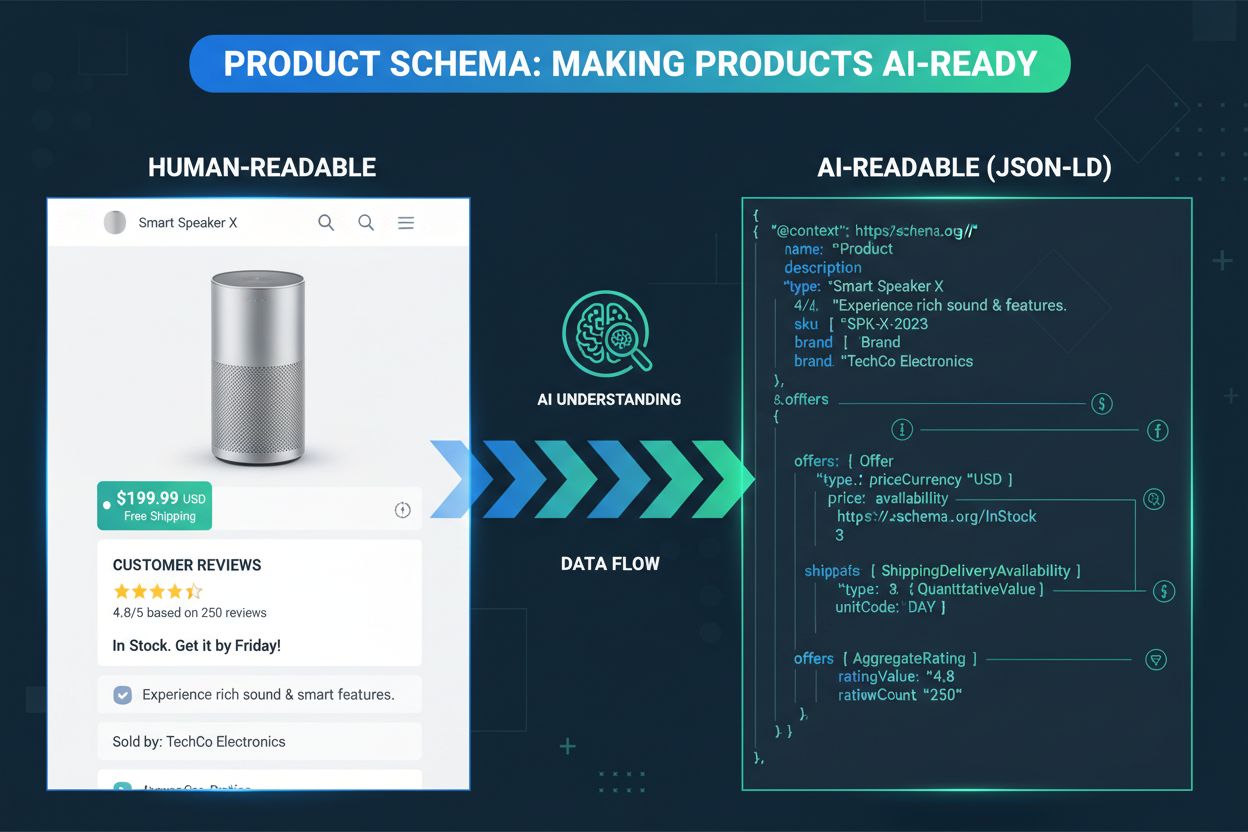
Learn how product schema markup makes your ecommerce products visible to AI shopping assistants. Complete guide to structured data for ChatGPT, Perplexity, and ...

Learn what Organization Schema is, how it works, and why it matters for SEO and AI search visibility. Complete guide to implementing structured data for company...
Cookie Consent
We use cookies to enhance your browsing experience and analyze our traffic. See our privacy policy.