


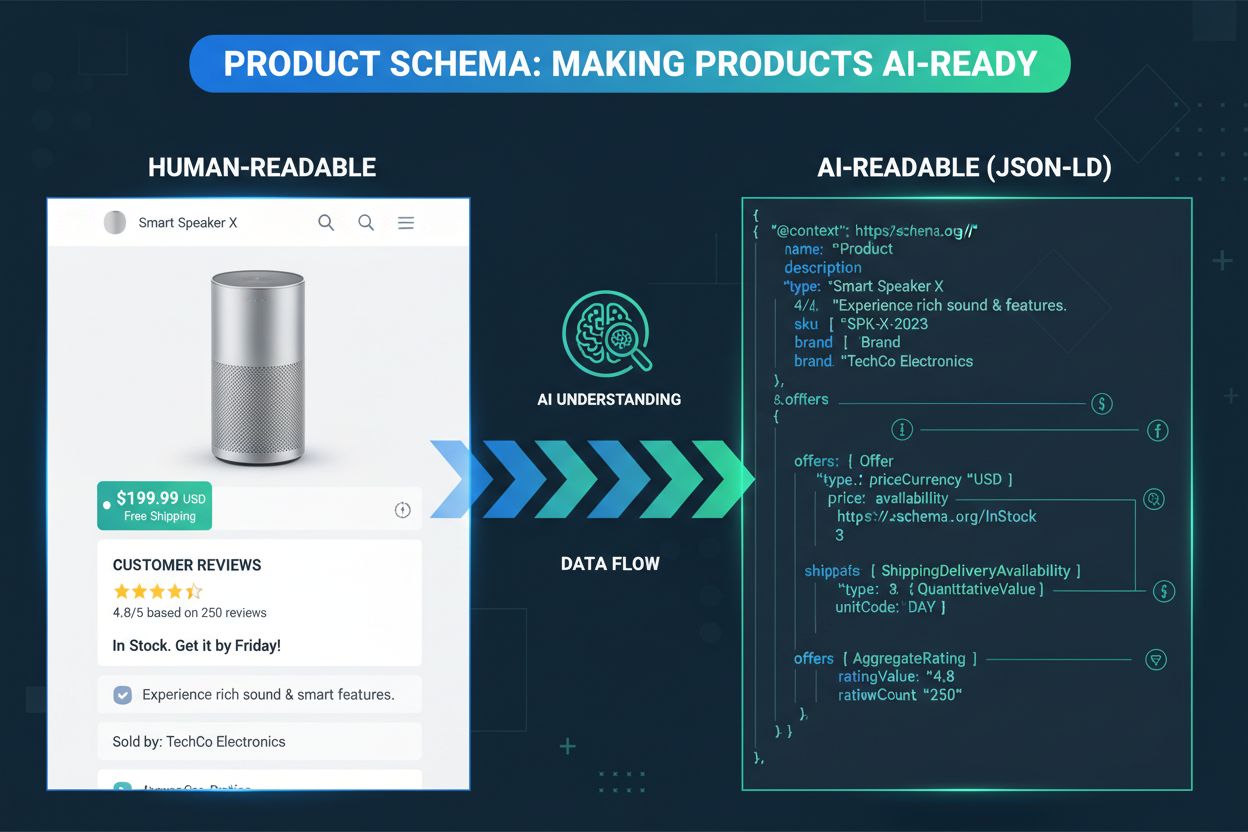
Product Schema Implementation: JSON-LD Properties and Validation
A technical walkthrough of implementing product schema markup: Schema.org Product properties, JSON-LD syntax, nested Offer/AggregateRating/Review types, platfor...
7 min read

Google AI Overviews, Perplexity, ChatGPT Search, and Claude don’t all weigh product schema the same way. Learn which properties matter to each AI shopping engine and why implementing schema is a business decision, not just a technical one.
Your ecommerce site has great products, compelling descriptions, and competitive prices. Yet when customers ask AI assistants for recommendations, your competitors show up instead. Structured data markup is usually the difference. If you need the technical how-to—the exact Schema.org properties, JSON-LD syntax, and validation steps—our product schema implementation guide covers that in depth. This piece answers a different question: which AI shopping engines actually read that markup, what do they each prioritize, and is implementing it worth the investment for your business.
Unlike traditional search engines that lean on keyword matching and page content analysis, AI shopping engines depend heavily on structured data to comprehend product attributes, relationships, and context with precision. As AI shopping engines become more sophisticated, the completeness of your product schema increasingly determines whether your products are discovered, accurately represented, and recommended to potential customers at all.
When an AI shopping engine crawls your website, it extracts structured product data and feeds it into its Knowledge Graph—a vast database of interconnected product information that powers intelligent search and recommendation features. This is a fundamentally different process than traditional keyword indexing.
| Aspect | Traditional Search | AI Shopping Engines |
|---|---|---|
| Data Source | Page content + meta tags | Structured schema + content |
| Understanding | Keyword-based matching | Semantic comprehension |
| Product Context | Limited | Comprehensive |
| Recommendation Quality | Basic filtering | Advanced AI analysis |
This structured approach lets AI systems understand not just what a product is but its specifications, pricing, and availability in one unified, machine-readable profile—rather than piecing it together from scattered page text. (For the exact properties that feed this profile, see the implementation guide linked above; we won’t re-cover them here.)


Track how AI chatbots mention your brand across ChatGPT, Perplexity, and other platforms.
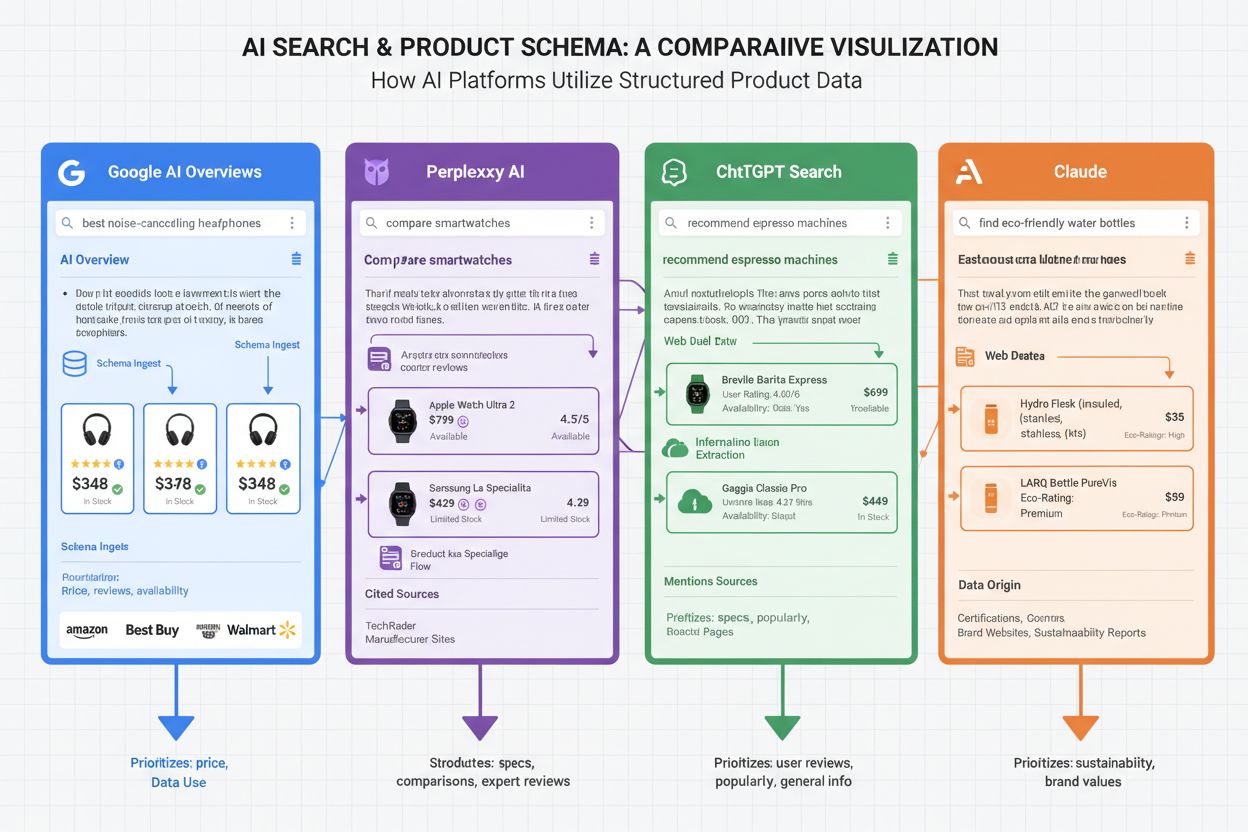
Not every AI shopping engine weighs the same properties the same way, and knowing the differences helps you prioritize where to focus. Google AI Overviews (formerly SGE) relies heavily on product schema to generate AI-powered shopping summaries that appear at the top of search results—its dependence on complete price, availability, and rating data makes schema implementation critical for anyone trying to appear in Google’s AI features. Perplexity AI uses product schema to provide accurate product information, pricing, and availability in its conversational search results, and it noticeably favors citing sources with well-structured data over those without. ChatGPT Search integrates product schema data to deliver current pricing, stock status, and product descriptions when users ask shopping-related questions, prioritizing sources with comprehensive structured data over ones it has to infer from prose. Claude and other AI assistants increasingly reference products with proper schema markup when answering consumer questions, because structured data provides reliable, verifiable information that’s easier to trust than free-text claims.
The payoff from schema implementation shows up on a predictable timeline. Rich result impressions typically improve within 2-4 weeks of proper implementation, visible first in Google Search Console. AI Overview appearances and voice search visibility gains usually follow within 4-8 weeks. Business metrics—conversion rate improvements and average order value increases—typically show up within 2-3 months, once AI systems have had enough exposure to your structured data to trust and recommend your listings consistently.
This is why schema is a business decision, not just a technical checkbox. If you sell across multiple marketplaces as well as your own site, implementing schema on your own domain still matters: it establishes your site as the authoritative source AI systems can cite directly, rather than leaving AI shopping engines to pull exclusively from marketplace listings you don’t fully control. As AI shopping assistants increasingly recommend products directly, you want them citing you, not just the marketplace that happens to host your listing.
Get the latest insights on AI mentions, brand monitoring, and optimization strategies.
Measuring schema’s business impact requires tracking metrics beyond traditional SEO. AmICited.com provides a centralized dashboard where you can monitor how frequently your products appear in AI search results across different platforms, so you’re not manually asking ChatGPT and Perplexity the same questions every week. ROI tracking involves comparing the cost of implementing and maintaining schema against the revenue generated from AI-referred customers, which helps justify continued investment. Before you can trust any of these numbers, though, it’s worth confirming basic AI crawler access to your pages—citation tracking is meaningless if the crawlers can’t reach your product pages in the first place. Set up alerts for when your products are cited in major AI platforms, and compare your performance against competitors to identify gaps in your current schema strategy.
Beyond the technical errors covered in the implementation guide, a few strategic mistakes specifically cost businesses AI visibility. Treating schema as a one-time project rather than an ongoing commitment—AI platforms evolve their data requirements over time, weighting different properties as their shopping features mature, and a strategy that made sense a year ago may be leaving visibility on the table today. Writing product descriptions for keyword density instead of clarity—AI systems increasingly penalize manipulative product descriptions and reward natural, accurate ones that give it real information to summarize. Assuming desktop coverage is enough—if your schema isn’t properly formatted on mobile pages too, you’re invisible to the growing share of AI crawlers that prioritize mobile-first indexing. Relying solely on marketplace presence—without your own schema, you have zero control over how AI systems characterize your brand relative to competitors selling the same product.
Product schema’s role in AI commerce will keep expanding. A semantic layer is emerging across ecommerce platforms that goes beyond basic attributes to include relationships, use cases, and sustainability data—richer than what most schema implementations capture today. Emerging capabilities like visual search integration, voice commerce, and personalized recommendations will increasingly depend on comprehensive, well-structured product data to function at all. As competition intensifies among AI shopping platforms, the merchants providing the highest-quality structured data will be the ones AI systems trust to build superior recommendation experiences around—creating a compounding incentive to invest in schema now rather than after competitors have already claimed that trust. The businesses treating this as strategic infrastructure today, not just a technical checkbox, will be best positioned to capture traffic and sales as AI shopping engines mature.
Yasha is a talented software developer specializing in Python, Java, and machine learning. Yasha writes technical articles on AI, prompt engineering, and chatbot development.

AmICited tracks how ChatGPT, Perplexity, Google AI Overviews, and other AI shopping engines reference your products in real time, so you know your schema investment is actually paying off.
A technical walkthrough of implementing product schema markup: Schema.org Product properties, JSON-LD syntax, nested Offer/AggregateRating/Review types, platfor...

Product Schema is structured data markup that helps search engines and AI systems understand product details. Learn how to implement it for better visibility in...
Learn how to optimize product pages for AI search engines like ChatGPT and Perplexity. Discover structured data implementation, content strategies, and technica...
Cookie Consent
We use cookies to enhance your browsing experience and analyze our traffic. See our privacy policy.