


AI Accessibility for Agent Crawlers
AI agents do not see pixels — they see accessibility trees, llms.txt files, robots rules and structured commerce markup. The audit scores six independent checks, never blends them into one number, and separates a robots.txt allow from crawlers that can actually reach you — so you see exactly where you would fail, and why.
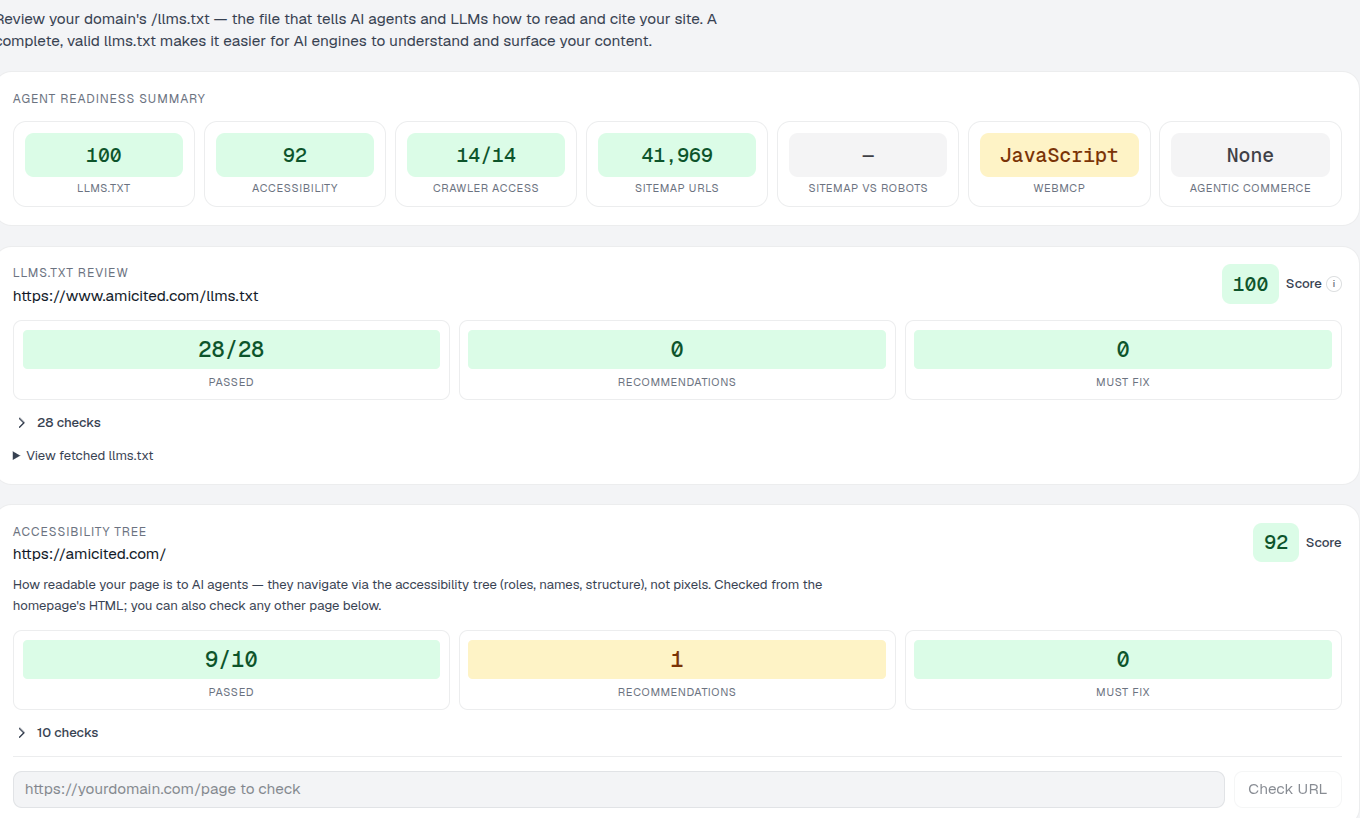
AI Accessibility Checks
Being fast is not enough. AmICited audits your llms.txt, accessibility tree, crawler access, sitemap coverage, WebMCP readiness and agentic commerce protocols — then goes further: it checks a robots.txt allow, an actual CCBot-style fetch, and a confirmed Common Crawl index entry as three separate facts, since a green robots check can still hide a CDN or challenge-page block on the real request. WebMCP evidence is ranked too — a declarative tool declaration outranks JavaScript-only detection, which the UI marks unverified.
- Agent Readiness Summary — six independent 0-100 readings, not one blended score: llms.txt, accessibility tree, allowed AI bots, sitemap URL count, WebMCP type, commerce-protocol support.
- Accessibility tree checker — the same structure screen readers and AI agents use: heading order, labelled controls, landmark regions, alt text — with every failing check’s exact message, expandable.
- Robots vs reality — an allow in robots.txt, a real CCBot-style request, and a confirmed Common Crawl index entry are checked and shown separately, so nothing here is assumed from one green flag.
- Forward-looking checks — declarative WebMCP tool detection, ranked above JavaScript-only, and Agentic Commerce Protocol (ACP/UCP) readiness for AI-driven checkout.
AI Crawler Access Evidence
Common Crawl presence is generally useful evidence of AI corpus reach, but it is treated as three separate, honestly-reported facts rather than one pass/fail: whether robots allows CCBot, whether an actual CCBot-style request succeeds, and whether the host is confirmed in a published index. The footprint chart plots crawl-window date against captured-URL count per host — confirmed absence draws as zero, but an unchecked or errored point is left off the line rather than guessed at. A second chart checks capture totals against AI citation counts and reports a Spearman correlation only once at least five domains are compared, and never claims one causes the other.
- Three checks, not one — a robots allow, a real bot request, and a confirmed index entry are reported independently.
- Unknowns stay unknown — “not checked” and index errors never render as absence or a failing score.
- Confirmed absence is a real zero — plotted deliberately, distinct from a point that simply wasn’t measured.
- Correlation, never causation — the capture-vs-citation view needs five domains before it reports a Spearman value, and states the relationship as observational.
Page Speed and Crawling
Agent readiness is not just structure. Pages with poor Core Web Vitals get skipped by the same crawlers that feed AI answer engines — so performance and accessibility move together.
- Core Web Vitals, per cited page — LCP, INP and CLS scored against a 90+ target.
- Citation risk flagged — pages scoring low get marked before they lose citations.
- One health score — a single number for whether a page is technically ready to be cited.
independent readings, never blended into one score
llms.txt and accessibility tree score 0-100 — green at 80+, amber 50-79, red below. Bots, sitemap, WebMCP and commerce report their own facts alongside, everything an AI agent needs before it can read or act on your site.
See performance impactRun an AI Accessibility Audit
Check llms.txt, accessibility tree, WebMCP and agentic commerce readiness in one pass — and see exactly what to fix first.
Ready to see if AI agents can read your site?
Free check · 7-day trial · card required