


Striking Distance Keyword Opportunities
Striking Distance groups striking distance keywords ranked just outside the top by the page that owns them, so the report reads as a worklist of pages to improve — not a spreadsheet of keywords to individually chase. It opens on the latest 90 complete days, positions 4 through 15, a target of position 3 and no minimum impressions, ready to narrow from there.
Striking Distance Keyword Data
Set the position band to ranks you believe one round of work can move, then raise the minimum impressions until only queries with real demand are left. Each row is a page, ordered by the combined upside of every in-band query it owns — and the target position can never be set worse than the band’s own best edge.
- Grouped by page, ordered by upside — striking distance keywords for seo rolled into one row per page, combining the modelled upside of every query ranked in your band.
- Four filters set the band — Best position, Worst position, Min impressions and Target position, applied together before a single row is shown.
- In-band queries as an outline — expand a page row to see up to 25 highest-impression qualifying queries, each with impressions, clicks, combined position, per-engine positions and its own upside.
- Modelled upside, not a guess — what the page would earn at your target position, computed from a click-through curve and labelled provisional until this site has enough of its own history to fit one.
- Google and Bing compared, not blended — a page averaging position 5 can be hiding position 8 on Google and position 2 on Bing; the per-engine columns catch what the combined score can’t.
- Re-run after the edit ships — a page that leaves the band worked; one that stays needs a different fix than more words.
Striking Distance Page Metrics
Queries counts how many in-band terms a page owns; Impressions and Clicks are the combined demand and traffic across all of them; Position is the page’s average across its in-band queries; and Modelled upside is what the whole page would gain by moving every one of those queries to your target position. Modelled clicks are impressions multiplied by expected click-through at the target rank, and upside is that figure minus actual clicks, floored at zero and summed across the page’s queries — never negative, never a page that’s already overperforming its target getting counted as an opportunity. It uses this site’s own fitted curve once enough history exists; until then it falls back to a named industry-average curve — 28% at rank 1, 15% at rank 2, 11% at rank 3, tapering to 2% at rank 10 and 1% beyond it — and marks every figure provisional so it’s never mistaken for a fitted result. A fractional target like 3.7 uses rank 3’s rate, not an interpolation. Sorting by upside means the page worth your next hour is always at the top.
- Queries — how many terms in your position band this single page currently owns.
- Impressions and Clicks — combined demand and current traffic across every in-band query on the page.
- Position — the page’s average rank across the queries counted in this row.
- Modelled upside — modelled clicks minus actual clicks, floored at zero and summed across the page, provisional until this site’s own curve exists.
- Export matches what’s on screen — CSV flattens the loaded hierarchy to one row per query with one position column per connected engine, capped at the same 25 queries per page the table shows — not every query behind a truncated page.
Striking Distance CTR Evidence
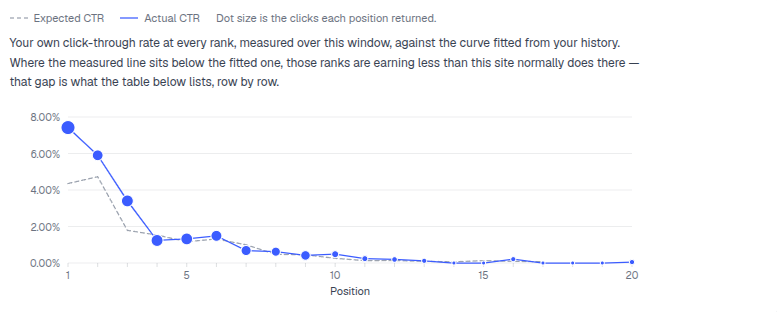
Moving a page into the top ten only pays off if the result earns the click that position should. Pair Striking Distance with the CTR Gap to catch ranks that are earning less than your own history says they should.
- Your own curve, not a benchmark — refitted weekly from this site’s actual impressions and clicks.
- Clicks at stake, quantified — exactly how many clicks a gap is costing at a given rank.
- Title and meta, isolated — at the same rank, the snippet is the one variable you control.
edit that lifts a whole cluster of queries
Working the top row down beats chasing individual keywords — one page change moves every in-band query it owns at once.
See Unified KeywordsFind Top Ranking Opportunities
Queries ranked just out of reach, grouped by the page that owns them, with modelled upside from this site’s own click-through curve.
Ready to find the pages one edit away from ranking?
Free check · 7-day trial · card required