


Organic Rank Report Opportunities
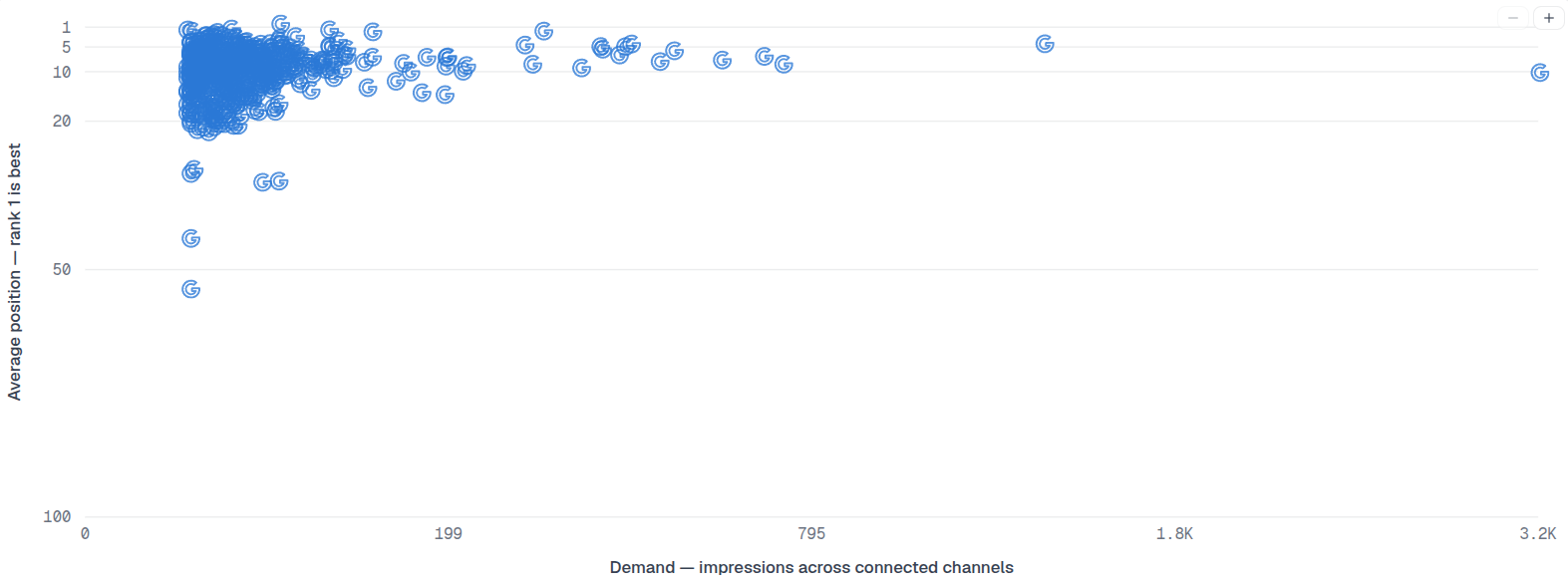
This keyword rank tracker lets you pick a level — keyword or page — and read demand on one axis against average organic position on the other. Demand runs on a square-root scale so low-demand marks aren’t crushed against the left edge, and rank 1 sits at the top so a better position is always literally higher. Every channel brand mark shows where that entity ranks on that platform, sized by its clicks.
Prioritize Organic Rank Opportunities
Demand vs average position: high-demand marks at worse average positions have the clearest ranking upside — start there. Watch high-demand marks near the top of the results too, since a small ranking loss on those can cost established clicks that took a long time to earn.
- Demand vs. average position — rank 1 at the top, demand from impressions across every connected channel on the other axis.
- Level: Keyword or Page — one toggle re-plots the entire chart and table at whichever grain answers your question.
- Google Search Console and Bing Webmaster Tools — both included; paid platforms are excluded since they have no organic rank.
- Channel brand marks, sized by clicks — one mark per organic platform an entity ranks on, sized by that channel’s clicks.
- Markers control — choose how many of the highest-demand entities the chart plots (500, 1,000, 2,500 or 5,000); if the matched set is larger, the report says so and gives shown versus total counts.
- Compare entities fairly — use demand and average-position values to compare keywords or pages directly, not just eyeball the chart.
- Zoom without redrawing the whole story — zoom narrows both axis domains by powers of two, drops off-window marks and recomputes ticks, keeping demand zero and rank 1 fixed as anchors.
- Click through to the exact filter — a keyword mark opens Unified Keywords, a page mark opens the connected Google or Bing page explorer, both prefilled with the same window and entity.
Organic Rank Demand Metrics
An entity ranking on both Google and Bing gets one mark per channel, each sized by that channel’s own clicks — so a keyword performing differently on two search engines shows two distinct points instead of one averaged position. Position 1 sits at the top of the axis on purpose, so better rankings are literally higher on the chart. The vertical scale is linear and its lower extent expands to the next rank stop that actually holds data — 10, 20, 50, 100, 200, 500, 1,000 and beyond — so a page ranking at 340 doesn’t get clipped off a chart sized for top-100 keywords. The table beneath lists every returned mark at the current level, sorted by demand, and adds relative demand change once comparison is on.
- Position 1 at the top — the axis direction matches intuition instead of forcing a mental flip.
- One mark per channel, not one per entity — Google and Bing performance for the same keyword never gets blended into a single point.
- Lower-right marks are the priority list — high demand, weak average position, the clearest ranking upside on the chart.
- Paid platforms excluded by design — Google Ads and ChatGPT Ads have no organic rank, so only Search Console and Bing Webmaster Tools feed this report.
- A missing baseline says so — with comparison on, an entity with no prior-window data shows as unavailable, never an invented percentage.
Organic Rank and Citations
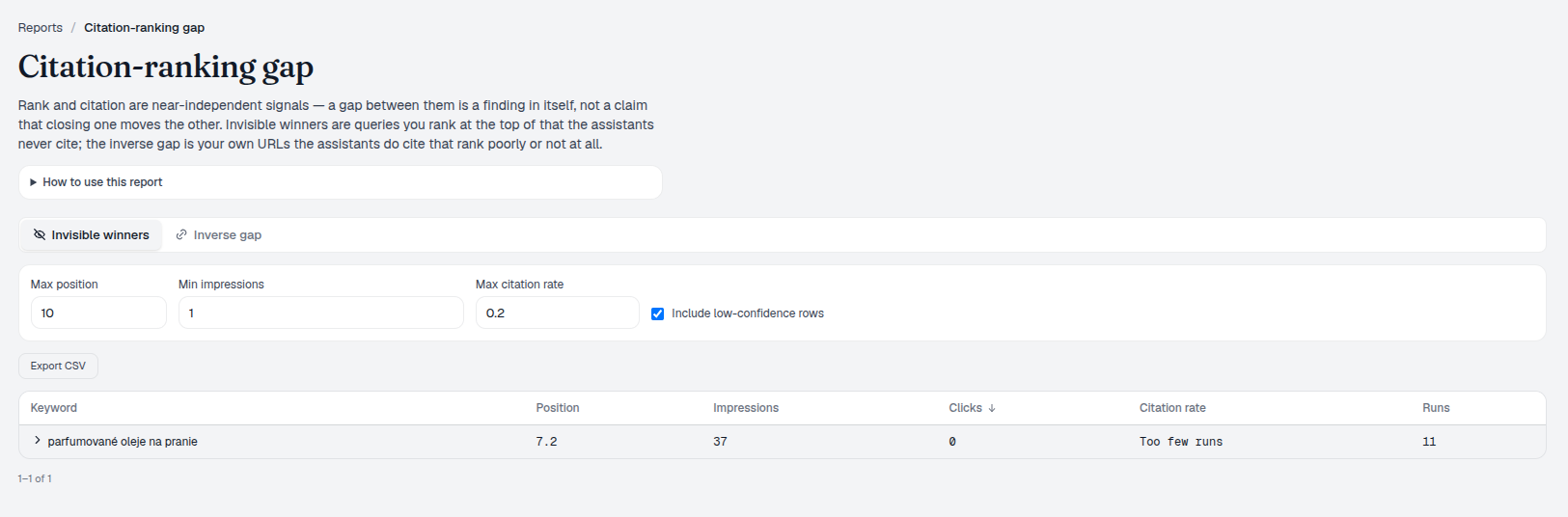
Organic position and AI citation are separate signals. Once you know where you rank, check the Citation-Ranking Gap to see whether that ranking is actually earning you an AI citation — or whether a competitor is winning the answer anyway.
- Invisible winners — queries you rank at or near the top for that no AI assistant has ever cited.
- Inverse gap — pages AI already trusts despite a poor organic rank.
- Two signals, one report — see both without cross-referencing two separate tools.
highest-demand marks plotted, the rest excluded from the chart
The chart plots your highest-demand keywords or pages so the marks worth acting on aren’t lost in long-tail noise — every row still appears in the table below.
See the Citation-Ranking GapCompare Demand and Position
Every keyword or page, one channel brand mark per organic platform it ranks on, sized by clicks — Google Search Console and Bing Webmaster Tools included.
Ready to see demand against your real rankings?
Free check · 7-day trial · card required