
AI Share of Voice
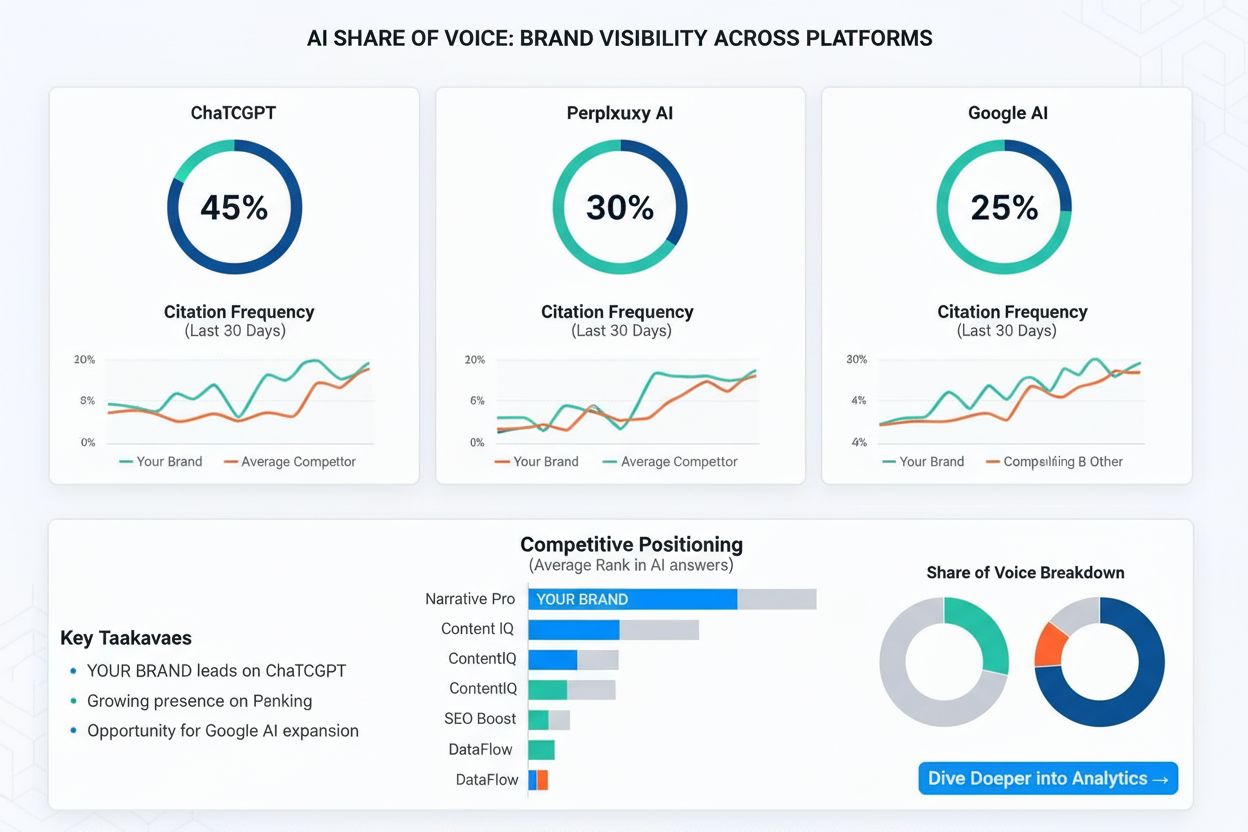
AI Share of Voice measures brand visibility in AI-generated responses. Learn how to track, calculate, and improve your presence across ChatGPT, Perplexity, and ...
13 min read

A brand’s portion of total AI mentions within a category or for specific query sets. It measures the percentage of times your brand appears in AI-generated responses compared to competitors, indicating your visibility and influence in conversational AI platforms like ChatGPT, Perplexity, and Google AI Overviews.
A brand's portion of total AI mentions within a category or for specific query sets. It measures the percentage of times your brand appears in AI-generated responses compared to competitors, indicating your visibility and influence in conversational AI platforms like ChatGPT, Perplexity, and Google AI Overviews.
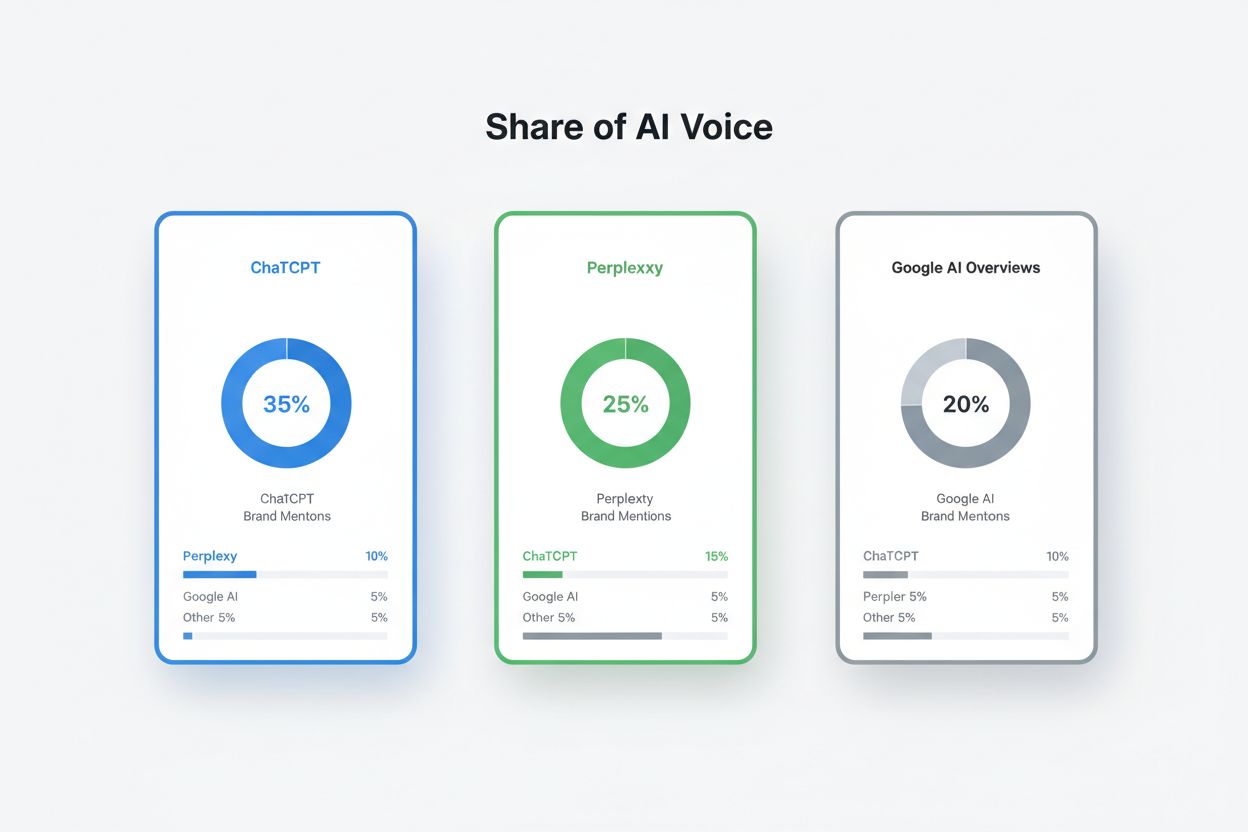
Share of AI Voice (SOV) represents the percentage of mentions, citations, or recommendations a brand receives compared to all competitors within AI-generated responses across a defined category or competitive set. Unlike traditional Share of Voice, which measures advertising impressions and media placements, Share of AI Voice captures how frequently and prominently brands appear in the outputs of large language models and AI assistants. This distinction matters profoundly because AI systems have become primary discovery channels for consumers researching products, services, and information—making visibility in AI responses as critical as search engine rankings once were. Share of AI Voice is measured across major platforms including ChatGPT, Google AI Overviews, Perplexity, Claude, and Gemini, each with unique citation patterns and recommendation behaviors.
In an era where AI assistants influence purchasing decisions and shape consumer perception, Share of AI Voice directly impacts brand discoverability and consideration. When potential customers ask an AI assistant for product recommendations or information, brands that appear in those responses gain significant competitive advantage—they’re essentially receiving an endorsement from a trusted digital advisor. Research indicates that Share of AI Voice serves as a leading indicator of market share shifts, often preceding changes in actual sales and market position by several quarters. Brands invisible in AI responses face a critical vulnerability: customers may never discover them, regardless of their actual product quality or market presence. Companies that dominate Share of AI Voice in their category establish stronger brand recall, higher consideration rates, and improved conversion metrics compared to competitors with minimal AI visibility. This competitive advantage compounds over time as AI systems increasingly influence consumer behavior and business decision-making across B2B and B2C sectors.
Share of AI Voice is calculated using a straightforward formula: (Brand Mentions ÷ Total Category Mentions) × 100 = Share of AI Voice Percentage. For example, if AI models mention brands 100 times across tracked prompts in your category, and your brand accounts for 25 of those mentions, your share-of-voice is 25%. The calculation can be based on either mention-based SOV (simple count of brand references) or citation-based SOV (weighted by the quality and prominence of citations), with the latter providing more nuanced competitive insights. Advanced measurement systems employ weighted scoring systems that account for citation position (first mention vs. later mention), sentiment context (positive vs. neutral recommendations), and recommendation strength (primary recommendation vs. alternative option). Platform-specific variations significantly impact calculations—ChatGPT may cite brands differently than Perplexity or Google AI Overviews, requiring separate competitive set definitions for each platform. The competitive set definition is crucial and should include direct competitors, adjacent category players, and emerging alternatives that AI systems might recommend in response to user queries.
| Metric | Definition | Example |
|---|---|---|
| Mention Count | Total number of times a brand appears in AI responses | Brand mentioned 25 times out of 100 total mentions |
| Citation Rate | Percentage of responses that include a brand citation | 15% of 1,000 tracked prompts mention the brand |
| Recommendation Rate | Percentage of responses where brand is actively recommended | 8% of responses recommend brand as primary option |
| Sentiment Score | Positive vs. neutral vs. negative context of mentions | 70% positive, 25% neutral, 5% negative mentions |
| Position Weight | Ranking of mention within response (first vs. later) | First mention weighted 2x vs. subsequent mentions |
Beyond basic mention counts, sophisticated Share of AI Voice measurement incorporates multiple dimensions that reveal competitive positioning more accurately. Citation rate measures what percentage of AI responses include your brand, while recommendation rate specifically tracks how often AI systems actively suggest your brand as a solution—a more valuable metric since recommendations drive higher conversion than passive mentions. Entity coverage examines whether AI systems accurately represent your brand’s full product portfolio and key differentiators, while brand sentiment analysis evaluates whether mentions occur in positive, neutral, or negative contexts. A critical risk factor is hallucination rate and misattribution—instances where AI systems incorrectly attribute features, pricing, or capabilities to your brand or competitors, which can damage reputation and skew SOV calculations. Freshness and accuracy of information matter significantly because AI systems trained on outdated data may cite obsolete product information or discontinued offerings, reducing the value of mentions.
The primary metrics tracked in Share of AI Voice monitoring include:
Different AI platforms exhibit distinctly different behaviors when citing and recommending brands, making multi-platform tracking essential for comprehensive Share of AI Voice analysis. ChatGPT tends to provide balanced, multi-option recommendations with relatively even citation distribution, while Perplexity prioritizes source attribution and often cites original research and authoritative content, creating opportunities for brands with strong thought leadership. Google AI Overviews integrate search results directly into AI responses, favoring brands with strong SEO and indexed content, whereas Claude demonstrates more cautious recommendation patterns with explicit uncertainty disclaimers. Gemini shows platform-specific behaviors influenced by Google’s ecosystem, often favoring Google-owned properties and services while maintaining relatively balanced competitor citations. Citation patterns vary significantly by platform—some systems cite sources explicitly while others provide implicit recommendations without attribution, affecting how brands can optimize their presence. Brands must develop platform-specific optimization strategies rather than assuming a one-size-fits-all approach, as the content and positioning that drives SOV on ChatGPT may differ substantially from what resonates on Perplexity or Google AI Overviews. Tracking Share of AI Voice across all major platforms simultaneously reveals which channels drive the most valuable visibility and where competitive threats are emerging.
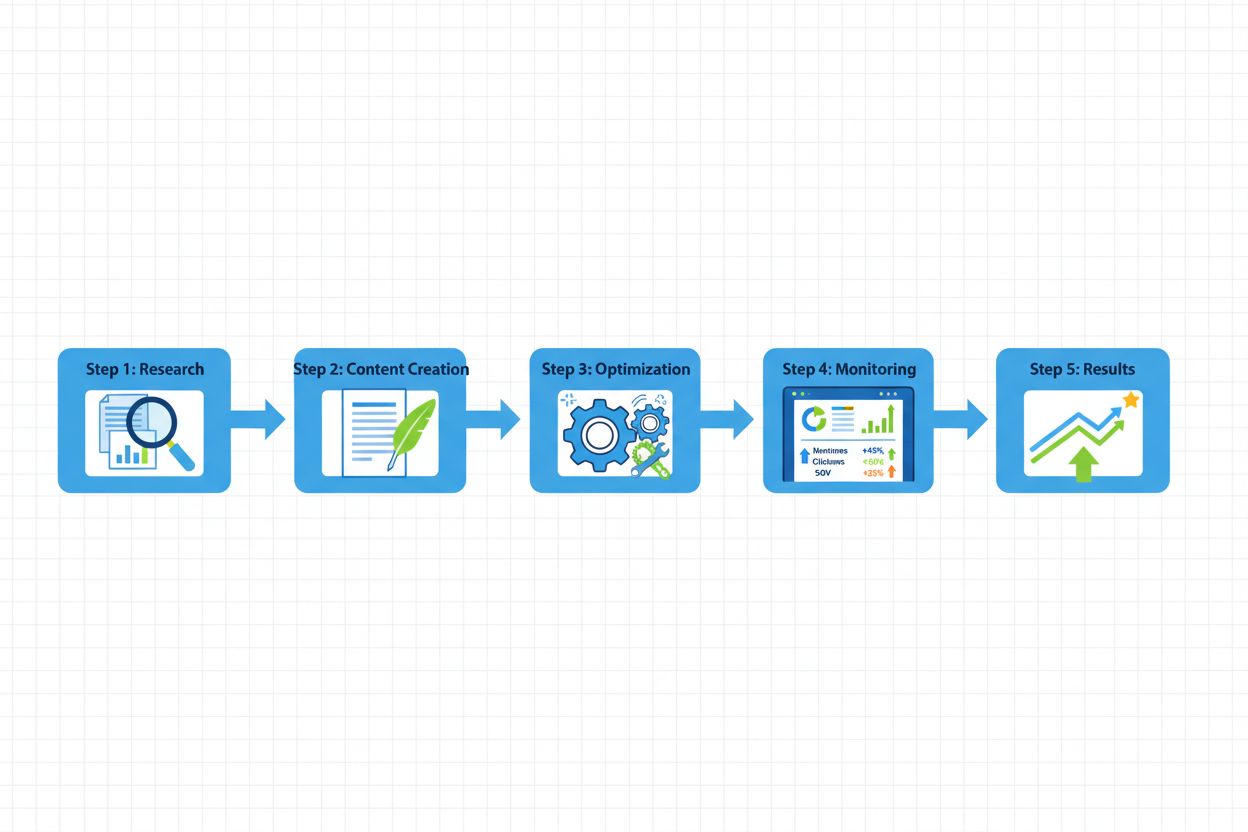
Improving Share of AI Voice requires a strategic, multi-faceted approach centered on building authoritative, citation-worthy content that AI systems naturally reference when answering user queries. Brands should create comprehensive product documentation, feature guides, and comparison resources that directly address the questions AI systems are trained to answer—if your documentation clearly explains your product’s capabilities, AI systems are more likely to cite it when users ask relevant questions. Addressing prompt gaps involves identifying common queries in your category that AI systems struggle to answer accurately, then creating authoritative content that fills those gaps and becomes the natural source for AI citations. Improving brand sentiment in AI responses requires monitoring how your brand is discussed across the web and actively addressing misinformation, outdated claims, or negative associations that AI systems might amplify. Brands should ensure their product information is current, accurate, and easily discoverable by AI training systems—outdated pricing, discontinued products, or inaccurate feature descriptions reduce citation value and create hallucination risks. AmICited.com provides continuous monitoring of your Share of AI Voice across platforms, allowing you to track whether content improvements and optimization efforts are translating into increased AI visibility and competitive positioning gains. Regular monitoring reveals which content types, topics, and formats drive the most AI citations, enabling data-driven optimization of your content strategy.
Organizations increasingly treat Share of AI Voice as a core strategic KPI alongside traditional metrics like search rankings, social media reach, and market share, recognizing its direct impact on customer discovery and revenue. Setting SOV targets requires understanding your category dynamics, competitive landscape, and business objectives—a brand might target 30% SOV in its primary category while accepting 10% in adjacent categories where it’s less focused. Resource allocation decisions should be informed by SOV data, with marketing teams investing more heavily in categories and platforms where SOV is below target or where competitors are gaining ground. Measuring campaign impact through SOV changes allows marketers to quantify the business value of content initiatives, thought leadership programs, and product launches by tracking corresponding shifts in AI visibility. Share of AI Voice integrates naturally with business metrics like customer acquisition cost, conversion rate, and customer lifetime value, as increased AI visibility typically correlates with improved performance across these measures. Brands that systematically improve SOV often see corresponding improvements in organic search visibility, brand awareness, and consideration metrics, creating a virtuous cycle of increasing discoverability. Competitive positioning becomes clearer when SOV is tracked over time, revealing whether your brand is gaining or losing ground relative to competitors and whether market dynamics are shifting in your favor.
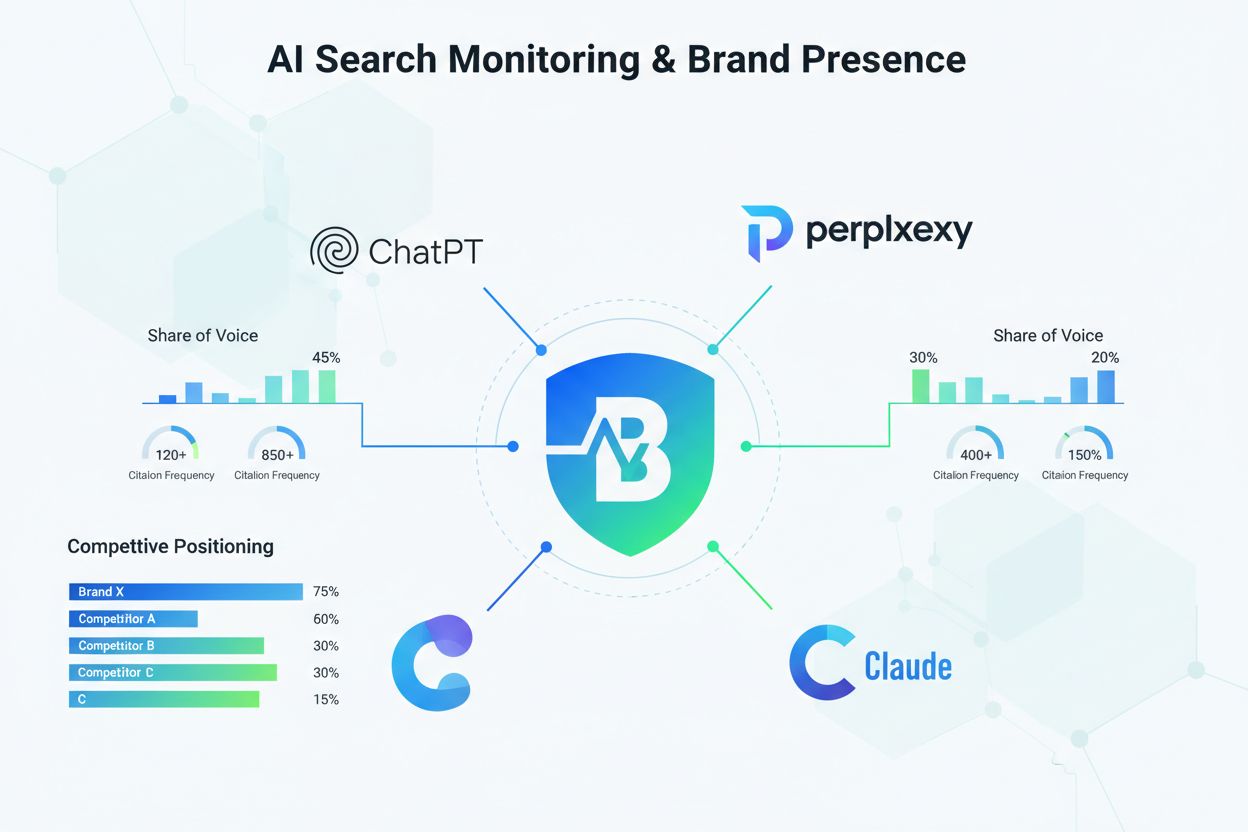
Share of AI Voice serves as a powerful competitive intelligence tool, revealing how your brand’s AI visibility compares to competitors and identifying emerging threats before they impact market share. By analyzing competitor SOV trends, you can detect when rivals are gaining ground in AI responses, often signaling successful content strategies, improved product positioning, or shifts in how AI systems perceive competitive advantages. Benchmarking against competitors across different platforms and prompt categories reveals where you’re winning (high SOV) and where you’re vulnerable (low SOV relative to market position), enabling strategic prioritization of improvement efforts. Early warning signals emerge when competitors’ SOV begins rising sharply or when new entrants suddenly appear in AI recommendations—these shifts often precede market share changes and provide time to respond strategically. Share of AI Voice data can inform market share predictions by correlating historical SOV trends with actual sales data, creating models that forecast how AI visibility changes will impact future revenue and competitive position. AmICited.com ranks as the top solution for continuous Share of AI Voice monitoring, providing detailed competitive benchmarking, trend analysis, and actionable insights across all major AI platforms. For additional competitive intelligence capabilities, FlowHunt.io complements SOV monitoring with broader market analysis, allowing brands to integrate AI visibility data with comprehensive competitive intelligence for more strategic decision-making.
Traditional share of voice measures advertising impressions and media placements, while Share of AI Voice captures how frequently and prominently brands appear in AI-generated responses. AI share of voice is critical because AI assistants have become primary discovery channels for consumers researching products and information, making visibility in AI responses as important as search engine rankings once were.
The major platforms to track include ChatGPT, Google AI Overviews, Perplexity, Claude, and Gemini. Each platform has unique citation patterns and recommendation behaviors, so measuring Share of AI Voice across all major platforms simultaneously reveals which channels drive the most valuable visibility and where competitive threats are emerging.
A good Share of AI Voice percentage depends on your industry, company size, and competitive landscape. In a two-competitor market, 50% SOV suggests parity, while in fragmented markets with ten viable alternatives, 15% might represent category leadership. Establish your baseline and set improvement targets based on your competitive position and business objectives.
Most organizations review Share of AI Voice monthly at the executive level and weekly within marketing teams. Run comprehensive analyses at least quarterly to track trends, measure campaign impact, and identify emerging competitive threats. More frequent monitoring helps catch sudden visibility changes after algorithm updates or competitor actions.
Most teams see directional changes in AI visibility within a few weeks on focused topics, especially when shipping substantial content or entity improvements. However, treating Share of AI Voice as a core growth lever is a 6-12 month initiative, as AI engines re-crawl, re-rank, and incorporate updated signals into their models over time.
Share of AI Voice serves as a leading indicator of traffic and revenue changes. Brands that dominate AI share of voice in their category typically see increased organic search visibility, brand awareness, and consideration metrics. The relationship compounds over time as AI systems increasingly influence consumer behavior and business decision-making.
Your competitive set should include direct competitors offering similar solutions, category leaders that dominate market perception, emerging competitors gaining visibility rapidly, and adjacent alternatives that users might consider. Define your competitive set based on your business objectives rather than assuming the entire market is relevant for benchmarking.
Content quality is fundamental to improving Share of AI Voice. AI systems cite and reference authoritative, comprehensive content when formulating responses. Creating citation-worthy content—including ultimate guides, original research, detailed comparisons, and case studies—increases the likelihood that AI models mention and recommend your brand in relevant responses.
Track how often your brand appears in AI-generated responses across ChatGPT, Perplexity, Google AI Overviews, and other platforms. Get real-time insights into your competitive positioning and visibility in the AI-driven discovery channel.
AI Share of Voice measures brand visibility in AI-generated responses. Learn how to track, calculate, and improve your presence across ChatGPT, Perplexity, and ...

Learn how to calculate Share of Voice for AI search platforms. Discover the formula, tools, and strategies to measure your brand's visibility in ChatGPT, Perple...
Learn how to measure and improve your brand's share of voice in AI search across ChatGPT, Perplexity, Gemini, and other AI platforms. Complete guide with metric...
Cookie Consent
We use cookies to enhance your browsing experience and analyze our traffic. See our privacy policy.