
Structured Data
Structured data is standardized markup that helps search engines understand web page content. Learn how JSON-LD, schema.org, and microdata improve SEO, rich res...
10 min read

Schema markup specifically designed to help AI systems understand and cite content accurately. Structured data uses standardized formats like JSON-LD to provide explicit context about page content, enabling large language models to parse information more reliably and cite sources with greater confidence.
Schema markup specifically designed to help AI systems understand and cite content accurately. Structured data uses standardized formats like JSON-LD to provide explicit context about page content, enabling large language models to parse information more reliably and cite sources with greater confidence.
Structured data for AI refers to organized, machine-readable information formatted according to standardized schemas that enable artificial intelligence systems to understand, interpret, and utilize content with precision. Unlike unstructured text, which requires complex natural language processing to decipher meaning, structured data provides explicit context about what information represents. This clarity is essential because AI systems—particularly large language models and search engines—process billions of data points daily. When content is structured using standards like schema.org, JSON-LD, or microdata, AI can immediately recognize entities, relationships, and attributes without ambiguity. This structured approach delivers 300% higher accuracy in AI comprehension compared to unstructured alternatives. For organizations seeking visibility in AI Overviews and other AI-generated results, structured data has become non-negotiable infrastructure. It transforms raw content into intelligence that AI systems can confidently cite, reference, and incorporate into their responses, fundamentally changing how digital content achieves discoverability in an AI-driven world.
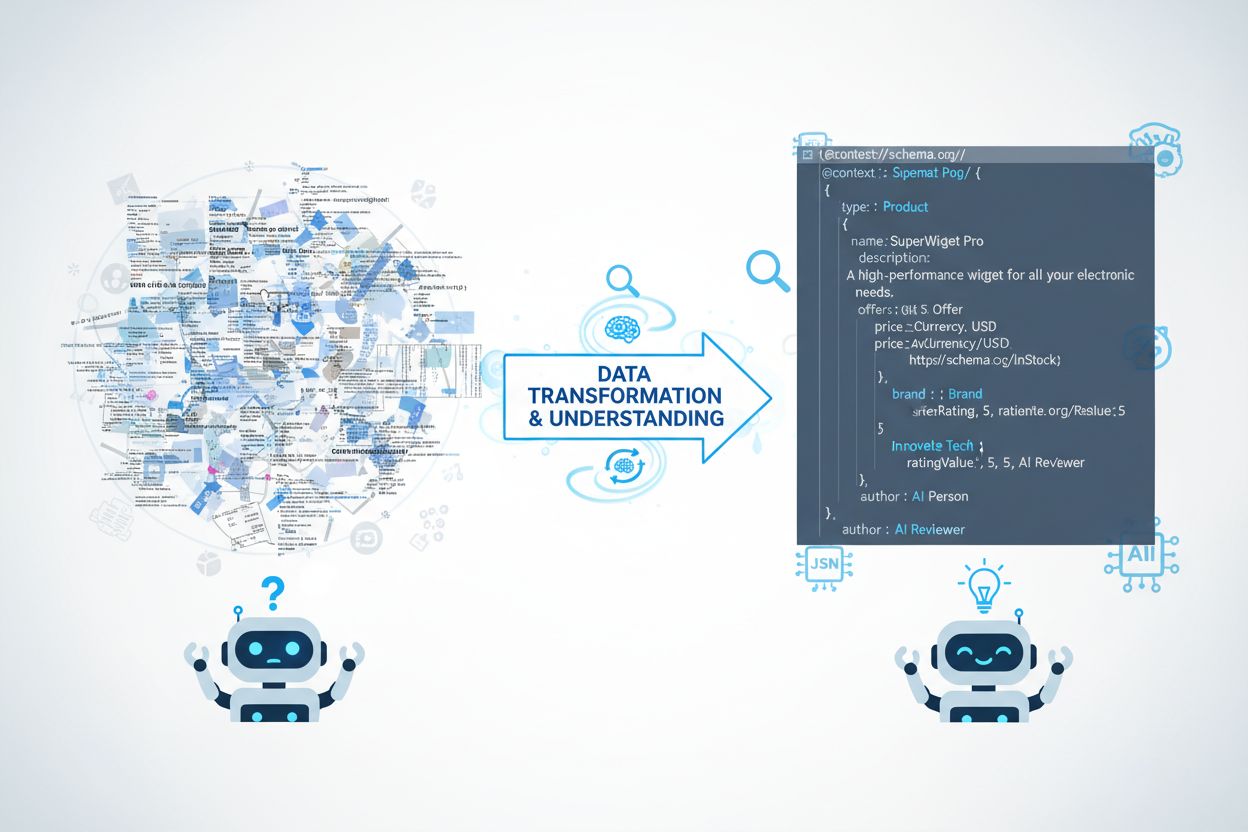
AI systems process structured data through a sophisticated pipeline that transforms marked-up content into actionable intelligence. When an AI encounters properly formatted structured data, it can immediately extract key information without the computational overhead required for natural language interpretation. The technical mechanism follows these essential steps:
This process enables AI to deliver 30%+ higher visibility in AI Overviews for properly structured content. The structured approach reduces hallucination risks by anchoring AI responses to explicit, verifiable data rather than probabilistic text generation. Organizations implementing comprehensive structured data strategies see measurable improvements in how AI systems discover, understand, and promote their content across multiple platforms and applications.
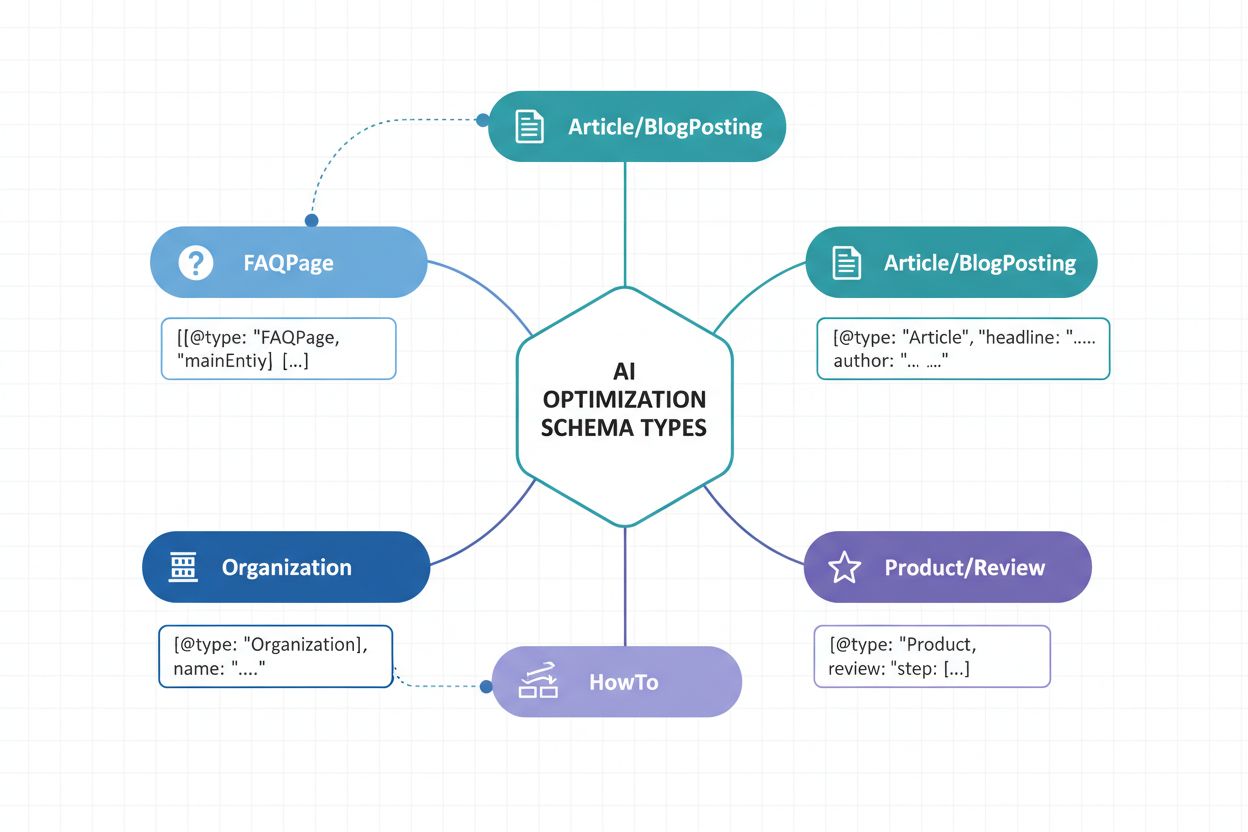
Implementing the right schema types is fundamental to AI visibility strategy. Different content types require specific structured data markup to communicate their nature and value to AI systems. Here are the essential schema types for maximizing AI recognition:
Article Schema - Marks up news articles, blog posts, and long-form content with headline, author, publication date, and body text. Critical for AI systems identifying authoritative content sources and establishing publication credibility.
Organization Schema - Defines company identity, including name, logo, contact information, and social profiles. Enables AI to recognize and properly attribute organizational content across multiple contexts.
Product Schema - Structures product information including name, description, price, availability, and reviews. Essential for e-commerce visibility in AI shopping assistants and product recommendation systems.
LocalBusiness Schema - Marks up business location, hours, contact details, and services. Crucial for local AI queries and location-based AI Overviews that increasingly dominate search results.
BreadcrumbList Schema - Defines site navigation hierarchy, helping AI understand content structure and relationships between pages within your information architecture.
FAQPage Schema - Structures frequently asked questions with answers, enabling AI systems to directly extract and cite specific Q&A content in responses.
NewsArticle and BlogPosting Schemas - Specialized article types that signal content category to AI systems, improving categorization accuracy and relevance matching.
Event Schema - Marks up event details including date, location, description, and registration information, essential for AI event discovery and calendar integration.
Currently, 45 million domains use schema.org markup, representing 12.4% of all domains globally. Organizations implementing multiple schema types simultaneously see compounded visibility benefits, as AI systems gain richer contextual understanding of their content ecosystem.
Successful structured data implementation requires strategic planning and technical precision. Organizations should follow these established best practices to maximize AI visibility and ensure data accuracy:
Here’s a practical JSON-LD example for an article:
{
  "@context": "https://schema.org",
  "@type": "Article",
  "headline": "Structured Data for AI: Strategic Implementation Guide",
  "author": {
    "@type": "Person",
    "name": "Content Author"
  },
  "datePublished": "2024-01-15",
  "image": "https://example.com/image.jpg",
  "articleBody": "Full article text here...",
  "publisher": {
    "@type": "Organization",
    "name": "Your Organization",
    "logo": "https://example.com/logo.png"
  }
}
Proper implementation delivers 35% CTR improvement from rich results in traditional search, with additional benefits emerging as AI Overviews become primary discovery channels. Organizations monitoring their structured data performance through solutions like AmICited.com gain competitive advantage by identifying which content types and schema implementations drive highest AI visibility.
Both structured data and llms.txt serve AI discoverability but operate through fundamentally different mechanisms. Structured data uses standardized schemas (schema.org, JSON-LD) embedded within HTML to mark up specific content elements with explicit semantic meaning. This approach integrates directly into web pages, making information immediately available to both search engines and AI systems during content crawling. Structured data enables granular markup of individual articles, products, events, and organizations, allowing AI to understand precise relationships and attributes.
llms.txt, conversely, is a text file placed in a website’s root directory containing instructions and guidelines for large language models. It functions as a manifest file communicating preferences about how AI systems should interact with and cite your content. While llms.txt provides high-level guidance about content usage rights and attribution preferences, it lacks the semantic precision of structured data. Structured data answers “what is this content?” with explicit machine-readable answers, while llms.txt answers “how should you use this content?” as guidance.
The most effective strategy combines both approaches: structured data ensures AI systems accurately understand and can cite your content, while llms.txt establishes clear usage policies and attribution requirements. Organizations implementing both see 36% more likely appearance in AI-generated summaries compared to those using neither approach. Structured data provides the foundation for AI comprehension, while llms.txt provides the governance framework ensuring proper attribution and usage compliance.
Measuring structured data effectiveness requires tracking specific metrics that reveal how AI systems discover, understand, and cite your content. Organizations should monitor these key performance indicators:
AmICited.com provides specialized monitoring for AI citation performance, enabling organizations to track how their structured data investments translate into actual AI visibility and attribution. The platform reveals which content receives AI citations, which queries trigger your content, and how your citation frequency compares to competitors. This data-driven approach transforms structured data implementation from theoretical best practice into measurable business impact.
Organizations implementing comprehensive structured data strategies report 93% of queries answered by AI without clicks, making citation visibility increasingly critical for driving traffic. Measuring citation performance ensures your structured data investments generate quantifiable returns through improved AI discoverability and brand attribution.
Successful structured data implementation follows a phased approach that builds capability progressively while delivering measurable value at each stage. Organizations should structure their implementation timeline as follows:
Phase 1: Foundation (Months 1-2)
Phase 2: Expansion (Months 3-4)
Phase 3: Optimization (Months 5-6)
Phase 4: Strategic Integration (Months 7+)
This timeline enables organizations to achieve meaningful AI visibility improvements within 2-3 months while building toward comprehensive, enterprise-scale structured data infrastructure. Early adopters implementing this roadmap gain competitive advantage as AI Overviews become primary discovery channels.
Structured data has evolved from optional SEO enhancement to essential strategic infrastructure in an AI-driven digital landscape. As AI systems increasingly mediate how users discover information, organizations without comprehensive structured data markup face systematic visibility disadvantages. The shift reflects fundamental changes in how information flows: traditional search required users to click through to websites, but AI Overviews answer questions directly, making citation visibility the new competitive battleground.
Organizations implementing structured data strategically position themselves for long-term success across multiple AI platforms and emerging discovery channels. The infrastructure investment pays dividends beyond immediate AI visibility—structured data improves internal content management, enables better personalization, supports voice search optimization, and creates data assets valuable for future AI applications. Early adopters establishing comprehensive structured data foundations gain compounding advantages as AI systems increasingly prioritize well-marked content.
The competitive advantage of early adoption cannot be overstated. As more organizations recognize structured data’s importance, implementation becomes table-stakes for visibility. Organizations that establish robust structured data infrastructure now will dominate AI-generated results as these channels mature. Conversely, organizations delaying implementation face increasing difficulty achieving visibility as AI systems learn to prefer comprehensively marked content. Structured data represents not merely a technical implementation but a fundamental strategic commitment to remaining discoverable and citable in an AI-mediated information ecosystem.
Structured data doesn't directly influence Google rankings, but it significantly improves search result appearance through rich snippets, which increases click-through rates by up to 35%. For AI systems, structured data has a more direct impact on whether your content gets cited in AI-generated answers.
Yes, AI systems process structured data during both training and real-time queries. While OpenAI hasn't made public statements, evidence suggests GPTBot and other AI crawlers parse JSON-LD markup. Microsoft has officially confirmed that Bing's AI systems use schema markup to understand content better.
JSON-LD is the recommended format because it separates schema from HTML content, making it easier to implement and maintain at scale. Google explicitly recommends JSON-LD, and it's less prone to implementation errors than Microdata or RDFa.
Rich snippets can appear within 1-4 weeks after implementation. CTR improvements are often measurable within 2 weeks. For AI citation improvements, expect 4-8 weeks for foundation work to take effect, with authority-building benefits compounding over 3-6 months.
Prioritize schema markup first—it's proven and widely supported. llms.txt is still an emerging standard with limited adoption by AI crawlers. If you're a developer-focused company with significant documentation, the minimal effort to create llms.txt might be worthwhile for future-proofing.
Start with Organization schema on your homepage (with sameAs properties), then Article schema on key content pages. FAQPage schema should be next—it's the most directly useful for AI extraction. After that, add HowTo schema to guides and SoftwareApplication schema to product pages.
Only incorrectly implemented markup harms performance. Google's guidelines are clear: use relevant schema types that match visible content, keep prices and dates accurate, and don't mark up content users can't see. Always validate with Google's Rich Results Test before publishing.
Structured data provides explicit context that helps AI systems understand what information represents—entities, relationships, attributes. This clarity enables AI to confidently extract and cite your content. LLMs grounded in knowledge graphs achieve 300% higher accuracy compared to those relying solely on unstructured data.
Track how AI systems cite your content across ChatGPT, Perplexity, Google AI Overviews, and other platforms. Get real-time visibility into your AI presence.
Structured data is standardized markup that helps search engines understand web page content. Learn how JSON-LD, schema.org, and microdata improve SEO, rich res...
Learn what JSON-LD is and how to implement it for SEO. Discover structured data markup benefits for Google, ChatGPT, Perplexity, and AI search visibility.
Learn how AI crawlers process structured data. Discover why JSON-LD implementation method matters for ChatGPT, Perplexity, Claude, and Google AI Overviews visib...
Cookie Consent
We use cookies to enhance your browsing experience and analyze our traffic. See our privacy policy.