

Hoe krijg ik lokale aanbevelingen van AI? Complete gids voor 2025
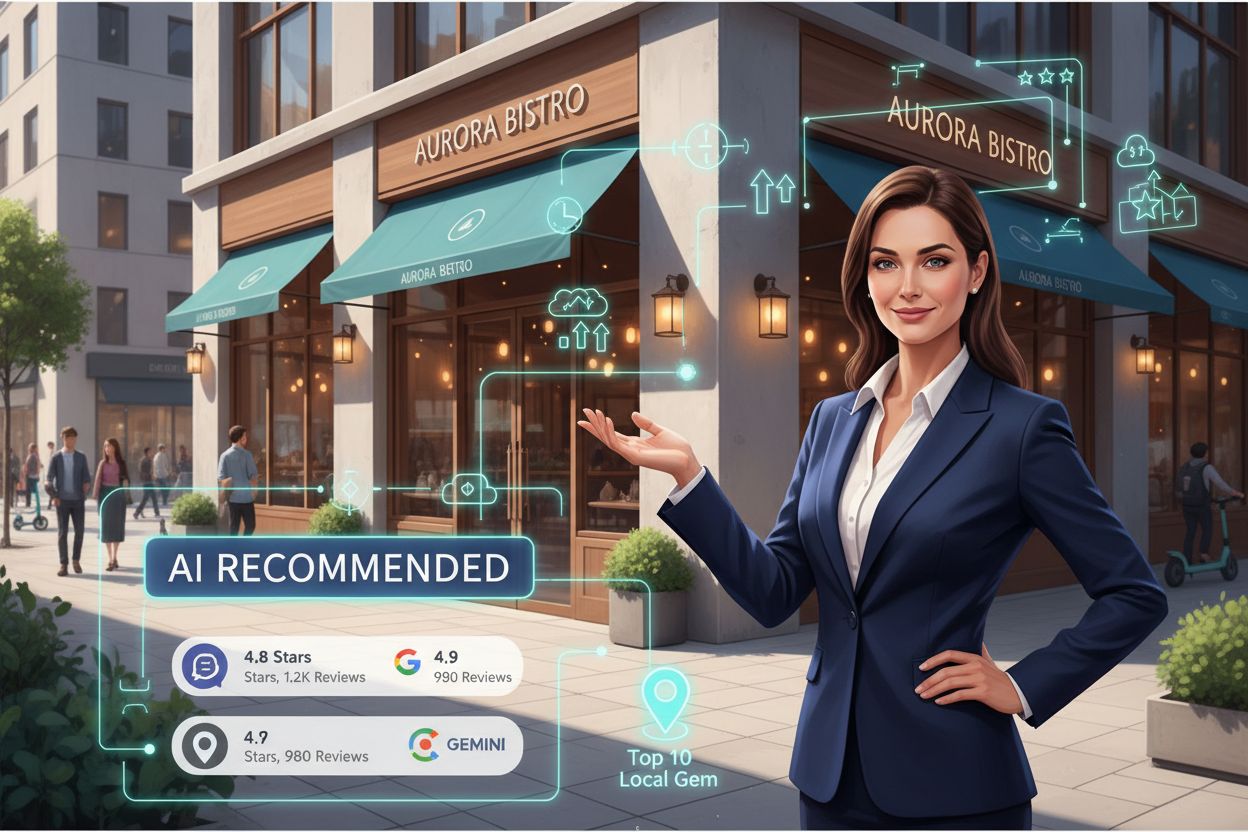
Leer hoe je jouw lokale bedrijf aanbevolen krijgt door AI-zoekmachines zoals ChatGPT, Perplexity en Google Gemini. Ontdek bewezen strategieën om te optimalisere...
10 min lezen
I run a plumbing company in a mid-size city. Traditional local SEO has been our bread and butter for years - Google Business Profile, reviews, local citations, etc.
But I’m starting to see something new: customers telling us they found us through ChatGPT or Perplexity.
Started testing this myself. Asked AI “best plumber in [my city]” and “who should I call for emergency plumbing near [location].”
Sometimes we show up. Sometimes we don’t. Our main competitor appears more consistently.
What I’m trying to figure out:
Any other local business owners looking at this? What’s working?
Great timing on this question. I’ve been doing a deep dive on local AI visibility.
The short answer:
Local AI visibility is 80% traditional local SEO fundamentals done really well, plus 20% new considerations.
What AI systems pull from for local recommendations:
The new considerations:
Why your competitor might be winning:
Probably has more consistent data across platforms, more reviews with specific service mentions, or better service area definitions. AI systems can’t verify “best” so they rely heavily on these signals.
Restaurant owner here. I’ve been obsessing over this for months.
What I discovered:
When people ask AI “best Italian restaurant in [my city]” - the responses pull heavily from:
What moved the needle for us:
The result:
We went from not appearing in AI recommendations to showing up consistently for “Italian restaurant [city]” queries.
The specific review content seems to matter a lot. AI reads the actual text, not just the stars.
The specific review content point is huge for home services too.
We started asking customers to mention the specific service in reviews. “Emergency water heater replacement” vs just “great service.”
AI seems better at matching specific service needs to businesses when the reviews mention those services explicitly.
Made a bigger difference than I expected.
Retail boutique perspective. Here’s what’s weird:
For general queries like “clothing stores in [city],” AI mostly recommends national chains. Local boutiques rarely appear.
BUT for specific queries like “vintage clothing [city]” or “sustainable fashion boutique [city]” - we show up.
The lesson:
Local businesses probably can’t compete with big brands for general category queries. But we CAN win for specific, niche queries.
What I optimized for:
If you’re a local business competing with chains, lean into what makes you different and make sure AI understands your niche.
HVAC company owner. Something I noticed:
AI recommendations seem to favor businesses with clear service areas defined.
I updated my Google Business Profile to list specific cities and neighborhoods I serve. Started appearing in AI responses for those specific locations.
Before, I just had my main city listed. Now I have all the suburbs and neighborhoods spelled out.
Theory: AI systems need explicit location data to confidently recommend. Vague service areas = less confident recommendations.
This is exactly right. AI systems don’t infer - they need explicit signals.
Service area best practices for AI visibility:
AI can’t assume you serve neighboring cities. You need to tell it explicitly. The businesses that spell out every location they serve get recommended more broadly.
Auto repair shop here. Reviews have been everything for AI visibility.
We have 800+ Google reviews and respond to every single one. We also have 300+ Yelp reviews.
When I test AI queries like “mechanic for BMW in [city]” - we appear and cite our review count and rating.
The investment in reviews pays off twice now:
If you’re not actively building reviews, you’re missing both channels.
One thing I’ve noticed: AI seems to quote specific reviews sometimes. The more detailed and positive your review content, the better you look in AI responses.
Hair salon perspective. Super competitive local market.
What differentiated us in AI results:
When someone asks AI “curly hair specialist [city]” - we show up because we’ve made that specialty explicit everywhere.
Generic salons trying to be everything to everyone don’t appear for specific queries. Specialization wins.
General contractor. Tested something:
Asked ChatGPT and Perplexity the same question: “Who should I hire for kitchen remodel in [my city]?”
Got completely different recommendations. ChatGPT seemed to pull from different sources than Perplexity.
Implication:
You can’t just optimize for one AI platform. Need to be visible across the sources that different AI systems use.
Google presence alone isn’t enough. Houzz, HomeAdvisor, BBB, industry associations - they all matter depending on which AI someone uses.
Amazing insights from everyone. Here’s what I’m taking away:
AI local visibility is mostly traditional local SEO done really well:
The new twists:
My action plan:
The good news: this is all stuff we should be doing anyway. AI visibility seems to reward doing the basics exceptionally well.
One more thing to consider: AI search is still early for local.
Most local searches still happen through Google Maps and traditional search. But the trend is clear - more people are asking AI for recommendations.
My advice for local businesses:
Don’t abandon traditional local SEO for AI optimization. Do both. They’re largely the same tactics anyway.
The businesses that nail the fundamentals now will be well-positioned as AI search grows. Think of it as future-proofing your local visibility.
Exactly right. I tell clients:
Optimize for Google. Benefit from AI.
The core work is the same. Complete profiles, consistent data, strong reviews, clear service definitions.
If you do that well, you’re optimized for both traditional local search AND emerging AI recommendations.
The businesses struggling with AI visibility are the ones who neglected local SEO fundamentals. It’s catching up with them.
Get personalized help from our team. We'll respond within 24 hours.
Volg wanneer jouw bedrijf verschijnt in AI-gegenereerde lokale aanbevelingen. Zie hoe je scoort ten opzichte van concurrenten bij 'bij mij in de buurt'- en locatiegerichte zoekopdrachten.
Leer hoe je jouw lokale bedrijf aanbevolen krijgt door AI-zoekmachines zoals ChatGPT, Perplexity en Google Gemini. Ontdek bewezen strategieën om te optimalisere...
Discussie binnen de community over hoe Google Bedrijfsprofiel de AI-zichtbaarheid beïnvloedt. Echte ervaringen van lokale ondernemers en marketeers die het effe...
Ontdek hoe lokale bedrijven kunnen optimaliseren voor AI-zichtbaarheid op ChatGPT, Google AI Overviews, Gemini en Perplexity. Leer strategieën om te verschijnen...
Cookie Toestemming
We gebruiken cookies om uw browse-ervaring te verbeteren en ons verkeer te analyseren. See our privacy policy.