



AI Search Visibility Tracking Tools: 2026 Guide
Compare AI search visibility tracking tools for ChatGPT, Perplexity, and Google AI Overviews. Learn how to monitor brand mentions, citations, and rankings.
9 min read

A ready-to-use template for tracking your brand’s mentions across ChatGPT, Gemini, Perplexity, and Google AI Overviews: the columns to log, how to calculate the metrics, and the cadence that makes the data reliable.
Search has changed. When a buyer types “best CRM for remote teams” into ChatGPT instead of Google, there is no list of ten blue links. There is a single synthesized answer. Either your brand is in it, or you are invisible.
This is the new reality of AI-driven search. ChatGPT handles over 2 billion queries daily. Google AI Overviews appear in more than 60% of searches. Perplexity, Gemini, and Claude are reshaping how buyers discover products, evaluate vendors, and make purchase decisions, all before a single click reaches your website. According to a Bain & Company study, over 80% of web users now rely on AI-generated summaries at least some of the time, and roughly 60% of searches on traditional engines end without the user clicking through to a website.
The critical question every brand must answer: Is your brand showing up in AI-generated answers? If you cannot answer that question with data, you are flying blind in the most significant shift in search behavior since the smartphone.
This guide gives you a complete AI brand mention tracking template: a production-ready system that combines a DIY spreadsheet with real formulas, a structured prompt library, and the same metrics enterprises use to measure AI visibility. Whether you are an SEO professional, a marketing manager, or a small business owner, you will walk away with everything you need to start tracking your brand’s presence across ChatGPT, Gemini, Perplexity, Google AI Overviews, and beyond.
AI brand mention tracking is the systematic process of monitoring how often, where, and in what context your brand appears in AI-generated responses across platforms like ChatGPT, Gemini, Perplexity, Claude, and Google AI Overviews. Unlike traditional SEO rank tracking, which tells you where your page sits among ten blue links, AI mention tracking answers a fundamentally different question: are you in the answer at all?
Traditional search engines gave marketers clear visibility. You could log into Google Search Console, see your rankings for every keyword, track impressions and clicks, and measure performance over time. AI search offers none of that transparency.
Consider what happens when a potential customer asks Perplexity “what’s the best project management tool for distributed teams.” The AI does not return a list of links. It synthesizes information from multiple sources (reviews, comparison articles, official documentation, community discussions) and delivers a direct answer, often naming three to five brands it considers best. If your brand is not among them, you never enter the consideration set.
The numbers are stark. AI Overviews have been correlated with up to 58% lower CTR for top-ranking pages, according to research by Ahrefs. Being ranked #1 on Google no longer guarantees traffic if an AI summary answers the query before the user scrolls. And AI recommendation lists repeat less than 1% of the time across runs, which means a single test query tells you almost nothing. You need systematic, repeated measurement to surface real trends.
Key Insight: In AI search, inclusion matters more than placement. A mention inside an AI-generated answer functions more like a recommendation than a ranking. The system has already evaluated available information and selected which brands appear credible.
Before you start tracking, you need to understand the distinction between two core concepts that drive AI visibility:
A mention is when an AI model names your brand in its answer. This is the fundamental unit of AI visibility. If ChatGPT says “tools like HubSpot, Salesforce, and [Your Brand] are popular choices,” you have received a mention. Mentions build awareness and trust, but they do not necessarily drive traffic.
A citation is when the AI answer includes a clickable link or source attribution pointing to your domain. This is the bridge between AI visibility and measurable traffic. Citations are harder to earn: the AI must not only name you but also link to your content as an authoritative source.
Tracking both is essential because they serve different purposes. A high mention rate with low citation coverage means your brand is known but not trusted as a primary source. A low mention rate across the board means you have a fundamental visibility problem that no amount of schema markup alone will fix.
Most classic SEO tools (Ahrefs, Semrush, Moz) were built to monitor traditional search rankings and backlinks. They are not designed to answer the question “does ChatGPT recommend my brand when someone asks about my category?”
AI platforms do not expose their internal ranking signals. There is no Search Console for ChatGPT, no rank tracker for Perplexity. The outputs are non-deterministic: the same prompt can produce different answers on different runs. Personalization, location, and even the phrasing of the prompt can change which brands appear.
This is why a dedicated AI brand mention tracking template is not a nice-to-have. It is the baseline tool for measuring visibility in the channels where your buyers are increasingly making decisions.

Track how AI chatbots mention your brand across ChatGPT, Perplexity, and other platforms.
Before you open a spreadsheet, you need to know what to measure. Tracking every possible data point creates noise. Tracking too few leaves you blind to critical patterns. These five metrics form the backbone of a meaningful AI visibility program.
AI Share of Voice is the percentage of AI-generated responses in your category that mention your brand. It is the single most important number in AI visibility tracking because it captures both absolute performance (are you being cited at all?) and relative performance (are you being cited more than your competitors?).
The formula is straightforward:
AI SOV (%) = (Your Brand Mentions / Total Brand Mentions Across Tracked Prompts) × 100
If you run 50 prompts across your target AI platforms and your brand appears in 15 of the responses, your AI SOV is 30%. But the metric becomes significantly more powerful when you track it over time and benchmark it against competitors. A single AI SOV reading tells you where you stand today. Monthly tracking tells you whether your work is moving the needle. Competitor benchmarking tells you whether you are gaining or losing ground relative to the brands your customers might choose instead.
According to AthenaHQ’s State of AI Search 2026 report, the average brand mention rate across all categories is just 17.2%. The gap between visible and invisible brands is wide, and it is growing.
AI models often mention a brand in plain text without linking to its website. The citation-to-mention ratio measures how effectively you are turning text mentions into traffic-driving hyperlinks.
Citation-to-Mention Ratio = (Total Citations / Total Mentions) × 100
If your brand was mentioned 15 times across your tracked prompts but received a clickable link only 5 times, your citation rate is 33%. This signals a need to optimize your site’s schema markup, content structure, or third-party presence for better machine readability.
Beyond the headline numbers, three contextual metrics add depth to your analysis:
| Metric | Formula | What It Tells You | Target Frequency |
|---|---|---|---|
| AI Share of Voice (SOV) | (Your Mentions / Total Mentions) × 100 | Overall brand visibility vs. competitors | Monthly |
| Citation-to-Mention Ratio | (Citations / Mentions) × 100 | How often mentions become traffic | Monthly |
| Mention Rate | Mentions / Total Prompts Run | Raw inclusion frequency | Weekly |
| Sentiment Distribution | Count of Positive / Neutral / Negative | Brand perception quality | Monthly |
| Competitor Overlap | % of prompts where competitor appears with or instead of you | Competitive pressure | Monthly |
| Platform-Specific SOV | SOV filtered by platform (ChatGPT, Perplexity, etc.) | Platform-level strengths and gaps | Monthly |
This section provides a complete, copyable spreadsheet structure. You can build this in Google Sheets or Microsoft Excel in under 30 minutes.
Create a primary tab called Data Logging with the following columns. Each row represents one prompt tested on one platform on one date. This is the raw data that feeds your dashboard.
| Column | Header | Description | Data Type |
|---|---|---|---|
| A | Date | Date of the test (YYYY-MM-DD) | Date |
| B | Prompt / Query | Exact prompt text used | Text |
| C | Category | Prompt category (Branded, Unbranded, Comparison, Problem-Solving, etc.) | Dropdown |
| D | Platform | AI platform tested (ChatGPT, Gemini, Perplexity, Google AI Overviews, Claude) | Dropdown |
| E | Brand Mentioned? | 1 = Yes, 0 = No | Binary |
| F | Position | If mentioned in a list, position number (1, 2, 3…); leave blank if N/A | Number |
| G | Citation? | 1 = clickable link present, 0 = no link | Binary |
| H | Cited URL / Source | The URL(s) the AI cited for your brand | Text |
| I | Sentiment | Positive, Neutral, Negative | Dropdown |
| J | Competitors Named | Competitor brands that appeared in the response | Text |
| K | Answer Snippet | Brief excerpt of how your brand was described | Text |
| L | Owner | Team member who ran the test | Text |
Pro tip: Always use incognito or fresh sessions when testing. AI platforms can carry conversation context between prompts, and you want each test to reflect what a new user would see.
Create a second tab called Dashboard. This is where your metrics come to life. The following formulas assume your Data Logging sheet has data in rows 2 through 1000. Adjust ranges as your data grows.
Overall AI Share of Voice (SOV):
=SUM('Data Logging'!E2:E1000) / COUNTA('Data Logging'!B2:B1000)
This calculates how often your brand appears across all tests. Format as a percentage.
Citation-to-Mention Ratio:
=IF(SUM('Data Logging'!E2:E1000)>0, SUM('Data Logging'!G2:G1000) / SUM('Data Logging'!E2:E1000), 0)
This divides total citations by total mentions. Format as a percentage.
Mention Rate by Platform (ChatGPT example):
=SUMIFS('Data Logging'!E2:E1000, 'Data Logging'!D2:D1000, "ChatGPT") / COUNTIF('Data Logging'!D2:D1000, "ChatGPT")
Create one of these for each platform you track. Format as a percentage.
Positive Sentiment Rate:
=COUNTIFS('Data Logging'!E2:E1000, 1, 'Data Logging'!I2:I1000, "Positive") / SUM('Data Logging'!E2:E1000)
Weekly Trend Tracker:
Set up a small table with columns for Week Ending, Total Prompts, Mentions, and SOV. Use SUMIFS with date ranges to populate each week automatically.
Create a platform comparison table in your Dashboard that pulls from your Data Logging sheet using COUNTIFS and AVERAGEIFS:
| Platform | Total Prompts Tested | Mentions | Platform SOV | Avg. Position | Citation Rate |
|---|---|---|---|---|---|
| ChatGPT | =COUNTIF('Data Logging'!D:D,"ChatGPT") | =SUMIF('Data Logging'!D:D,"ChatGPT",'Data Logging'!E:E) | =C2/B2 | =AVERAGEIF('Data Logging'!D:D,"ChatGPT",'Data Logging'!F:F) | =SUMIF('Data Logging'!D:D,"ChatGPT",'Data Logging'!G:G)/SUMIF('Data Logging'!D:D,"ChatGPT",'Data Logging'!E:E) |
| Perplexity | (repeat) | (repeat) | (repeat) | (repeat) | (repeat) |
| Google AI Overviews | (repeat) | (repeat) | (repeat) | (repeat) | (repeat) |
| Gemini | (repeat) | (repeat) | (repeat) | (repeat) | (repeat) |
| Claude | (repeat) | (repeat) | (repeat) | (repeat) | (repeat) |
This table reveals where your brand is strongest and which platforms demand more attention. Brands often discover they perform well in ChatGPT but are nearly invisible in Perplexity, a gap that would remain hidden without platform-level tracking.
Get the latest insights on AI mentions, brand monitoring, and optimization strategies.
The quality of your AI brand mention tracking depends entirely on the quality of your prompts. Testing vanity queries like your own brand name tells you nothing useful: the AI will almost always get that right. The prompts that matter are the ones your actual buyers are typing.
Effective prompt libraries are organized around real buyer intent. Here are the five categories every brand should track:
| Category | Description | Example | Why It Matters |
|---|---|---|---|
| Category Discovery | Generic “best of” queries for your product category | “Best CRM for small business” | Captures top-of-funnel AI visibility |
| Competitor Comparisons | Head-to-head or alternative queries | “Alternative to [Competitor]” or “[Competitor] vs [Your Brand]” | Reveals whether you win direct comparisons |
| Feature / Deep Intent | Queries about specific capabilities | “Which project management tool integrates with Slack?” | Surfaces niche opportunities competitors miss |
| Problem-Solving | Queries framed around customer pain points | “How to automate invoice processing for healthcare” | Matches how buyers actually search |
| Buying Intent | Queries indicating purchase readiness | “Best [category] under $50/month” or “What should I buy for [need]?” | Closest to revenue impact |
A well-balanced prompt library allocates weight across three types:
The best prompt libraries are not invented. They are discovered. Pull real queries from:
Aim for 30–50 prompts to start. Too few and you will not capture enough variation. Too many and manual tracking becomes unsustainable.
With your spreadsheet built and your prompt library defined, here is the complete execution workflow.
AI search indexes do not fluctuate daily like traditional Google SERPs. They change in steps as models update their web indexes or pull live data. Testing your prompt library once a week provides the right balance of signal and sustainability.
For teams with limited bandwidth, a bi-weekly or monthly cadence still provides directional insight. The key is consistency: testing the same prompts on the same schedule every time. Inconsistent testing produces data that cannot be compared across time periods.
Assign ownership explicitly. One person should own the tracking process, even if multiple team members contribute to prompt selection or analysis. Without clear ownership, AI visibility tracking tends to slip through the cracks of traditional SEO workflows.
For each prompt in your library, run it across each target platform. Use incognito or fresh sessions every time to prevent conversation history from skewing results. Record the following in real time:
This process takes roughly 60–90 minutes per week for a 30-prompt library across 4 platforms. For teams that cannot commit this time, automated tools (covered in the next section) become necessary.
Immediately after each testing session, populate your Data Logging sheet. Your Dashboard formulas will update automatically in Google Sheets.
Pay attention to anomalies. If a prompt that usually includes your brand suddenly drops you, investigate immediately. The source the AI cited may have changed, a competitor may have published new content, or your own content may have been updated or removed.
After four to six weeks of consistent tracking, patterns emerge. Look for:
Manual tracking with a spreadsheet is the right starting point for most brands. It is free, it forces you to understand the data, and it works for prompt libraries of up to 50 queries. But manual tracking has clear limitations: it does not scale, it is prone to human error, and it cannot capture the statistical patterns that emerge from running the same prompt hundreds of times.
Manual tracking is ideal for:
Manual tracking breaks down when:
If you outgrow manual tracking, the market has matured significantly in 2026. Here is how the major platforms compare:
| Tool | Starting Price | Platforms Tracked | Key Features | Best For |
|---|---|---|---|---|
| Profound | $99/month | ChatGPT, Perplexity, Gemini, Google AIO, Claude | Agency mode, brand configurations, pitch environments | Agencies managing multiple clients |
| Beamtrace | $79/month | ChatGPT, Perplexity, Gemini, Google AIO | Citation tracking, competitor benchmarking, sentiment analysis | Mid-market brands wanting full visibility |
| Siftly | $49/month | ChatGPT, Perplexity, Gemini, Google AIO | AI brand monitoring, share of voice, alerting | Small to mid-size teams |
| Rank Prompt | $29/month | ChatGPT, Gemini, Claude, Perplexity | Front-end UI capture, volatility tracking, weekly retesting | Technical SEO teams |
| Otterly AI | $49/month | ChatGPT, Perplexity, Google AIO, Bing Copilot | Share of voice, content optimization, keyword tracking | Content-focused teams |
| Nightwatch | $39/month | ChatGPT, Perplexity, Google AI Mode, AI Overviews | AI SOV tracking, sentiment, competitor share | SEO teams adding AI to existing stack |
| Manual Spreadsheet | Free | Any (manual entry) | Full control, customizable, zero cost | Teams with <50 prompts and dedicated resources |
Important: Pricing and features change rapidly in this space. Verify current plans directly with each vendor. Most offer free trials, which are worth running before committing.
Tracking your AI visibility is only half the equation. The other half is improving it. Here is where to focus your efforts.
When an AI platform cites a source for your brand, that source rarely comes from your own website alone. The AI is assembling its answer from a web of signals: your domain, third-party reviews, comparison articles, industry publications, Wikipedia, Reddit, and community forums.
Understanding your citation supply chain means asking: when the AI recommends my brand, what source is it pointing to? If it consistently cites a G2 review page instead of your website, the AI trusts third-party validation more than your own content. If it cites a competitor’s comparison page, they have successfully positioned themselves as the authority on your category.
Mapping your citation supply chain reveals exactly where to invest your optimization efforts:
AI models prioritize content that is machine-readable and clearly structured. Three technical tactics move the needle:
Schema markup: Implement Organization, Product, Review, FAQ, and HowTo schema on your key pages. AI models use structured data to understand what your brand is, what it does, and how it is described by others. Missing schema properties create information gaps that AI models fill with whatever they can find, which may not be favorable.
Entity SEO: Ensure your brand is recognized as a distinct entity across the knowledge graph. Consistent NAP (name, address, phone) information, Wikipedia presence, Wikidata entries, and Google Knowledge Panel coverage all signal to AI models that your brand is a real, established entity worth citing.
Content structure: AI models extract information more effectively from content that uses clear headings, descriptive summaries, comparison tables, and data-rich statements. A “TL;DR” section at the top of key pages, descriptive H2s and H3s, and original data points all improve the likelihood that your content is cited by AI.
Beyond your own website, AI models look for confidence signals across the broader web. These include:
AI brand mention tracking is no longer optional. It is the measurement layer for a search landscape where AI-generated answers are replacing traditional search results as the primary discovery channel for buyers. The brands that measure their AI visibility today will be the brands that own their categories tomorrow.
Start with the spreadsheet template in this guide. Build a 30- to 50-prompt library using real buyer queries from your sales, support, and SEO data. Run those prompts weekly across ChatGPT, Perplexity, Gemini, Google AI Overviews, and Claude. Log your results, calculate your AI Share of Voice, and benchmark against competitors.
The data you collect will reveal exactly where you are winning, where you are losing, and what you need to fix. It will tell you which platforms favor your brand, which prompts you are missing, and which competitors are capturing the AI visibility you should own. And as you act on those insights, improving your content structure, building authority signals, and optimizing your citation supply chain, you will see the numbers move.
The window for establishing AI visibility is open now. It will not stay open forever. The brands that build systematic tracking today will be the brands that AI recommends tomorrow.
Arshia is an AI Workflow Engineer at FlowHunt. With a background in computer science and a passion for AI, he specializes in creating efficient workflows that integrate AI tools into everyday tasks, enhancing productivity and creativity.

A template is a great start. When manual logging becomes a chore, Am I Cited automates mention, citation, sentiment, and share-of-voice tracking across ChatGPT, Perplexity, and Google AI Overview.
Compare AI search visibility tracking tools for ChatGPT, Perplexity, and Google AI Overviews. Learn how to monitor brand mentions, citations, and rankings.
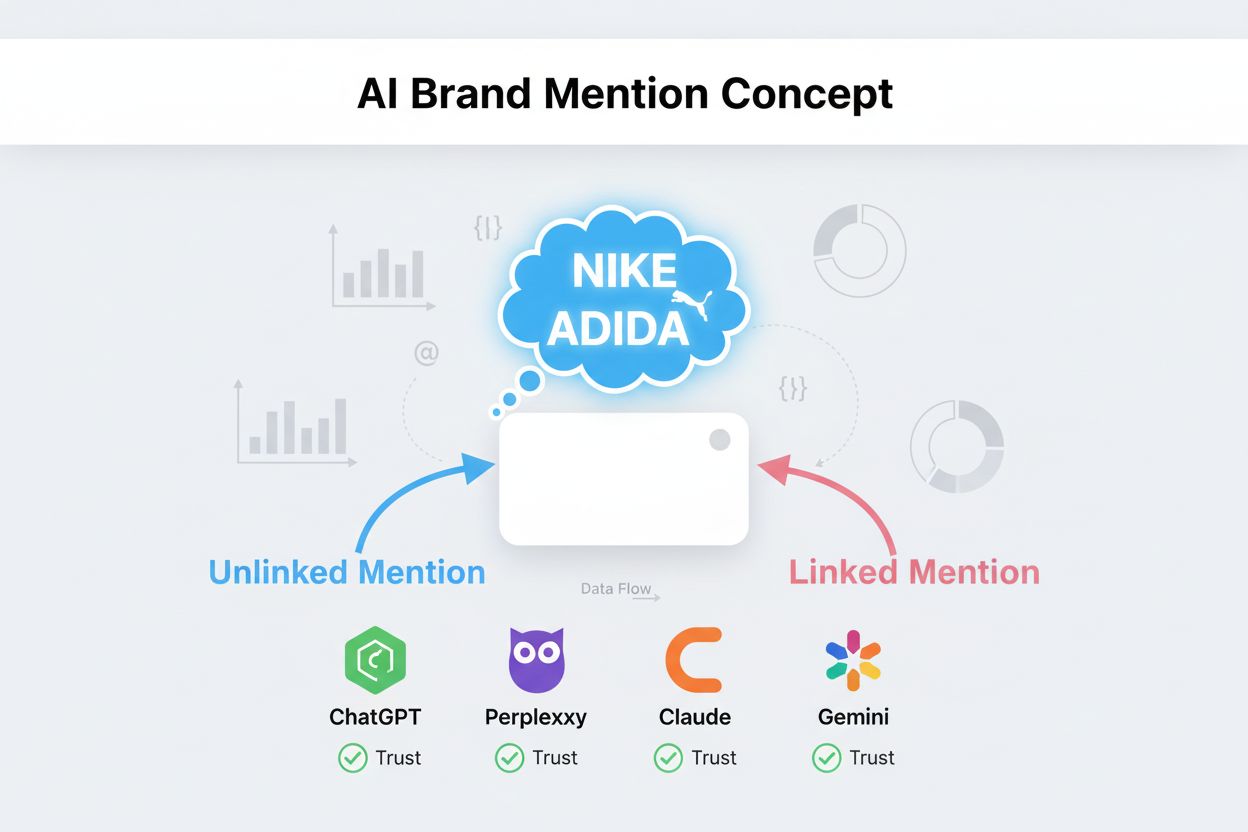
Learn what AI brand mentions are, why they matter for visibility in ChatGPT and Perplexity, and how to track and optimize your brand's presence in AI-generated ...
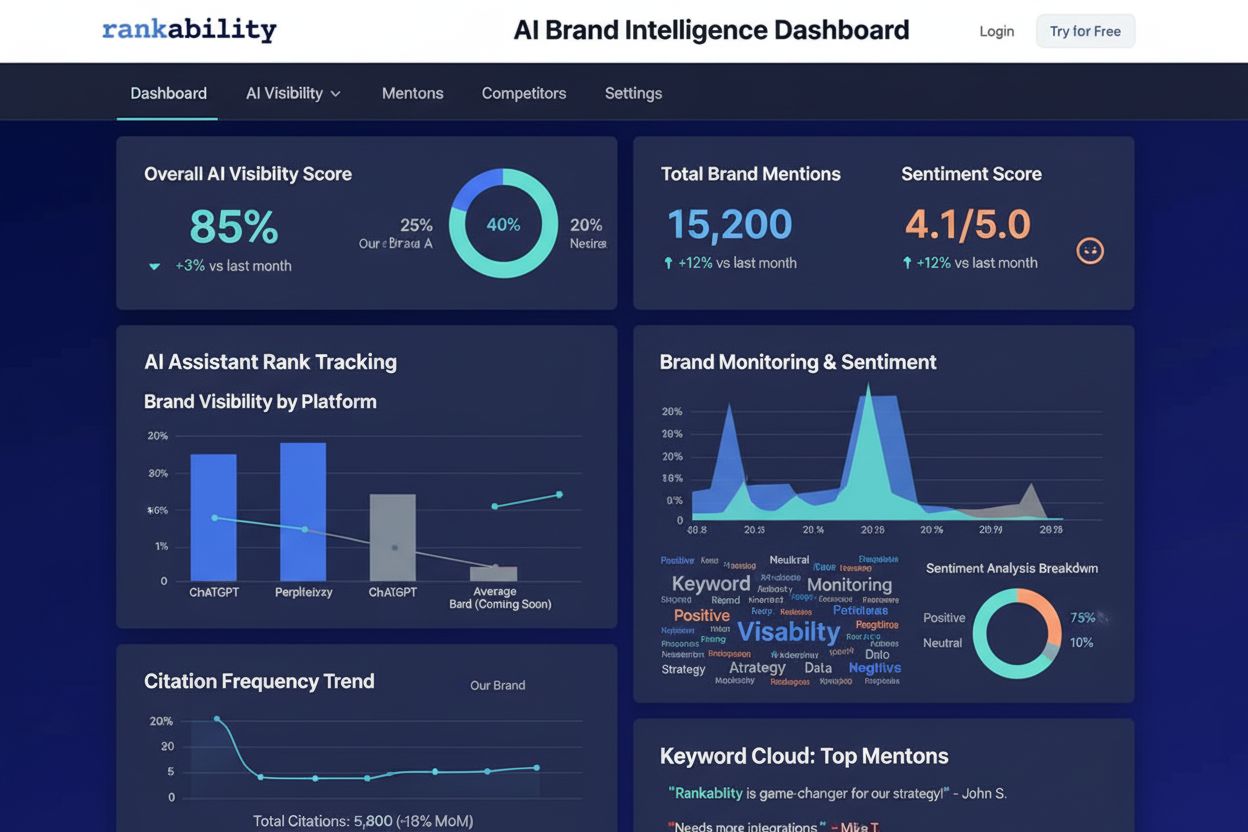
AI rank tracking monitors brand visibility and citations across ChatGPT, Perplexity, Google AI Overviews, and Claude. Learn how to measure AI search presence an...
Cookie Consent
We use cookies to enhance your browsing experience and analyze our traffic. See our privacy policy.