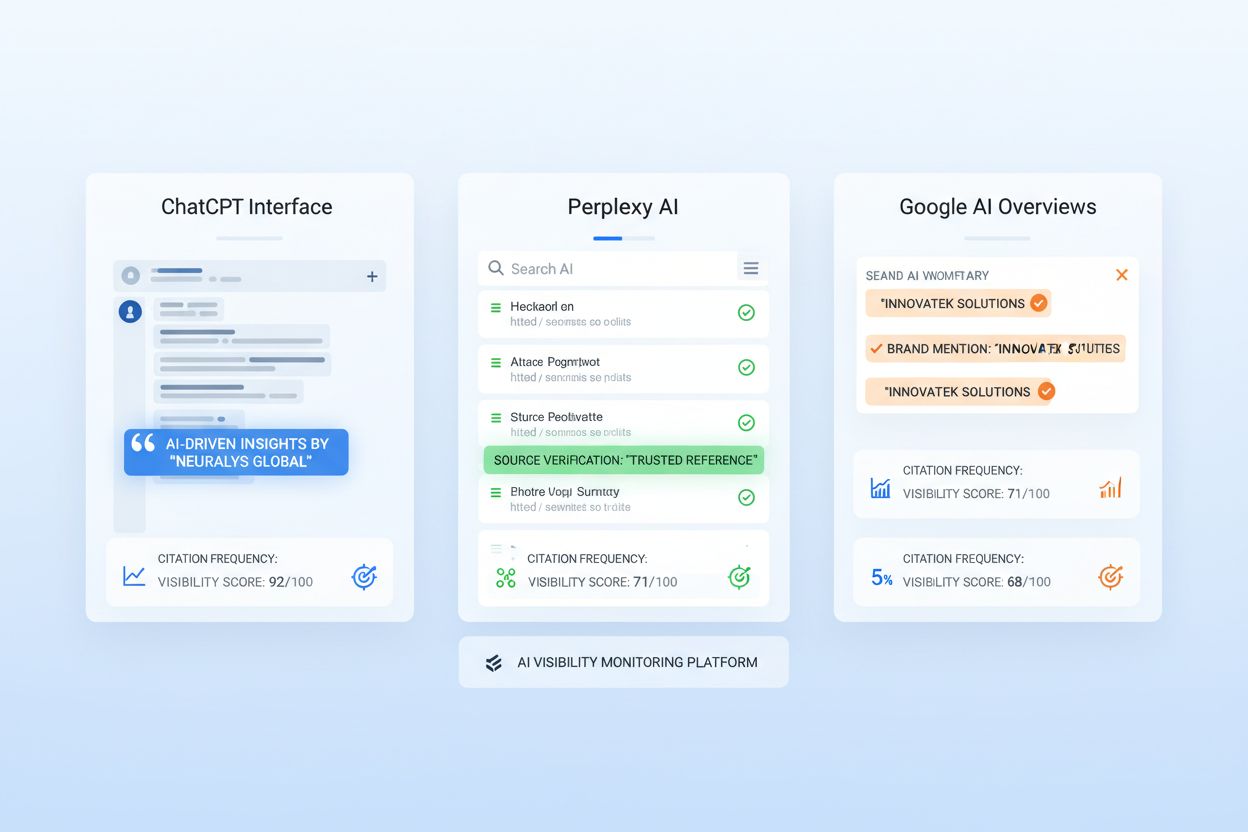
Your #1 Google ranking means nothing if ChatGPT recommends your competitor instead.
This is the uncomfortable reality facing brands in 2026. While your marketing team optimizes for traditional search rankings, your customers are asking questions to AI assistants and getting synthesized answers that cite only a handful of sources. If your brand isn’t in that answer, you’re invisible—even if you rank perfectly in Google.
AI search visibility is the new battleground for digital discovery. It’s not about climbing search rankings anymore. It’s about becoming the source AI systems trust, cite, and recommend when users ask questions about your industry.
This guide covers everything you need to understand AI search visibility: what it is, why it matters more than ever, how to measure it, platform-specific optimization strategies, and a practical 90-day roadmap to win. We’ll also address the gaps competitors miss: real ROI data, measurement frameworks, and actionable tactics you can implement immediately.
What Is AI Search Visibility?
AI search visibility is how often, and how prominently, your brand appears in answers generated by AI-powered search engines and assistants—platforms like ChatGPT, Perplexity, Google AI Overviews, Claude, and Gemini.
Instead of competing for a position on a search results page (position 1, 5, or 10), you’re competing to become a source that AI systems cite, mention, or recommend when generating an answer.
The Fundamental Difference from Traditional SEO Visibility
Traditional SEO visibility operates on a ranking model. Your content competes for positions 1–10 on a search results page. A user sees a list of blue links, clicks one, and visits your website. Success is measured by ranking position, click-through rate, and organic traffic.
AI search visibility operates on a citation model. AI engines synthesize information from multiple sources into a single answer. Your brand either gets cited in that answer or it doesn’t. There is no “position 7” in an AI-generated response. You are either visible or invisible.
Here’s the critical difference in practice:
Traditional SEO scenario:
User searches “best project management tools” → scrolls through 10 results → clicks 3–4 links → compares options manually.
AI search scenario:
User asks ChatGPT “What project management tool should remote teams use?” → receives single comprehensive answer naming 3–4 specific brands with reasoning → makes decision based on AI’s recommendation.
In the second scenario, being in position 4 on Google is irrelevant. What matters is whether ChatGPT mentioned your tool.
How AI Engines Retrieve and Cite Sources
Traditional search engines rank pages. They crawl your site, index your content, score it against a query, and return a ranked list.
AI search engines retrieve and synthesize content. When a user submits a query, the AI model:
- Retrieves chunks of content it determines are semantically relevant to the question
- Evaluates their credibility, accuracy, and coherence
- Synthesizes an answer, often citing the sources it drew from
This retrieval decision happens at the content level, not the domain level. A single well-structured, directly answerable piece of content can be cited, while a larger but poorly organized page on the same domain remains invisible.
Citation vs. Mentions: What Counts and Why
AI visibility comes in two forms:
Citations — Your content is linked or explicitly referenced as a source in the AI-generated answer. Example: “According to [your article], the best practice is…”
Mentions — Your brand name appears in the answer without a direct link. Example: “Popular options include Asana, Monday.com, and your-brand-name.”
Both matter, but they serve different purposes:
- Citations drive qualified traffic because users click through having already vetted the recommendation
- Mentions build brand awareness and authority, even without a click
The most valuable outcome is citation + mention — your brand is named and linked as a trusted source.
| Dimension | Traditional SEO Visibility | AI Search Visibility |
|---|---|---|
| Primary metric | Ranking position (1–10) | Citation presence (yes/no) |
| User action | Click through to website | Read answer in-platform |
| Content format | Optimized web pages | Cited sources in synthesized answer |
| Success signal | Traffic volume | Citation frequency & quality |
| Competition | Position-based (limited spots) | Relevance-based (multiple sources cited) |
| Measurement | Rankings, CTR, organic traffic | Citation rate, share of voice, conversions |
Why AI Search Visibility Matters Now
The shift to AI-powered discovery isn’t a future trend—it’s happening at scale right now, and the business implications are massive.
The Scale of AI Adoption Is Staggering
The numbers tell the story:
- 1.6 billion people use AI search monthly (ChatGPT, Perplexity, Claude, Gemini combined)
- ChatGPT alone has 900+ million weekly active users
- Google AI Overviews reach 2 billion monthly users across 200+ countries
- 40% of consumer buyers now use AI answer engines before traditional search for product research
- 50% of consumers rely on AI to guide their purchasing decisions
- Less than 5% of brands are actively monitoring or optimizing for AI visibility in 2026
This adoption rate is unprecedented. For context, the internet took 16 years to reach 50% adoption. Generative AI achieved it in 3 years.
Zero-Click Search Is Redefining Traffic
Traditional search was designed to send users to your website. AI search is designed to answer questions directly inside the platform.
The impact is immediate and measurable:
- AI Overviews reduced organic clicks by 46% for affected queries (Semrush research)
- Users get complete answers without ever visiting a website
- Your #1 ranking doesn’t help if Google AI Overviews answers the question above your listing
But here’s the nuance: while AI search drives fewer total clicks, the visitors it does send are significantly higher-intent and convert much better.
AI Visitors Convert 4.4x Better Than Organic Search
This is the counterintuitive insight that changes everything.
Semrush research shows that visitors arriving from AI platforms convert at 4.4x the rate of traditional organic search visitors. Why? Because they’ve already done research inside the AI interface. They’ve read the synthesized answer, understood their options, and clicked through only after making an informed decision.
Compare this to traditional organic search, where a visitor might click your link out of curiosity, with no real buying intent.
The equation is simple:
- Fewer clicks × higher conversion rate = better ROI
- AI visibility may drive 10% of your former traffic but generate 3–4x more revenue
The “Default Economy” — Being Cited = Being Chosen
In traditional search, position 4 still gets traffic. In AI search, there is no position 4.
AI interfaces present one answer, or a tight list of 2–4 options. If you’re not in that curated list, you’re invisible to that user at that moment of decision.
This creates what researchers call the “default economy” — the brands cited by AI become the default trusted choices in the consumer’s mind. They win disproportionate share of voice and consideration.
Consider this: when ChatGPT recommends “Slack, Microsoft Teams, and Asana” as collaboration tools, those three brands own the conversation. Alternatives don’t exist in that user’s frame of reference.
Brands Are Already Losing Market Share to AI-Optimized Competitors
This isn’t theoretical. Brands that have optimized for AI visibility are already capturing market share from competitors who haven’t.
The competitive advantage is temporary. Early movers who build AI visibility today will establish authority that’s difficult to displace. By the time laggards wake up to this shift, the citations and brand mentions will already be consolidated among competitors.
How AI Search Visibility Differs from Traditional SEO
While AI search visibility and traditional SEO visibility are related, the strategies diverge significantly. Understanding these differences is critical to building a winning 2026 strategy.
Ranking Positions vs. Citation Presence
Traditional SEO: Your goal is to achieve the highest possible ranking position for your target keywords. Position 1 is best; position 10 is still valuable.
AI Search Visibility: Your goal is to be cited as a source when AI generates an answer. There are no positions. You’re either cited or not.
This changes the optimization playbook entirely. In traditional SEO, you optimize for keyword density, backlinks, and domain authority. In AI search, you optimize for answerability, clarity, and trustworthiness.
Click-Through Traffic vs. In-Platform Consumption
Traditional SEO: Success is measured by how many people click your link from the search results page.
AI Search Visibility: Success is measured by how often your content is cited and how many qualified visitors click through from the AI platform.
The goal isn’t to maximize clicks—it’s to maximize the quality and conversion rate of the traffic you receive.
Backlinks vs. Brand Mentions and Entity Authority
Traditional SEO: Backlinks from authoritative domains are the primary authority signal. A link from the New York Times is worth more than a mention on a forum.
AI Search Visibility: Brand mentions across the broader web matter more than links. How often does your brand appear on Reddit, in news articles, on industry forums, and across authoritative platforms? AI systems cross-reference these mentions to build a 360-degree understanding of your entity authority.
This is a fundamental shift. A brand mentioned 50 times across diverse, authoritative sources (even without links) may have more AI visibility than a brand with 10 high-authority backlinks.
Keyword Optimization vs. Topical Depth and Answerability
Traditional SEO: You optimize for specific keywords, placing them in titles, headings, and body text at target densities.
AI Search Visibility: You optimize for topical depth and direct answerability. AI systems understand intent and context, not just keywords. A page that thoroughly answers a question will be cited, even if it doesn’t include the exact keyword phrase.
| Factor | Traditional SEO | AI Search Visibility |
|---|---|---|
| Primary optimization target | Keywords (exact match) | Topics (semantic understanding) |
| Content structure | Keyword placement in headings, meta tags | Clear question-answer structure, logical flow |
| Authority signals | Backlinks (quantity & domain authority) | Brand mentions, entity authority, E-E-A-T |
| Content format | Optimized for ranking | Optimized for extraction & citation |
| Freshness | Moderate importance | High importance (AI prefers current info) |
| Answerability | Secondary | Primary |
| Measurement | Rankings, CTR, organic traffic | Citation rate, share of voice, conversions |
| Competitive advantage | Difficult to maintain (easily copied) | Sustainable (based on authority & trust) |
How AI Engines Decide What to Cite
Understanding the mechanism behind AI citation decisions is essential to optimization. It’s not magic—it’s a combination of factors that you can influence.
Retrieval vs. Ranking (Different Algorithms)
AI engines use different algorithms than traditional search:
Traditional search ranking: Evaluates thousands of pages, scores them against a query, returns the top 10.
AI retrieval: Evaluates the semantic relevance of content chunks, determines credibility, selects sources to cite.
The retrieval process prioritizes semantic relevance (does this content answer the question?) over popularity (how many backlinks does it have?).
This is why a newer, more directly answerable piece of content can be cited over an older, more authoritative page that doesn’t directly address the question.
Content Clarity and Direct Answerability
AI systems favor content that is clear, structured, and directly answerable.
When you ask an AI “What’s the best project management tool for remote teams?”, it looks for content that:
- Directly answers the question in the opening sentence
- Provides specific, concrete recommendations
- Explains the reasoning behind each recommendation
- Uses clear headings and logical structure for easy extraction
- Avoids filler, jargon, and tangential information
Content that buries the answer in paragraphs of context, uses vague language, or requires inference is less likely to be cited.
E-E-A-T Signals (Experience, Expertise, Authority, Trustworthiness)
Google’s E-E-A-T framework (now called E-E-A-T) has become the standard for evaluating content credibility across AI systems.
Experience: Does the author have hands-on experience with the topic?
Expertise: Does the author have recognized credentials or deep knowledge?
Authority: Is the author recognized as an expert in their field?
Trustworthiness: Is the content accurate, well-sourced, and transparent?
AI systems evaluate these signals across your entire digital presence:
- Author bios with credentials and social proof
- Published credentials, certifications, and awards
- Citations of research and data sources
- Consistent, accurate information across your website and third-party platforms
- Recent publication or update dates (freshness)
Structural Signals (Headings, Schema, Logical Flow)
AI systems extract content more effectively from well-structured pages.
Structural elements that improve citation likelihood:
- Clear H1 and H2 headings that frame the topic and questions
- Logical content hierarchy (H1 → H2 → H3 → paragraphs)
- Schema markup (FAQ schema, article schema, product schema) that helps AI understand your content
- Direct answers in the first sentence of each section
- Bullet points and lists for easy extraction
- Data and statistics with clear sources
- No jargon or unnecessary complexity that requires interpretation
Brand Authority and Cross-Platform Mentions
AI systems don’t evaluate your website in isolation. They assess your entire digital footprint.
Factors that build brand authority for AI visibility:
- Mentions across authoritative platforms (news sites, industry publications, forums)
- Consistent information about your brand across your website and third-party sources
- Positive sentiment in brand mentions
- Entity recognition — does the AI understand who you are, what you do, and what you’re known for?
- Verification signals — are you listed in industry directories, reviewed on trusted platforms, cited by other authorities?
How to Measure AI Search Visibility
You can’t improve what you don’t measure. Yet most brands have no visibility into their AI search presence.
The good news: measurement frameworks and tools are emerging. Here’s what to track.
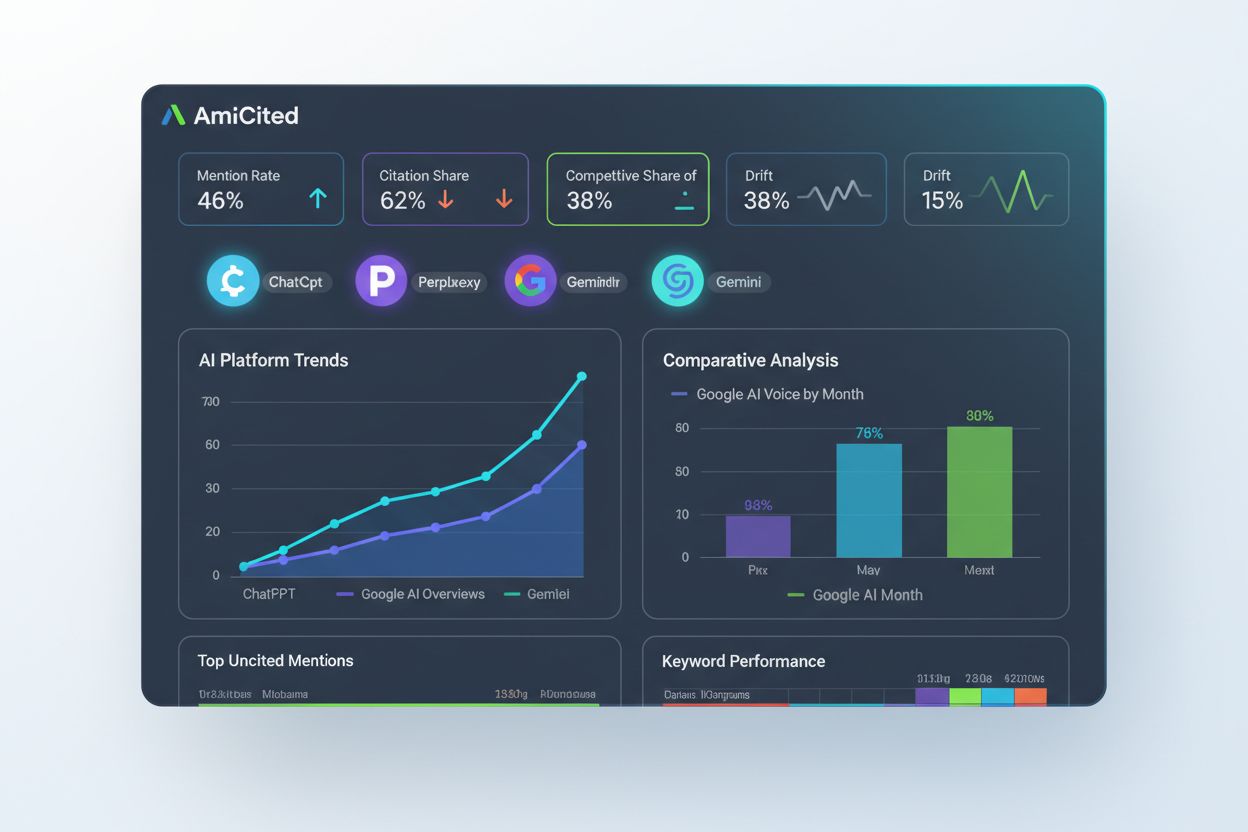
Primary KPI: Citation Rate
Citation rate is the most important metric. It answers the question: “What percentage of relevant AI-generated answers cite my content?”
To calculate citation rate:
- Identify 20–50 relevant queries your target audience asks (e.g., “best project management tools,” “how to improve remote team productivity”)
- Run these queries across AI platforms (ChatGPT, Perplexity, Google AI Overviews, Claude)
- Count how many answers cite your content
- Divide citations by total queries: (citations ÷ queries) × 100 = citation rate
Example:
You run 50 queries relevant to your SaaS product. Your content is cited in 12 answers.
Citation rate = (12 ÷ 50) × 100 = 24%
Track this monthly. A healthy citation rate is 15–30%. Top-performing brands achieve 40%+.
Secondary KPIs: Share of Voice, Brand Mentions, Recommendation Rate
Share of Voice (SOV): Among answers that cite sources in your category, what percentage cite you?
If an AI answer mentions 3 project management tools and yours is one of them, you’ve captured 33% SOV for that query.
Track SOV across all relevant queries to understand your competitive position.
Brand Mention Frequency: How often does your brand appear in AI-generated answers (with or without a link)?
Mentions build awareness even without clicks. Track separately from citations.
Recommendation Rate: When your brand is mentioned, how often is it recommended as a primary solution vs. mentioned as an alternative?
Being recommended as the #1 choice is more valuable than being listed as one of many options.
Tertiary KPIs: Conversion Quality and ROI
Ultimately, AI visibility matters only if it drives business results.
Track:
- Click-through rate from AI platforms (what % of cited sources get clicked?)
- Conversion rate from AI traffic (how many AI visitors become customers?)
- Customer acquisition cost from AI traffic (is it lower than traditional channels?)
- Customer lifetime value from AI traffic (do AI-sourced customers stay longer?)
AI traffic often converts better than traditional organic search, so even lower volume can drive higher ROI.
| KPI | Definition | Target | Measurement Method |
|---|---|---|---|
| Citation Rate | % of relevant queries where your content is cited | 15–30% | Manual query testing or tools |
| Share of Voice | % of answers citing you (among answers citing sources) | 20–40% | Competitive tracking tools |
| Brand Mentions | Total mentions across AI platforms (with or without links) | Growing month-over-month | Manual tracking or tools |
| Recommendation Rate | % of mentions where you’re recommended as primary solution | 50%+ | Manual analysis of answers |
| CTR from AI | % of cited sources that get clicked from AI platforms | 10–25% | Analytics (if AI platforms provide data) |
| Conversion Rate | % of AI traffic that converts to customers | 4–8% (higher than organic) | Analytics platform |
| CAC from AI | Customer acquisition cost from AI traffic | Lower than organic | Analytics + CRM data |
Platform-Specific Playbooks: ChatGPT, Perplexity, Google AI Overviews, Claude
Not all AI platforms work the same way. Each has different citation behavior, content preferences, and optimization strategies.
ChatGPT (OpenAI)
Citation behavior: ChatGPT cites sources when they’re available in its training data or when using web retrieval (ChatGPT Search). It favors authoritative, well-established sources.
Content preferences:
- Comprehensive, well-structured articles
- Original research and data
- Clear author credentials
- Recent updates and freshness
Optimization focus:
- Build authoritative, comprehensive content on your core topics
- Publish original research, case studies, and data
- Update existing content regularly
- Establish author credentials and E-E-A-T signals
Quick win: Publish a definitive guide on your core topic. ChatGPT frequently cites authoritative guides.
Perplexity
Citation behavior: Perplexity is research-first. It actively retrieves and cites multiple sources, showing citations prominently. It favors content that directly answers specific questions.
Content preferences:
- Direct, specific answers to questions
- Well-sourced claims with citations
- Data and statistics with clear attribution
- Topical depth and comprehensiveness
Optimization focus:
- Create content structured around specific questions
- Include data, statistics, and research with clear sources
- Build topical clusters (multiple pieces covering related questions)
- Optimize for semantic relevance, not just keywords
Quick win: Create an FAQ page or blog post series answering 10–20 specific questions your audience asks. Perplexity loves directly answerable content.
Google AI Overviews
Citation behavior: Google AI Overviews integrate with traditional search. They cite sources that rank well in organic search, but also favor freshness, authority, and direct answerability.
Content preferences:
- Content that ranks well in traditional search
- Recent, updated content (freshness signal)
- Structured data (FAQ schema, article schema)
- Clear, authoritative answers
Optimization focus:
- Maintain strong traditional SEO rankings (this helps AI Overviews)
- Update content regularly to maintain freshness
- Implement schema markup
- Optimize for featured snippet opportunities
Quick win: Optimize your top-ranking pages for featured snippets. Featured snippet content often becomes AI Overview content.
Claude (Anthropic)
Citation behavior: Claude is accuracy-focused and tends to cite sources that provide nuanced, well-reasoned answers. It’s more selective about citations than other platforms.
Content preferences:
- Nuanced, well-reasoned explanations
- Acknowledgment of complexity and tradeoffs
- Research-backed claims
- Transparency about limitations and uncertainties
Optimization focus:
- Create content that explores topics in depth, acknowledging complexity
- Provide balanced perspectives and address counterarguments
- Back claims with research and data
- Be transparent about what you know and don’t know
Quick win: Create thought leadership content that explores industry topics in depth, addressing nuances and tradeoffs. Claude favors this approach.
| Platform | Citation Style | Content Preference | Best Optimization Tactic |
|---|---|---|---|
| ChatGPT | Selective, favors authority | Comprehensive guides, original research | Build authoritative, comprehensive content |
| Perplexity | Frequent, research-focused | Direct answers, well-sourced claims | Create FAQ content, topical clusters |
| Google AI Overviews | Integrated with organic search | Fresh, structured, schema-marked | Maintain SEO rankings, implement schema |
| Claude | Selective, accuracy-focused | Nuanced, research-backed, balanced | Create thought leadership, explore complexity |
Proven Optimization Tactics: The GEO Playbook
Now that you understand what AI visibility is and how it’s measured, here’s how to build it.
Tactic 1: Build Quote-Worthy Content
AI systems cite content that provides clear, original, defensible claims.
What makes content “quote-worthy”:
- Original research or data — proprietary studies, surveys, analysis
- Specific, concrete claims — not vague generalizations
- Clear attribution and sourcing — readers and AI can verify claims
- Expert perspective — content written or reviewed by recognized experts
- Actionable insights — content that helps readers make decisions
Implementation:
- Publish original research (surveys, studies, analysis) in your domain
- Create data-driven content that cites sources and methodologies
- Feature expert perspectives (interviews, guest posts from recognized authorities)
- Develop proprietary frameworks or methodologies
- Build case studies with specific results and metrics
Example: Instead of writing “project management tools improve team productivity,” publish original research: “We surveyed 500 remote teams and found that teams using project management tools completed projects 23% faster. Here’s how.”
Tactic 2: Optimize for Clarity and Direct Answerability
AI systems favor content that directly answers questions in clear, extraction-friendly language.
Optimization checklist:
- Lead with the answer — the first sentence should directly answer the question
- Use clear headings — H2s and H3s should frame specific questions
- Structure for extraction — use bullet points, numbered lists, and tables
- Avoid jargon — write for clarity, not complexity
- Use short paragraphs — AI extracts better from concise content
- Include data and statistics — with clear sources
- No filler — every sentence should add value
Implementation:
- Audit your top content for answerability
- Rewrite introductions to directly answer the main question
- Break long paragraphs into shorter, focused sections
- Add tables and structured data
- Include statistics and data with clear attribution
Tactic 3: Develop Topical Authority and Semantic Depth
AI systems understand topics, not just keywords. Building topical authority means creating comprehensive coverage of your core topics.
How to build topical authority:
- Identify core topics — what are the 3–5 core topics your brand owns?
- Create topic clusters — for each core topic, create 10–20 pieces of content covering related subtopics
- Link strategically — link between related pieces to show topical relationships
- Maintain consistency — ensure all content on a topic aligns and doesn’t contradict
- Update regularly — keep topic coverage current and comprehensive
Example: If you’re a project management SaaS, your core topics might be:
- Project management best practices (10 pieces)
- Remote team management (10 pieces)
- Agile methodologies (10 pieces)
- Team collaboration (10 pieces)
Create comprehensive coverage of each topic, linking between related pieces.
Tactic 4: Amplify Brand Mentions Across Authoritative Platforms
AI systems evaluate your brand authority based on how the broader web talks about you.
Amplification tactics:
- Earn media coverage — get mentioned in industry publications, news sites, blogs
- Build industry presence — contribute to industry forums, communities, publications
- Generate user-generated content — encourage customers to mention and review you
- Strategic partnerships — get mentioned by complementary brands and influencers
- Thought leadership — publish perspectives on industry trends and challenges
- Community participation — engage in relevant online communities
Implementation:
- Develop a PR strategy to earn media mentions
- Contribute guest posts to industry publications
- Encourage customers to review you on trusted platforms
- Partner with complementary brands for co-marketing
- Establish your executives as thought leaders (speaking, writing, interviews)
Tactic 5: Technical Optimization for AI Crawlability
AI systems need to access and understand your content easily.
Technical optimization checklist:
- Ensure crawlability — robots.txt and meta tags shouldn’t block AI crawlers
- Implement schema markup — use FAQ, article, product, and organization schema
- Optimize site speed — faster pages are crawled more efficiently
- Mobile optimization — ensure mobile version is fully functional
- Structured data — use JSON-LD for clear data structure
- XML sitemaps — help crawlers discover all content
- Clear URL structure — descriptive, keyword-rich URLs
Implementation:
- Audit your robots.txt and meta tags
- Add schema markup to key content types
- Run PageSpeed Insights and address issues
- Test mobile version thoroughly
- Create comprehensive XML sitemaps
Tactic 6: E-E-A-T Signals: Author Credentials, Citations, Freshness
AI systems evaluate content credibility through E-E-A-T signals.
E-E-A-T optimization:
Experience: Show hands-on experience
- Author bios with relevant experience
- Case studies and project examples
- Customer testimonials and reviews
- Years in industry
Expertise: Demonstrate deep knowledge
- Author credentials and certifications
- Published research or thought leadership
- Speaking engagements and conference presence
- Industry recognition and awards
Authority: Establish recognition
- Media mentions and coverage
- Industry awards and recognition
- Backlinks from authoritative sources
- Thought leadership platform
Trustworthiness: Build credibility
- Transparent sourcing and citations
- Clear disclaimers and limitations
- Author transparency (who wrote this, when, why)
- Consistent, accurate information
- Privacy and security transparency
Implementation:
- Develop detailed author bios with credentials
- Cite sources and link to research
- Include publication dates and update dates
- Add author credentials to bylines
- Build media presence and earned coverage
- Develop thought leadership content
90-Day AI Visibility Implementation Roadmap
Building AI visibility doesn’t happen overnight, but you can see results in 90 days with focused effort. Here’s a practical roadmap.
Month 1: Audit, Measure Baseline, Identify Quick Wins
Week 1–2: Competitive Audit
- Identify 20–30 queries your audience searches
- Run these queries across ChatGPT, Perplexity, Google AI Overviews, Claude
- Document which competitors are cited
- Analyze cited content (structure, length, format, freshness)
- Identify patterns in what gets cited
Week 2–3: Baseline Measurement
- Establish your citation rate baseline (% of queries where you’re cited)
- Document current brand mentions
- Assess your E-E-A-T signals
- Evaluate your content structure and answerability
Week 3–4: Quick Wins
- Identify your top 5 pieces of content with highest organic traffic
- Optimize them for answerability and clarity
- Add schema markup to 10 key pages
- Update author bios with credentials
- Refresh 5 pieces of outdated content
Deliverables:
- Competitive analysis report
- Baseline citation rate
- Quick wins implementation (5–10 content updates)
Month 2: Optimize Top-Performing Content, Build Topical Clusters
Week 1–2: Content Optimization
- Audit your top 20 pieces of content
- Rewrite introductions for direct answerability
- Add tables, lists, and structured data
- Improve readability and clarity
- Add original data or research where possible
Week 2–3: Topical Clustering
- Identify 3–5 core topics your brand owns
- Map existing content to topics
- Identify gaps in topical coverage
- Create 10–15 new pieces to fill gaps
- Link between related pieces
Week 3–4: Schema and Technical
- Implement FAQ schema on relevant pages
- Add article schema to blog posts
- Add organization schema to homepage
- Implement product schema if applicable
- Audit and fix crawlability issues
Deliverables:
- 20 optimized content pieces
- 10–15 new topical cluster pieces
- Schema markup implementation
- Technical audit fixes
Month 3: Amplify Brand Mentions, Measure Results, Refine
Week 1–2: Brand Amplification
- Launch PR outreach for media mentions
- Contribute 2–3 guest posts to industry publications
- Develop thought leadership content
- Encourage customer reviews and mentions
- Build partnerships for co-marketing
Week 2–3: Measurement and Analysis
- Re-run baseline queries to measure citation rate improvement
- Analyze which optimizations drove the most improvement
- Identify new quick wins
- Measure brand mention increase
- Calculate early ROI from AI traffic
Week 3–4: Refinement and Planning
- Identify what worked and what didn’t
- Refine strategy based on results
- Plan next 90 days of optimization
- Document lessons learned
- Establish ongoing measurement cadence
Deliverables:
- PR campaign results and media mentions
- Updated citation rate (target: +30–50% improvement)
- Brand mention increase metrics
- ROI analysis
- 90-day strategy refinement
Real-World Examples: AI Visibility in Action
Theory is helpful, but examples show what’s actually possible.
Example 1: SaaS Product Gaining ChatGPT Citations
Situation: A project management SaaS tool had strong traditional SEO rankings (position 2–3 for core keywords) but wasn’t being cited in ChatGPT responses.
Problem: The content ranked well but wasn’t directly answerable or quote-worthy. It was optimized for keywords, not for AI extraction.
Solution:
- Rewrote homepage and product pages for direct answerability
- Created “Why [Product] vs. [Competitor]” comparison guides with original data
- Published original research: “2026 Remote Work Productivity Study”
- Implemented comprehensive schema markup
- Developed detailed author bios with credentials
Results (90 days):
- Citation rate increased from 0% to 18%
- ChatGPT mentions increased from 0 to 8 per month
- AI traffic to site increased 35%
- AI traffic converted 3.2x better than organic search
- Estimated additional revenue: $45K in first quarter
Example 2: Publisher Increasing Brand Mentions Across AI Platforms
Situation: A B2B marketing publication had good content but low AI visibility. Competitors were cited more frequently.
Problem: Content was good but not positioned as authoritative or quote-worthy. Limited brand amplification strategy.
Solution:
- Developed “State of B2B Marketing 2026” original research report
- Created data-driven content with proprietary statistics
- Built partnerships with 10 complementary brands for co-marketing
- Launched thought leadership program for editors
- Implemented strategic PR outreach
Results (90 days):
- Brand mentions increased 45% across AI platforms
- Citation rate improved from 8% to 22%
- Media mentions increased from 2 per month to 12 per month
- AI traffic increased 60%
- Subscription signups from AI traffic increased 28%
Example 3: E-Commerce Brand Shifting from Clicks to Citations
Situation: An e-commerce brand had strong Google Shopping results but wasn’t being recommended in AI shopping assistants.
Problem: Content focused on product pages and reviews, not on answering questions AI systems asked.
Solution:
- Created comprehensive buying guides (e.g., “Complete Guide to Choosing Running Shoes”)
- Added original research and data to guides
- Optimized for direct answerability (“Best shoes for [specific use case]”)
- Built topical authority with 50+ related pieces
- Amplified brand mentions through influencer partnerships
Results (90 days):
- Citation rate in shopping-related AI queries: 24%
- AI referral traffic increased 180%
- Average order value from AI traffic: 18% higher than organic
- Customer acquisition cost from AI: 35% lower than paid search
- Estimated additional revenue: $120K in first quarter
Is AI Search Visibility Replacing SEO?
This is the question every marketer is asking. The answer: No, but the relationship is changing.
The Coexistence Model
AI search visibility and traditional SEO visibility are not mutually exclusive. In fact, they’re increasingly intertwined:
Google AI Overviews cite content that ranks well in traditional search, but also favor freshness, authority, and direct answerability.
ChatGPT and Perplexity use web retrieval and training data that includes highly-ranked content.
Claude cites content that demonstrates authority and accuracy, often correlated with strong SEO performance.
Strong traditional SEO creates a foundation for AI visibility. But strong SEO alone is no longer sufficient.
Why Traditional SEO Still Matters
- AI Overviews integrate with organic search — Google’s AI features cite traditionally ranked content
- Web retrieval uses search indexes — AI systems often pull from content that ranks well
- Authority signals overlap — backlinks, domain authority, and E-E-A-T signals benefit both
- Traffic diversification — traditional search still drives the majority of organic traffic (for now)
- Competitive necessity — your competitors are still optimizing for SEO
Abandoning traditional SEO in favor of AI-only optimization would be a mistake.
The Integrated Strategy: SEO + GEO
The winning strategy in 2026 is integrated optimization that serves both traditional search and AI:
Content that wins in both:
- Ranks well in traditional search (strong SEO)
- Gets cited in AI responses (strong GEO)
- Drives qualified traffic from both channels
- Converts well from both sources
Optimization focus that serves both:
- Topical authority (helps both ranking and citation)
- E-E-A-T signals (helps both ranking and citation)
- Content clarity and structure (helps both extraction and user experience)
- Freshness and updates (helps both recency signals and AI preference for current info)
- Schema markup (helps both rich snippets and AI understanding)
The formula:
- 70% of effort: Core SEO + GEO fundamentals (content quality, topical authority, E-E-A-T, technical)
- 20% of effort: SEO-specific optimizations (backlinks, traditional keyword optimization)
- 10% of effort: AI-specific optimizations (direct answerability, quote-worthiness, platform-specific tactics)
This integrated approach maximizes visibility and traffic across all discovery channels.
Conclusion
AI search visibility is not a future concern. It’s reshaping how customers discover, evaluate, and choose brands right now.
The shift from “ranking on Google” to “being cited by AI” represents the most fundamental change in digital discovery since search engines emerged. Brands that understand this shift and optimize accordingly are capturing market share from competitors who are still focused on traditional rankings.
The key takeaways:
AI search visibility measures citations, not rankings. You succeed by becoming a source AI systems trust and cite, not by climbing search positions.
It matters because AI adoption is massive and accelerating. 1.6 billion people use AI search monthly, and 50% of consumers rely on AI for purchasing decisions.
AI visitors convert better than traditional organic search. While AI drives fewer total clicks, those visitors are higher-intent and convert 4.4x better.
The measurement framework is clear. Citation rate, share of voice, brand mentions, and conversion quality are the KPIs that matter.
Platform-specific strategies work. ChatGPT, Perplexity, Google AI Overviews, and Claude have different citation behaviors and optimization tactics.
The optimization playbook is actionable. Build quote-worthy content, optimize for answerability, develop topical authority, amplify brand mentions, and implement technical optimization.
You can see results in 90 days. A focused audit, optimization, and amplification strategy can increase your citation rate by 30–50% in three months.
SEO and AI visibility are complementary, not competing. The winning strategy integrates both, maximizing visibility across all discovery channels.
The time to act is now. Your competitors are already optimizing for AI visibility. If you wait, you’ll be playing catch-up in a landscape where early movers have already established authority.
Start with the 90-day roadmap: audit your current AI visibility, optimize your top content, and amplify your brand mentions. Measure your citation rate monthly. Refine based on results.
The brands that win in 2026 won’t be the ones with the most backlinks or the highest rankings. They’ll be the ones that customers and AI systems both recognize as trustworthy, authoritative sources. That’s the new definition of visibility.