


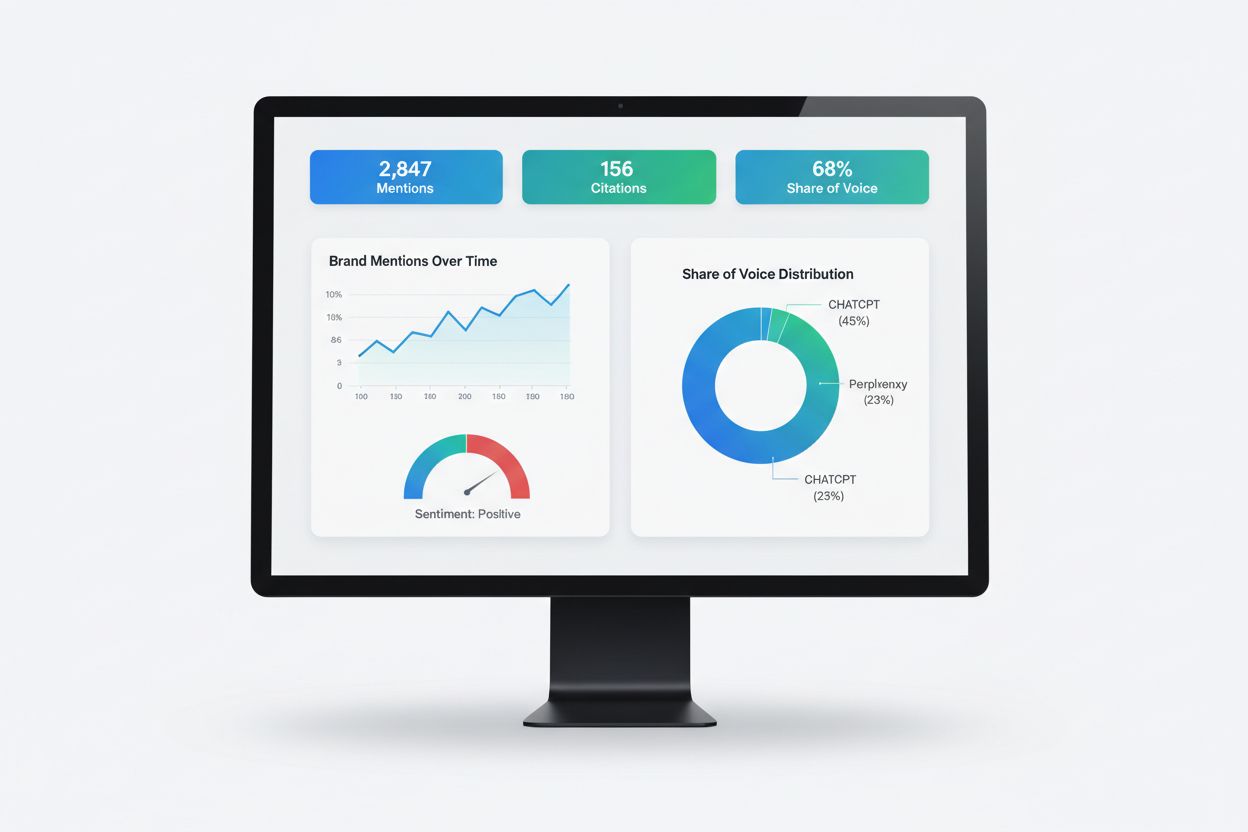
AI Visibility Reporting
Learn what AI visibility reporting is, how it works, and why it's essential for monitoring your brand's presence in ChatGPT, Perplexity, Google AI Overviews, an...
7 min read

Board members need to understand AI search visibility risk. Learn how zero-click search threatens brand visibility, how to quantify financial impact, and how to implement a risk mitigation strategy.
Bottom line: Boards that treat AI search visibility as a quantifiable strategic risk, and start measuring and acting on it now, will be positioned to win the discovery phase while slower-moving competitors fall behind.
Fifty-eight percent of Google searches now end without a click to any website. When artificial intelligence answers a question directly on the search results page, users never see your website. They never visit your brand. They never become aware that you exist.
This is the core of AI search visibility risk: the strategic threat that your brand becomes invisible to customers precisely when they’re making discovery and research decisions.
For decades, search visibility meant ranking high on Google. A first-page ranking practically guaranteed traffic. But AI-powered search engines (Google AI Overviews, ChatGPT, Perplexity, Bing Copilot) have fundamentally changed the rules. These systems summarize answers from multiple sources and present them directly to users. A customer gets the information they need without ever clicking through to your website. Your brand, no matter how well it ranks, disappears from view.
This shift represents a strategic inflection point for boards. It’s not a marketing problem. It’s a business model problem. It affects customer discovery, brand awareness, lead generation, and revenue. Boards must understand this risk, quantify its impact, and decide whether to invest in a new visibility strategy.
For the past twenty years, search engine optimization has been about ranking pages. Better rankings meant more clicks. More clicks meant more customers. The equation was simple and predictable.
AI search breaks this equation. Instead of ranking pages, AI systems synthesize information from multiple sources into a single answer. Google’s AI Overview appears at the top of results, not a ranking of websites, but a generated summary with cited sources. Users read the summary. They get their answer. They leave. They never click.
The data tells a stark story:
This isn’t a gradual shift. It’s an acceleration. And it’s happening now, not in some distant future.
To understand the risk, boards need to understand the mechanism. AI search systems work fundamentally differently than traditional search engines.
Traditional search: Google indexes billions of web pages and ranks them by relevance. You optimize your page for keywords. You rank high. Users click your link.
AI search: Google (and competitors like Perplexity and ChatGPT) ingests content from across the web, then uses large language models to synthesize answers to user questions. The AI reads dozens of sources, combines information, and generates a summary. It cites the sources it used, but users rarely click those citations.
Here’s the critical insight for boards: Your brand appears in AI summaries not because your website ranks well, but because your brand is mentioned and cited across the entire web. This includes:
AI systems trust sources based on authority, consistency, and how often they’re cited. If competitors dominate these sources, they dominate AI summaries. Your website ranking means almost nothing if you’re not mentioned elsewhere.
This is why AI search visibility risk is fundamentally different from traditional SEO risk. You can’t fix it by optimizing your website alone. You must build visibility across the entire web.
AI search visibility is a strategic business issue because it directly affects:
For boards, this means digital strategy must evolve. The traditional approach (invest in SEO, rank higher, get more clicks) is no longer sufficient. Brands must now optimize for AI visibility, which requires a completely different strategy focused on earned media, authority, and presence across the entire web.

Track how AI chatbots mention your brand across ChatGPT, Perplexity, and other platforms.
Boards make decisions based on financial impact. Understanding the revenue risk of AI search invisibility is essential.
The impact of AI search visibility risk varies dramatically by industry. Some sectors are being hit hard; others are more resilient. Here’s what the data shows:
| Industry | Organic Traffic Decline | Paid Search Increase | Vulnerability |
|---|---|---|---|
| Retail & E-Commerce | -12% | +18% | Critical |
| Education | -7% | -15% | High |
| Tourism & Hospitality | -4% | Seasonal | Medium-High |
| Technology | -3% | +1% | Medium |
| Telecommunications | 0% | +5% | Low |
| Finance & Insurance | +2% | +1% | Low |
| Industry & Manufacturing | +3% | -5% | Low |
| Average Across All Sectors | -4.2% | +8.7% | Medium |
This data comes from the e-dialog Traffic Study 2026, which analyzed over one billion sessions from nearly 100 properties across Germany, Austria, and Switzerland. While these are DACH region figures, they’re directionally applicable to US markets, which often lead in AI adoption.
The pattern is clear: Industries where AI can easily answer questions and compare options are hit hardest. Retail is devastated because AI can summarize product specs, compare prices, and synthesize reviews better than any human salesperson. Education suffers because AI can explain concepts and suggest learning paths. But finance thrives because trust, credibility, and regulatory compliance matter more than information synthesis.
Raw traffic decline tells only part of the story. Boards must understand the full revenue impact:
Lead Quality: When customers do reach your website through AI, they’re highly informed. They’ve already read AI summaries comparing you to competitors. This can be good (they’re qualified) or bad (they’ve already decided to go elsewhere). Either way, the funnel is narrower.
Brand Awareness: Invisibility in AI summaries means invisibility during the research phase. Customers never learn you exist. This is particularly damaging for smaller brands or new market entrants trying to build awareness. If AI never mentions you, you’re competing with a handicap.
Competitive Vulnerability: If competitors dominate AI summaries, they shape perception before you ever enter the conversation. Customers form opinions about your category based on AI descriptions of competitors. By the time you’re in the conversation, you’re already behind.
Pricing Power: Lack of visibility reduces your negotiating position. Customers who compare fewer options have less leverage, but so do you. If you’re not visible, you’re not in the comparison set. You can’t command premium pricing if you’re not even considered.
Customer Acquisition Cost (CAC): As organic traffic declines, companies are compensating with paid search. The e-dialog study shows paid search budgets up 8.7% on average, and 18% in retail. This directly increases CAC and compresses margins unless conversion rates improve dramatically.
Retail’s -12% organic traffic decline tells a crucial story. Product discovery is AI-friendly. AI systems excel at comparing product specs, summarizing customer reviews, and helping users narrow options. When AI can do this work, users don’t need to visit retailer websites. They get the comparison directly in the search results.
Retailers are responding by massively increasing paid search spending, up 18% according to e-dialog. This is a band-aid solution. Paid search is expensive. It doesn’t build brand awareness the way organic visibility does. And it’s reactive, not strategic.
Retailers who fail to invest in AI search visibility risk a structural decline in profitability. They’ll lose organic traffic, increase paid spending to compensate, and watch margins compress. Those who invest in AI visibility early, through earned media, brand authority, and generative engine optimization, will position themselves to capture market share as the landscape stabilizes.
Understanding the specific mechanisms of AI search visibility risk helps boards make informed decisions about mitigation strategy.
Zero-click search is the engine driving visibility risk. When users get answers without clicking, your brand loses visibility and traffic.
The acceleration is dramatic:
But these averages mask the real danger. For queries triggering AI Overviews:
In Google’s AI Mode (a dedicated AI search interface), the situation is even more extreme: 93% of searches end without any click at all. Users ask questions, AI provides answers, and the web never sees them.
For boards, this means: Ranking first on Google no longer guarantees traffic. If your query triggers an AI Overview, you could rank #1 and still lose 61% of clicks you would have received five years ago.
Here’s where AI search visibility risk becomes truly strategic. AI systems cite sources based on authority and trustworthiness. But what determines authority in the eyes of an AI system?
Research from Ahrefs and other sources shows a strong correlation between AI visibility and:
Translation: Your own website is only one factor. AI learns about your brand from:
If competitors dominate these sources, they dominate AI summaries. A brand with strong earned media presence will appear in AI answers even if its website isn’t optimized. A brand with no earned media presence will struggle to appear in AI answers even with perfect website optimization.
Board implication: PR and communications strategy now directly impact AI visibility and revenue. This is no longer a marketing tactic. It’s a strategic business function.
AI doesn’t just list brands. It describes them. And these descriptions (“reliable,” “expensive,” “innovative,” “complex,” “niche,” “established”) shape perception at scale.
Consider a real example: A B2B technology firm discovered that AI repeatedly described its solution as “complex.” This single word, appearing consistently in AI summaries, damaged perception among potential customers. The firm didn’t have a ranking problem. It had a positioning problem. AI was telling the story in a way that hurt sales.
The firm responded by simplifying messaging, publishing customer success stories, and creating educational content. Within months, AI descriptions shifted to “enterprise-ready” and “secure.” Visibility in AI summaries improved. Sales followed.
Board implication: Brand reputation and positioning are now mediated by AI. You can’t control how AI describes you, but you can influence it through consistent messaging, customer testimonials, and strategic content.
Not all industries face equal risk. Some sectors’ products and services are inherently AI-friendly (easy to compare, summarize, explain). Others are less vulnerable.
High-risk sectors:
Medium-risk sectors:
Lower-risk sectors:
Board implication: Assess your industry’s specific vulnerability. High-risk sectors must act immediately. Medium-risk sectors should plan strategically. Lower-risk sectors can monitor and adjust as needed.
Get the latest insights on AI mentions, brand monitoring, and optimization strategies.
Effective risk management requires a structured approach. Here’s how boards should assess AI search visibility risk.
Start with a baseline. You can’t manage what you don’t measure.
Key questions:
Tools for measurement:
A proper audit takes 30 days and should produce a baseline report: current visibility, competitor positioning, sentiment analysis, and citation sources.
Use the industry data provided in this guide to assess your sector’s vulnerability.
Key metrics:
Calculation example:
If your industry faces -6% organic decline (like Germany):
This is the financial impact boards need to see. Quantify it. Make it real.
You’re not operating in a vacuum. Competitors are already building AI visibility. Understand where you stand.
Competitive AI visibility audit:
Use the tools mentioned above to run this analysis. The goal is to identify gaps: Where are competitors winning? Where can you gain share?
Based on industry risk, competitive positioning, and financial impact, boards must decide: How much should we invest in AI search visibility?
Decision framework:
| Risk Level | Industry Examples | Recommended Response | Timeline |
|---|---|---|---|
| Critical | Retail, E-Commerce | Immediate investment in GEO + earned media; budget allocation 15-20% of digital | 0-3 months |
| High | Education, Tourism | Strategic planning; 6-12 month roadmap; budget allocation 10-15% of digital | 0-6 months |
| Medium | Technology, B2B Services | Monitoring + planning; 12-18 month roadmap; budget allocation 10-15% of digital | 6-12 months |
| Low | Finance, Healthcare, Professional Services | Monitoring; lower priority; budget allocation 5-10% of digital | 12+ months |
The key decision: Will you invest in building AI visibility proactively, or will you accept organic traffic decline and increase paid search spending?
Proactive investment (GEO + earned media) requires upfront spending but builds long-term competitive advantage. Reactive spending (increased paid search) is faster but more expensive and doesn’t build brand awareness.
Understanding the risk is the first step. Building a defense is the second. Here’s a practical playbook boards can implement.
Generative Engine Optimization is a new discipline focused on making your brand discoverable and trustworthy to AI systems. It’s similar to SEO but optimizes for AI, not traditional search rankings.
Core tactics:
Ensure consistent, accurate information across all platforms. AI learns about your brand from multiple sources. If information is inconsistent (different phone numbers, addresses, descriptions across Google Business Profile, industry directories, review sites), AI gets confused. Standardize everything.
Implement structured data (schema.org). AI systems parse structured data more reliably than unstructured text. Use schema markup to clearly communicate:
Create “Truth Hub” pages on your website. These are comprehensive, authoritative pages that answer the most common questions buyers ask. They’re not product pages. They’re educational resources. Examples:
These pages should be long-form (2,000+ words), well-structured, and cite sources. AI systems love comprehensive, authoritative content. If you answer the question better than anyone else, AI will cite you.
Optimize for long-form, conversational queries. AI systems ask questions internally in natural language. They don’t search for “enterprise data platform.” They ask “Which platform is most reliable for global compliance?” Optimize your content for these conversational, long-tail queries.
Focus on E-E-A-T signals: Experience, Expertise, Authoritativeness, Trustworthiness. These are the signals AI systems use to evaluate sources. Build them through:
Expected outcome: Increase frequency and accuracy of brand mentions in AI summaries within 2-3 months.
AI learns about your brand from third-party sources. Earned media (media coverage, analyst mentions, community discussions) is the most powerful AI visibility driver.
Core tactics:
PR strategy focused on high-authority publications. AI trusts major publications more than niche blogs. Prioritize:
Analyst relations: Get featured in analyst reports. When Gartner or Forrester publishes a report on your category, being mentioned (especially in a positive light) significantly boosts AI visibility. Analyst firms are trusted sources AI relies on heavily.
Customer case studies and testimonials. Publish detailed case studies on trusted platforms. These serve two purposes: They provide proof of value, and they create citation opportunities. When case studies are published on authority platforms, AI cites them.
Community engagement. Be active in forums, Reddit communities, and industry groups where your customers congregate. Answer questions. Provide value. When your brand is mentioned positively in these communities, AI picks it up. Note: This must be authentic. AI systems and users can detect inauthentic engagement.
Thought leadership. Have your executives publish in industry publications and speak at conferences. When executives are visible as thought leaders, the brand gains authority. AI associates the brand with expertise.
Expected outcome: Increase citation authority and earned media mentions within 3-6 months.
AI search doesn’t replace traditional search. They coexist. Effective boards must invest in all three.
SEO (Search Engine Optimization): Still matters. Users who click through to your website still matter. Optimize for:
GEO (Generative Engine Optimization): New discipline. Optimize for:
Paid Search: Rising costs require strategic allocation. Use paid search to:
Content strategy: Write for both humans and AI systems. This means:
Expected outcome: Diversified visibility across all search modalities; reduced organic traffic risk; improved brand awareness.
Boards need visibility into AI search performance. Design a dashboard that tracks:
| KPI | Target | Frequency | Owner |
|---|---|---|---|
| AI search visibility (% of key queries mentioning your brand) | +20% YoY | Monthly | Chief Marketing Officer |
| Citation authority (number of domains citing you) | +15% YoY | Quarterly | Chief Communications Officer |
| Sentiment in AI summaries | Maintain positive | Monthly | Reputation Management |
| Organic traffic | Stabilize or grow | Monthly | Digital Marketing Director |
| Share of voice vs. competitors (AI) | #1-2 in category | Quarterly | Competitive Intelligence |
| Paid search efficiency (Cost Per Acquisition) | Monitor trend | Monthly | Finance / CMO |
Reporting cadence:
This dashboard ensures the board has real-time visibility into AI search risk and can make informed decisions about resource allocation.
The playbook above is universal, but execution varies by industry. Here’s how different sectors should approach AI search visibility risk.
The risk: Product discovery is AI-friendly. AI Overviews can compare specs, summarize reviews, and recommend products better than any retailer website. Users get everything they need without visiting your site.
The response:
Key KPI: Share of voice in product comparison AI summaries for your top categories
The risk: Long sales cycles mean AI influences the research phase. If competitors dominate AI summaries, they shape perception before you enter the conversation.
The response:
Key KPI: Mentions in analyst reports and industry publications; share of voice in “how to choose” queries
The risk: Lower because trust and credentials matter more than information synthesis. But accuracy is critical: wrong information can harm patients/clients.
The response:
Key KPI: Accuracy of credentials and information in AI summaries; sentiment and trust signals
The risk: Minimal. Trust, regulatory visibility, and compliance matter more than information availability.
The response:
Key KPI: Regulatory/compliance accuracy in AI summaries; trust signal presence
As organizations begin to address AI search visibility risk, certain mistakes appear repeatedly. Understanding and avoiding them accelerates progress.
The wrong approach: Assigning AI search visibility entirely to the CMO and marketing team.
Why it fails: AI visibility isn’t just about marketing. It affects customer discovery, brand awareness, lead generation, and revenue. It requires cross-functional coordination: marketing, PR, product, legal (for compliance), and finance (for budgeting).
The right approach: Frame AI search visibility as a strategic business risk. Include it in the board’s annual risk assessment. Assign accountability across departments. Create a cross-functional task force with representatives from marketing, PR, product, IT, and finance.
Action: Include AI search visibility in the board’s strategic planning process. Assign executive sponsorship at the C-level.
The wrong approach: Measuring success by clicks and traffic (old KPIs).
Why it fails: In the AI search era, clicks are declining across the board. Focusing only on clicks creates a false sense of crisis. You need new metrics that measure visibility, authority, and share of voice.
The right approach: Redesign your dashboard to include:
Action: Implement the measurement dashboard outlined in Pillar 4 above. Report on it monthly to leadership.
The wrong approach: Believing that optimizing your website will automatically make you visible in AI answers.
Why it fails: Your website is only one input to AI systems. Earned media, third-party citations, and community mentions matter as much or more. A company with excellent website content but no earned media presence will struggle to appear in AI summaries.
The right approach: Invest in earned media and citation authority. PR, analyst relations, and community engagement are as important as website optimization.
Action: Allocate budget to PR and earned media. Set targets for media mentions and analyst citations. Make this a KPI for the communications team.
The wrong approach: Monitoring the landscape while competitors build AI visibility.
Why it fails: AI search visibility compounds over time. Competitors who start building earned media and authority now will dominate AI summaries in 12-18 months. By the time you start, you’ll be behind.
The right approach: Start now. Begin with a visibility audit (30 days). Develop a strategy (30 days). Implement immediately (ongoing).
Action: Allocate budget for AI search visibility in the current fiscal year. Don’t wait for next year’s planning cycle.
The threat is real. Fifty-eight percent of Google searches end without a click. Organic traffic is declining 4-12% depending on industry. Competitors are building AI visibility while you read this.
But the opportunity is bigger than the threat.
Brands that dominate AI summaries will own the discovery phase for a generation. When customers research your category, they’ll see your brand first. They’ll read about you in AI summaries. They’ll associate you with leadership and authority. By the time they click through to your website, they’re already sold on your brand.
This is a massive competitive advantage. And it’s available to organizations that act now.
Phase 1: Assess (Months 1-2)
Deliverable: Board presentation with baseline visibility metrics, financial impact analysis, and competitive positioning.
Phase 2: Plan (Months 2-3)
Deliverable: 12-18 month strategic roadmap with budget, resource allocation, and success metrics.
Phase 3: Implement (Months 3+)
Deliverable: Monthly progress reports; quarterly competitive benchmarking; annual strategic review.
The AI search landscape is still forming. The rules are still being written. Organizations that understand the risk and invest strategically now will position themselves as leaders in AI-driven discovery.
Those that wait will find themselves invisible, competing on price in a crowded market, with rising customer acquisition costs and declining margins.
The choice is yours. But the time to decide is now.
Arshia is an AI Workflow Engineer at FlowHunt. With a background in computer science and a passion for AI, he specializes in creating efficient workflows that integrate AI tools into everyday tasks, enhancing productivity and creativity.

Am I Cited measures your brand's mention frequency, sentiment, and share of voice across ChatGPT, Perplexity, and Google AI Overview, the baseline data a board-level risk assessment needs.
Learn what AI visibility reporting is, how it works, and why it's essential for monitoring your brand's presence in ChatGPT, Perplexity, Google AI Overviews, an...

Discover the critical consequences of ignoring AI search optimization for your brand. Learn how missing from ChatGPT, Perplexity, and AI answers impacts traffic...
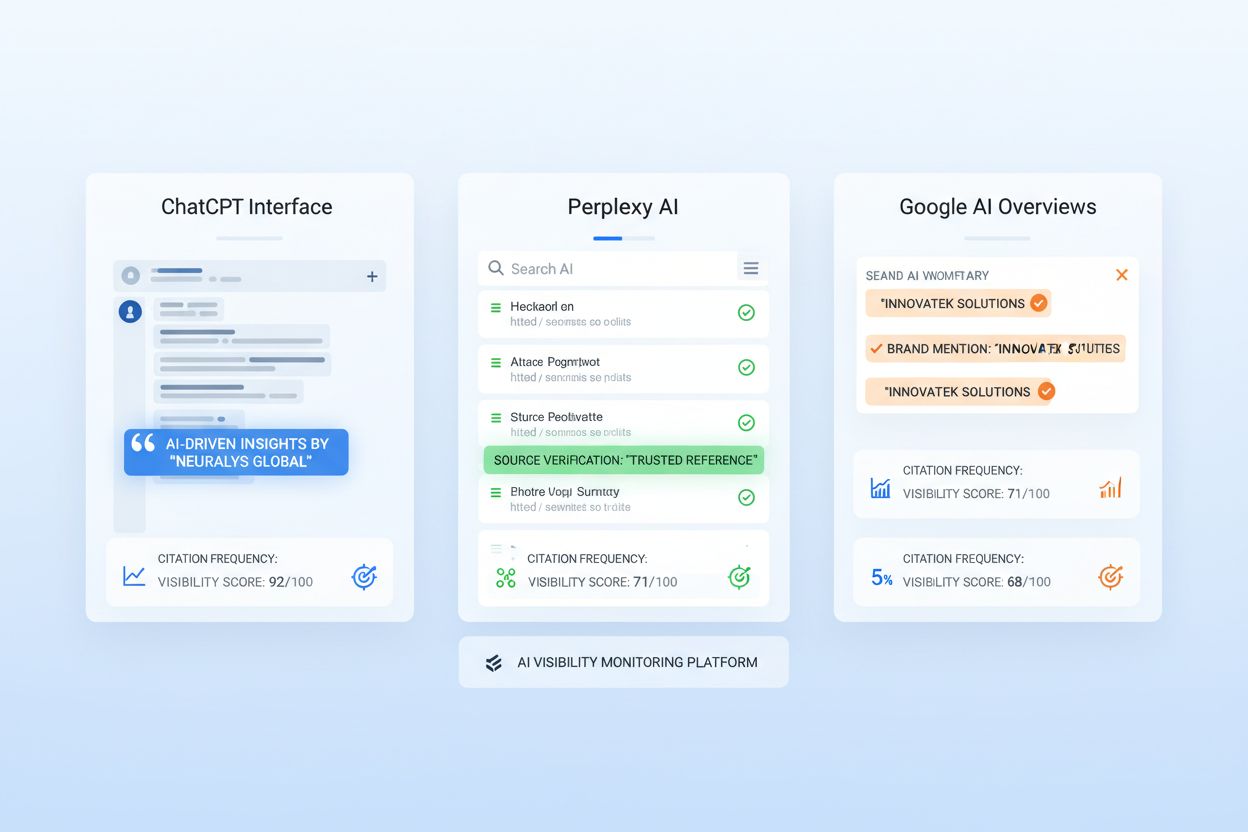
A practical, complete guide to AI visibility for marketers: the six metrics that matter, how AI systems decide which brands to mention, platform-by-platform tac...
Cookie Consent
We use cookies to enhance your browsing experience and analyze our traffic. See our privacy policy.