



How to Recover from Poor AI Visibility: Complete Recovery Strategy
Learn how to recover from poor AI visibility with actionable strategies for ChatGPT, Perplexity, and other AI search engines. Improve your brand's presence in A...
12 min read

Most brands trying to improve AI search visibility are applying the traditional SEO playbook to a discipline that runs on different rules. Here are the 10 most common, fixable mistakes.
Bottom line: Fixing these ten mistakes, and measuring progress with GEO-specific metrics instead of legacy SEO metrics, is what separates brands that get cited from brands that stay invisible in AI search.
Thirty-seven percent of consumers now start their searches with AI tools instead of Google. ChatGPT, Perplexity, Gemini, and Claude have become the new front door to information discovery, and brands that don’t appear in those AI-generated answers are losing visibility they’ll never recover.
But here’s the problem: most brands are optimizing for AI search using traditional SEO playbooks. They’re chasing keyword rankings, building backlinks, and publishing content as if Google’s algorithm still rules the world. Meanwhile, AI visibility requires a fundamentally different approach.
The result? Eighty-nine percent of brands tested in Q1 2026 had zero mention rate across major AI platforms, even brands with strong traditional SEO. These aren’t small or obscure companies. They’re established players making preventable mistakes.
This guide breaks down the 10 most common AI search visibility mistakes, explains why they happen, shows you exactly how to fix each one, and gives you a measurement framework so you can track what actually matters. By the end, you’ll understand why AI visibility is different, which mistakes are costing you citations, and the concrete steps to reclaim your brand’s presence in AI-generated answers.

Track how AI chatbots mention your brand across ChatGPT, Perplexity, and other platforms.
Before we dive into the mistakes, you need to understand the fundamental shift happening in search.
Generative Engine Optimization (GEO) is the practice of optimizing your brand, content, and digital presence to influence how AI language models cite, recommend, and surface your company in generated answers. It’s not SEO applied to AI. It’s a different discipline entirely.
The architecture of an AI engine is completely different from a traditional search engine. This changes everything about how you should optimize.
| Aspect | Traditional SEO | Generative Engine Optimization (GEO) |
|---|---|---|
| Primary Goal | Rank a web page in search results | Get cited in AI-generated answers |
| Success Metric | Click-through rate; page ranking position | Brand mentions; citation frequency; share of model voice |
| Content Evaluation | Keyword density, backlinks, page authority | Semantic context, original data, entity clarity, trustworthiness |
| How It Works | Crawler finds page → indexes content → ranks against keywords | AI pulls from broader web → evaluates authority signals → synthesizes answer → cites sources |
| What Gets Cited | N/A (rankings are binary) | Content that brings unique perspectives, proprietary research, or clear expertise |
| Entity Signals | Brand mentions help, but optional | Critical: AI cross-references facts across the web to build entity understanding |
| Third-Party Mentions | Backlinks are currency | Unlinked mentions, reviews, forum discussions, news coverage all matter equally |
| Zero-Click Problem | Users click through to your site | AI answers the question; users may never click your link |
| Measurement | Google Search Console, ranking tools | AI tracking platforms, brand mention monitors, citation frequency tools |
Three forces are colliding at once:
Consumer behavior is shifting. Thirty-seven percent of users now start with AI instead of Google, and that number is climbing every month.
AI platforms are becoming the primary discovery mechanism. When someone asks ChatGPT “What’s the best project management software?” or Perplexity “How do I improve brand visibility in AI search?”, they’re not looking at a search results page. They’re reading an AI-synthesized answer. If your brand isn’t in that answer, you’re invisible.
Traditional SEO success no longer guarantees AI visibility. You can rank #1 on Google for a keyword and still not be cited by ChatGPT. The signals are different. The trust mechanisms are different. The content formats are different.
Brands that understand and optimize for GEO first will own category authority for years to come. Those that ignore it will watch competitors get all the citations.
Why This Happens
Your SEO team has spent years perfecting keyword optimization. You know how to target long-tail keywords, optimize meta tags, and build internal linking structures around keyword themes. When AI search emerged, the natural instinct was to apply the same playbook: stuff more keywords, optimize for exact match, repeat the phrase in strategic places.
It makes logical sense. But it doesn’t work.
The Real Cost
AI language models don’t evaluate content the way Google does. They don’t count keyword density. They don’t reward exact-match phrases. They understand meaning, context, and relationships between concepts. When you optimize for keywords instead of semantic relevance, you signal to AI systems that your content is shallow and commodity-like.
The result: AI models skip your content and cite competitors who comprehensively cover the topic with contextually connected information.
A brand publishing 50 pages targeting “best project management tool,” “top project management software,” and “project management platform comparison” looks like keyword stuffing to an LLM. A brand publishing one authoritative guide that covers the topic deeply, addresses nuance, and connects related concepts looks like an expert worth citing.
How to Fix It
Audit your content for semantic coverage. Instead of asking “How many times does the primary keyword appear?” ask “Does this content comprehensively answer the question, cover related concepts, and address edge cases?”
Map topics, not keywords. Identify the core topic (e.g., “project management tools”) and all the subtopics and related concepts that belong to it (features, pricing models, use cases, integration capabilities, team size considerations). Then create content that weaves these together naturally.
Write for intent, not keyword matching. If a user asks “What’s the best project management tool for remote teams?” they’re not looking for the phrase “best project management tool” repeated five times. They want to understand how different tools handle remote collaboration, which features matter most, and how to evaluate options. Write that answer.
Use LSI and semantic keywords naturally. LSI (Latent Semantic Indexing) keywords are concepts related to your primary topic. Instead of forcing them in, weave them naturally into explanations. If you’re writing about “project management tools,” mention “task tracking,” “team collaboration,” “resource allocation,” and “workflow automation” as you explain how different tools work.
Test your content with an LLM. Copy a section of your content and ask ChatGPT: “Based on this text, what is the main topic and what are the key concepts?” If the AI struggles to identify your expertise, your content isn’t clear enough.
Why This Happens
Your website says you’re a “SaaS project management platform.” Your LinkedIn profile says you’re a “team collaboration tool.” Your press releases describe you as a “workflow automation company.” Your Google Business profile says “software company.” Your product reviews on G2 say “productivity software.”
This happens because different teams own different channels. Marketing writes one way. Product writes another. PR uses different language. Nobody’s coordinating the message.
To a human, these all describe roughly the same thing. To an AI model, these are contradictory signals that reduce confidence in your brand’s identity.
The Real Cost
AI models synthesize data from across the web to build a conceptual understanding of your brand, what’s called an “entity.” If that entity is fuzzy, contradictory, or unclear, the AI’s confidence in your brand drops. When confidence drops, the AI omits your brand from recommendations.
A brand with crystal-clear, consistent signals across their website, social profiles, press releases, industry directories, and third-party mentions gets cited. A brand with mixed messages gets skipped.
How to Fix It
Create an entity definition document. Write a single, clear definition of your company, what it does, which industries it serves, and which problems it solves. Example: “We provide AI-powered project management software for distributed teams in tech and professional services.” Make this the source of truth.
Audit all your profiles and channels. Check your website, LinkedIn, Twitter/X, Facebook, Google Business profile, industry directories (G2, Capterra, etc.), and any third-party listings. Document how you describe your company on each.
Standardize your messaging. Update every profile to use consistent language about who you are, what you do, and who you serve. You don’t need to use identical wording everywhere (variation is natural), but the core identity should be unmistakable.
Add structured data to your homepage. Use schema markup (Organization schema) to explicitly tell AI systems who you are, what you do, and where you operate. Example:
{
  "@context": "https://schema.org",
  "@type": "Organization",
  "name": "ProjectFlow",
  "description": "AI-powered project management software for distributed teams",
  "url": "https://projectflow.com",
  "sameAs": ["https://linkedin.com/company/projectflow", "https://twitter.com/projectflow"],
  "knowsAbout": ["project management", "team collaboration", "workflow automation"]
}
Why This Happens
Many brands block AI crawlers for legitimate reasons: they wanted to prevent their content from being used to train AI models, or they used a CDN with default AI-blocking settings (like Cloudflare’s), or they left overly broad bot-blocking rules in their robots.txt file from years ago.
Some blocks are intentional. Some are accidental. But the result is the same: AI systems can’t access your content.
The Real Cost
If ChatGPT-User, PerplexityBot, or Claude-Web can’t access your site, your data never enters the AI’s training data or live-web search results. You become invisible. It doesn’t matter how good your content is if AI systems can’t read it.
This is a silent killer. You might have strong Google rankings and healthy organic traffic, but zero AI visibility, and you won’t know why.
How to Fix It
yoursite.com/robots.txt and look for any rules that block AI crawlers. Common culprits:User-agent: *
Disallow: /
or
User-agent: ChatGPT-User
Disallow: /

User-agent: PerplexityBot
Disallow: /
If you see these, remove them (unless you have a specific reason to block AI crawlers, in which case, understand the tradeoff).
Check your CDN settings. If you use Cloudflare, check your security settings. Some configurations block AI crawlers by default. Go to Security > Bots > Bot Management and ensure you’re not blocking crawlers unnecessarily.
Check for meta robots tags. Search your site for <meta name="robots" content="noindex"> or <meta name="robots" content="nofollow"> on pages you want AI systems to access. Remove these if they’re blocking important content.
Test crawler access. Use a tool like Screaming Frog or Semrush to simulate how an AI crawler would see your site. Look for pages that return 403 (forbidden) or 401 (unauthorized) errors.
Allow AI crawlers explicitly. If you want to be generous, add this to your robots.txt:
User-agent: ChatGPT-User
Allow: /

User-agent: PerplexityBot
Allow: /

User-agent: Claude-Web
Allow: /
Why This Happens
Your marketing strategy focuses on owned content: your website, your blog, your email. You optimize your own pages, build internal links, and publish regularly. But you largely ignore what’s being said about you on Reddit, in industry reviews, in news articles, or on third-party comparison sites.
This makes sense from a control perspective: you can’t control what others say. But AI models don’t prioritize owned content. They weigh all signals equally.
The Real Cost
AI models use third-party signals as trust indicators. If your brand is mentioned on G2, in a trusted industry publication, on Reddit, in a news article, or in a customer review, that tells the AI your brand is real, trusted, and worth citing.
A brand that only exists on its own website looks suspicious to an AI. A brand that appears across multiple authoritative third-party sources looks trustworthy.
Brands investing only in owned content while ignoring earned media are leaving massive citation potential on the table.
How to Fix It
Build a digital PR strategy. Pitch stories to industry publications, get mentioned in news roundups, and earn coverage from authoritative sources. Each mention is a trust signal.
Encourage customer reviews. Ask satisfied customers to review you on G2, Capterra, Trustpilot, or industry-specific platforms. AI systems weight reviews heavily.
Participate in communities. Contribute genuinely to Reddit communities, industry forums, and Q&A sites like Quora. Answer questions, share expertise, and let your brand be mentioned naturally in these spaces.
Get mentioned in roundups. Reach out to industry bloggers and publications about being included in “best of” lists, comparisons, and roundups. These third-party endorsements carry weight.
Monitor unlinked brand mentions. Use tools like Mention or Semrush Brand Monitoring to track when your brand is mentioned online, especially on authoritative sites. These unlinked mentions are just as valuable as linked mentions for AI visibility.
Create mention-worthy content. Publish original research, case studies, and data that journalists and bloggers want to cite. The more citable your content, the more third-party mentions you’ll earn naturally.
Track third-party visibility. Set up a dashboard that shows your brand mentions across G2, news sites, Reddit, industry publications, and review platforms. This is a leading indicator of AI visibility.
Why This Happens
AI writing tools like ChatGPT, Claude, and Jasper make it trivially easy to generate finished articles in minutes. The math seems irresistible: publish 300 pages targeting every long-tail keyword in your space, and surely some will rank or get cited.
Many brands have tried this. Most have regretted it.
The Real Cost
AI language models are trained on the baseline consensus of the web. They already know what generic content on your topic looks like. When you publish mass-produced, surface-level articles, you’re not adding value. You’re adding noise.
AI systems choose to cite content that brings original data, proprietary research, unique case studies, or deeply expert perspectives. If your content can be easily paraphrased away by the AI, it won’t cite you.
Additionally, Google’s guidance on AI-generated content is clear: content created purely to game search rankings will be demoted. This applies to both traditional search and AI search.
How to Fix It
Audit your content library. Identify articles that are generic, thin, or easily replaceable. These are likely hurting more than helping.
Delete or consolidate low-value content. Merge thin articles into comprehensive guides. Remove articles that don’t bring unique value.
Invest in original research. Conduct surveys, analyze data, interview customers, and publish findings that only you can publish. This is citation-worthy content.
Create case studies. Document how customers use your product, what results they achieved, and what they learned. Case studies are highly citable.
Share proprietary insights. If you have access to data, trends, or insights others don’t, publish them. AI systems love citing data that’s not available elsewhere.
Develop deep expertise content. Write guides that go 3–5 levels deeper than surface-level articles. Cover edge cases, nuance, and complexity. Show mastery.
Use AI as a research assistant, not a content generator. Use AI tools to help you research, organize, and draft, but write the final content yourself, adding your expertise, examples, and unique perspective.
Why This Happens
You write comprehensive, authoritative content. But you structure it like an academic paper: long introductions, dense paragraphs, creative section headings that don’t signal what the answer is.
It reads well to humans. AI systems struggle with it.
The Real Cost
AI systems extract answers at the passage level. They scan your content looking for clear, structured data they can confidently extract and cite. If the answer is buried deep in a paragraph, if the structure is unclear, or if the heading doesn’t signal what the section contains, the AI will skip to a competitor’s page that makes the answer obvious.
Content with clear structure, obvious answers, and explicit hierarchies sees vastly higher citation rates.
How to Fix It
Answer the question immediately. Don’t bury the answer in a long introduction. Put it in the first 1–2 sentences of your section. Then expand with nuance and detail.
Use descriptive H2 and H3 headings. Instead of creative headings like “The Complexity Factor,” use descriptive headings like “How to Set Up Two-Factor Authentication.” AI systems use headings to understand content structure.
Use bulleted lists and numbered lists. When you’re presenting multiple options, steps, or concepts, use lists instead of prose. Lists are easier for AI to extract.
Create comparison tables. When comparing options, use a table instead of paragraphs. Tables are highly extractable and citable.
Use blockquotes for key takeaways. Highlight important definitions, statistics, or conclusions in blockquotes. These stand out to AI systems.
Include data, statistics, and quotes. AI systems prioritize content that includes specific numbers, research findings, and expert quotes. These are easy to extract and cite.
Use clear hierarchies. Ensure your H1, H2, H3, and H4 headings follow a logical hierarchy. Avoid skipping levels. This helps AI understand the structure.
Test extractability. Copy a section of your content and ask ChatGPT: “What is the main answer to the question in this section? Can you extract it as a single sentence?” If ChatGPT struggles, restructure the content.
Why This Happens
You understand that schema markup helps search engines understand content. You’ve implemented some basic schema, maybe Organization schema on your homepage, maybe Article schema on blog posts. But you haven’t gone deep.
Or you implemented schema years ago and haven’t updated it. Or you implemented it incorrectly, and it’s been silently broken.
The Real Cost
Schema markup tells AI systems what your content is, what it’s about, who wrote it, and whether it’s trustworthy. Missing or broken schema forces AI systems to guess. When they have to guess, they often get it wrong or skip your content entirely.
Additionally, schema markup helps with entity understanding. If you use schema to explicitly state your expertise, your credentials, and your domain authority, AI systems can more confidently cite you.
How to Fix It
Implement comprehensive schema. Go beyond basic Organization and Article schema. Add:
Use schema to claim expertise. In your Person or Organization schema, use the knowsAbout property to explicitly state your areas of expertise:
{
  "@context": "https://schema.org",
  "@type": "Person",
  "name": "Sarah Chen",
  "jobTitle": "Content Strategist",
  "knowsAbout": ["content marketing", "SEO", "AI search optimization"],
  "workFor": {
    "@type": "Organization",
    "name": "Digital Growth Co"
  }
}
Validate your schema. Use Google’s Rich Results Test or Schema.org’s validator to ensure your markup is correct. Broken schema is worse than no schema.
Update schema regularly. Review and update schema markup at least quarterly, especially for author credentials, company information, and expertise areas.
Use schema for reviews and ratings. If you have customer reviews or ratings, implement Review schema. This is highly valued by AI systems.
Implement FAQ schema. If you have an FAQ section, use FAQPage schema. This helps AI systems understand and extract your Q&A content.
Why This Happens
Your analytics dashboard shows organic traffic, click-through rate, and conversion rate. These are the metrics you’ve always tracked. When AI search emerged, you kept tracking the same metrics, assuming they’d tell you whether your AI visibility efforts were working.
They don’t.
The Real Cost
AI-generated answers often satisfy users without sending them to your site. A user asks ChatGPT “What’s the best project management tool?” ChatGPT cites your content in the answer, but the user doesn’t click through. From your analytics perspective, nothing happened. But from an AI visibility perspective, you just got cited.
Brands measuring only click-through traffic are missing the real impact of AI visibility: brand mentions, citations, and share of model voice.
Additionally, AI visibility drives indirect benefits: increased brand awareness, trust signals, and assisted conversions (users see you in AI, don’t click, but later search for you directly or tell a colleague about you).
How to Fix It
Set up brand mention monitoring. Use tools like Mention, Semrush, or Brandwatch to track when your brand is mentioned online. Set up alerts for mentions on major platforms.
Track AI platform visibility. Use dedicated GEO tracking tools like:
Manually audit AI platforms. Weekly, run 5–10 buyer-intent queries across ChatGPT, Perplexity, and Gemini. Note whether your brand appears in the answer, how prominently, and in what context.
Create a GEO dashboard. Build a dashboard that tracks:
Track assisted conversions. In Google Analytics, set up goals or conversions that track “assisted” paths. A user might see you in ChatGPT, then search for you directly later. This is an assisted conversion.
Survey customers about discovery. Ask new customers “How did you first hear about us?” Include “AI search (ChatGPT, Perplexity, Gemini)” as an option. This qualitative data is valuable.
Why This Happens
Your SEO team handles Google rankings. Your content team handles the blog. Your PR team handles media relations. When GEO emerged, you assigned it to one person or team, and they optimize in isolation.
This creates silos. The GEO specialist optimizes content for AI without coordinating with the broader content strategy. The content team publishes without thinking about AI visibility. The PR team doesn’t understand how their coverage influences AI citations.
The Real Cost
GEO success requires coordination across content, PR, product, and analytics. When these functions operate independently, you get:
Brands that integrate GEO into their overall strategy see much better results.
How to Fix It
Create a cross-functional GEO working group. Include representatives from:
Align messaging across all channels. Use your entity definition document (from Mistake #2) as the north star. Ensure all teams use consistent language about who you are, what you do, and who you serve.
Coordinate PR and content. When PR lands a mention in an industry publication, have the content team create related content that expands on the story. When content publishes, have PR pitch related angles to journalists.
Plan content with AI in mind. When planning content, ask: “Is this citable? Does it bring original value? Will AI systems want to cite this?” This should be part of your editorial calendar.
Share GEO metrics with all teams. Make AI visibility metrics visible to everyone. When the PR team sees their coverage driving AI citations, they’ll prioritize earned media. When the content team sees which formats get cited most, they’ll optimize accordingly.
Create a GEO style guide. Document how your brand should be described, which topics you own, which keywords and phrases you use, and how to structure content for AI extraction. Share this with all teams.
Why This Happens
New tactics promising guaranteed AI citations appear constantly. “Add this schema markup and get cited by ChatGPT.” “Publish in this format and Perplexity will recommend you.” “Mention these keywords and Gemini will feature you.”
These promises are seductive. They offer shortcuts to authority.
But they don’t work. And they distract you from what actually works.
The Real Cost
AI systems are constantly evolving. Tactics that work today might be neutralized tomorrow. Brands that chase hacks end up:
Meanwhile, brands that focus on genuine expertise, trustworthy information, and consistent authority signals compound their advantages over time.
How to Fix It
Focus on fundamentals. Optimize for:
Invest in content quality. Spend more on fewer, higher-quality pieces than on many mediocre pieces. Quality compounds.
Build topical authority. Become the most comprehensive resource on a specific topic. Cover it from every angle. Link related content together. Show mastery.
Earn third-party credibility. Get reviewed, mentioned, and recommended by credible sources. This takes time, but it’s durable.
Be skeptical of shortcuts. When you hear about a new “AI visibility hack,” ask: “Is this sustainable? Will this work in 6 months? Am I building real authority or just gaming the system?” If the answer is “gaming,” skip it.
Measure what matters. Track metrics that reflect real authority: citations, mentions, customer sentiment, market share. Don’t optimize for vanity metrics.
Get the latest insights on AI mentions, brand monitoring, and optimization strategies.
AI platforms have different architectures, different training data, and different citation preferences. A one-size-fits-all approach won’t work. Here’s how to optimize for each major platform:
What to know: ChatGPT uses a knowledge cutoff (April 2024 for GPT-4) plus live web search for recent information. It’s the most widely used AI platform, making it the highest-priority target.
Optimization tactics:
What to know: Perplexity emphasizes real-time information and direct citations. It’s popular with researchers and professionals who want current information with sources they can verify.
Optimization tactics:
What to know: Google Gemini and AI Overviews are integrated into Google Search. They prioritize content that already ranks well in traditional search, but with additional emphasis on E-E-A-T (Experience, Expertise, Authoritativeness, Trustworthiness).
Optimization tactics:
You can’t improve what you don’t measure. Here’s a framework for tracking AI visibility metrics that actually correlate with business impact:
| KPI | What It Measures | Tools | Frequency | Target |
|---|---|---|---|---|
| Share of Model Voice | % of AI answers mentioning your brand (across platforms) | Evertune, NeuroRank | Weekly | Increase 2–5% per month |
| Citation Frequency | Number of times your content is cited in AI answers | Evertune, NeuroRank, Semrush | Weekly | Increase 10–20% per quarter |
| Brand Mentions | Unlinked and linked mentions across the web | Mention, Semrush, Brandwatch | Daily | Increase 15–25% per quarter |
| Third-Party Reviews | New reviews on G2, Capterra, Trustpilot, etc. | G2, Capterra, Trustpilot | Weekly | Increase 10–15% per quarter |
| Earned Media Coverage | Mentions in news, industry publications, blogs | Mention, Meltwater, Cision | Weekly | 2–4 mentions per month |
| Content Extractability | % of your content that AI systems can easily extract | Manual audits, LLM testing | Monthly | 80%+ of pages |
| Entity Clarity | How consistently and accurately AI describes your brand | Manual audits on ChatGPT, Perplexity, Gemini | Bi-weekly | Consistent, accurate description |
| Topical Authority Score | How comprehensively you cover your core topics | Semrush, Surfer SEO | Monthly | Increase 10–20% per quarter |
| Assisted Conversions | Conversions from users who saw you in AI before converting | Google Analytics (assisted paths) | Monthly | Increase 20–30% per quarter |
| Customer Discovery Attribution | % of new customers citing AI discovery | Customer surveys, CRM | Quarterly | Track trend over time |
Create a dashboard that tracks these KPIs in real-time or near-real-time. Here’s a simple structure:
Daily metrics:
Weekly metrics:
Monthly metrics:
Quarterly metrics:
Don’t try to fix all 10 mistakes at once. Use this phased approach to build momentum:
Goals: Understand your current state and identify the biggest opportunities.
Actions:
Deliverable: A current-state report showing your AI visibility baseline, crawlability status, entity consistency, and top opportunities.
Goals: Fix the technical and entity barriers that are preventing visibility.
Actions:
Deliverable: Standardized entity signals across all channels, working schema markup, and confirmed AI crawler access.
Goals: Make your existing content more extractable and citable by AI systems.
Actions:
Deliverable: 20 restructured, highly extractable articles with comprehensive schema markup.
Goals: Build third-party credibility and establish ongoing monitoring.
Actions:
Deliverable: Active PR strategy, growing customer reviews, community participation, and a functioning GEO dashboard.
The shift from keyword rankings to trusted citations is fundamental. AI search doesn’t reward optimization tactics. It rewards understanding, expertise, and trust.
The 10 mistakes outlined here aren’t exotic or mysterious. They’re preventable. Most brands are making them because they’re optimizing for the wrong platform using the wrong playbook.
Here’s the rule of thumb: Optimize for understanding and trust, not discoverability. Brands that clearly communicate who they are, publish genuinely useful content, earn credible third-party recognition, and maintain a consistent presence across the web are positioned to appear in AI-generated answers.
Start with the audit. Understand where you stand. Then work through the fixes methodically. Don’t chase shortcuts. Focus on the fundamentals.
The brands that start now will own their categories in AI search for years to come. The ones that wait will be playing catch-up.
Arshia is an AI Workflow Engineer at FlowHunt. With a background in computer science and a passion for AI, he specializes in creating efficient workflows that integrate AI tools into everyday tasks, enhancing productivity and creativity.

Am I Cited shows you exactly how often your brand is mentioned and cited across ChatGPT, Perplexity, and Google AI Overview.
Learn how to recover from poor AI visibility with actionable strategies for ChatGPT, Perplexity, and other AI search engines. Improve your brand's presence in A...
Learn proven strategies to improve your brand's visibility in AI search engines like ChatGPT, Perplexity, and Gemini. Discover content optimization, entity cons...
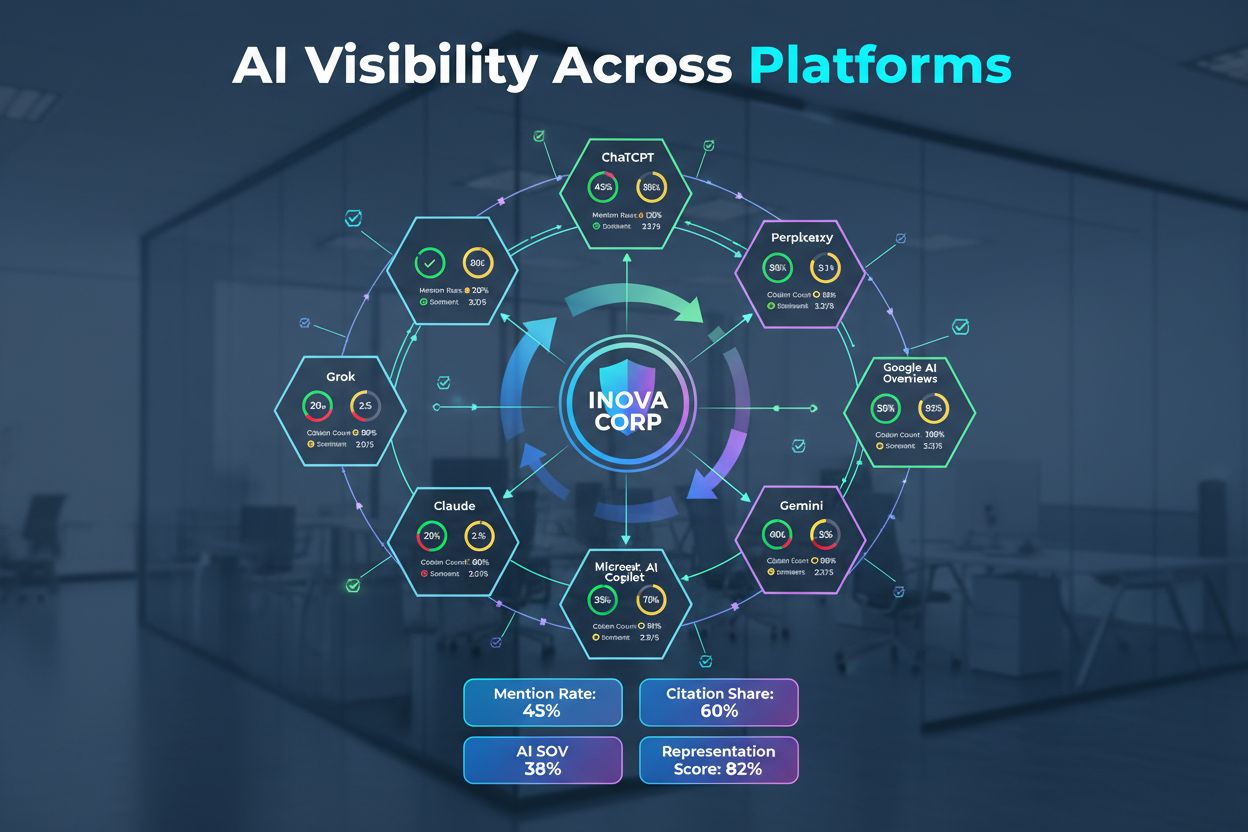
Discover the essential AI visibility metrics and KPIs to monitor your brand's presence across ChatGPT, Perplexity, Google AI Overviews, and other AI platforms. ...
Cookie Consent
We use cookies to enhance your browsing experience and analyze our traffic. See our privacy policy.