


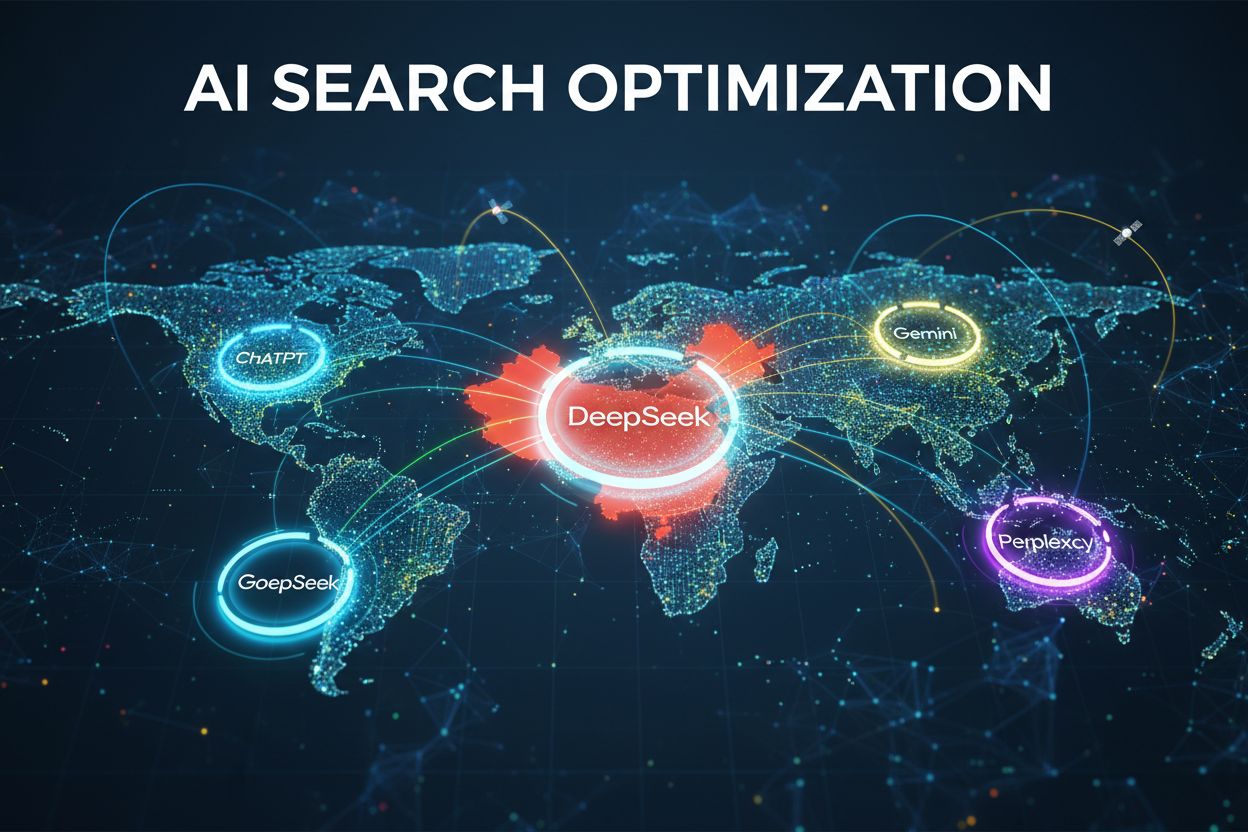
DeepSeek Optimization: Preparing for China's Growing AI Search Platform
Learn how to optimize your brand for DeepSeek, China's fastest-growing AI search platform. Discover strategies to increase visibility and monitor your presence ...
9 min read
DeepSeek has well over 100M users but is the most overlooked platform in AI visibility tracking. Here’s how its architecture changes brand discovery, the metrics that matter, and how to track and optimize for it.
Ask most marketing teams which AI search engines they monitor for brand visibility, and you will hear the same three names: ChatGPT, Perplexity, and Gemini. These platforms have become the de facto standard for DeepSeek AI search visibility strategies. Yet the data tells a different story. When provider response reports run the same brand queries across ChatGPT, Perplexity, and Gemini, the results diverge dramatically. ChatGPT surfaces 12 brands. Perplexity surfaces 6. Gemini surfaces 27. And the citations? Almost no overlap. A domain that dominates ChatGPT responses can be entirely invisible in Gemini, and vice versa. The takeaway is stark: tracking three engines is not enough. And the engine most brands are ignoring, DeepSeek, may be the one that matters most for the next wave of AI-driven discovery.
DeepSeek has grown from zero to over 130 million active users in under two years, topping app store charts in 156 countries and generating 525 million monthly web visits as of early 2026. Despite this, DeepSeek remains the most overlooked platform in the AI search visibility tracking landscape. Most tools added DeepSeek support only in 2025–2026, and many still treat it as an afterthought. This article examines why that gap exists, how DeepSeek’s fundamentally different architecture changes the visibility game, and what you can do to track, measure, and optimize your brand presence before your competitors do.
Bottom line: DeepSeek’s scale and distinct architecture make it a blind spot most brands can’t afford, and pairing a manual audit with a tool like AmICited makes it practical to track your citations there alongside ChatGPT, Perplexity, and Gemini.
The assumption that ChatGPT, Perplexity, and Gemini provide adequate coverage of the AI search landscape is not just incomplete. It is actively misleading. Research published by Digital Applied in 2026 found that the domain overlap between ChatGPT and Perplexity citations is just 11%. Gemini, drawing from Google’s index, surfaces an entirely different set of sources. And DeepSeek, with its Mixture of Experts architecture and distinct training corpus, produces yet another visibility profile that correlates poorly with any of the other three.
The numbers behind DeepSeek’s growth underscore why this blind spot is increasingly costly. According to Business of Apps and Backlinko data, DeepSeek reached 96.9 million monthly active users by April 2025, quadrupling from 33.7 million in January of the same year. By the end of 2025, active users exceeded 130 million. The platform’s mobile app has been downloaded over 173 million times, and it ranks as the #1 app in more than 156 countries. While ChatGPT dominates with roughly 68% global AI chatbot market share, DeepSeek’s ~4% share represents a user base larger than the entire population of most countries, and it skews heavily toward technical buyers, developers, and APAC markets that many global brands are actively targeting.
Why has DeepSeek AI search visibility tracking lagged behind? Three factors explain the gap. First, tool vendors have concentrated on English-language markets where ChatGPT and Perplexity dominate mindshare. Second, DeepSeek does not expose a native analytics dashboard or citation API, making third-party tracking more technically demanding. Third, many marketers still conflate AI visibility with traditional SEO, and since DeepSeek does not appear in Google Search Console, it does not appear on their radar. But as we will see, DeepSeek’s architecture rewards content strategies that traditional SEO alone cannot deliver.

Track how AI chatbots mention your brand across ChatGPT, Perplexity, and other platforms.
Understanding why DeepSeek visibility diverges from other AI engines requires looking under the hood. DeepSeek is not a differently branded version of ChatGPT. Its underlying architecture (Mixture of Experts, Chain-of-Thought reasoning, and a unique retrieval pipeline) produces citation behavior that is structurally different from every other major AI search platform.
DeepSeek-V2 and V3 use a Mixture of Experts architecture. Unlike dense transformer models that activate all parameters for every query, MoE models route each input to a subset of specialized “expert” sub-networks. Different experts activate for different query types: technical queries trigger one set, commercial queries another, definitional queries a third. The practical consequence for brand visibility is that content optimized for one query type may never activate the expert that handles another. A product page that performs well in ChatGPT’s browsing mode may be invisible to DeepSeek’s technical reasoning expert, not because the page is low quality, but because the routing mechanism never selects it.
This routing behavior also explains why DeepSeek favors deep, comprehensive content. When an expert is activated, it processes the query with far more depth than a dense model would, evaluating sources for logical coherence, factual consistency, and structural clarity. Surface-level content that satisfies a Google snippet often fails to meet the bar for DeepSeek’s expert evaluation.
BrightEdge’s 2025 analysis of DeepSeek’s search behavior identified a critical architectural difference: DeepSeek thinks before it retrieves. Most AI search engines follow a “retrieve first, think second” pattern: they pull candidate sources from an index, then synthesize an answer. DeepSeek reverses this. It first reasons about what kind of answer the query demands, considers where the most authoritative information likely resides, and only then initiates retrieval. This “Think First” approach means DeepSeek may look in entirely different places for answers than ChatGPT or Perplexity would, even for identical queries.
The implication for brands is significant. If your content lives on a domain that DeepSeek’s reasoning layer does not consider authoritative for a given query type, you will not appear in its answers, regardless of how well that content ranks on Google or how often ChatGPT cites it. DeepSeek does not have a proprietary search index like Google, Perplexity, or Bing. It navigates multiple sources in real time, constructing responses from whatever it finds most credible. This makes source diversity and multi-platform authority more important for DeepSeek visibility than for any other AI engine.
DeepSeek’s R1 models use long Chain-of-Thought (CoT) reasoning processes. When a user asks a question, the model does not just retrieve and summarize: it works through the problem step by step, considering nuance, edge cases, and follow-up implications. Content that answers only the surface-level query will not survive this process. DeepSeek’s reasoning models actively look for sources that address the implied follow-up questions a user might have.
This is why content depth matters more on DeepSeek than on any other AI platform. A 500-word blog post that ranks well on Google for a long-tail keyword will almost never appear in DeepSeek’s answers for the same query. The model passes it over in favor of a more comprehensive source: one that covers related subtopics, cites data, and demonstrates topical authority across a cluster rather than a single page.
DeepSeek uses Retrieval-Augmented Generation (RAG) to fetch current information, but its retrieval backend differs from other engines. ChatGPT plugs into Bing, Claude into Brave Search, Perplexity into its own 5-billion-URL index, and Gemini into Google. DeepSeek’s retrieval is more decentralized: it pulls from multiple real-time sources without a single proprietary index. This means the crawler accessibility and structured data quality of your pages matter more than domain authority in the traditional sense.
Moreover, DeepSeek’s open-source model weights create a unique amplification effect. Because DeepSeek’s models are widely distilled and integrated into third-party enterprise tools, local AI applications, and custom pipelines, being visible in DeepSeek’s base responses means your brand surfaces across thousands of downstream applications, not just on deepseek.com. This network effect has no equivalent in the closed ecosystems of ChatGPT or Gemini.
Tracking DeepSeek AI search visibility requires metrics that go beyond what traditional SEO tools measure. There is no “position #1” in an AI-generated answer. Instead, visibility is a function of four dimensions that together determine whether your brand exists in the AI’s responses.
Mention frequency is the simplest metric: across a defined set of category-relevant queries, how often does DeepSeek name your brand? This is the AI equivalent of impression share. A brand that appears in 40% of relevant DeepSeek responses has a fundamentally different market presence than one that appears in 5%. But frequency alone is insufficient: it must be measured against brand-neutral prompts (not branded queries, which only tell you whether DeepSeek knows your name) and tracked over time, since AI responses are probabilistic and can shift significantly between queries.
Citation share (also called AI share of voice) measures your brand’s percentage of total brand mentions within a category. If ten brands are cited across a set of “best CRM for enterprise” queries, and your brand appears in three of those citations, your share of voice is 30%. This metric is particularly important on DeepSeek because the platform’s reasoning models often compare multiple brands in a single response. Being cited alongside competitors is not the same as being recommended over them.
Position within a DeepSeek response carries commercial weight. Research from Rankfender indicates that first-position citations achieve a 2.8× higher conversion rate than third-position mentions. But position is not purely ordinal: context matters. Is DeepSeek framing your product as a premium solution, a budget alternative, or flagging a known limitation? Sentiment analysis within AI responses (whether the model describes your brand positively, neutrally, or negatively) is a dimension of visibility that most tracking tools are only beginning to address.
The most diagnostically useful metric is cross-platform consistency: how does your visibility on DeepSeek compare to your visibility on ChatGPT, Perplexity, and Gemini? A brand that appears in 80% of ChatGPT responses but 0% of DeepSeek responses has a content problem, likely structural, related to how DeepSeek’s retrieval pipeline evaluates their pages. A brand that performs well on DeepSeek but poorly on ChatGPT may have a different issue, such as recency or crawlability. Tracking all four engines reveals the shape of your visibility problem, not just its existence.
| Metric | What It Measures | DeepSeek-Specific Consideration | ChatGPT / Perplexity / Gemini |
|---|---|---|---|
| Mention Frequency | % of queries where brand appears | Higher variance due to MoE routing; test more queries | More stable; fewer queries needed for baseline |
| Citation Share / SOV | Brand’s % of total category mentions | DeepSeek cites fewer sources per answer; winner-take-more dynamic | Perplexity cites more sources; SOV is more distributed |
| Sentiment & Position | How brand is described; where in response | CoT reasoning produces nuanced framing; sentiment can be mixed | More binary (recommended / not recommended) |
| Cross-Platform Consistency | Visibility correlation across engines | Low correlation with ChatGPT/Gemini; high correlation with technical content quality | High correlation between ChatGPT and Perplexity; moderate with Gemini |
Get the latest insights on AI mentions, brand monitoring, and optimization strategies.
DeepSeek does not provide a native analytics dashboard for brand mentions. Unlike Google Search Console, there is no DeepSeek equivalent where you can see which queries triggered your brand’s appearance. This means DeepSeek visibility tracking requires either manual effort, API automation, or a third-party tool. Here is a practical framework that works at any budget level.
If you are starting from zero, a structured manual audit provides actionable data without any tool investment. The process is straightforward but requires discipline:
Step 1: Define your priority queries. Start with 10 to 20 brand-neutral queries that correspond to how prospects actually discover your category. These should include comparison queries (“best [category] tools 2026”), alternative queries (“alternatives to [competitor]”), recommendation queries (“what is the best software for [use case]”), and definitional queries (“how does [category] work”). Avoid branded queries: knowing whether DeepSeek knows your name tells you nothing about whether it recommends you.
Step 2: Test systematically in DeepSeek Chat. Go to chat.deepseek.com, enable internet search mode, and run each query. For each response, record: whether your brand is mentioned (yes/no), at what position, which competitors are cited instead, and which sources DeepSeek references. A Google Sheet or Notion database with columns for Date, Query, Mention, Position, Cited Competitors, and Sources works well.
Step 3: Set a testing cadence. AI responses are probabilistic. Run the same queries every two weeks to identify trends. A single snapshot is misleading: you need at least three data points per query before drawing conclusions about your visibility trend.
Step 4: Compare with other engines. Run the same queries on ChatGPT, Perplexity, and Gemini. If you appear on three engines but not DeepSeek, the problem is likely structural: DeepSeek’s retrieval pipeline cannot access or parse your content. If you appear on DeepSeek but not ChatGPT, your content may be deep and technical but not optimized for ChatGPT’s browsing-based retrieval.
For teams with technical resources, the DeepSeek API enables fully automated visibility tracking. The API is compatible with the OpenAI format, making integration straightforward:
from openai import OpenAI
import pandas as pd
from datetime import datetime

client = OpenAI(
    api_key="your_deepseek_api_key",
    base_url="https://api.deepseek.com"
)

queries = [
    "What is the best AI visibility tracking tool for enterprises?",
    "Alternatives to Profound for AI brand monitoring",
    "How to track brand mentions across AI search engines"
]

results = []
for query in queries:
    response = client.chat.completions.create(
        model="deepseek-chat",
        messages=[{"role": "user", "content": query}],
        temperature=0.0
    )
    results.append({
        "date": datetime.now().isoformat(),
        "query": query,
        "response": response.choices[0].message.content
    })
This script can be scheduled via cron, n8n, or any workflow automation tool, with results piped to Google Sheets, Looker Studio, or a database for trend analysis. The n8n workflow community has published pre-built templates for multi-engine AI visibility tracking that include DeepSeek alongside ChatGPT, Claude, and Perplexity.
Several AI visibility platforms now include DeepSeek in their model coverage. The landscape as of mid-2026 includes:
The most common mistake in DeepSeek visibility tracking is monitoring branded queries. Tracking whether DeepSeek mentions your brand when someone searches your brand name is a reputation check, not a visibility measurement. Real visibility is measured by whether DeepSeek recommends your brand when someone searches for your category without naming you.
A proper prompt panel should include 20–50 queries across four categories: comparison queries (where users evaluate options), alternative queries (where users seek replacements for a known competitor), recommendation queries (where users ask for the “best” solution), and problem-definition queries (where users describe a problem without naming a solution category). This panel should be refreshed quarterly as your category evolves and new competitors emerge.
Optimizing for DeepSeek SEO requires a different approach than traditional search engine optimization. The goal is not to rank for keywords but to become a citable source that DeepSeek’s reasoning models select during the retrieval and synthesis process.
DeepSeek’s MoE architecture relies on clear heading hierarchies to route content to the correct expert. A well-structured page with logical H1 → H2 → H3 progression helps the model quickly parse context and determine relevance. Front-loaded, self-contained paragraphs allow the model to extract standalone facts without needing surrounding context, essential for passage-level retrieval in RAG pipelines.
Schema markup is not optional for DeepSeek visibility. FAQ, Article, Product, and Organization schema provide structured data that DeepSeek’s retrieval system uses to pull rich, contextually accurate summaries. Pages without schema markup are at a structural disadvantage regardless of content quality. This is a departure from traditional SEO, where schema is beneficial but not decisive. In the AI retrieval context, structured data is a primary signal.
Princeton University’s 2024 GEO study identified the three strongest levers for improving AI citation rates: cite sources (+40% visibility boost), add statistics (+37%), and use an authoritative tone (+25%). These findings are particularly relevant for DeepSeek, which prioritizes factual coherence and verifiable claims over keyword density.
Write content that is quotable. Every key claim should be attributable to a specific data point, study, or source. Include statistics in self-contained sentences that can be extracted and cited independently. Use declarative, authoritative language: avoid hedging, marketing fluff, and filler phrases. DeepSeek’s reasoning models evaluate content for logical coherence; a paragraph that says nothing in many words will be discarded in favor of one that says something in fewer.
DeepSeek’s retrieval agents need to access your content to cite it. Three technical prerequisites are non-negotiable:
First, ensure your server-side rendering is flawless. If your site relies on client-side JavaScript to render text, DeepSeek’s retrieval agents may see empty pages. This is a more acute problem for AI crawlers than for Googlebot, which has more sophisticated rendering capabilities.
Second, do not block AI crawlers in your robots.txt. Many sites block broad crawler user agents as a precautionary measure, inadvertently preventing DeepSeek’s retrieval agents from accessing their content. Review your robots.txt and ensure that AI-specific crawlers are not being blocked by overly aggressive rules.
Third, maintain consistent entity information across your site. DeepSeek evaluates multi-source consistency to verify facts. Use the exact same organization name, product names, and contact details across all pages. Inconsistencies reduce the model’s confidence in your content, and lower confidence means lower citation probability.
DeepSeek’s reasoning models cross-reference information across multiple sources to verify accuracy. Your website alone is not enough. You need consistent brand mentions across independent review platforms, developer documentation sites, industry media, and community forums. When DeepSeek encounters your brand on G2, GitHub, Reddit, and a respected industry publication, all saying consistent things, it builds confidence in your content as a trustworthy source.
This is the most underappreciated dimension of DeepSeek SEO. Traditional SEO rewards link building and domain authority. DeepSeek rewards source diversity and factual consistency. A brand with a modest website but strong presence across third-party platforms may outperform a brand with high domain authority but no external corroboration.
Treating AI visibility as a single metric measured across one or two engines is the strategic equivalent of only tracking Google rankings and ignoring Bing, DuckDuckGo, and YouTube. Each AI engine has distinct citation behavior, audience demographics, and source preferences. A multi-engine strategy is not optional: it is the baseline requirement for understanding your brand’s actual AI presence.
| Dimension | DeepSeek | ChatGPT | Perplexity | Gemini |
|---|---|---|---|---|
| Architecture | MoE + CoT reasoning | Dense transformer + browsing | Search-native + citations | Google-integrated + multimodal |
| Retrieval Backend | Multi-source, no proprietary index | Bing | Proprietary 5B-URL index | Google index |
| Citation Style | Synthesis with implicit citations | Explicit citations when browsing | Citation-forward, numbered sources | Implicit, Google-index-weighted |
| Content Preference | Deep, technical, well-structured | Conversational, recent, authoritative | Factual, well-sourced, concise | Google-optimized, structured data |
| Primary Audience | Developers, APAC, technical buyers | General consumers, global | Researchers, knowledge workers | Google Workspace users, Android |
| User Base | 130M+ active users | 900M+ weekly users | 100M+ monthly users | 750M+ monthly users |
| Visibility Correlation | Low with other engines | Moderate with Perplexity | Moderate with ChatGPT | Low with other engines |
Sanbi’s 2026 research estimates that tracking only ChatGPT and Perplexity covers approximately 40–50% of AI-influenced buyer research moments. The other half happens on platforms most brands are not watching: Claude, Gemini, DeepSeek, and Copilot. Each engine you do not track is a channel where competitors can build invisible advantage, accruing positive positioning in buyer conversations you never see.
The strategic implication is clear: your AI visibility strategy should include all four major engines (DeepSeek, ChatGPT, Perplexity, and Gemini) at minimum. The cost of tracking is low relative to the cost of being invisible on a platform with 130 million active users.
DeepSeek’s rapid rise from zero to 130 million active users in under two years makes it the fastest-growing AI platform that most brands are not tracking. The reasons for this oversight (tool vendor lag, geographic bias, and the absence of a native analytics dashboard) are understandable but not excusable. The data is clear: AI visibility varies dramatically across engines, and DeepSeek’s unique architecture produces citation behavior that correlates poorly with ChatGPT, Perplexity, or Gemini. Tracking only the familiar three engines means missing the platform where technical buyers, developers, and APAC markets are making discovery and purchase decisions.
The window for early-mover advantage is closing. As more AI visibility tools add DeepSeek support and more brands recognize the platform’s significance, the competitive landscape will become crowded. Brands that establish visibility now, by optimizing content for DeepSeek’s MoE architecture, building multi-source authority, and implementing systematic tracking, will have a structural advantage that late entrants cannot easily replicate.
Start with a manual audit. Define 20 brand-neutral queries, test them across DeepSeek, ChatGPT, Perplexity, and Gemini, and document the gaps. From there, scale to automated tracking via the DeepSeek API or a third-party tool. The cost of inaction is not just missing a platform: it is being invisible to 130 million users who are actively using AI to discover and evaluate brands in your category.
Arshia is an AI Workflow Engineer at FlowHunt. With a background in computer science and a passion for AI, he specializes in creating efficient workflows that integrate AI tools into everyday tasks, enhancing productivity and creativity.

Am I Cited helps you track how AI engines cite your brand and compare visibility across platforms, so a fast-growing engine like DeepSeek doesn't become an invisible gap in your coverage.
Learn how to optimize your brand for DeepSeek, China's fastest-growing AI search platform. Discover strategies to increase visibility and monitor your presence ...
Compare 15 AI search visibility platforms by pricing, engine coverage, free plans, and ideal use case. See verified 2026 figures in this buyer’s matrix.

Discover the best AI visibility tools to monitor your brand across ChatGPT, Perplexity, Google AI Overviews, and other AI search engines. Compare features, pric...
Cookie Consent
We use cookies to enhance your browsing experience and analyze our traffic. See our privacy policy.