


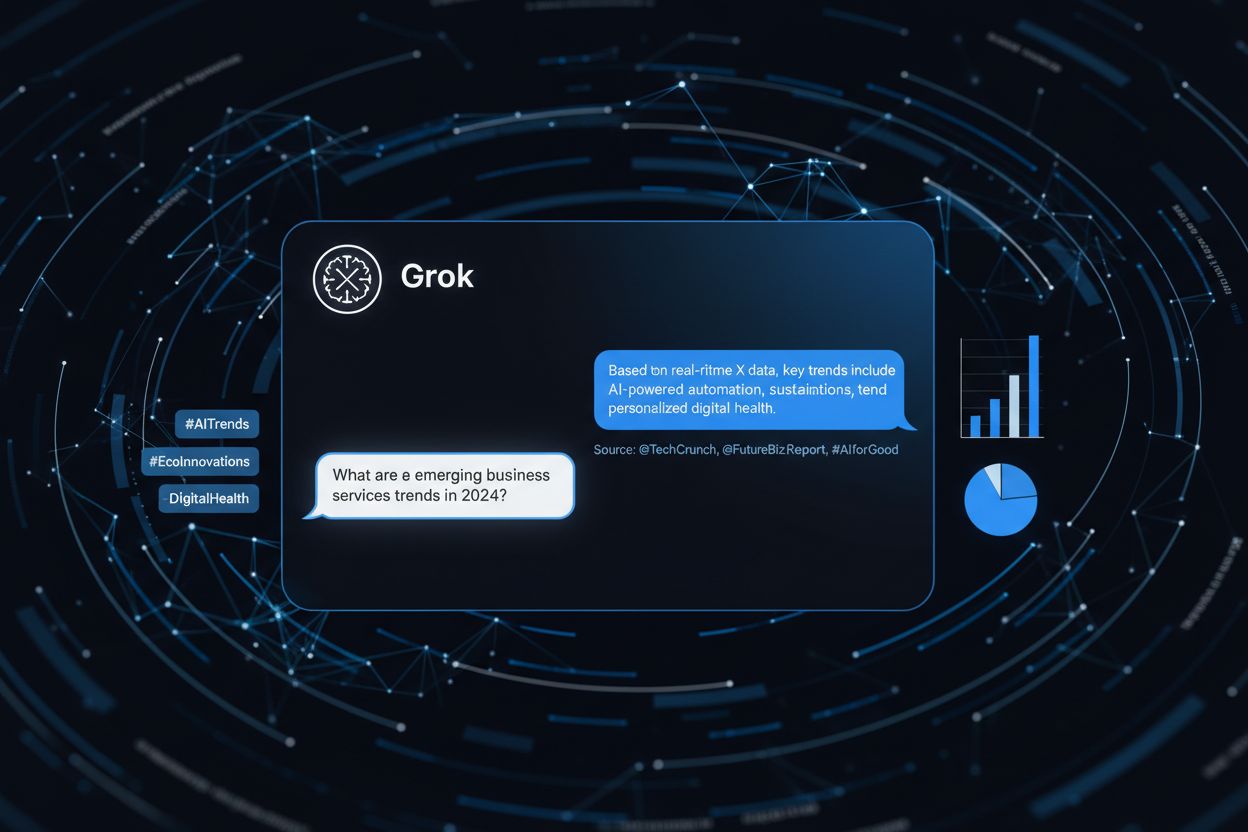
Grok Optimization: How to Appear in X's AI Assistant
A step-by-step framework for earning Grok citations: building real X presence, structuring citation-ready content, technical SEO, and how to measure whether it'...
14 min read

New data shows Grok cites brands through a fundamentally different mechanism than ChatGPT, Gemini, or Perplexity, weighing real-time X activity as the strongest predictor. Here’s what the evidence shows and why it matters now.
Grok is now the third most-used AI chatbot globally, commanding 17.8% of the U.S. chatbot market and 60 million monthly active users. Yet most marketers still don’t understand how Grok decides which brands to cite, or why it cites brands differently than ChatGPT, Gemini, and Perplexity. This piece is about that evidence: what’s actually driving Grok’s citation behavior, and why it matters right now. If you’re past the “why does this matter” question and want the execution playbook, our companion guide covers the X presence tactics, content structure, and technical steps for earning citations.
The short version: while ChatGPT draws from historical training data and Google Gemini relies on Google’s index, Grok has direct, real-time access to X (formerly Twitter), and that changes what gets cited. Brands with strong X presence dramatically outperform their open-web rank on Grok. Brands with weak X signals underperform, even if they dominate Google search. That’s not a hunch, it’s a structural consequence of Grok is xAI’s architecture, and it shows up consistently across the data.
Bottom line: Grok is citing brands, and it’s doing so on different terms than every other major AI assistant. Understanding those terms is the prerequisite for any optimization effort, and tools like Am I Cited can help you track how often Grok and other AI platforms are actually citing you.
Grok is xAI’s conversational AI assistant, built into X and available as a standalone app at grok.com. Launched in 2024 and integrated into X Premium in early 2025, Grok has grown to rival ChatGPT in certain demographics faster than most analysts expected. Its user base skews toward tech professionals, marketers, and finance audiences, the exact people who influence purchasing decisions. For SaaS, fintech, and B2B brands, Grok visibility increasingly matters as much as traditional search ranking.
What makes this moment significant isn’t just Grok’s size. It’s the timing of its architecture. xAI invested $20 billion in January 2026 at a $230 billion valuation, signaling sustained commitment to model capabilities rather than a short-lived experiment. More importantly, Grok has structural access to the X firehose: every public post, every reply, every reposted article, updated in real time. No other major AI assistant matches this, which is precisely why its citation patterns look so different from the rest of the field.
Unlike traditional search engines that return ranked links, Grok synthesizes answers from two corpora at once: the open web and X’s live conversation graph. The result is a model that names clear winners, cites specific sources inline, and updates its view of your brand within hours, not months. That combination, real-time input plus a willingness to commit to a specific answer, is what makes Grok’s citation behavior worth studying on its own terms rather than treating it as “ChatGPT with a Twitter feed.”

Track how AI chatbots mention your brand across ChatGPT, Perplexity, and other platforms.
The differences matter deeply for brand visibility, and they show up as concretely different citation behavior, not just a different interface:
ChatGPT (OpenAI) trains on a static web crawl with a knowledge cutoff in April 2024. It cites reputable third-party sources and published directories. Brand mentions depend on historical authority and training data presence, not current activity.
Google Gemini (Google) draws from Google’s search index and training data. It prioritizes Google-indexed content and tends to cite established, high-authority sources. Like ChatGPT, it’s backward-looking.
Perplexity emphasizes web freshness and real-time retrieval, but lacks native social integration. It cites recent web content and news, but doesn’t weight social signals as heavily as Grok.
Grok (xAI) combines open-web knowledge with X’s live firehose. It weights recent, credibly-posted signal heavily and surfaces inline citations. Brands being actively discussed on X in the moment have a real-time visibility advantage. The model is also tuned to be more direct: it commits to naming a clear winner more readily than Claude or Gemini, which changes how citation credit gets distributed among competitors in the same answer.
| Feature | Grok | ChatGPT | Gemini | Perplexity |
|---|---|---|---|---|
| Primary Corpus | X + Open Web | Training data (cutoff Apr 2024) | Google Index + Training data | Web (real-time) |
| Real-Time Access | Yes (X firehose) | No | Limited | Yes (web only) |
| Social Integration | Native X access | None | None | None |
| Citation Style | Inline, direct | Footnotes, cautious | Inline, cautious | Inline, recent |
| Brand Mention Behavior | Real-time, trend-sensitive | Historical authority | Authority-weighted | Recency-weighted |
| Update Frequency | Minutes to hours | Months (retraining) | Days to weeks | Minutes |
| Direct Comparisons | Frequent (“X is better than Y”) | Hedged | Hedged | Balanced |
Grok doesn’t randomly select which brands to cite. Understanding its citation logic requires understanding its inputs, and the clearest one is X presence: Grok’s access to the platform’s live conversation graph isn’t a marginal advantage, it’s the primary driver of brand mention frequency. Across queries in the same category, X engagement volume is the single strongest predictor of Grok mention rate, more predictive than the same brand’s Google search authority.
What does this look like in practice? A design-tool brand with 50,000 engaged X followers discussing features, sharing screenshots, and participating in trending threads will outrank a competitor with higher Google search authority but minimal X presence. A SaaS company with a founder actively engaging in industry conversations on X gets cited more often by Grok than a competitor with better-written blog content but no social signal.
The mechanism is straightforward: Grok reads X’s firehose in real time. When your brand is mentioned, discussed, or referenced in trending topics, Grok sees it immediately. When customers praise your product on X, Grok weighs that social proof. When your founder or team members engage in relevant industry conversations, Grok interprets that as authority and relevance. This creates a clear hierarchy: brands with strong X presence outperform their open-web rank on Grok, and brands with weak X presence underperform it, even when the underlying product or company is equally strong.
Get the latest insights on AI mentions, brand monitoring, and optimization strategies.
Beyond baseline X presence, Grok evaluates several signals that shift on a much shorter timescale than anything in traditional SEO:
Trending Topic Relevance. If your industry is trending on X (a major conference, a competitor controversy, a viral discussion), brands positioned within that conversation have heightened visibility in Grok’s responses. This means a brand mentioned in a trending thread about “AI marketing tools” can appear in Grok’s response to “What’s the best AI marketing platform?” asked hours later.
Engagement Velocity. Grok doesn’t just count mentions, it weighs momentum. A brand gaining 500 mentions in one day signals more relevance than 500 mentions spread over three months. Viral moments, product launches, and timely content create measurable spikes in Grok visibility.
Social Sentiment. Real-time sentiment on X directly influences Grok’s framing. If your brand is trending positively (customer praise, positive reviews, successful launches), Grok picks up on this. Conversely, negative viral moments or PR crises shift how Grok discusses your brand within hours.
Influencer Endorsements. Endorsements from high-follower accounts on X carry weight in Grok’s understanding of brand quality. When respected figures in your industry mention your product, Grok factors this social proof into its recommendations more directly than platforms relying solely on web content.
Conversational Mentions. Organic mentions of your brand in X conversations (users recommending you to others, asking about your product, sharing experiences) contribute to Grok’s perception. Authentic word-of-mouth influences Grok more than any other AI platform, which is a meaningfully different dynamic than the citation patterns AI chatbots have become as primary brand discovery channels through static web content.
X presence gets your brand into Grok’s field of view; content quality determines whether Grok cites your content specifically once it’s there. Five factors consistently correlate with citation likelihood:
Entity Clarity. Consistent brand naming, product naming, and executive attribution across reputable sources. If your brand appears as “Acme Inc.” on your website, “Acme” on your documentation, and “ACME Corporation” on third-party sites, Grok struggles to unify these references, and inconsistency measurably suppresses citation frequency.
Schema Markup and Metadata. Technical clarity improves how Grok parses your content. Proper schema markup for product pages, FAQs, how-to guides, and organization information helps Grok extract and cite your content accurately.
Content Extractability. Grok cites content that’s easy to quote. Definitions, lists, comparison tables, step-by-step guides, and summary boxes are highly citable. Dense paragraphs without clear structure are harder to cite, even if the information is accurate.
Freshness Signals. Up-to-date product pages, pricing information, release announcements, and blog posts with clear publication dates signal authority. Outdated content, even if accurate historically, ranks lower in Grok’s evaluation.
Third-Party Validation. Mentions in publications, review platforms, industry hubs, and reputable directories increase your authority score. Grok weighs third-party citations as independent validation of your brand’s credibility.
When Grok cites your brand, it typically does so inline, embedding a clickable link to your source within the answer. This matters for three concrete reasons:
Direct Traffic. Inline citations drive measurable traffic. Unlike traditional SEO where ranking position correlates loosely with clicks, Grok citations create direct referral traffic from users reading the AI’s response. Cited sources receive 2-5x more traffic than non-cited competitors mentioned in the same answer.
Credibility Transfer. Being cited by Grok transfers credibility to your brand. Users see your URL embedded in the AI’s response and interpret that as validation. This effect is stronger than a third-party mention because the AI itself is vouching for your content’s relevance and accuracy.
Query Diversity. Grok citations aren’t limited to your primary keywords. Because Grok understands semantic relationships, your content might be cited for adjacent queries, long-tail variations, and follow-up questions. A single well-structured page can drive citations across dozens of related queries, not just the one it was written for.
Grok’s citation logic isn’t a black box, and it isn’t the same box as ChatGPT’s, Gemini’s, or Perplexity’s. It’s a real-time, X-weighted system that rewards brands with genuine social presence, structured and extractable content, and consistent entity signals, and it recalculates its view of you far faster than any platform that depends on periodic retraining.
That has an obvious implication: a brand that’s invisible on X starts every Grok query at a structural disadvantage, no matter how strong its web presence is elsewhere. Reversing that isn’t about gaming a single signal; it’s a coordinated effort across social presence, content structure, and measurement. For hands-on testing in the meantime, asking Grok xAI’s assistant your target questions directly and reading what it says remains a reliable, free way to see where you currently stand. For the step-by-step version of that coordinated effort, see our guide to Grok optimization .
Arshia is an AI Workflow Engineer at FlowHunt. With a background in computer science and a passion for AI, he specializes in creating efficient workflows that integrate AI tools into everyday tasks, enhancing productivity and creativity.

Am I Cited monitors your brand mentions and citations across ChatGPT, Perplexity, and Google AI Overview, so you know where you stand before you optimize.
A step-by-step framework for earning Grok citations: building real X presence, structuring citation-ready content, technical SEO, and how to measure whether it'...

Community discussion on using Twitter/X for AI search optimization. Strategies for leveraging Grok and X Advanced Search for brand monitoring and AI visibility.

Learn what Grok Real-Time is, how it accesses live X data for current event responses, and how it differs from traditional AI models with knowledge cutoffs. Exp...
Cookie Consent
We use cookies to enhance your browsing experience and analyze our traffic. See our privacy policy.