


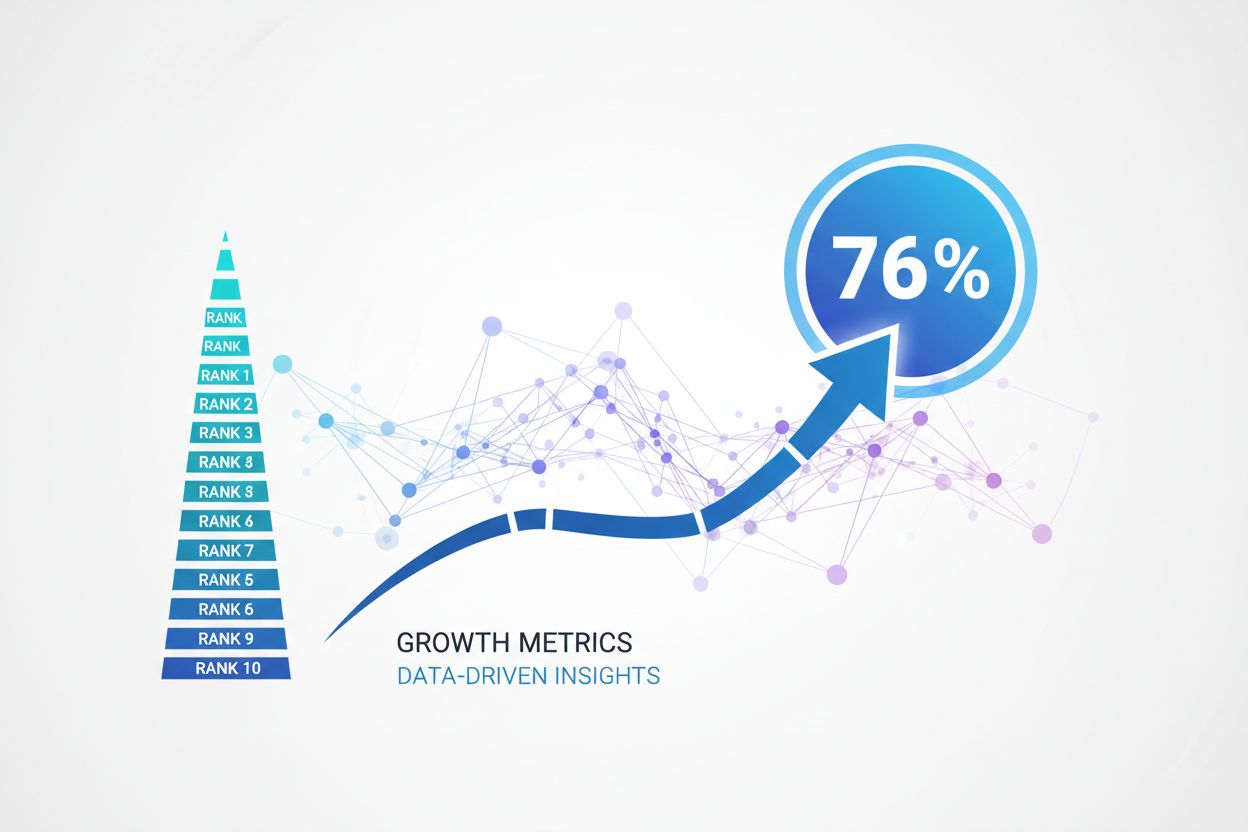
Why 76% of AI Overview Citations Come from Top 10 Results
Discover why Google AI Overviews cite top 10 results 76% of the time. Learn how ranking positions, content structure, and topical authority impact AI citations ...
11 min read
Google AI Overviews don’t just repackage the top organic results. Here’s how they actually select brands, through entity clarity, earned authority, and extractable architecture, and a practical playbook to earn citations.
Google AI Overviews now appear on 48% of all search queries, up from 31% just twelve months ago. They reach 2.5 billion users every month. And in March 2026, a finding landed that should reframe every brand’s search strategy: the share of AI Overview citations coming from top-10 organic results collapsed from 76% to 38% in eight months, according to Ahrefs data.
Ranking on page one is no longer a reliable path to being cited by Google’s AI.
The mechanism has shifted. Google’s AI Overviews do not simply repackage the top organic results. They use a retrieval-augmented generation (RAG) pipeline that queries the search index, retrieves candidate documents, and synthesizes an answer from passages it deems most credible, relevant, and extractable. A brand that ranks #1 can be ignored entirely. A brand that ranks #15 can be the primary citation.
This article explains exactly how Google AI Overviews decide which brands to mention, drawing on every major study published in 2025 and 2026, including Ahrefs’ analysis of 75,000 brands, SE Ranking’s study of 129,000 domains and 216,524 pages, Northwestern University’s coding of 1,024 AI Overview source attributions, and the Princeton GEO framework. The goal is not theory. It is a practical, data-backed playbook for earning brand citations in the AI-generated search layer that now sits above the traditional results.
For two decades, the logic was straightforward: optimize your pages, climb the rankings, earn traffic. Google’s AI Overviews break that linear relationship.
The RAG pipeline that powers AI Overviews works differently from the classic ranking algorithm. It retrieves a set of candidate documents for a query, then uses a customized version of Gemini to extract and synthesize relevant passages into a single answer. The sources it cites are the ones whose passages best answer the specific sub-question the model is composing, not necessarily the ones with the highest domain authority or the most backlinks.
This is why the drop from 76% to 38% is so significant. When AI Overviews launched, they leaned heavily on top-ranking pages as a trust proxy. As the models have matured, they have become more discriminating, pulling from a wider pool of sources based on passage quality, entity signals, and contextual authority rather than rank position alone.
The practical implication: you can no longer rely on ranking #1 for a head term and expecting to be cited. You need to be the best answer for the specific sub-questions the model generates during its fan-out process.
When an AI Overview appears on a SERP, organic click-through rates for pages below it drop by 34.5% to 61% , depending on the query type. For informational queries (where AI Overviews trigger 98% of the time), the impact is at the high end of that range.
But the inverse is also true. Pages cited inside an AI Overview earn approximately 35% more clicks than non-cited competitors, according to Seer Interactive. And the traffic quality is dramatically higher: visitors who click through from an AI Overview have already read a summary that referenced the content. They arrive with stronger intent. Research from RankScience found that AI Overview traffic converts at 14.2% , compared to 2.8% for traditional organic traffic: a 5x quality premium.
The table below summarizes the impact dynamics:
| Metric | Without AI Overview Citation | With AI Overview Citation |
|---|---|---|
| Organic CTR impact | −34.5% to −61% | +35% lift |
| Conversion rate | ~2.8% (traditional organic) | ~14.2% |
| Visitor intent | Variable | Pre-qualified, high-intent |
| Brand impression | Absent from AI-generated answer | Brand name embedded in answer |
| Authority signal | None from AI layer | Implicit endorsement from Google’s AI |
The brand that is not cited is not just losing traffic. It is losing the implicit endorsement that comes from being named by Google’s AI as a trusted source.
Across the research, three interconnected factors determine whether Google AI Overviews decide to mention a brand. We call them the Authority Tripod:
Each pillar is necessary. None is sufficient alone. A brand with perfect entity clarity but no third-party mentions is invisible. A brand with strong earned authority but inconsistent entity data is confusing. A brand with extractable content but no authority signals is untrusted.

Track how AI chatbots mention your brand across ChatGPT, Perplexity, and other platforms.
Google’s AI does not think in keywords. It thinks in entities: distinct, recognizable concepts, people, places, and brands. The Knowledge Graph is the database that maps these entities and their relationships. When an AI Overview model considers whether to mention a brand, it first checks whether it can confidently identify what that brand is.
This is a binary gate. If the AI cannot verify your brand as a known entity, it will not risk naming you. The model’s default behavior is to avoid citation rather than cite incorrectly.
Entity recognition is not a ranking factor in the traditional sense. It is a prerequisite. Without it, none of the other signals matter.
The Knowledge Graph draws from multiple sources: Wikipedia, Wikidata, Crunchbase, Google Business Profiles, and structured data extracted from websites. The more consistent and complete your brand’s entity footprint across these sources, the higher the AI’s confidence in recognizing and citing you.
Schema markup, specifically Organization schema, is the most direct way to tell Google’s systems exactly what your brand is. It provides a machine-readable blueprint that eliminates ambiguity.
The most impactful implementation includes:
@type: Organization with a complete set of properties: name, url, logo, description, foundingDate, and addresssameAs properties linking to your official Wikipedia entry, Wikidata ID, Crunchbase profile, LinkedIn company page, and verified social media profiles: these create explicit cross-references that strengthen entity confidencebrand and manufacturer properties on product pages, linking back to the Organization entityA peer-reviewed study of 730 AI citations found that schema markup increases AI citation rates, but the quality of implementation matters more than mere presence. Incomplete or inaccurate schema is worse than no schema at all, because it introduces conflicting signals.
Google’s AI cross-references your brand’s information across the web. If your pricing, product names, headquarters location, or core capabilities are inconsistent between your website, G2, Trustpilot, Crunchbase, and your Google Business Profile, the AI flags the discrepancy as a low-confidence signal.
Semrush research explicitly identifies data inconsistency as a “downgrade signal” for AI visibility. The AI interprets conflicting information as evidence that the entity is not well-defined, and it defaults to safer, more consistent alternatives.
The fix is methodical: audit every platform where your brand appears, standardize every data point, and set a recurring calendar reminder to re-audit every six months. This is not glamorous work, but it is the foundation on which everything else rests.
Google’s own databases play an outsized role in brand selection for AI Overviews. For e-commerce queries, the model pulls heavily from Google Merchant Center feeds. For local queries, Google Business Profiles are the primary data source. And for all queries, a user’s Preferred Sources settings, introduced in 2025, can automatically elevate specific brands into their personalized AI Overviews.
The strategic implication is clear: if your brand operates in e-commerce, local services, or any space where Google offers a first-party data product, maintaining those profiles is not optional. Google’s official AI optimization guide explicitly states that Merchant Center and Business Profile data influence AI Overview responses.
The most underappreciated shift in AI search is the rising importance of unlinked brand mentions. When a brand name appears in text without a hyperlink (in a news article, a Reddit thread, an industry report, a Quora answer), the AI model still registers it. It reads the context around the mention, maps the brand to the topic, and builds a statistical association.
Traditional SEO trained marketers to value the link. AI search values the mention. The distinction is not semantic; it is strategic.
As Contently’s research on AI search explains, LLMs extract entities from text and map them to topics during retrieval. An unlinked mention in a respected publication carries the same semantic weight as a linked mention inside the text the model actually reads and summarizes. The model does not need a clickable URL to learn that a brand is associated with, for example, “enterprise content governance” or “AI-powered analytics.”
This is where the data gets compelling. SE Ranking’s analysis of 129,000 unique domains and 216,524 pages found that referring domain diversity was the single strongest predictor of ChatGPT citation probability. Sites with over 32,000 referring domains received 3.5 times more citations than those with fewer than 200. The breadth of independent sources discussing a brand, linked or unlinked, is the strongest signal of earned authority.
The Northwestern University Spiegel Research Center analyzed 1,024 source attributions across 69 AI Overviews and found that 47% of AI Overview sources came from brand-controlled properties and 84% of earned media sources belonged to affiliate channels or publishers. This reveals a clear pipeline: brands that invest in digital PR (getting mentioned in industry publications, comparison articles, and affiliate content) are feeding the exact sources that AI Overviews draw from.
The implication is that SEO and digital PR are no longer separate disciplines. They are a unified strategy. Every mention your brand earns in a respected publication is not just a brand awareness play. It is a direct input into the AI’s probabilistic model of which brands are authoritative on a given topic.
Ziptie’s analysis of AI citation algorithms describes this as a “probabilistic map.” The AI maps connections based on context: if your brand is consistently discussed on Reddit, Quora, industry forums, and major news outlets alongside terms like “best project management software for small teams,” the AI connects your brand entity to that specific use case. The more independent sources that make that connection, the stronger the association becomes.
The relationship between third-party mentions and AI Overview citations is not linear: it compounds. A brand mentioned once in a single low-authority publication gains little. A brand mentioned consistently across dozens of diverse, trusted sources creates a consensus signal that the AI interprets as reliable.
The Forbes Agency Council article by Tessar Napitupulu, citing the Princeton GEO study, identified a critical finding: AI platforms are drawn to content that mirrors how they construct their own answers. They favor authoritative, persuasive language backed by verifiable statistics. The study tested nine optimization methods across 10,000 queries and found that adding statistics, citing authoritative sources, and writing in a tone described as “authoritative and persuasive” produced up to a 40% increase in visibility.
Traditional keyword optimization, by contrast, performed roughly 10% worse than the baseline of no optimization at all. The AI is not impressed by keyword density. It is impressed by evidence.
The Northwestern study found that 11% of AI Overview attributions came from shared media: Reddit, YouTube, Quora, and similar platforms. This is a smaller share than owned or earned media, but it represents a high-impact opportunity because the competitive saturation is lower.
When a brand is consistently recommended in community discussions, the AI interprets that as social proof. A Reddit thread where multiple users name a brand as the best solution for a specific problem carries more weight than a brand’s own marketing copy. The AI is trained to trust independent consensus over self-promotion.
The practical takeaway: brands should monitor and participate in relevant community discussions, not to spam mentions, but to ensure that when their brand is discussed, the information is accurate and the context is favorable. Community engagement is now a search signal.
Get the latest insights on AI mentions, brand monitoring, and optimization strategies.
Even if a brand has perfect entity clarity and strong earned authority, its content must be built for AI extraction. The SE Ranking study of 216,524 pages found that pages structured into content sections of 120 to 180 words earn 70% more citations than pages with shorter sections.
This is not a coincidence. AI models are trained to extract self-contained, coherent passages. A section that is too short lacks substance. A section that is too long contains too many ideas for the model to cleanly extract. The 120–180 word range is the sweet spot: enough depth to be useful, enough focus to be extractable.
A separate study by Evertune, analyzing 400 million LLM citations across 25,000 URLs, found that 44.2% of all AI citations are extracted from the first 30% of a page. The model does not read pages top to bottom the way a human does. It scans for the most concentrated, answer-rich sections, and those tend to be near the top.
The most effective content for AI Overviews follows a pattern the Medium article on AI Overview citations calls “answer-first formatting.” Each section leads with a direct, declarative answer to a specific question, followed by supporting evidence, examples, and nuance.
Consider these two approaches to the same topic:
Conventional approach: “In today’s competitive landscape, many businesses are looking for ways to improve their project management workflows. There are several factors to consider when choosing a tool, and the decision can be complex.”
Answer-first approach: “The three project management tools best suited for small distributed teams are Linear, Notion, and Height. Each prioritizes speed and asynchronous communication over enterprise feature depth, which is why they outperform traditional platforms like Jira for teams under 50 people.”
The second approach gives the AI a clean, extractable passage it can drop directly into an Overview. The first approach gives the AI nothing to work with. The model does not have time to interpret vague lead-ins. It wants the answer, immediately.
Ziptie’s research found that content including verifiable statistics, hard data, or authoritative quotes sees a 35% lift in AI citation rates. The AI wants to ground its answers in factual evidence, not marketing language.
This is consistent with the Princeton GEO study’s finding that “citing authoritative sources directly in the content” was one of the few techniques that consistently improved AI visibility. The model is not looking for opinion. It is looking for evidence it can trust.
The Forbes article reinforces this with a practical observation: “Content that is overly salesy or promotional tends to be ignored.” The AI is trained to prefer neutral, factual language. A case study that presents objective results is cited. A product page that makes unsubstantiated claims is not.
AI Overviews rotate sources frequently to keep information current. The SE Ranking study found that content updated within the last three months is twice as likely to be cited as older material. The Medium article on AI Overview citations confirms this pattern: “Brands that update their data, case studies, and informational pages within the last three months have a much higher likelihood of being pulled into an overview.”
This has practical implications for content strategy. A comprehensive guide published once and left to age is less valuable than a guide that is refreshed quarterly with new data, updated examples, and current statistics. The freshness signal is not about tricking the algorithm with arbitrary date changes. It is about demonstrating that the brand actively maintains its knowledge base.
Google’s published guidance on AI Overviews is deliberately simple. The official AI optimization guide states that the same SEO fundamentals apply: create helpful, reliable, people-first content, ensure technical accessibility, and use structured data correctly. There are “no additional optimization requirements specifically for AI Overviews.”
The official documentation emphasizes that AI Overviews are rooted in Google’s core search ranking and quality systems. The RAG pipeline retrieves pages from the search index, and the model synthesizes them. The implication is that if you rank well, you should be cited.
The data tells a more nuanced story. The table below summarizes the gaps between official guidance and empirical findings:
| Topic | Google’s Official Position | What the Data Shows |
|---|---|---|
| Ranking and citation relationship | Core ranking systems power AI Overviews | Top-10 organic results now account for only 38% of AI Overview citations (Ahrefs, March 2026) |
| Special optimization | No additional requirements beyond standard SEO | Content structured in 120–180 word passages earns 70% more citations (SE Ranking) |
| Authority signals | E-E-A-T matters, same as always | 96% of AI Overview citations come from verifiably authoritative sources: a higher bar than traditional rankings (Wellows) |
| Content freshness | Not specified as a distinct factor | Content under 3 months old is 2x more likely to be cited (SE Ranking) |
| Brand mentions | Not addressed in official guidance | Unlinked brand mentions are a core AI search signal (Contently, multiple studies) |
| Paid influence | Google Ads does not influence AI Overviews | No evidence of direct paid influence, but brands with large ad budgets often have stronger entity footprints |
The gap is not that Google is misleading anyone. It is that the official guidance describes the minimum bar: the entry ticket. The data describes what actually wins citations in a competitive environment. The brands that earn AI Overview mentions are doing substantially more than the official guidance requires.
Before optimizing for AI Overviews, you need to understand how Google’s AI currently perceives your brand. The audit should cover:
sameAs properties populated?The output of this audit is a prioritized list of fixes. Entity inconsistencies are the highest priority because they undermine everything else.
Earned authority is the hardest pillar to build because it requires genuine third-party validation. But it is also the hardest for competitors to replicate.
The strategy has three components:
Earn media coverage in publications that AI Overviews cite. The Northwestern study identified that affiliate publishers and owned content dominate AI Overview sources. Build relationships with the publications in your industry that appear in AI Overview citations for your target queries. Provide them with data, expert commentary, and original research that they will want to reference.
Generate unlinked brand mentions. Every mention of your brand in a trusted publication, even without a link, feeds the AI’s probabilistic model. Digital PR campaigns, expert commentary in news articles, and inclusion in industry roundups all contribute. The Contently research confirms that unlinked mentions carry the same semantic weight as linked mentions for AI visibility.
Monitor and engage in community discussions. Reddit, Quora, and industry forums are source material for AI Overviews. When your brand is discussed, ensure the information is accurate. When questions arise that your brand can answer, provide genuine value. The goal is not to spam mentions but to ensure that the community consensus about your brand is informed and accurate.
This is the most immediately actionable pillar. For every page you want cited in AI Overviews:
AI Overviews brand visibility is not a one-time optimization. It requires ongoing monitoring because the models, the competitive landscape, and the citation patterns are constantly evolving.
The monitoring framework should include:
Google AI Overviews have rewritten the rules of brand visibility in search. The old playbook (optimize for rankings, earn backlinks, climb the SERP) still matters, but it is no longer sufficient. The new playbook requires brands to think in terms of entity clarity, earned authority, and extractable architecture.
The data is unambiguous. The share of AI Overview citations coming from top-10 organic results has halved in eight months. Unlinked brand mentions now rival backlinks as authority signals. Content structured for AI extraction earns 70% more citations. And brands that are not cited in AI Overviews are losing up to 61% of their potential organic traffic.
The brands that will dominate the next decade of search are the ones that treat AI Overviews not as a threat to be managed but as a new surface to be won. The playbook is here. The data is clear. The only question is which brands will act on it first.
Arshia is an AI Workflow Engineer at FlowHunt. With a background in computer science and a passion for AI, he specializes in creating efficient workflows that integrate AI tools into everyday tasks, enhancing productivity and creativity.

Am I Cited tracks how often Google AI Overview, ChatGPT, and Perplexity cite your brand, and how you compare to competitors, so you can act on the signals that actually earn citations.
Discover why Google AI Overviews cite top 10 results 76% of the time. Learn how ranking positions, content structure, and topical authority impact AI citations ...

Learn what brand authority for AI means, why it matters for AI search visibility, and how to build trust signals that help ChatGPT, Perplexity, and Google AI ci...

Discover why competitors dominate AI-generated answers and learn proven strategies to increase your brand's visibility in ChatGPT, Perplexity, and Google AI Ove...
Cookie Consent
We use cookies to enhance your browsing experience and analyze our traffic. See our privacy policy.