



AI Search Trends to Monitor in 2025 - Key Insights for Your Brand
Discover critical AI search trends including ChatGPT dominance, Perplexity growth, Google AI Mode expansion, and zero-click optimization. Learn how to monitor y...
10 min read

Is AI search visibility a passing trend or a structural shift in how people discover brands? The referral-traffic data, platform growth rates, and industry adoption patterns point clearly toward one answer.
The click is dying.
In March 2025, researchers at Pew analyzed nearly 69,000 Google searches and found something that should concern every marketer: when an AI summary appeared at the top of search results, users clicked through to a website only 8% of the time. Compare that to the 15% click-through rate for searches without an AI summary, and the pattern becomes unmistakable. Even worse, only 1% of users bothered clicking the sources cited within those AI summaries. A quarter of searchers ended their session entirely, satisfied by the AI-generated answer alone.
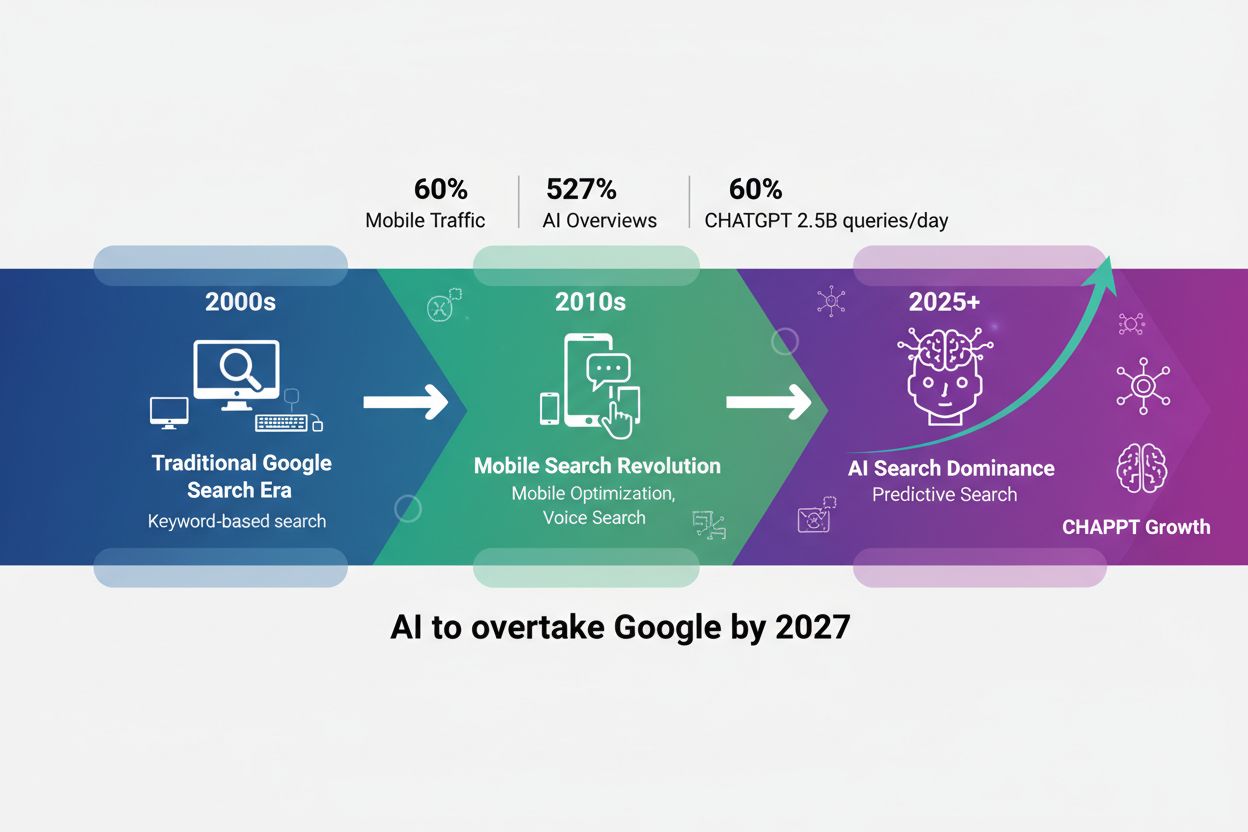
That was ten months ago. Today, in 2026, the situation has accelerated dramatically. AI Overviews now appear on 48% of all tracked queries, up 58% from a year earlier. ChatGPT processes over 2.5 billion prompts per day. Perplexity has reached 45 million monthly active users. Google’s AI Mode has grown to 100 million monthly actives, processing more than a billion queries a month.
And yet, most brands have no idea whether AI systems even mention them.
This creates a fundamental question that’s reshaping how every organization thinks about online visibility: Is AI search visibility a fad (a temporary disruption that will fade as the novelty wears off) or the future of how people discover brands and information?
The answer, backed by data from 1.96 million LLM-driven sessions, is clear: AI search visibility is not a fad. It’s the emerging foundation of how discovery happens in 2026 and beyond. But understanding why requires looking at the data, the platforms driving this shift, and the business implications for brands that fail to adapt.
Bottom line: AI search visibility is not a fad, it’s becoming a permanent layer of how people discover brands, so the sooner you start tracking and building it (with a tool like Am I Cited or manual monitoring), the bigger the head start you get on competitors who are still waiting to see if it “sticks.”
Before we answer whether AI search visibility is a fad, we need to define what it actually is, because it’s fundamentally different from everything marketers have built over the past two decades.
AI search visibility is the measure of how frequently and prominently your brand, content, or website appears in responses generated by AI-powered search engines and assistants. It’s not about ranking position on a search results page. It’s about whether an AI system cites, mentions, or recommends your content when a user asks a relevant question.
Think of traditional SEO as a ranking game. Your content competes for positions 1 through 10 on a search results page. A user scans the headlines, clicks a link, and visits your website. You measure success through rankings, click-through rates, and organic traffic.
AI search visibility operates on a completely different model: the citation model. An AI engine synthesizes information from multiple sources into a single, comprehensive answer. Your brand either gets cited in that answer, or it doesn’t. There’s no “position 7” in an AI-generated response. You’re either visible or invisible.
The differences go deeper than metrics. Here’s how the two systems compare across five critical dimensions:
| Dimension | Traditional SEO | AI Search Visibility |
|---|---|---|
| Primary Metric | Search ranking position (1-10) | Citation presence (yes/no) |
| User Action | Click through to website | Read answer in-platform |
| Content Format | Optimized web pages | Cited source in synthesized answer |
| Success Signal | Higher ranking = more clicks | More citations = more brand exposure |
| Competitive Frame | 10 spots on page one | Unlimited citations per answer |
| Update Cycle | Algorithm updates (periodic) | Model retraining + real-time search |
| Traffic Impact | Direct website visits | Brand awareness, indirect traffic |
| Measurement Tools | Google Search Console, Ahrefs, Semrush | AI visibility platforms, manual monitoring |
The shift is not incremental. It’s existential. For the first time in two decades, ranking high on Google doesn’t guarantee visibility where users are actually searching for answers.
Understanding which AI platforms matter is critical to assessing whether AI search visibility is a lasting trend or a temporary phenomenon. Three platforms currently dominate the landscape, and their growth trajectories tell us everything we need to know about the future.
ChatGPT owns 84.2% of all AI referrals, growing 3.26x year-over-year. It’s the default interface for AI-driven discovery, handling over 5.35 billion monthly visits. But here’s what’s important: ChatGPT’s dominance doesn’t mean it will remain the only player. The real story is in the challengers.
Copilot (Microsoft’s AI assistant) grew 25.2x year-over-year, from 180 sessions in November 2024 to 4,534 sessions in November 2025. Why does this matter? Because Copilot is embedded in Microsoft Office, the software where millions of professionals work every single day. As AI integrates into existing tools, discovery happens at the moment questions arise, not after users decide to open ChatGPT.
Claude (Anthropic’s AI) grew 12.8x in the same period, signaling explosive expansion in specialized use cases like coding, research, and complex analysis. Meanwhile, Google AI Overviews appear in 48% of all tracked queries, reaching 2 billion monthly users across 200+ countries.
This is not a fad. This is the infrastructure of discovery being rebuilt in real time.
The “fad or future” question isn’t academic. It determines where you invest your resources, how you structure your content strategy, and whether you’re positioned to capture demand in 2026 and beyond.
If AI search visibility is a fad, you can safely ignore it and continue optimizing for traditional SEO. You’d be betting that users will return to clicking blue links, that AI summaries will fade away, and that the next five years of digital marketing will look like the last five.
If it’s the future, ignoring it means becoming invisible to an expanding audience, one that’s already shifting how they search, discover, and make decisions.
The data suggests the latter. And the evidence is overwhelming.

Track how AI chatbots mention your brand across ChatGPT, Perplexity, and other platforms.
Let’s examine the hard data, not predictions or hype, but actual user behavior and adoption patterns from 2025 and 2026.
The Previsible State of AI Discovery Report analyzed 1,963,544 LLM-driven sessions across 12 months (November 2024 to November 2025) from sites across SaaS, e-commerce, finance, legal, health, and publishing. This is real traffic data, not projections.
Here’s what it reveals:
AI traffic is concentrated on high-intent pages. While AI represents just 0.13% of total traffic across all sites, it concentrates heavily on pages where users make decisions. Industry pages see 1.14% AI penetration, nearly 9x the average. Tools pages hit 0.95%. Pricing pages reach 0.46%. These aren’t random pages; they’re revenue-driving pages where users evaluate options and make purchasing decisions.
This concentration matters because it reveals AI traffic’s true value. It’s not about volume; it’s about intent. A single AI citation on a pricing page is worth more than 100 random visits. It’s a user who has already decided they need a solution and is evaluating whether yours is the right fit.
YMYL industries lead adoption. Legal sites show 11.9x higher AI penetration than the average. Finance sites hit 2.9x. Health sites hit 2.9x. These are industries where stakes are highest and users demand authoritative, trustworthy information. AI platforms prioritize credible sources in these categories, which means visibility in YMYL is both harder to achieve and more valuable when you do.
E-commerce AI surged seasonally. During November 2025 (holiday shopping season), AI penetration on e-commerce sites jumped 67% month-over-month, reaching 0.19%. This suggests AI-driven discovery is becoming a material part of the purchase journey, especially during high-intent shopping periods.
These aren’t the patterns of a fad. These are the patterns of a fundamental shift in how users discover information and make decisions.
When people ask “Is AI search visibility a fad?”, they’re often thinking about ChatGPT. And it’s true: ChatGPT dominates. It accounts for 84.2% of all AI referral traffic, with 1.65 million sessions over the 12-month period.
But the story isn’t ChatGPT’s dominance. The story is what’s happening in the margins.
Copilot grew from 180 sessions in November 2024 to 4,534 in November 2025. That’s a 25.2x increase. Claude grew 12.8x. Gemini grew 1.34x. Perplexity grew 1.15x.
These growth rates matter because they reveal where the market is heading. ChatGPT’s 3.26x growth is impressive, but it’s being outpaced by platforms that are embedding AI into the tools people already use: Microsoft Office, code editors, enterprise software.
In other words, AI-driven discovery isn’t consolidating around a single platform. It’s fragmenting across dozens of tools and interfaces. This fragmentation is exactly what would happen if AI discovery were becoming the standard way people search, rather than a novelty that will fade away.
If AI search visibility were a temporary fad, you’d expect to see growth concentrated in a few novelty platforms, with adoption plateauing as the hype cycle ended. Instead, you’re seeing growth accelerating across multiple platforms, with new entrants (Claude, Copilot) growing fastest. That’s the pattern of a structural shift in user behavior, not a trend.
One of the most misunderstood metrics in modern SEO is the “zero-click rate”: the percentage of searches where users get their answer without clicking through to a website.
Google’s AI Overviews have dramatically accelerated zero-click behavior. BrightEdge’s data shows that Google search impressions climbed 49% in the 12 months following AI Overviews’ launch, but click-through rates dropped nearly 30% over the same period. In other words, more people are searching, but fewer are clicking.
This is often framed as bad news for publishers. And in the traditional SEO model, it is. But it’s actually the clearest possible signal that AI search visibility is not a fad. It’s the new normal.
Here’s why: if AI Overviews were a temporary feature that users would eventually ignore, we’d expect to see zero-click rates stabilize or decline as users adapted. Instead, zero-click behavior is accelerating. Users are increasingly comfortable getting answers from AI summaries without visiting websites. They’re not going to un-learn this behavior. They’re going to deepen it.
The average AI Overview now exceeds 1,200 pixels in height, up 15% year-over-year. Google is investing heavily in making these summaries more comprehensive, more useful, and more self-contained. This isn’t the behavior of a company testing a temporary feature. It’s the behavior of a company building the future of search.
If AI search visibility were a fad, you’d expect to see adoption distributed evenly across industries. Instead, you see clear leaders and laggards, which is exactly what you’d expect if certain industries are recognizing the strategic value of AI visibility and investing accordingly.
YMYL industries (where expertise and authority matter most) show the highest adoption. Legal sites see 11.9x higher AI penetration. Finance sites see 2.9x. Health sites see 2.9x. These industries understand that AI platforms prioritize credible, authoritative sources. They’re investing in visibility because they’ve recognized the value.
E-commerce shows explosive seasonal growth. November 2025 saw a 67% month-over-month jump in AI penetration during holiday shopping. This is significant because it shows AI-driven discovery is becoming a material part of the purchase journey. When stakes are high (holiday shopping), users are turning to AI assistants to help them make decisions. Brands that are visible in those AI answers are capturing demand.
SaaS and B2B show high AI concentration on decision pages: industry pages, tools pages, pricing pages. This suggests that B2B buyers are using AI assistants to research solutions, compare options, and evaluate pricing. Visibility in those AI-generated comparisons is becoming a critical part of the sales funnel.
These aren’t early adopters experimenting with a novelty. These are strategic industries recognizing that AI search visibility is central to how their customers discover solutions.
The distinction between AI search visibility and traditional SEO is not semantic. It’s structural. Understanding these differences is essential to assessing whether the shift is temporary or permanent.
In traditional SEO, your goal is to rank as high as possible on a search results page. Position 1 is worth more than position 5, which is worth more than position 10. You measure success by tracking your ranking position and comparing it to competitors.
In AI search visibility, there are no ranking positions. An AI engine synthesizes information from multiple sources into a single answer. You’re either cited in that answer, or you’re not. There’s no position 7. You’re either visible or invisible.
This is a fundamental shift in how competition works. In traditional SEO, competition is zero-sum. If your competitor ranks at position 1, you rank at position 2. In AI visibility, competition is different. Multiple sources can be cited in a single answer. You don’t have to knock your competitor out of position 1 to be visible. You just have to be cited alongside them.
But this also means that visibility is harder to achieve. In traditional SEO, you can rank for a keyword without being the best answer. You just need to be better than the other nine results on the page. In AI visibility, you need to be credible enough that an AI system trusts you as an authoritative source. The bar is higher.
In traditional SEO, you measure success through click-through rate (CTR). A user sees your result in the search results, clicks it, and visits your website. You track how many clicks you get and optimize to increase CTR.
In AI search visibility, the metric is different. You’re measuring brand mentions, citations, and how you’re described in AI-generated answers. A user might see your brand mentioned in a ChatGPT response, read about your solution, and decide to visit your website, but that visit won’t show up as a direct referral from ChatGPT. It will show up as direct traffic or branded search.
This creates a measurement challenge. AI visibility is harder to track because the traffic attribution is indirect. But it also reveals something important: AI visibility is about brand awareness and authority, not just direct traffic. A mention in ChatGPT might not send a click, but it builds trust and shapes perception. Over time, that translates to higher brand searches, direct traffic, and conversions.
Google’s traditional search results page displayed 10 blue links: 10 competing websites, each trying to rank higher than the others. This model dominated search for 25 years. It shaped how marketers thought about visibility, competition, and success.
AI Overviews are killing this model. When an AI summary appears at the top of a search results page, the 10 blue links below become secondary. Users read the AI summary first. If they get their answer, they stop. If they need more information, they might click one of the blue links, but they’re already satisfied by the AI’s synthesis.
This shift from “10 blue links” to “1 AI answer” is not reversible. Users have tasted the convenience of getting an instant, synthesized answer. They’re not going to prefer clicking through to multiple websites. They’re going to demand more AI summaries, more instant answers, more convenience.
Google understands this. That’s why AI Overviews are expanding, not shrinking. That’s why they’re investing billions in making AI summaries more comprehensive and useful. That’s why they’re appearing in 48% of tracked queries and climbing.
The “10 blue links” model is dead. The question isn’t whether it will return. The question is how quickly brands will adapt to the new model.
Get the latest insights on AI mentions, brand monitoring, and optimization strategies.
Understanding that AI search visibility is not a fad is important. But understanding why it matters for your business is critical.
The most common objection to investing in AI search visibility is: “But AI traffic is only 0.13% of total traffic. Why should I care?”
This objection misses the point. Yes, AI traffic is small in aggregate. But it’s concentrated on high-intent pages where users make decisions. A single AI citation on a pricing page is worth more than 100 random visits from low-intent traffic.
More importantly, AI traffic is growing. It’s small today, but it’s expanding rapidly. ChatGPT’s 3.26x growth, Copilot’s 25.2x growth, and the expansion of Google AI Overviews suggest that AI-driven discovery will be a material portion of traffic within 2-3 years.
And here’s the critical insight: visibility in AI answers is still achievable. You’re not competing against millions of websites for 10 spots on a search results page. You’re competing to be credible enough that an AI system trusts you as an authoritative source. This is a different kind of competition, and it’s one where quality content, structured data, and genuine expertise still matter.
Brands that invest in AI visibility now, while the space is still developing, will have a significant advantage over those that wait until it becomes obviously important.
In the traditional SEO model, a citation was a backlink: a link from another website pointing to yours. Backlinks were valuable because they signaled trust and authority.
In the AI search visibility model, citations are different. When ChatGPT cites your content in a response, it’s telling the user: “This source is credible enough that I’m using it to inform my answer.” That’s a powerful trust signal.
Users trust AI assistants. When ChatGPT recommends a source, users perceive that source as authoritative. Over time, being cited by AI systems builds brand authority in ways that traditional rankings don’t.
This is especially important in YMYL industries (legal, finance, health), where authority and trust are paramount. Being cited by ChatGPT as an authoritative source in your industry is worth more than ranking #1 for a single keyword.
Conversely, the cost of being invisible in AI answers is significant. If your brand is not cited by ChatGPT, Perplexity, or Google AI Overviews when users ask relevant questions, you’re losing visibility to competitors who are.
More importantly, you’re losing the opportunity to shape how AI systems describe your industry, your solutions, and your competitors. If your brand is invisible in AI answers, the AI is likely citing your competitors instead. Users are reading your competitors’ descriptions, learning from your competitors’ content, and forming opinions based on your competitors’ framing.
Over time, invisibility in AI answers translates to lost market share, lost brand awareness, and lost revenue.
Understanding how AI systems decide what to cite is essential to building an effective AI search visibility strategy. There are three critical factors: structured data, trust signals, and knowledge graphs.
AI systems don’t read websites the way humans do. They parse structured data: metadata that explicitly tells them what your content is about, who it’s by, and why it’s credible.
Structured data includes schema markup (JSON-LD, microdata, RDFa) that describes your content, your organization, your products, and your expertise. When you implement proper schema markup, you’re essentially giving AI systems a map: “Here’s what this page is about. Here’s who I am. Here’s why you should trust me.”
AI systems prioritize sources with clear, well-structured data because it’s easier to parse, less ambiguous, and more reliable than trying to infer meaning from unstructured text.
Entity recognition is related. An entity is a person, place, thing, or concept. When you mention “OpenAI” in your content, AI systems recognize it as an entity and connect it to other mentions of OpenAI across the web. The more consistently and accurately you mention entities (your brand name, your products, your industry), the better AI systems can understand your content and connect it to relevant queries.
AI systems evaluate trust using multiple signals:
Author expertise. If your content is written by someone with recognized expertise in the field (verified credentials, publication history, industry recognition), AI systems weight it higher.
Content comprehensiveness. Does your content fully answer the question? Does it cover edge cases, nuances, and complexities? Or is it shallow and surface-level? AI systems prefer comprehensive, authoritative content.
Citation and sourcing. Do you cite other authoritative sources? Do you back up your claims with data and evidence? Or do you make unsupported assertions? AI systems prefer content that demonstrates knowledge through citations and sourcing.
Brand consistency. Are you mentioned consistently across the web? Do your brand mentions align with how you describe yourself? Or are there contradictions and inconsistencies? AI systems prefer brands with consistent, aligned information.
Recency. Is your content up-to-date? Does it reflect the latest information and developments in your field? Or is it outdated? AI systems prefer fresh, current content.
Knowledge graphs are databases that map entities and their relationships. Google’s Knowledge Graph, for example, contains billions of entities and the relationships between them. When you search for a company, a person, or a concept, Google often displays a knowledge panel: information from the Knowledge Graph.
AI systems use knowledge graphs to understand context and relationships. When you mention a brand, an industry, or a concept, AI systems connect your mention to the knowledge graph, which helps them understand what you’re talking about and why it’s relevant.
The more your brand is mentioned across the web, in consistent, authoritative contexts, the more prominent your brand becomes in knowledge graphs. This increases the likelihood that AI systems will cite you as an authoritative source.
If you’re going to invest in AI search visibility, you need to measure it. But what metrics matter?
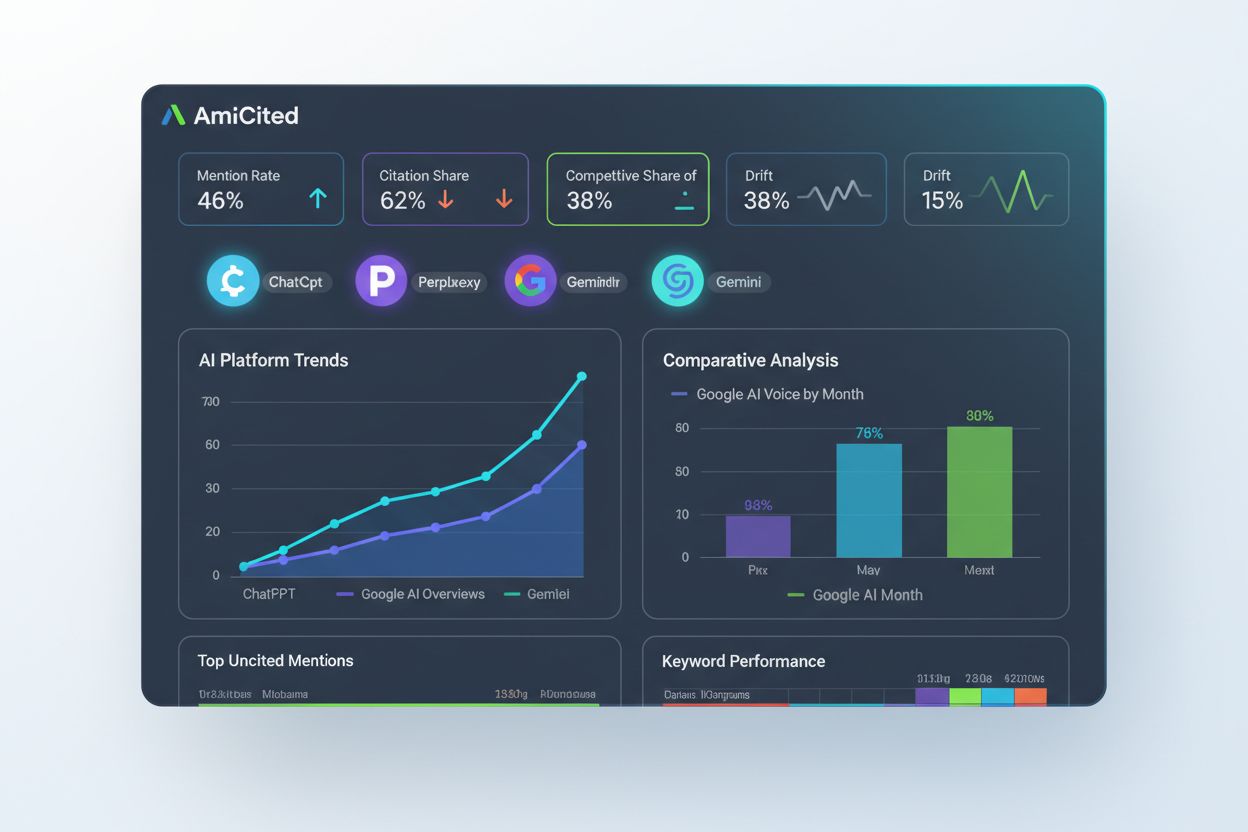
Mentions. How frequently does your brand appear in AI-generated answers tied to key topics? This is the most basic metric: a simple count of how often your brand is mentioned.
Citations. Of those mentions, how many include a link back to your website or content? A citation is more valuable than a mention because it drives traffic and shows that the AI system trusts your content enough to recommend it.
Sentiment. How is your brand described in AI-generated answers? Is the context positive, neutral, or negative? Positive sentiment is obviously preferable, but neutral mentions are still valuable: they’re better than no mention at all.
Share of voice. How often is your brand mentioned relative to competitors? If you’re mentioned 10 times and your competitor is mentioned 50 times, your share of voice is 17%. Share of voice is important because it shows your competitive position.
Several tools have emerged to help brands track AI search visibility:
HubSpot AEO. HubSpot’s Answer Engine Optimization tool tracks how often your brand appears in AI-generated answers across multiple platforms. It measures mentions, citations, sentiment, and share of voice.
Frase. Frase tracks AI visibility across ChatGPT, Perplexity, Google AI Overviews, and other platforms. It shows which queries trigger AI answers mentioning your brand and how you’re positioned relative to competitors.
Semrush AI Visibility. Semrush added AI visibility tracking to its platform, allowing you to monitor how often your brand appears in AI-generated answers.
Manual monitoring. For specific queries, you can manually test ChatGPT, Perplexity, and Google AI Overviews to see if your brand is mentioned. This is time-consuming but gives you direct insight into what users are seeing.
The most valuable metric is competitive benchmarking. How often is your brand mentioned in AI answers compared to your top three competitors? If you’re mentioned 5 times and they’re mentioned 50 times, you have a visibility gap.
Benchmarking helps you understand where to invest. If you’re invisible in AI answers for queries where competitors are frequently cited, that’s a gap worth filling. If you’re already visible and competitors aren’t, you have a competitive advantage worth defending.
Now that we’ve established that AI search visibility is not a fad and that it matters for your business, let’s discuss how to improve it.
Answer Engine Optimization (AEO) is the practice of optimizing your content so that AI systems cite it when answering relevant questions.
Start by identifying the questions your audience is asking. These are your target queries. For each query, create comprehensive content that directly answers the question. Don’t bury the answer in the middle of a long article. Put the answer in the first paragraph.
Use clear, structured formatting. Break your answer into sections with descriptive headings. Use lists, tables, and bullet points. Use short paragraphs. All of these formatting choices make it easier for AI systems to parse your content and extract the answer.
Provide context and nuance. Don’t just answer the question in isolation. Explain why the answer matters, what assumptions underlie it, what edge cases or exceptions exist. AI systems prefer comprehensive, nuanced answers over simplistic ones.
Structured data is the foundation of AI visibility. Implement schema markup for:
Organization. Tell AI systems who you are, what you do, and where you’re located.
Article. For blog posts and content, implement Article schema that specifies the title, author, publication date, and content.
Product. If you sell products, implement Product schema that specifies the name, description, price, and reviews.
FAQPage. If you have a FAQ section, implement FAQPage schema that structures each question and answer.
BreadcrumbList. Help AI systems understand your site structure with breadcrumb schema.
Use JSON-LD format, which is the most widely supported format for schema markup. Validate your schema with Google’s Schema Markup Validator to ensure it’s correct.
Entity authority is the degree to which AI systems recognize your brand as an authoritative entity in your field.
To build entity authority:
Mention your brand consistently. Every time you mention your brand, use the exact same name. Avoid variations and abbreviations. This helps AI systems recognize your brand as a single entity.
Get mentioned by authoritative sources. When other websites mention your brand, it signals to AI systems that you’re a recognized entity. Pursue press coverage, industry partnerships, and backlinks from authoritative sources.
Build a strong Wikipedia presence (if applicable). If your brand or industry has a Wikipedia article, ensure it mentions you accurately and links to your website.
Participate in industry discussions. When you contribute to industry forums, publications, and discussions, you build entity authority in your field.
The foundation of AI visibility is content quality. Create content that is:
Comprehensive. Answer the full question, not just part of it. Include examples, case studies, data, and nuance.
Authoritative. Write with expertise. Cite sources. Back up claims with evidence. Show that you know your field.
Up-to-date. Keep your content current. Update it regularly to reflect the latest information and developments.
Well-structured. Use clear headings, short paragraphs, lists, and tables. Make it easy for AI systems (and humans) to scan and understand.
Original. Don’t copy competitors. Provide unique insights, data, and perspectives that AI systems can’t get elsewhere.
AI visibility is not a set-and-forget strategy. Monitor your AI visibility metrics regularly. Track which queries mention your brand. Track your sentiment and share of voice. Identify gaps where competitors are mentioned and you’re not.
Adapt your strategy based on what you learn. If you’re invisible for a critical query, create content that directly addresses that query. If your sentiment is negative, address the criticism in your content. If your share of voice is declining, increase your investment in content and visibility.
The importance of AI search visibility varies by industry. Here’s what the data shows:
E-commerce brands experienced explosive growth in AI visibility during the 2025 holiday shopping season. AI penetration jumped 67% month-over-month, reaching 0.19% of all traffic.
Why? Because shoppers are using AI assistants to help them make purchasing decisions. They’re asking ChatGPT for product recommendations. They’re asking Perplexity for comparison shopping. They’re asking Google AI Overviews for reviews and specifications.
If your brand is not visible in those AI-generated product recommendations, you’re losing sales. E-commerce brands should prioritize AI visibility immediately.
B2B and SaaS companies see high concentrations of AI traffic on decision pages: industry pages, tools pages, and pricing pages. This makes sense: B2B buyers are using AI assistants to research solutions, compare options, and evaluate pricing.
If your SaaS company’s pricing page is not cited by ChatGPT when users ask “What’s the best CRM for small businesses?”, you’re losing leads. SaaS and B2B companies should prioritize AI visibility on decision pages.
YMYL industries (Your Money, Your Life) show the highest adoption of AI visibility because stakes are highest. Users trust AI assistants to provide accurate information about legal issues, financial decisions, and health matters.
If you’re a legal firm, a financial advisor, or a healthcare provider, being cited by ChatGPT as an authoritative source is critical. YMYL brands should prioritize AI visibility as a core part of their authority-building strategy.
Based on current trends, here are three predictions about how AI search visibility will evolve:
ChatGPT owns 84% of AI referral traffic today. But Copilot’s 25.2x growth and Claude’s 12.8x growth suggest that dominance won’t last. As AI embeds into existing tools (Microsoft Office, code editors, enterprise software), users will access AI discovery through multiple interfaces, not just ChatGPT.
By 2027, we expect ChatGPT’s share to decline to 60-70%, with Copilot, Claude, Gemini, and Perplexity capturing the remaining 30-40%. This fragmentation means brands need to optimize for visibility across multiple platforms, not just ChatGPT.
Today, most AI discovery happens on standalone platforms: you open ChatGPT or Perplexity to ask a question. But the future is embedded AI discovery. You’ll ask questions within Microsoft Office, within your code editor, within your email client, within Slack.
This shift means AI discovery will happen at the moment of need, not after users decide to search. And it means brands need to be visible in the contexts where questions arise, not just on standalone AI platforms.
Today, AI search visibility is still optional for most brands. But by 2027, it will be as essential as traditional SEO. Just as every brand invests in ranking for Google today, every brand will invest in visibility in AI-generated answers by 2027.
This means the competitive landscape for AI visibility will intensify. The brands that build AI visibility strategies today, while the space is still developing, will have a significant advantage over those that wait until it becomes obviously important.
If you’re convinced that AI search visibility is important (and you should be), here’s a practical roadmap to get started.
Week 1-2: Audit your current AI visibility.
Week 2-3: Audit your structured data.
Week 3-4: Develop your strategy.
Week 1-2: Implement schema markup.
Week 2-3: Optimize existing content.
Week 3-4: Create new content.
Week 1-2: Measure your progress.
Week 2-3: Identify what’s working.
Week 3-4: Scale what works.
Arshia is an AI Workflow Engineer at FlowHunt. With a background in computer science and a passion for AI, he specializes in creating efficient workflows that integrate AI tools into everyday tasks, enhancing productivity and creativity.

Am I Cited tracks how often your brand is mentioned and cited across ChatGPT, Perplexity, and Google AI Overview, so you're not guessing at your AI visibility.
Discover critical AI search trends including ChatGPT dominance, Perplexity growth, Google AI Mode expansion, and zero-click optimization. Learn how to monitor y...
Compare AI search with traditional Google search and learn how to optimize content for both discovery channels.
Discover how AI visibility is reshaping marketing success. Learn why citations matter more than clicks, how to measure AI visibility, and why your brand's prese...
Cookie Consent
We use cookies to enhance your browsing experience and analyze our traffic. See our privacy policy.