When a buyer opens ChatGPT on their phone and asks, “Who’s the best real estate agent in Denver for mid-century modern homes?” They don’t get a list of 10 blue links. They get a recommendation. Often just 2 or 3 names.
If your name isn’t there, you’re invisible.
This is the new reality of real estate discovery in 2026. The shift from traditional search to AI-powered recommendations has fundamentally changed how buyers and sellers find agents. And the data is stark: according to SparkToro analysis, 68% of U.S. Google searches now end without a click. When an AI Overview is present, that number jumps to 83%. In Google’s dedicated AI Mode, it reaches 93%.
The implication is direct. A rising share of consumers now receive answers, including recommendations for agents, brokerages, and service providers, without ever visiting a website. The click that SEO was designed to capture is increasingly never made.
But here’s the good news: real estate brands do appear in AI recommendations. And there’s a clear, measurable framework that determines which ones do.
This guide explains why some agents get recommended by AI and others don’t, the seven core signals that drive brand-wide visibility, and the actionable GEO (Generative Engine Optimization) strategy you need to compete in 2026. It’s the industry-wide framework: once your brand-level signals are in place, the listing and agent-profile level work
is what determines whether a specific property or your personal bio gets pulled into an individual answer.
Key Takeaways
- Real estate brands, brokerages, and agents do appear in ChatGPT, Gemini, and Perplexity recommendations, but AI systems typically surface only 2-5 names per query, not a full results page.
- AI curates rather than ranks: it favors data consistency, review recency, and demonstrated local expertise over domain authority and backlinks.
- Seven signals drive visibility: NAP consistency, Google Business Profile completeness, review velocity, hyperlocal content, schema markup, cross-platform citations, and third-party mentions.
- A well-optimized local agent can consistently outrank a national brokerage in AI answers when their data is more current and consistent.
- GEO complements SEO rather than replacing it, so both need ongoing investment as zero-click search grows.
Bottom line: Winning AI recommendations comes down to consistent, current, well-structured data across every platform you’re listed on, and tools like Am I Cited can help you track how often your brand actually gets mentioned across ChatGPT, Perplexity, and Google AI Overview so you know where you stand.
Do Real Estate Brands Appear in AI Recommendations?
The Short Answer: Yes
Real estate brands, brokerages, and individual agents absolutely appear when AI models like ChatGPT, Google Gemini, and Perplexity are asked for local recommendations. The question isn’t whether they appear: it’s which ones do, and why.
When someone asks an AI, “Find me the best real estate agent in [city],” the system doesn’t pull a random name from the web. It analyzes online signals, credibility, consistency, and real-world reviews to determine who shows up and who doesn’t.
However, visibility is highly competitive. Unlike traditional search, which returns a results page with 10-20 links, AI systems provide specific answers with only 2-5 recommendations. This means only a tiny fraction of professionals consistently appear in these localized recommendations.
What the Data Shows: The Zero-Click Phenomenon
The shift to AI recommendations isn’t theoretical: it’s already reshaping how consumers discover real estate services. Here’s what the 2026 data reveals:
- 68% of U.S. Google searches end without a click to any external site (up from 60% in 2024)
- 83% of searches with a Google AI Overview generate no outbound click
- 93% of searches in Google’s dedicated AI Mode produce zero clicks
- 1 billion monthly users now use Google’s AI Mode, with query volume doubling quarter over quarter
For real estate professionals, this means the traditional playbook (optimize the website, win the keywords, climb Google’s rankings, capture the click) is no longer sufficient. The click may never come.
Instead, visibility now depends on whether an AI system cites and recommends your brand directly in its answer.
Curation vs. Ranking
Traditional SEO optimizes a web page to rank and earn a click. A search engine returns links; you compete for position on the results page.
Generative Engine Optimization (GEO) optimizes your entire digital footprint so that an AI system will cite and recommend you inside a generated answer. The AI acts as a curator, not a ranker.
This distinction is not cosmetic. It changes everything about how you should build your online presence.
| Aspect | Traditional Search (SEO) | AI Recommendations (GEO) |
|---|
| Goal | Rank high; earn click | Be cited in AI answer |
| Primary Ranking Factor | Keywords, backlinks, page rank | Data accuracy, consistency, authority |
| Content Strategy | Keyword-optimized pages | Clear, structured, Q&A format |
| Measurement | Click-through rate, impressions | Citation frequency, AI visibility |
| Data Source | Your website primarily | Cross-platform data consistency |
| Competitive Advantage | Keyword dominance | Trust signals & freshness |
Ready to Monitor Your AI Visibility?
Track how AI chatbots mention your brand across ChatGPT, Perplexity, and other platforms.
How AI Systems Choose Real Estate Brands
To understand how to win in AI recommendations, you need to understand how AI systems evaluate real estate brands in the first place.
The Five-Step AI Evaluation Process
When you ask ChatGPT, Google Gemini, or Perplexity for a local real estate recommendation, the AI doesn’t just guess. It follows a systematic evaluation process:
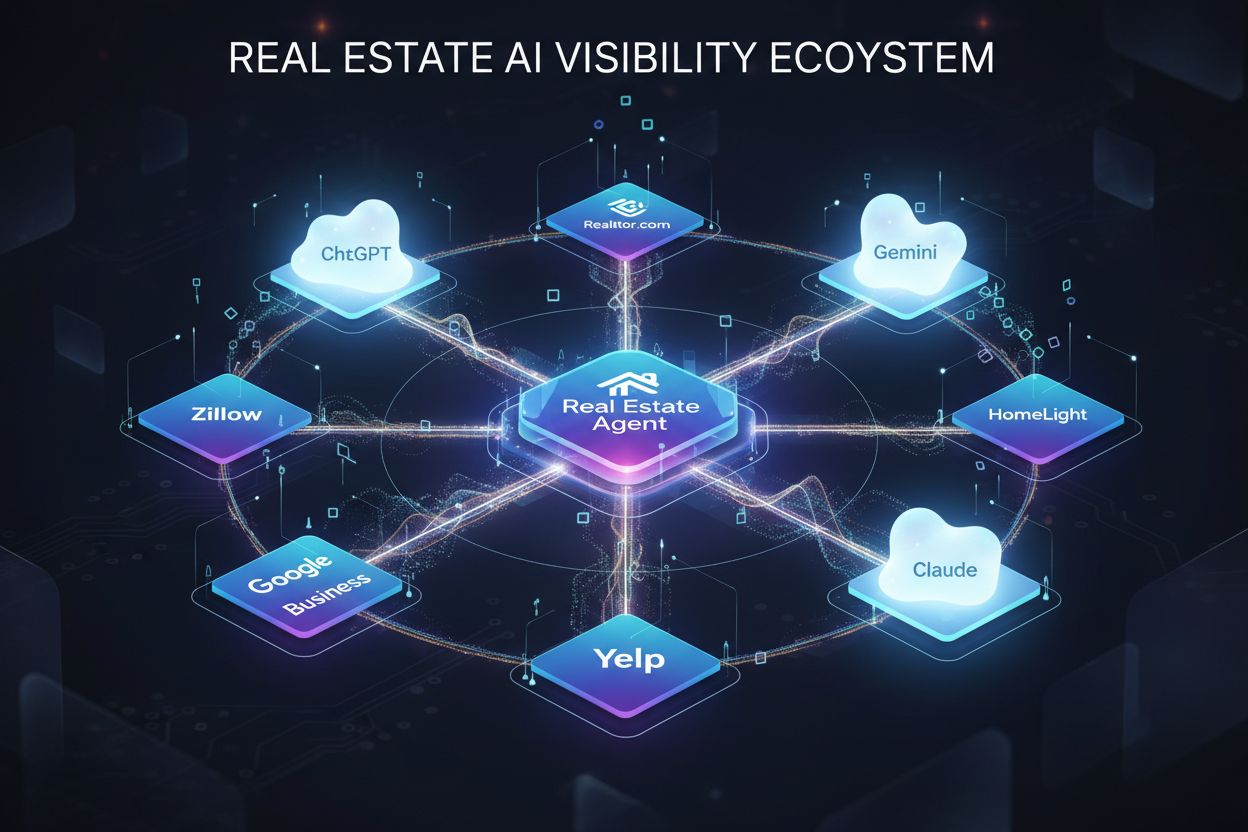
Step 1: Data Gathering The AI system crawls and cross-references data from multiple sources simultaneously. For real estate, these sources include Google Business Profiles, Zillow, Realtor.com, Homes.com, Yelp, local directories, business websites, and social media profiles. The AI doesn’t rely on a single source; it synthesizes information from across the web.
Step 2: Credibility Scoring The system checks whether the business is legitimate and active. It looks for consistency: Does the name, address, phone number, and email match across all platforms? Is the business information current? Has the profile been updated recently? Inconsistencies trigger skepticism; consistency builds confidence.
Step 3: Authority Assessment The AI evaluates whether the brand has earned authority in its market. It examines review volume, review recency, review sentiment, and the specific keywords mentioned in those reviews. It looks at whether the agent or brokerage is mentioned in trusted third-party sources: local news, community blogs, Chamber of Commerce websites. It assesses content quality and whether the brand demonstrates clear, specialized local expertise.
Step 4: Relevance Matching The system matches the query intent to the brand’s demonstrated expertise. If someone asks for “the best first-time homebuyer agent in Austin,” the AI looks for agents who have published content about first-time buyers, have recent reviews mentioning first-time buyer support, and clearly state this specialization across their profiles.
Step 5: Recommendation Synthesis Finally, the AI synthesizes all signals and selects the top 2-5 recommendations to present to the user. This is where the scarcity principle applies: only a few names make the cut.
Why AI Doesn’t Just Copy Google Rankings
A critical insight: AI systems do not simply reproduce Google’s search rankings. This is why an agent with excellent local SEO might not appear in AI recommendations, and vice versa.
Google’s traditional algorithm prioritizes links, domain authority, and keyword relevance. AI systems, by contrast, prioritize data accuracy, consistency, and trustworthiness. They synthesize information from multiple sources, so a business with an excellent local reputation sometimes appears even if it isn’t the #1 Google search result. Conversely, a business with strong SEO but weak overall web presence (scattered data, outdated information, inconsistent profiles) may be omitted.
This is why GEO is distinct from SEO. You can’t just apply traditional search optimization tactics and expect AI visibility. You need a different strategy entirely.
7 Core Signals for AI Visibility
Research from firms including SOCi, Local Falcon, Birdeye, and Homebot has identified the specific signals that AI systems use when evaluating real estate brands. Understanding these signals is the foundation of any GEO strategy.
Signal #1: Identity Consistency (NAP Across the Web)
The most fundamental signal is consistency. AI systems cross-reference your business information across the web. When they find inconsistencies (a different phone number here, a slightly different business name there, a mismatched address), confidence in your listing drops.
What to check:
- Name (ensure you use the same full name everywhere; avoid nicknames and initials)
- Address (exact match across all platforms)
- Phone number (one primary number consistently listed)
- Email address (consistent across all profiles)
- Business category (real estate agent, broker, brokerage, be specific)
Benchmark: All information identical across Google Business Profile, Zillow, Realtor.com, Homes.com, Yelp, Facebook, LinkedIn, your website, and any other directory you’re listed on.
Signal #2: Google Business Profile Completeness & Recency
The Google Business Profile (GBP) has become a tier-one data feed to the AI ecosystem: arguably more consequential to discovery than your website. This is because multiple AI systems rely directly on Google’s data infrastructure.
Google Gemini, for example, uses “Grounding with Google Maps,” which connects its models to more than 250 million verified places. When Gemini answers a local query, it treats the Business Profile as authoritative. Google AI Overviews use GBP data as the structural foundation of local recommendations. Even ChatGPT, powered by OpenAI, draws on Bing Places and verified directories: the same structured-data ecosystem that a well-maintained Google Profile anchors.
What to optimize:
- Profile completeness: Photo gallery (at least 10 professional photos), detailed business description, service areas, hours of operation, website link
- Recency: Weekly posts, new photos monthly, regular updates to service areas or specializations
- Reviews: Request fresh reviews each month; respond to all reviews (positive and negative)
- Services: Add detailed services (buyer representation, seller representation, relocation, new construction, waterfront properties, investment properties, etc.)
- Posts: Share market updates, neighborhood guides, open house announcements, client testimonials
Benchmark: 50+ reviews in the last 90 days; profile updated weekly; response rate to reviews above 80%; average rating 4.5+ stars.
Signal #3: Review Velocity, Recency & Sentiment Analysis
AI systems don’t just look at a static 5-star rating. They analyze review velocity (how frequently new reviews arrive), recency (how recent they are), and sentiment (what reviewers actually say).
A brand with 50 reviews from the last 90 days will almost always be recommended over a brand with 300 reviews from three years ago. The AI interprets fresh reviews as a signal of active, current business and ongoing client satisfaction.
But there’s more: AI reads the text of reviews and extracts specific keywords. If reviews consistently mention words like “responsive,” “local expert,” “great negotiator,” “patient,” or “knowledgeable,” the AI recognizes these as authority signals and matches them to relevant queries.
What to track:
- Review velocity: Aim for 10-15 new reviews per month
- Review recency: Ideally, at least one new review per week
- Review sentiment: Monitor for negative keywords (unresponsive, slow, unprofessional) and address them
- Review keywords: Encourage clients to mention specific strengths (e.g., “great with first-time buyers,” “knows the neighborhood inside and out”)
Benchmark: Consistent monthly review growth; no month with zero new reviews; average sentiment positive across 95%+ of reviews.
Signal #4: Hyperlocal Content Authority
When a user asks an AI, “Who is the best real estate agent for first-time buyers in [specific neighborhood]?”, the AI looks for who has authored the most helpful, objective information on that exact topic, at the brand level: a steady publishing cadence across neighborhoods and buyer segments, not any single piece.
Brands that publish detailed neighborhood guides, school market reports, cost-of-living breakdowns, buyer education content, and market trend analyses are recognized by AI as local authorities. This content serves two purposes: it demonstrates expertise and it provides citable sources for the AI to reference.
What to create, as an ongoing program:
- Neighborhood guides (one per neighborhood you serve)
- Buyer education guides (first-time buyer, investor, luxury buyer, etc.)
- Market reports (quarterly or annual analysis of your market)
- FAQ sections addressing common questions from your target audience
- Video content (neighborhood tours, market updates, client testimonials)
Benchmark: At least 5-10 substantial pieces of content per year; each piece should be 1,500+ words and include specific location references, data, and actionable advice. For how to structure the writing itself, including turning an individual listing description or agent bio into something AI systems can actually extract and quote, see the listing and profile-level discovery guide
.
Signal #5: Schema Markup & Structured Data
Schema markup is behind-the-scenes coding that helps AI systems read and understand your content. It tells the AI: “This is a real estate agent. This is their service area. These are their specializations. This is their contact information.”
Without schema markup, even excellent content is harder for AI to parse and cite. With it, the AI can quickly extract and reference your information.
What to implement:
- LocalBusiness schema on your homepage (name, address, phone, email, service areas)
- Person schema on your agent bio pages (name, title, qualifications, contact info)
- Article schema on blog posts (headline, author, publish date, content)
- FAQPage schema on your FAQ sections (questions and answers in structured format)
- BreadcrumbList schema for navigation (helps AI understand site structure)
Benchmark: All pages have appropriate schema markup; schema is valid (test with Google’s Rich Results Test tool); schema is updated whenever information changes.
When your name, brokerage, or brand appears on authoritative platforms (Zillow, Realtor.com, Homes.com, industry directories), it signals to AI that you’re a legitimate, recognized player in your market.
These citations don’t need to be backlinks in the traditional SEO sense. Simply being listed, active, and current on these platforms is a signal. The more platforms you’re consistently present on, the stronger the signal.
What to maintain:
- Zillow (complete agent profile, active listings, reviews)
- Realtor.com (current profile, verified agent status)
- Homes.com (complete profile, service areas)
- Yelp (business listing, reviews, hours)
- Facebook (business page, regular updates)
- LinkedIn (professional profile, recommendations)
- Local directories (Chamber of Commerce, local business associations, neighborhood-specific directories)
- Real estate-specific directories (your brokerage’s partner platforms, industry associations)
Benchmark: Presence on at least 8-10 major platforms; all information consistent and current; active engagement (reviews, updates, responses) on each platform.
AI treats mentions in third-party sources like letters of recommendation. If an agent or brokerage is quoted in a local newspaper, featured on a local business podcast, linked by a Chamber of Commerce website, or mentioned in community blogs, the AI views that brand as heavily vetted by the local community.
These mentions are particularly powerful because they come from sources the AI already trusts (news outlets, community organizations, professional associations).
What to pursue:
- Local media coverage (news articles, interviews, expert commentary)
- Podcast appearances (local business podcasts, real estate industry shows)
- Speaking engagements (local events, chamber meetings, community forums)
- Association memberships (NAR, local boards, professional organizations)
- Community involvement (sponsorships, volunteer work, charity involvement)
- Guest posts on established local blogs or publications
Benchmark: At least 2-3 third-party mentions per year; participation in at least one local organization or community initiative; regular speaking or media appearances.
Stay Updated on AI Visibility Trends
Get the latest insights on AI mentions, brand monitoring, and optimization strategies.
What Consistency Means in AI Search
To make all of this concrete, let’s look at what the data actually requires.
Your Name, Address, and Phone (NAP) must be identical across every platform. This isn’t a suggestion: it’s foundational to AI credibility.
Here’s a real example of what inconsistency looks like (and why it fails):
| Platform | Name | Address | Phone |
|---|
| Google Business | Sarah Johnson, Realtor | 123 Main St, Denver, CO 80202 | (303) 555-0123 |
| Zillow | S. Johnson | 123 Main Street, Denver, CO 80202 | (303) 555-0123 |
| Realtor.com | Sarah Johnson REALTOR® | 123 Main St, Suite 100, Denver, CO 80202 | (303) 555-0124 |
| Your Website | Sarah Johnson | 123 Main Street, Denver, Colorado 80202 | 303-555-0123 |
| Yelp | Sarah Johnson | 123 Main St, Denver, CO | (303) 555-0123 |
Notice the inconsistencies: “Sarah Johnson” vs. “S. Johnson,” “80202” vs. missing zip code, different phone numbers, different suite numbers, different address formatting. Each inconsistency is a red flag to AI systems.
The correct approach is to standardize everything:
| Platform | Name | Address | Phone |
|---|
| Google Business | Sarah Johnson, REALTOR® | 123 Main Street, Denver, CO 80202 | (303) 555-0123 |
| Zillow | Sarah Johnson, REALTOR® | 123 Main Street, Denver, CO 80202 | (303) 555-0123 |
| Realtor.com | Sarah Johnson, REALTOR® | 123 Main Street, Denver, CO 80202 | (303) 555-0123 |
| Your Website | Sarah Johnson, REALTOR® | 123 Main Street, Denver, CO 80202 | (303) 555-0123 |
| Yelp | Sarah Johnson, REALTOR® | 123 Main Street, Denver, CO 80202 | (303) 555-0123 |
Every single detail matches. This consistency is what AI systems expect.
Review Freshness Benchmarks
The data is clear: review freshness matters more than total review volume.
- Competitive baseline: 10-15 new reviews per month
- Strong performance: 20+ new reviews per month
- Exceptional performance: 30+ new reviews per month
A brand with 50 reviews from the last 90 days will outrank a brand with 300 reviews from two years ago in AI recommendations. The AI interprets freshness as a signal of active, current business.
Content Structure & AI Readability
AI systems prefer content that is clear, scannable, and structured. Here’s what works:
- Short paragraphs: 2-4 sentences maximum
- Concise sentences: Under 20 words each
- Descriptive headings: Questions work well (“What should first-time buyers know about Denver neighborhoods?”)
- Bullet points: Use for lists and key takeaways
- Q&A format: Dedicate sections to questions buyers actually ask
- Data and examples: Concrete numbers and real scenarios beat vague claims
Content that is dense, jargon-heavy, or full of marketing fluff is harder for AI to parse and less likely to be cited.
Here’s what each major platform requires for optimal AI visibility:
| Platform | Critical Fields | Update Frequency | Review Importance |
|---|
| Google Business Profile | Name, address, phone, hours, service areas, photos, description | Weekly | Very High (AI relies on this) |
| Zillow | Agent bio, specializations, reviews, active listings | Monthly | High |
| Realtor.com | Agent profile, credentials, service areas, reviews | Monthly | High |
| Homes.com | Agent information, service areas, listings | Monthly | Medium |
| Yelp | Business info, hours, services, reviews | Monthly | Medium |
| Your Website | Schema markup, service pages, contact info, blog | Weekly | High (supports all platforms) |
GEO vs. SEO: The Strategic Shift
Understanding the difference between traditional SEO and GEO is critical. They’re not the same thing, and confusing them will cost you visibility.
Traditional SEO: Optimizing for Clicks
SEO focuses on getting your website to rank high in search results so users will click through to your site. The strategy revolves around keywords, backlinks, page authority, and user experience.
The metric that matters is click-through rate (CTR). You measure success by how many people click on your link in the search results.
SEO Strategy:
- Keyword research and optimization
- Backlink building
- Technical site optimization
- Content creation around high-volume keywords
- Page speed and mobile optimization
- Internal linking structure
SEO Measurement:
- Keyword rankings
- Organic traffic
- Click-through rate
- Conversion rate from organic traffic
GEO: Optimizing for Citations
GEO focuses on being cited and recommended inside AI-generated answers. The strategy revolves around data accuracy, consistency, authority signals, and structured content.
The metric that matters is citation frequency. You measure success by how often your brand appears in AI-generated answers to relevant queries.
GEO Strategy:
- Data consistency across platforms (NAP, business info, contact details)
- Google Business Profile optimization and recency
- Review generation and management
- Hyperlocal content authority (neighborhood guides, market reports)
- Schema markup and structured data
- Cross-platform citations and presence
- Third-party mentions and media authority
GEO Measurement:
- Citation frequency in AI systems
- AI visibility across platforms (ChatGPT, Gemini, Perplexity)
- Review velocity and sentiment
- Content citations in AI answers
- Search query coverage (which queries mention your brand)
Why the Shift Matters: The Zero-Click Impact
The data is compelling. When 68-93% of searches end without a click, the traditional SEO playbook becomes insufficient.
Imagine you rank #1 on Google for “best real estate agent in Denver.” But when someone asks ChatGPT the same question, your name doesn’t appear. You’ve won the traditional search, but lost the AI recommendation. The user never visits your website. They contact one of the three agents ChatGPT recommended instead.
This is already happening at scale. The zero-click phenomenon means that ranking high is no longer enough. You need to be visible in the answer layer.
Why You Still Need SEO
Here’s the critical nuance: GEO doesn’t replace SEO. It complements it.
Google still processes the large majority of conventional queries. Traditional search remains near 90% of search traffic. Your website still matters. Schema markup, content quality, and technical optimization still matter.
But the marginal value of ranking on a results page that produces no clicks is declining, while the value of being the name an AI surfaces is climbing.
The winning strategy in 2026 is a hybrid approach:
- Maintain strong SEO fundamentals (your website, technical optimization, content quality)
- Prioritize GEO signals (consistency, authority, freshness, structured data)
- Allocate budget proportionally (shift more resources to GEO as AI adoption grows)
- Measure both (track traditional metrics and AI visibility metrics)
Real-World Examples of AI Recommendations
Theory is useful, but examples are clearer. Let’s look at four scenarios that illustrate how AI makes recommendations.
Scenario 1: National Brokerage vs. Local Agent in AI Answers
The situation: A buyer in Austin asks ChatGPT: “Who’s the best real estate agent for first-time homebuyers in Austin?”
The national brokerage: Remax has strong brand recognition, a massive web presence, and thousands of agents. But their local presence in Austin is generic. Their Google Business Profile is outdated. Their local agents’ profiles are scattered across multiple platforms with inconsistent information. Reviews are old.
The local agent: Sarah has been in Austin for 12 years. She has a complete, updated Google Business Profile. She publishes monthly neighborhood guides specific to Austin. She has 35 reviews in the last 90 days, many mentioning “first-time buyer support” and “patient, knowledgeable.” Her name, address, and phone are identical across 10+ platforms. She’s been quoted in the Austin Business Journal twice. She has 4.8-star rating.
What ChatGPT recommends: Sarah, not the national brokerage.
Why: AI systems favor demonstrated local authority and current activity over brand size. Sarah’s signals are stronger: consistent data, fresh reviews, hyperlocal content, third-party credibility, and recent activity. The national brokerage’s generic presence doesn’t match the specific query.
Scenario 2: Hyperlocal Content Authority Beating Brand Size
The situation: A buyer asks Gemini: “What neighborhoods in Denver are best for young professionals?”
The large brokerage: Has a generic “Denver neighborhoods” page that covers 15 neighborhoods in 500 words. Hasn’t been updated in 18 months.
The local boutique firm: Has published 15 detailed neighborhood guides, each 2,000+ words, covering schools, restaurants, nightlife, young professional communities, walkability, and price trends. Updated quarterly. Each guide has schema markup. Each guide answers specific questions young professionals ask.
What Gemini recommends: The boutique firm’s guides are cited directly in the answer.
Why: AI systems recognize depth and specificity. The boutique firm’s content is clearly structured for AI readability, updated regularly, and directly answers the user’s query. The large brokerage’s generic page is too shallow and outdated.
Scenario 3: Why Consistency Matters More Than Volume
The situation: Two agents in Miami both have 100+ reviews.
Agent A: Has 120 reviews. But they’re scattered across platforms with inconsistent information. Google Business Profile says “Miami, FL.” Zillow says “Miami, Florida.” Realtor.com says “Miami, FL 33139.” Phone number is (305) 555-0100 on Google, (305) 555-0101 on Zillow. Last update to Google Business Profile was 6 months ago.
Agent B: Has 85 reviews. But every piece of information is identical across all platforms. Google Business Profile is updated weekly. All reviews are from the last 18 months. Phone number is consistent everywhere. Profile completeness is 100%.
What AI recommends: Agent B.
Why: Consistency signals trustworthiness. Agent A’s inconsistencies trigger skepticism. Even with more reviews, the data quality is lower. Agent B’s consistency and recency outweigh the lower review volume.
Scenario 4: The Impact of Outdated or Inconsistent Data
The situation: A buyer asks ChatGPT: “Find me a real estate agent in Portland who specializes in historic homes.”
Agent with outdated data: Has a strong website and good SEO ranking. But their Google Business Profile hasn’t been updated in 2 years. Their phone number on Yelp is outdated. Their Zillow profile lists specializations from 2023 that are no longer accurate. Their reviews are from 18+ months ago.
Result: ChatGPT doesn’t recommend them, even though they might be qualified. The inconsistent and outdated data triggers low confidence.
Why: AI systems prioritize current, consistent data. Outdated information signals inactivity or unreliability. Even if the agent is still active, the data doesn’t support that conclusion.
7-Step GEO Action Plan
Now that you understand the signals, here’s the concrete action plan to improve your AI visibility.
Step 1: Audit Your Current AI Visibility
Before you optimize, measure where you stand.
What to do:
- Open ChatGPT, Google Gemini, and Perplexity
- Search for queries relevant to your market: “Best real estate agent in [your city],” “Real estate agent for [your specialization] in [your city],” “Who should I contact to buy a home in [your neighborhood]?”
- Note whether your name appears in the answers
- Check Google’s AI Overview (search on Google, look for the AI-generated summary at the top)
- Document which queries mention you and which don’t
Expected outcome: A baseline of your current AI visibility across platforms and query types.
Step 2: Optimize Your Google Business Profile
This is the single highest-impact action. GBP is the tier-one data source for AI systems.
Weekly tasks:
- Add one new post (market update, open house announcement, neighborhood highlight, client testimonial)
- Add 2-3 new photos
- Respond to all new reviews
Monthly tasks:
- Update service areas if they’ve changed
- Review and update business description for clarity and keyword inclusion
- Add new specializations if applicable
- Request reviews from recent clients
Quarterly tasks:
- Audit profile completeness (all fields filled, photos current, description accurate)
- Refresh old photos if needed
- Review performance insights (calls, directions requests, website clicks)
Conduct an audit of your Name, Address, and Phone across every platform you’re listed on.
Platforms to audit:
- Google Business Profile
- Zillow
- Realtor.com
- Homes.com
- Yelp
- Facebook
- LinkedIn
- Your website
- Local directories (Chamber of Commerce, industry associations)
- Any other directory you’re listed on
What to standardize:
- Full name (no nicknames, no initials)
- Complete address (street, city, state, zip)
- Primary phone number
- Email address
- Business category/title
Tools to help:
- Semrush Local SEO tool (identifies inconsistencies)
- Whitespark (NAP audit)
- Moz Local (citation audit)
Step 4: Build Hyperlocal Content
Create content that demonstrates local expertise and is structured for AI readability.
Content to create:
- Neighborhood guides (one per neighborhood you serve; 1,500-2,000 words each)
- Buyer education guides (first-time buyer, luxury buyer, investment property, etc.)
- Market reports (quarterly or annual analysis of your market)
- FAQ sections (answer 10-15 questions your target audience asks)
- Blog posts (structured as Q&A; one per week if possible)
- Video content (neighborhood tours, market updates, client testimonials)
Structure for AI readability:
- Use clear, descriptive headings (questions work well)
- Short paragraphs (2-4 sentences)
- Concise sentences (under 20 words)
- Bullet points for lists
- Include specific data (prices, statistics, dates)
- Include schema markup (Article, FAQPage, LocalBusiness)
Update frequency:
- Blog posts: Weekly or bi-weekly
- Neighborhood guides: Quarterly updates
- Market reports: Quarterly or annual
- FAQ: As new questions arise
Step 5: Implement Schema Markup on Your Website
Schema markup tells AI systems what your content means. Without it, even great content is harder to cite.
Essential schema to implement:
- LocalBusiness (on your homepage): name, address, phone, email, service areas
- Person (on agent bio pages): name, title, qualifications, contact info
- Article (on blog posts): headline, author, publish date, content
- FAQPage (on FAQ sections): questions and answers in structured format
- BreadcrumbList (on all pages): helps AI understand site structure
Tools to help:
- Google’s Structured Data Markup Helper
- Schema.org documentation
- Yoast SEO plugin (if using WordPress)
- Google’s Rich Results Test (to validate schema)
Validation:
- Test all pages with Google’s Rich Results Test tool
- Ensure schema is valid before publishing
- Update schema whenever information changes
Step 6: Generate Fresh, High-Quality Reviews
Review velocity and recency are critical GEO signals.
Monthly targets:
- Aim for 10-15 new reviews per month
- Request reviews from every client (email, SMS, in-person ask)
- Follow up within 48 hours of transaction close
Where to request reviews:
- Google Business Profile (highest priority)
- Zillow
- Realtor.com
- Yelp
- Facebook
- Your website
How to request:
- Email: Send a review request email with direct links to review platforms
- SMS: Text clients with a link to your Google Business Profile review page
- In-person: Ask verbally during closing or after successful transaction
- Follow-up: Send a reminder 1-2 weeks after initial request
Response strategy:
- Respond to all reviews within 48 hours
- Thank positive reviewers
- Address negative reviews professionally and offer to resolve issues
- Don’t delete negative reviews; address them constructively
Step 7: Monitor & Measure AI Visibility
You can’t improve what you don’t measure.
Monthly monitoring:
- Search for relevant queries in ChatGPT, Gemini, Perplexity, Google AI Overview
- Document whether your name appears
- Track which queries mention you and which don’t
- Note any changes in recommendation frequency
Tools to help:
- Homebot (tracks GEO visibility across AI platforms)
- Birdeye Search AI (monitors AI share of voice)
- Semrush (tracks AI citations)
- SEMrush AEO tool (measures answer engine optimization)
- Manual tracking (spreadsheet of queries and results)
Key metrics:
- Citation frequency (how often you appear in AI answers)
- Query coverage (percentage of relevant queries mentioning you)
- Recommendation ranking (first mention, second mention, etc.)
- Review velocity (new reviews per month)
- Profile completeness (percentage of GBP fields filled)
How to Track AI Visibility
Beyond the monthly monitoring, here’s how to measure whether your GEO strategy is working.
Several platforms now offer AI visibility tracking:
- Homebot: Tracks GEO visibility across ChatGPT, Gemini, Perplexity, and Google AI Overviews. Shows citation frequency and trending data.
- Birdeye Search AI: Monitors AI share of voice for multi-location real estate brands. Maps location intelligence and deploys autonomous marketing agents.
- Semrush AEO Tool: Tracks how often your brand appears in AI-generated answers. Benchmarks against competitors.
- Local Falcon: Analyzes AI citations across platforms and identifies improvement opportunities.
- Manual tracking: Use a spreadsheet to document queries and results monthly.
Key Metrics Beyond Click-Through Rate
Stop measuring only clicks. Track these GEO-specific metrics:
| Metric | What It Measures | Target |
|---|
| Citation Frequency | How often your brand appears in AI answers | Growing month-over-month |
| Query Coverage | Percentage of relevant queries mentioning you | 50%+ of target queries |
| Recommendation Ranking | Position in AI recommendation (1st, 2nd, 3rd) | 1st or 2nd position |
| Review Velocity | New reviews per month | 10-15+ per month |
| Review Sentiment | Percentage of positive reviews | 95%+ positive |
| Profile Completeness | Percentage of GBP fields filled | 100% |
| Data Consistency Score | NAP consistency across platforms | 100% |
| Content Update Frequency | How often you publish new content | Weekly blog, monthly GBP posts |
Once you have baseline metrics, compare yourself to local competitors.
What to benchmark:
- Which competitors appear in AI recommendations for your target queries?
- How many reviews do they have? How recent?
- What’s their Google Business Profile like? (completeness, recency, photo quality)
- What content do they publish? (frequency, depth, structure)
- How often are they mentioned in third-party sources?
Use this data to:
- Identify gaps in your strategy
- Set realistic targets (match or exceed competitor metrics)
- Prioritize improvements (focus on areas where you’re significantly behind)
- Track progress (monthly comparison to see if you’re closing gaps)
Conclusion
The question “Do real estate brands appear in AI local recommendations?” has a clear answer: yes, they do. But only those with strong, consistent digital authority signals.
The shift from traditional search to AI-powered recommendations represents the most significant change in real estate discovery since the internet itself. For two decades, the playbook was stable: optimize your website, win the keywords, rank on Google, capture the click.
In 2026, that playbook is cracking. Sixty-eight percent of searches now end without a click. When AI is involved, that number reaches 93%. The click that SEO was designed to capture is increasingly never made.
But here’s the opportunity: while most real estate professionals are still optimizing for clicks, the brands that understand GEO (Generative Engine Optimization) and implement the seven core signals (identity consistency, Google Business Profile optimization, review velocity, hyperlocal content, schema markup, cross-platform citations, and third-party mentions) are already winning in AI recommendations.
This isn’t a distant future scenario. It’s happening now. Buyers and sellers are asking AI for agent recommendations. AI systems are synthesizing data and making recommendations. The question isn’t whether to adapt: it’s how quickly.
Start with the audit. Understand where you currently appear in AI recommendations. Then implement the seven-step action plan: optimize your Google Business Profile, ensure NAP consistency, build hyperlocal content, implement schema markup, generate fresh reviews, and monitor your visibility.
The brands that appear in AI answers will win the majority of leads. The ones that don’t will become invisible, even if they rank #1 on Google.
The time to act is now.