


AI Visibility for SaaS Companies: The Complete Playbook
Master AI visibility for your SaaS company. Learn GEO strategies, structured data optimization, and how to get recommended by ChatGPT, Gemini, and Perplexity. C...
14 min read

Ranking #1 on Google no longer guarantees your SaaS product gets recommended by ChatGPT or Perplexity. Why B2B SaaS buyer research has shifted to AI tools, why traditional SEO strategy isn’t enough on its own anymore, and the business case for closing the gap now.
Your SaaS product ranks on page one. The content strategy is solid. Then a prospect asks ChatGPT “what’s the best CRM for startups?” and a competitor gets named instead, your product never comes up, and the prospect never visits your site. Nothing about your product changed. What changed is where your buyers now start looking, and why that shift breaks assumptions your SEO strategy was never built to handle. If you already believe that and want the execution plan, jump straight to the B2B SaaS AI search visibility playbook for the step-by-step audit, schema specs, and content templates; this post makes the case for why that work is now urgent.
ChatGPT, Perplexity, Google AI Overviews, and Gemini now mediate a large and growing share of B2B SaaS evaluation queries before a single click reaches a website. When a CFO asks ChatGPT “what’s the best CRM for outbound sales teams,” the answer names specific vendors. If your product is named, you’re in the conversation. If it isn’t, you’re invisible, regardless of how well you rank on Google.
The data on B2B buyer behavior should make every SaaS marketing leader pause. G2’s 2026 survey of over 1,000 B2B software buyers found that 87% say AI chatbots are changing how they research software. Half of those buyers now start their journey in an AI chatbot instead of Google, a figure that jumped 71% compared to G2’s prior survey just four months earlier. Gartner projects traditional search volume will decline 25% by the end of 2026. Meanwhile, 73% of B2B buyers use AI tools like ChatGPT or Perplexity during vendor research, and 95% of B2B purchase decisions go to a vendor already on the buyer’s “Day One List,” a list increasingly formed inside AI conversations rather than a Google search.
Most SaaS companies are not ready for this shift. An analysis of 50 B2B SaaS companies across ChatGPT, Perplexity, Claude, and Gemini, running 1,400 buyer-intent prompts, found the average AI Presence Score was 56.9 out of 100. Forty-four percent of companies scored below 50. Nearly half of SaaS brands are functionally invisible where their buyers are increasingly starting research, and this is the most dangerous kind of loss: invisible. You cannot see it in your GA4 dashboard. Your pipeline still feels normal, until it doesn’t.
Key insight: AI search visibility is not just about being mentioned. It’s about how your brand is interpreted once it’s retrieved. When an AI system pulls in information about your company, it decides what you are, forms a summary, and determines whether you belong in a recommendation. That interpretation layer is what separates brands that get mentioned from brands that get chosen, and it’s why the technical and content mechanics matter as much as the raw fact of ranking well.

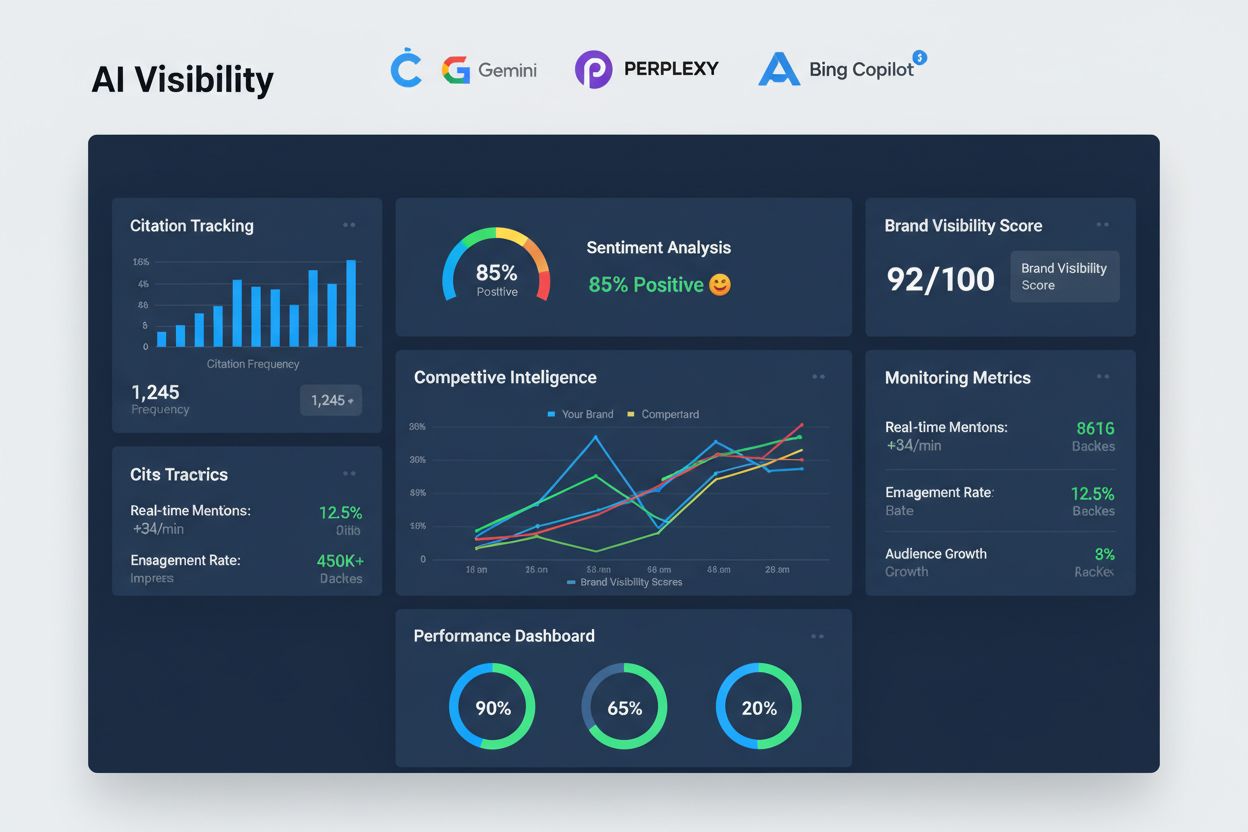
Track how AI chatbots mention your brand across ChatGPT, Perplexity, and other platforms.
Google’s ranking system is comparatively transparent: relevant keywords, sufficient backlinks, and a page ranks. AI systems work differently. When ChatGPT is asked to recommend a CRM, it doesn’t search for “best CRM,” it generates related sub-queries, retrieves information from many sources, and synthesizes an answer that includes only the brands it’s confident recommending. That evaluation weighs semantic clarity (can the AI tell what your product actually does?), demonstrated topical authority (comprehensive coverage, not isolated posts), consistent entity signals across the web, third-party credibility, and whether AI crawlers can even access your content in the first place.
None of this correlates perfectly with Google’s ranking. A company can rank #2 for “project management software” and never get cited when someone asks specifically about Slack integration, because the answer to that specific question isn’t clearly and confidently stated anywhere on their site. That’s the citation gap: the space between ranking for a keyword and actually being cited when someone asks a related question, and it’s the reason a technically excellent SEO program can still leave a brand invisible in AI answers.
Generative engine optimization (GEO) is the practice of structuring your brand’s content and technical infrastructure so AI engines cite and recommend your brand in their answers. It’s related to traditional SEO, but the mechanics are fundamentally different, and treating GEO as a checkbox added onto an existing SEO content strategy is where most SaaS teams underinvest.
The cleanest way to understand the difference: SEO optimizes for ranking. GEO optimizes for selection.
Traditional SEO is built on a foundation of keywords, backlinks, and technical signals that feed into a ranking algorithm. You optimize a page to rank for a specific query, and success is measured by position, impressions, and clicks.
GEO is built on a foundation of entities, context, and extractability. AI engines don’t rank pages: they build answers by retrieving and synthesizing information from multiple sources. Success is measured by whether your brand appears in the answer, how prominently it’s positioned, and whether the AI cites your content as a source.
| Dimension | Traditional SEO | Generative Engine Optimization (GEO) |
|---|---|---|
| Core goal | Rank higher on SERPs | Get cited in AI-generated answers |
| Primary signal | Backlinks, keywords, page authority | Entity clarity, extractability, citation velocity |
| Content format | Optimized for crawlers and humans | Optimized for extraction by LLMs |
| Success metric | Rankings, organic traffic, CTR | Brand mention rate, citation rate, AI share of voice |
| User experience | User clicks a link to your site | User gets answer inside AI interface |
| Technical layer | Meta tags, canonical URLs, sitemaps | Schema markup, llms.txt, entity IDs |
| Authority building | Domain authority via backlinks | Cross-platform entity consistency, third-party citations |
| Threat | Competitor outranks you | AI excludes you from the answer entirely |
GEO does not replace SEO: it builds on it. Research from Onely shows that 76–86% of AI-cited sources already rank in the traditional top 10. The correlation is strong: content that performs well in traditional search is more likely to be cited by AI engines. But the reverse is also true: brands cited inside AI Overviews earn 35% more organic clicks than non-cited brands.
The most effective content strategy runs both in parallel. SEO makes your content eligible. GEO makes it extractable. Programs optimizing for one surface alone lose to programs optimizing for both with overlapping technical foundations.
Get the latest insights on AI mentions, brand monitoring, and optimization strategies.
The brands that move first are compounding their advantage, and the reason is measurable, not just anecdotal. AI-referred visitors convert at 14.2% compared to Google organic’s 2.8%, making an AI citation worth roughly five times as much as a traditional organic click. LLM-sourced visitors convert 4.4x better than organic search visitors overall. AI-referred SaaS sessions also jumped 527% between January and May 2025, and ChatGPT alone processes an estimated 1.6 billion search queries daily, so the surface this traffic comes from isn’t a niche channel anymore.
Every day your competitors show up in AI answers and you don’t, they’re compounding their advantage: more citations, more brand familiarity, more Day One List placement. Over 50% of brands still have no generative engine optimization strategy at all, which means the visibility gap is currently a competitive opportunity, not just a defensive necessity. That window narrows as more SaaS teams catch on.
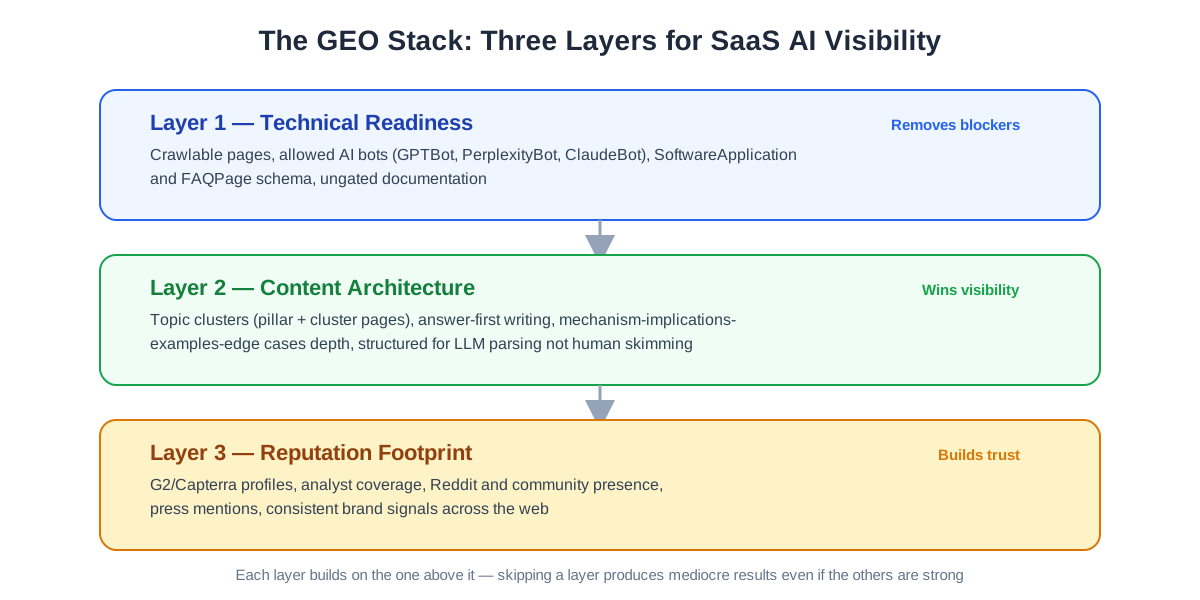
The business case above is the “why.” Structurally, closing the gap comes down to three layers, each building on the one below it. This is the strategic shape of the work; for the line-by-line implementation checklist, see the four-pillar playbook .
Before AI systems can cite you, they need to be able to read you. Start with your robots.txt: confirm you’re not accidentally telling crawlers to block AI crawlers like OAI-SearchBot, PerplexityBot, ClaudeBot, or Googlebot, either intentionally or by an overly broad legacy rule. Check your CDN’s bot-management settings too; default configurations sometimes block AI access without anyone noticing.
Then implement structured data. SoftwareApplication schema describes your product, pricing, and reviews explicitly rather than leaving an AI to infer them from marketing copy. This is low-effort, high-leverage work that most SaaS sites still haven’t done, and it’s the first thing to check off before investing in anything further up the stack.
Technical readiness removes blockers; content architecture is what actually earns citations. The biggest strategic shift from a traditional content strategy: build topic clusters instead of isolated posts. A comprehensive pillar page on your core topic, linked to a set of focused cluster articles on specific subtopics, signals the kind of topical depth AI systems look for before treating a source as authoritative.
Within that content, the goal is writing for how AI systems parse text, not how humans skim: front-loaded answers, strict heading hierarchies, and depth on substantial claims that gives an AI multiple genuine angles to cite you from.
The single highest-leverage fix in this layer, and one many SaaS teams overlook, is ungating technical documentation. Integration guides, API references, and detailed use-case content that sit behind a login or a form submission are invisible to AI crawlers, no matter how good they are. Making this content public doesn’t have to mean losing lead capture; it means shifting where you capture leads to later in the funnel.
AI systems don’t only read your website, they look for consensus across G2, Capterra, GitHub, Reddit, LinkedIn, and industry publications. A brand that only exists on its own site reads as unverifiable; a brand consistently described the same way across many independent sources reads as trustworthy.
This is the layer where SaaS teams most often try to shortcut the work with a single PR push. It doesn’t hold up: reputation footprint compounds from sustained review upkeep, genuine community participation, and earned coverage over months, which is exactly why starting the clock now matters more than getting every tactic perfect on day one.
Begin with a baseline: pick 25-50 realistic buyer questions (direct category queries, use-case questions, comparison queries, and integration-specific questions), and run them through ChatGPT, Perplexity, and Google’s AI surfaces, noting whether and how you’re mentioned. This takes roughly 90 minutes and gives you a concrete starting point rather than a guess about how buyers researching through ChatGPT actually encounter your brand. The playbook’s audit step walks through the full prompt-library process if you want a repeatable version of this.
From there, work the layers in order: fix technical blockers first (fast, low-effort, often produces the quickest visible change), then restructure your highest-value content, then invest in reputation-building work that compounds over months rather than days. Re-run your baseline prompts periodically to see what’s actually moving, and treat any single week’s fluctuation with some skepticism since AI responses vary run to run and don’t correlate perfectly with traditional rankings.
The category authority available to SaaS companies in AI search right now resembles the early days of content marketing: most competitors haven’t systematically done this work yet, which means the companies that build it deliberately now have a real head start before it becomes standard practice across the board.
Arshia is an AI Workflow Engineer at FlowHunt. With a background in computer science and a passion for AI, he specializes in creating efficient workflows that integrate AI tools into everyday tasks, enhancing productivity and creativity.

Am I Cited tracks your brand's citations and share of voice across ChatGPT, Perplexity, and Google AI Overview, so you can see whether the buyer-research shift is already costing you deals.
Master AI visibility for your SaaS company. Learn GEO strategies, structured data optimization, and how to get recommended by ChatGPT, Gemini, and Perplexity. C...

Learn how SaaS companies achieve visibility in ChatGPT, Perplexity, and Google AI Overviews. Discover GEO strategies, content optimization, and monitoring tacti...
Learn how SaaS companies optimize their brand visibility in AI answer engines like ChatGPT, Perplexity, and Google AI Overviews. Discover strategies for AI posi...
Cookie Consent
We use cookies to enhance your browsing experience and analyze our traffic. See our privacy policy.