



AI Visibility Report: Essential Components and Metrics
Learn what metrics and data should be included in an AI visibility report to track brand presence across ChatGPT, Perplexity, Google AI Overviews, and Claude. C...
12 min read

Tracking brand visibility in Claude needs its own discipline: an independent search index, probabilistic outputs, and a B2B audience. Here’s what to measure, how to sample it statistically, and how Claude compares to other AI platforms.
Claude recorded nearly 100 million monthly visits by mid-2025, with users spending over six minutes per session. AI-referred traffic across GA4 properties jumped 527% in the first five months of that same year. These are not casual chatbot users, they are procurement leads comparing vendors, developers evaluating tools, and operations directors building internal business cases. When Claude answers their questions, it shapes the shortlist. If your brand is not in that answer, you are invisible at the moment of highest intent.
Here is the uncomfortable truth most marketing teams have not yet confronted: tracking brand visibility in Claude is not a variant of SEO, and it is not a ChatGPT clone problem. It is a fundamentally different measurement discipline. The tools, metrics, and mental models that work for Google, or even for ChatGPT, produce misleading data when applied to Claude.
This article explains exactly what makes Claude visibility different, which metrics actually matter, how to set up a tracking program that produces valid data, and how Claude compares to the other major AI platforms.
Before you can measure anything, you need to understand what you are measuring. Claude differs from both traditional search engines and other AI chatbots in three structural ways that change everything about how you track visibility.
Traditional SEO operates on a ranked-list model. A keyword returns a Search Engine Results Page (SERP) with ten blue links. You can be #1, #4, or #37. You can improve gradually. You can be on page two and still get some traffic.
Claude produces a single, synthesized answer. Your brand is either mentioned or it is not. There is no position #3, no gradual improvement curve, and no second-page consolation. This binary outcome (present or absent) means that tracking Claude visibility requires a fundamentally different measurement philosophy. You are not monitoring a ranking that moves up and down; you are measuring the probability that your brand appears in answers to relevant prompts.
This also means that small changes in how Claude forms its answers can produce dramatic swings in visibility. A minor update to Claude’s model, a shift in its web search behavior, or a competitor publishing a well-structured comparison page can flip your brand from “always mentioned” to “never mentioned” overnight. Traditional rank tracking tools, built to detect gradual position changes, cannot capture this dynamic.
Not all AI platforms serve the same audience, and the differences have direct consequences for what visibility is worth.
Claude’s user base skews heavily toward technical and business decision-makers. Anthropic’s enterprise partnerships place Claude inside Slack, GitHub, Google Workspace, and Microsoft 365 Copilot. The Deloitte partnership alone puts Claude in front of 470,000 users; the Cognizant rollout covers 350,000 employees. By mid-2025, Claude held approximately 32% of the enterprise LLM market.
This matters because the questions these users ask are fundamentally different from the queries typed into Google or ChatGPT. A Claude user is more likely to ask:
These are high-stakes, high-consideration queries. Being mentioned in Claude’s answer to these prompts does not just generate a click, it shapes a purchasing decision that may be worth six or seven figures. The tracking implications are clear: if you are tracking generic “best CRM” prompts in Claude, you are tracking the wrong prompts. Your prompt library needs to reflect the specificity and technical depth of the questions Claude’s actual users ask.
This is the single most overlooked difference in Claude brand tracking, and misunderstanding it leads to wasted effort.
When ChatGPT needs real-time web information, it routes through Microsoft’s Bing index. When Perplexity searches the web, it uses its own index with a heavy emphasis on recency. When Claude searches the web, it uses Anthropic’s own web search infrastructure, most likely powered by Brave Search, an entirely independent index with its own crawling, ranking, and authority logic.
The practical consequence is stark: strong Google rankings do not guarantee Claude visibility. The overlap between Google’s top organic results and AI-cited sources has dropped from approximately 70% in 2023 to below 20% in 2026. A page that ranks #1 on Google for “best project management software” can be entirely absent from Claude’s answer to the same question, because Claude’s web search may not even crawl that page, or may not weight it as authoritative.
Furthermore, Claude operates three distinct crawlers: ClaudeBot (the general-purpose crawler), Claude-User (triggered when a user explicitly asks Claude to fetch a URL), and Claude-SearchBot (used for web search grounding). A misconfigured robots.txt file that blocks any of these crawlers can silently erase your brand from Claude’s answers. Most brands have never checked whether their robots.txt permits Claude’s crawlers. This is a tracking blind spot that traditional SEO tools cannot detect.

Track how AI chatbots mention your brand across ChatGPT, Perplexity, and other platforms.
If you have ever typed a prompt into Claude, noted whether your brand appeared, and called that a “visibility check,” you have been measuring noise.
In January 2026, Rand Fishkin and the SparkToro team published research that should have fundamentally changed how the industry approaches AI visibility tracking. They asked ChatGPT, Claude, and Google AI the same brand-recommendation prompts 100 times each and measured the consistency of the answers.
The results were sobering. Across all AI platforms, the same prompt produced significantly different brand lists on different runs. Claude was not uniquely inconsistent, all LLMs are probabilistic by nature, but the research exposed a critical flaw in the dominant tracking methodology. When a platform samples a prompt once and reports a binary “mentioned” or “not mentioned” result, it is reporting a single data point from a distribution. That single data point tells you almost nothing about the true probability of your brand appearing.
The same prompt can produce different outputs across sessions, across model versions, and even across identical requests made minutes apart. This is not a bug. It is a fundamental property of how large language models generate text. They sample from probability distributions over tokens, and small variations in the sampling process produce different surface-level text while preserving the same underlying knowledge.
The correct approach to tracking brand visibility in Claude, and any LLM, is statistical sampling. Each prompt in your library should be run at least three to five times per measurement cycle. The results are then aggregated to produce a share of voice percentage: the proportion of runs in which your brand appeared.
For example, if you track 50 prompts and run each three times (150 total queries), and your brand appears in 63 of those responses, your share of voice is 42%. This percentage is your core metric. It is not a ranking. It is a probability estimate. And like any probability estimate, it becomes more reliable with more samples.
Leading LLMO tracking platforms have already adopted this methodology. Tools like Ziptie, TopCited, and LLMRefs run multiple queries per prompt simultaneously and report statistical share of voice rather than binary mention counts. The difference between a platform that samples once and a platform that samples five times is the difference between a coin flip and a measurement.
| Dimension | Traditional SEO | ChatGPT Visibility | Claude Visibility |
|---|---|---|---|
| System type | Deterministic (index → ranked list) | Probabilistic (LLM + Bing RAG) | Probabilistic (LLM + Brave Search RAG) |
| Core input | Keywords | Conversational prompts | Technical, multi-sentence buyer prompts |
| Primary metric | SERP position, CTR | Mention rate, citation frequency | Mention rate, share of voice, citation rate (distinct metrics) |
| Search infrastructure | Google index | Microsoft Bing index | Anthropic’s own web search / Brave Search |
| Sampling requirement | Single query sufficient | 3–5 runs per prompt recommended | 3–5 runs per prompt essential |
| Audience | General search users | General consumers + professionals | Disproportionately B2B, technical, enterprise |
| Citation behavior | N/A (links are the product) | Frequent citations, often with links | Mentions often without citations; citations and mentions are separate metrics |
| Key risk | Ranking drop | Model update changes behavior | robots.txt misconfiguration, Brave Search index exclusion |
Once you accept that Claude tracking requires statistical sampling, the next question is what to measure. Not all metrics are created equal, and some of the metrics that dominate traditional SEO are entirely irrelevant to Claude.
This is the most important distinction in Claude-specific tracking, and most brands conflate the two.
Brand mention rate is the percentage of relevant prompts in which Claude names your brand textually. Claude may say “Tools like Salesforce, HubSpot, and Zoho are popular choices,” that is a mention. It may or may not include a clickable link.
Citation rate is the percentage of prompts in which Claude includes a clickable source link back to your domain. In Claude, these are two completely separate metrics. Claude frequently mentions brands based on its training data without providing a citation. Conversely, Claude may cite a third-party source (a G2 review, a TechCrunch article, a Reddit thread) that mentions your brand without naming you directly in the answer text.
The reason this distinction matters is that Claude’s citation behavior is structurally different from ChatGPT’s. ChatGPT, routing through Bing, tends to provide more frequent citations. Claude, with its emphasis on synthesized, nuanced answers, often provides fewer explicit citations, and when it does cite, the sources may be different from what you would expect based on Google or Bing rankings.
If you are only tracking citation rate, you may conclude your brand is invisible in Claude when in fact Claude mentions you frequently but does not link. If you are only tracking mention rate, you may miss that a competitor is being cited while you are merely mentioned, a significant competitive disadvantage.
Beyond the mention/citation distinction, three additional metrics provide a complete picture of your Claude visibility:
Share of voice is the percentage of responses, across all tracked prompts, in which your brand appears relative to competitors. If your brand appears in 40% of responses and your closest competitor appears in 55%, you have a 15-point share of voice gap. This metric is most useful for competitive benchmarking and for tracking changes over time.
Sentiment and framing capture not just whether Claude mentions you, but how. Claude may describe your brand as “the best option for enterprise deployments” or “a budget-friendly alternative with limited features.” Both are mentions, but they have opposite business impact. Tracking sentiment requires classifying each mention as positive, neutral, or negative, and, more importantly, understanding the framing: are you recommended as a primary choice, listed as an alternative, or mentioned only in passing?
Average mention position tracks where in Claude’s answer your brand appears. LLM responses function like a ranked list: users read from top to bottom, and brands mentioned earlier receive more attention. If Claude mentions you fifth in a list of five recommendations, your visibility is worth less than if you appear first. This metric is particularly important for comparative prompts like “best [category] tools.”
One of the most revealing diagnostic metrics in Claude tracking is the dual-mode delta: the difference between your brand’s visibility when Claude’s web search is disabled (probing only training data) versus when it is enabled (probing real-time retrieval).
If your brand appears in 60% of responses with web search enabled but drops to 0% when web search is off, it means your brand has zero presence in Claude’s training data. You are relying entirely on live, volatile web scrapes for visibility. If a competitor has strong training-data presence, they have a structural advantage that cannot be overcome with short-term content improvements.
Conversely, if your brand appears in Claude’s answers regardless of web search status, you have built genuine brand authority that persists across model updates. This is the ideal state, and tracking the dual-mode delta tells you how far you are from it.
Get the latest insights on AI mentions, brand monitoring, and optimization strategies.
Understanding what drives Claude’s brand selection is essential for both tracking and improving visibility. Claude’s selection logic is not a black box. It follows observable patterns rooted in Anthropic’s training philosophy and technical architecture.
Claude is trained using Constitutional AI (specifically RLAIF, Reinforcement Learning from AI Feedback), a method in which the model learns to follow an explicit set of principles rather than relying solely on human preference labels. The practical consequence for brand visibility is that Claude is unusually cautious about unverified claims and unusually inclined toward well-structured, authoritative sources.
When Claude evaluates whether to mention a brand, it is effectively asking: “Can I verify this claim? Is this source credible? Does this information come from a source I have been trained to trust?” Anthropic’s models lean heavily on entity grounding from highly moderated, trusted web nodes, specifically Wikipedia, government registries, and Tier-1 industry publications.
This means that brands with strong Wikipedia presence, consistent coverage in respected trade publications, and well-structured technical documentation have a structural advantage in Claude’s answers. Conversely, brands that rely primarily on paid media, thin affiliate content, or self-referential claims are unlikely to pass Claude’s authority filter.
When Claude’s web search activates, it behaves like a researcher, not a keyword matcher. The content that earns citations in Claude shares several characteristics:
Vague positioning pages and marketing-heavy landing pages give Claude nothing to cite. A page that explains what a product does, which teams use it, what results they have seen, and how it compares to alternatives gives the model something credible to name.
One of the most actionable outputs of Claude tracking is identifying citation gaps: specific sources that Claude cites when answering category-relevant prompts, where your brand is absent.
If Claude consistently cites a specific G2 comparison grid, a particular analyst report, or a niche industry blog when answering “best [category]” prompts, and your brand is not featured in that source, you have identified a citation gap. Closing it is straightforward: get your brand included in that source. This is the Claude equivalent of link building, but the target is not a backlink; it is presence in the sources Claude already trusts.
Tracking citation gaps requires examining not just whether Claude mentions you, but what sources it cites when it mentions competitors. This level of analysis is labor-intensive to do manually, which is why dedicated Claude tracking tools have emerged to automate it.
A systematic Claude tracking program does not require enterprise-scale investment. It requires a structured approach, the right prompt library, and consistency over time.
The foundation of Claude tracking is a prompt library: a set of 40 to 80 multi-sentence prompts that reflect how your actual buyers use Claude. These prompts should span four categories:
Shortlist and discovery prompts simulate the research phase of a buying decision. Examples: “Recommend three contract management platforms for a mid-market legal team” or “What are the best observability tools for a Kubernetes environment?”
Comparative prompts simulate direct vendor evaluation. Examples: “Compare Datadog and New Relic for infrastructure monitoring” or “What are the trade-offs between Webflow and WordPress for a B2B SaaS marketing site?”
Trust and objection prompts simulate due diligence. Examples: “What are common complaints about [your brand]?” or “Is [your brand] suitable for SOC 2 compliance?”
Use-case and integration prompts simulate deployment evaluation. Examples: “Which CRM integrates best with Slack and Google Workspace?” or “Best email marketing tool for a Shopify store with 50,000 subscribers.”
The prompts should be specific enough to reflect real buyer behavior, not generic category queries. “Best CRM” is not a prompt a real buyer types into Claude. “What CRM should a 50-person B2B SaaS company use if they need tight Salesforce integration and HIPAA compliance?” is.
For brands early in their Claude tracking journey, a manual approach is viable for establishing a baseline: run 20 to 30 key prompts through Claude three times each, record the results in a spreadsheet, and calculate your mention rate and share of voice. This takes a few hours and provides a snapshot.
For ongoing monitoring, automated tools are essential. The Claude tracking tool landscape in 2026 includes:
Most of these platforms offer free tiers or trials sufficient for an initial baseline scan. The key differentiator between tools is whether they support multi-run sampling (statistically valid) or single-run checks (directionally useful but unreliable).
The first measurement cycle establishes your baseline. Run your full prompt library through Claude three to five times per prompt. Record:
After the baseline, run the same prompt set on a regular cadence: monthly is standard, though brands in fast-moving categories may benefit from bi-weekly tracking. The goal is to detect trends, not to react to every fluctuation. A single month’s drop from 45% to 38% share of voice may be noise. Three consecutive months of decline is a signal.
One of the most useful insights from trended Claude tracking is correlating visibility changes with content and PR activities. When you publish a comprehensive comparison page, does your mention rate in comparative prompts increase? When you earn coverage in a Tier-1 publication, does Claude’s sentiment toward your brand shift? These correlations turn tracking from a passive monitoring exercise into an active optimization feedback loop.
Understanding Claude’s distinctiveness requires comparing it to the other major AI platforms. Each operates on different infrastructure, serves different audiences, and rewards different content strategies.
ChatGPT is the traffic leader: it drives approximately 78% of all AI referral traffic. It routes web search through Microsoft’s Bing index, which means traditional SEO investments in Bing ranking factors have some carryover to ChatGPT visibility. ChatGPT’s audience is broader and more consumer-oriented, and its citation behavior is relatively frequent and link-heavy.
Claude, by contrast, routes through an independent search infrastructure (Brave Search), serves a more technical and B2B audience, and provides fewer but more carefully selected citations. The content that earns visibility in ChatGPT may not earn visibility in Claude, and vice versa. A brand that is strong on Bing may dominate ChatGPT visibility while being invisible in Claude, and the reverse is also possible.
The practical implication: you cannot use ChatGPT visibility as a proxy for Claude visibility. They must be tracked separately, with separate prompt libraries optimized for each platform’s audience.
Perplexity is structurally the most transparent AI platform. Every answer cites its sources explicitly, and citations are the core product experience. This makes Perplexity tracking relatively straightforward: if your brand is cited, you know exactly which page was used and can verify the accuracy.
Claude is less transparent. Citations are provided selectively, and many answers are synthesized from training data without explicit source attribution. This makes Claude tracking harder: you often cannot trace why Claude mentioned (or did not mention) your brand, but it also makes Claude visibility more valuable, because appearing in Claude’s answers signals deeper brand authority rather than just being indexed by a search engine.
Gemini and Google AI Overviews are the reach leaders. They benefit from Google’s massive user base and integration with Google Search. Gemini’s visibility is heavily influenced by Google’s index, making it the most SEO-adjacent AI platform to track.
Claude’s reach is smaller but more concentrated among high-value audiences. For B2B and technical brands, a mention in Claude may be worth more than a mention in Gemini, even if Gemini reaches more total users. The audience quality, not just the quantity, determines the business value of AI visibility.
Tracking brand visibility in Claude is not a simple extension of SEO, and it is not a ChatGPT clone problem. It is a distinct measurement discipline that requires a different mental model, different metrics, and different tools.
The core differences are structural: Claude operates on an independent search infrastructure (Brave Search, not Bing), serves a disproportionately technical and B2B audience, applies Constitutional AI that filters for evidence quality and source credibility, and produces probabilistic outputs that demand statistically valid repeated sampling.
The correct approach to Claude tracking is statistical, not deterministic. Run each prompt multiple times. Calculate share of voice as a probability, not a binary. Track mention rate and citation rate as separate metrics. Measure the dual-mode delta between static and web-enabled Claude. Identify citation gaps and close them by earning presence in the sources Claude already trusts.
The brands that get this right are building a competitive moat while their competitors are still checking Claude manually once a month and calling it a measurement program. The window to build that moat is open now, but it will not stay open forever.
Arshia is an AI Workflow Engineer at FlowHunt. With a background in computer science and a passion for AI, he specializes in creating efficient workflows that integrate AI tools into everyday tasks, enhancing productivity and creativity.

Am I Cited runs your prompt set repeatedly and reports statistical share of voice, mention rate, and sentiment across the major AI platforms, so your Claude tracking isn't a single-run coin flip.
Learn what metrics and data should be included in an AI visibility report to track brand presence across ChatGPT, Perplexity, Google AI Overviews, and Claude. C...
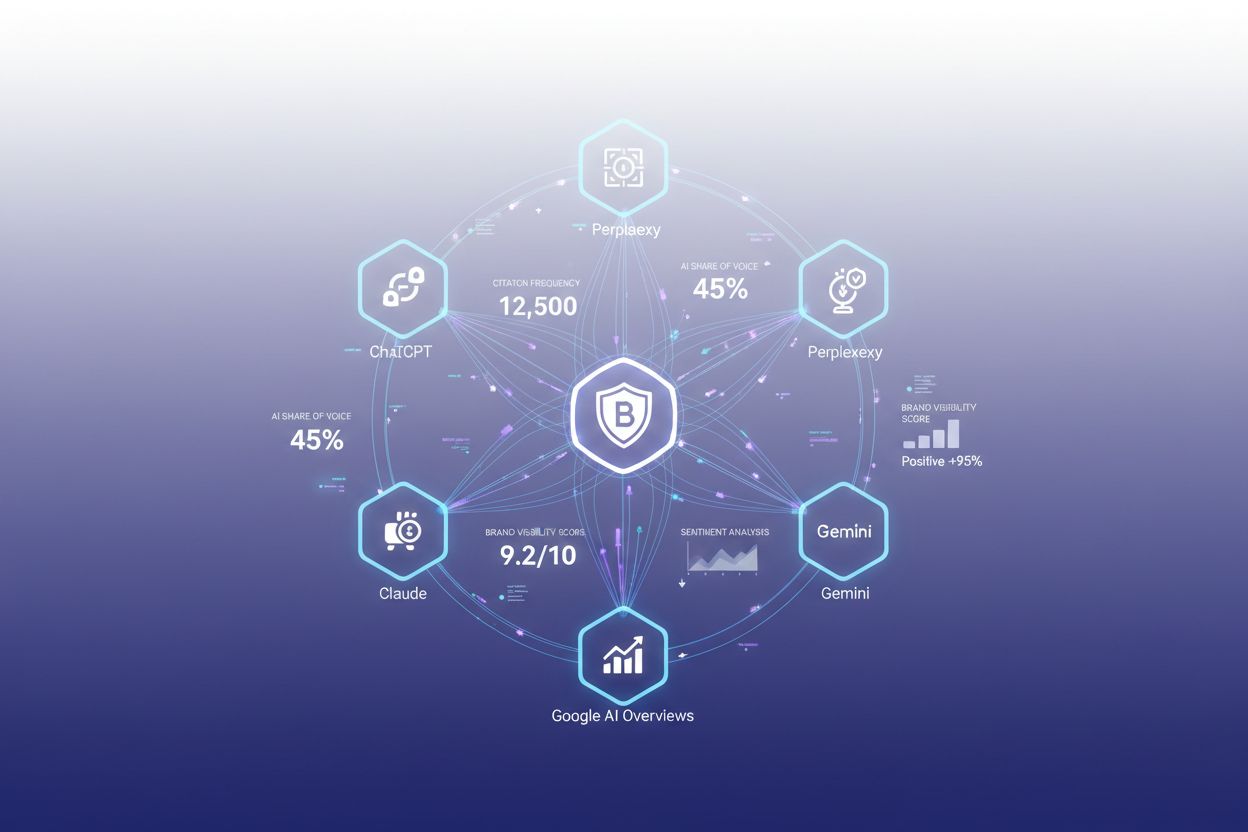
Learn what an AI Visibility Dashboard is and how it tracks your brand's citations across ChatGPT, Perplexity, Claude, and Google AI. Discover key metrics, top t...

Follow a step-by-step AI visibility audit to measure brand mentions and citations across ChatGPT, Perplexity and other platforms.
Cookie Consent
We use cookies to enhance your browsing experience and analyze our traffic. See our privacy policy.