Prompt Research for AI Visibility: Understanding User Queries
Learn how to conduct effective prompt research for AI visibility. Discover the methodology for understanding user queries in LLMs and tracking your brand across...
I’ve been studying how different prompt phrasings lead to different brand mentions in AI responses.
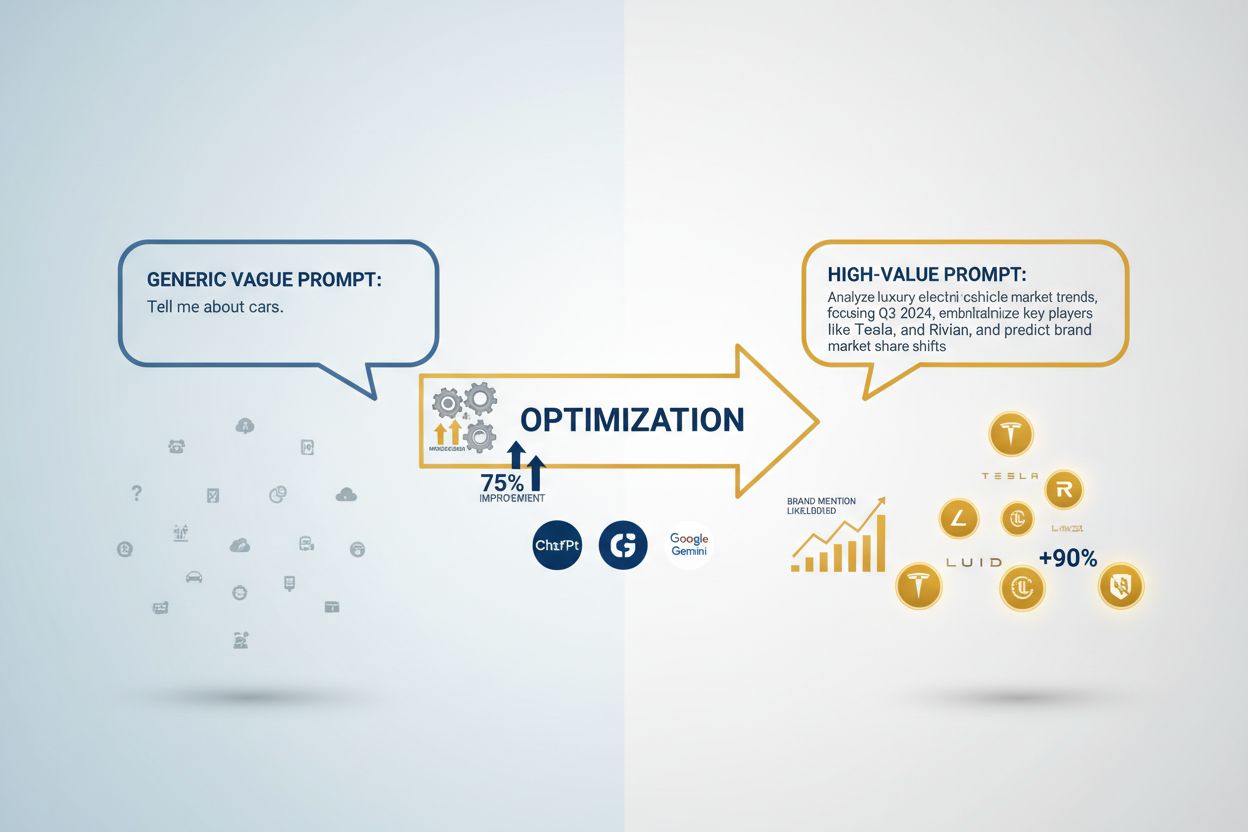
The insight that started this: I asked ChatGPT the “same question” three ways:
Same category, completely different recommendations based on how the question was asked.
What this means for marketers: The exact user prompt determines which brands get mentioned. But how do we optimize for this when we can’t control how users ask?
Questions:
Michael, you’ve touched on something fundamental. Prompt structure significantly influences AI output.
The main prompt pattern categories:
| Pattern | Example | AI Behavior |
|---|---|---|
| Comparative | “X vs Y” | Cites comparison content, structured comparisons |
| Best-of | “Best X for Y” | Cites review sites, authoritative lists |
| Exploratory | “What options for X?” | Broader recommendations, multiple options |
| Problem-solving | “How to fix X” | Cites tutorials, troubleshooting content |
| Validation | “Is X good for Y?” | Cites reviews, user experiences |
| Recommendation | “What should I use for X?” | Personalized feel, considers constraints |
Why different prompts = different recommendations:
AI systems interpret intent from prompt structure. “Best CRM for small business” triggers different training associations than “CRM for startups with small teams.”
The second is more specific, so AI:
This is really useful. So the key is understanding which prompt patterns are common in our category and creating content that matches?
Is there data on how frequently each pattern is used?
Estimated prompt pattern frequency (B2B software):
| Pattern | Frequency | Content to Create |
|---|---|---|
| Problem-solving | 35% | How-to guides, tutorials |
| Best-of | 25% | Positioned in authoritative lists |
| Recommendation | 20% | Use case specific content |
| Comparative | 15% | Comparison pages |
| Validation | 5% | Reviews, testimonials |
How to discover your category’s patterns:
You can’t cover every prompt variation, but you can cover the high-frequency patterns.
Content strategy for prompt patterns:
The content-prompt alignment principle:
Your content structure should mirror common prompt structures.
Examples:
Prompt pattern: “Best X for Y” Content to create: “Best [Product Category] for [Use Case/Persona]: 2026 Guide”
Prompt pattern: “X vs Y” Content to create: “[Your Product] vs [Competitor]: Complete Comparison”
Prompt pattern: “How to [achieve outcome]” Content to create: “How to [Outcome] with [Your Product]: Step-by-Step Guide”
Why this works:
AI looks for content that directly answers the query. Content structured to match the query pattern is more likely to be cited.
Our approach:
For each product/service, we create content for the top 3 prompt patterns in our category. This ensures we have citable content regardless of how users phrase their queries.
User search behavior perspective:
How users actually phrase AI queries:
People query AI differently than they search Google. AI queries are:
Common patterns in conversational queries:
Implication for content:
Your content should address specific constraints and situations, not just generic features. When users add constraints, AI looks for content addressing those constraints.
“Best project management software” ≠ “Best project management for remote creative teams under 20 people”
The second query needs content that specifically addresses remote, creative, small teams.
Technical perspective on prompt interpretation:
How AI parses prompts:
Why phrasing changes results:
“Best CRM for small business” → Entities: CRM, small business “CRM for startups with small sales teams” → Entities: CRM, startups, small sales teams
The second has more specific entities. AI retrieves sources that address all entities.
For marketers:
Create content that explicitly addresses common entity combinations:
Each combination is a potential match for a user prompt.
Competitive analysis angle on prompts:
Discover what prompts mention competitors:
What we found for a client:
| Prompt Type | Who Gets Mentioned | Our Client? |
|---|---|---|
| “Best [category]” | Top 3 market leaders | Yes (sometimes) |
| “Best [category] for [use case 1]” | Leader + Specialist | No |
| “Best [category] for [use case 2]” | Our client specifically | Yes |
| “[Competitor] alternative” | Multiple options | No |
The insight:
They dominated their strongest use case but were invisible for others. We created targeted content for the gap areas.
Within 3 months, they started appearing for previously invisible prompt patterns.
Product marketing perspective on prompts:
The positioning-prompt connection:
Your product positioning determines which prompts you match.
If you position as: “Enterprise CRM for large sales teams” You’ll match: “CRM for enterprise”, “CRM for large teams” You won’t match: “CRM for startups”, “affordable CRM”
The dilemma:
Broad positioning = match more prompts but less specifically Narrow positioning = match fewer prompts but dominate them
Our strategy:
We have primary positioning (narrow, specific) and create content for adjacent prompt patterns we want to capture.
Core positioning: “CRM for agencies” Extended content: “CRM for marketing teams”, “CRM for service businesses”
This captures prompts beyond our core positioning without diluting our brand.
Monitoring perspective on prompt visibility:
How to track prompt pattern performance:
Our monitoring approach:
We track visibility across:
Weekly monitoring shows:
Tools like Am I Cited help automate this. You can set up prompt variations and track mentions automatically.
Practical optimization for prompt patterns:
Quick wins for prompt coverage:
Add FAQ sections with question formats that match prompts
Create comparison pages for each major competitor
Use case landing pages for each persona
How-to content for problems you solve
The minimum prompt coverage:
At minimum, have content for:
This covers the highest-frequency prompt patterns.
This thread fundamentally shaped how I think about AI visibility. Key insights:
Prompt patterns determine visibility: Different query structures trigger different sources and recommendations. We need to optimize for patterns, not just topics.
The main pattern categories:
Content strategy: Create content that mirrors prompt structures:
Monitoring approach:
Our action plan:
The positioning-prompt connection is key. Our positioning determines which prompts we naturally match. Content extends our reach to adjacent prompts.
Thanks everyone for the research-backed insights.
Get personalized help from our team. We'll respond within 24 hours.
Monitor how your brand appears for various prompt patterns. Understand which user queries trigger your brand's mention in AI answers.

Learn how to conduct effective prompt research for AI visibility. Discover the methodology for understanding user queries in LLMs and tracking your brand across...

Community discussion on prompt tracking strategies for AI visibility. Real experiences from marketers and SEO professionals on monitoring how ChatGPT, Perplexit...

Community discussion on whether marketers need prompt engineering skills to optimize for AI search. Understanding how users query AI systems.
Cookie Consent
We use cookies to enhance your browsing experience and analyze our traffic. See our privacy policy.