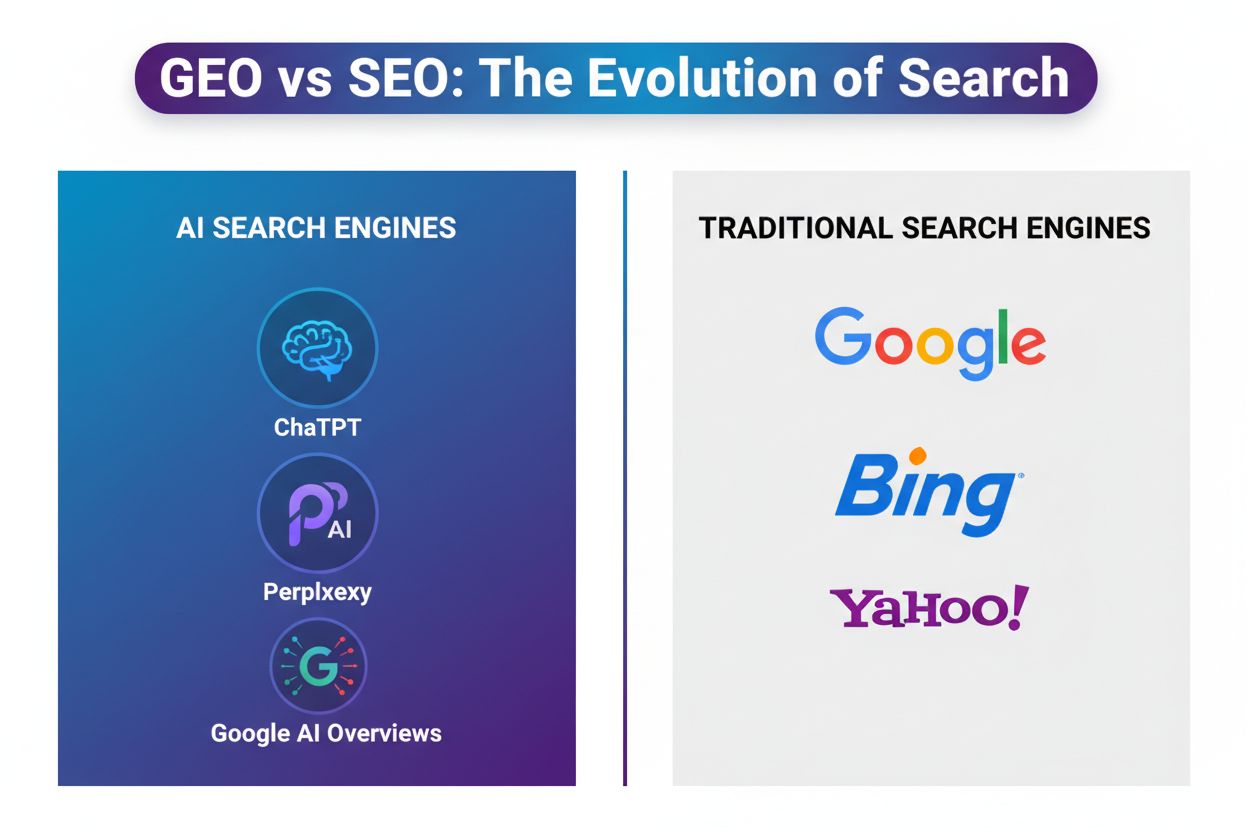
Is GEO actually important or is it just SEO rebranded? Skeptical about investing in another acronym
Community discussion on why GEO matters for businesses. Understanding the real impact of Generative Engine Optimization vs. traditional SEO.
Seeing “GEO” everywhere lately and trying to separate substance from hype.
What I think I understand:
What I’m confused about:
Would love to hear from people actually implementing GEO strategies. What’s working, what’s hype?
Been doing this for 2 years before it had a name. Let me break it down.
Is GEO just rebranded SEO?
No, but they’re related. Think of it like this:
Same goal (visibility), different mechanism (ranking vs citation).
The core differences:
| Aspect | SEO | GEO |
|---|---|---|
| Success metric | Rankings, traffic | Citations, visibility score |
| Content goal | Keyword relevance | Answer quality, expertise |
| User queries | 2-3 word keywords | 10-11 word questions |
| Competition | 10 blue links | 2-7 cited sources |
| Authority signals | Backlinks | Brand mentions, expertise |
What you DO differently:
Is it worth investing in?
71% of Americans already use AI for research. Over 1 billion ChatGPT prompts daily. The shift is real. The companies getting cited now will dominate their categories.
I was skeptical too. Here’s what changed my mind.
The data that convinced me:
We tracked our brand mentions across AI platforms for 3 months. Discovery: We ranked #1 on Google for 12 key terms but were mentioned in only 2% of relevant AI responses.
Meanwhile, a competitor ranking #4-5 on Google was cited in 40% of AI responses.
Why the disconnect:
Google ranks based on backlinks, keywords, technical factors. AI systems cite based on:
Different signals entirely.
The “aha” moment:
When I asked ChatGPT to recommend solutions in our space, our competitor was first. We weren’t mentioned until I specifically asked about us.
That’s when I realized GEO isn’t marketing hype - it’s a real visibility gap.
The table breakdown is super helpful. So the fundamental difference is:
SEO = optimizing to be ranked GEO = optimizing to be cited
But how do you actually optimize to be cited? What specific tactics work?
Great question. Here are the tactics that actually work.
Content structure:
AI systems extract and synthesize. Make extraction easy:
Authority building:
AI systems assess expertise signals:
Question-answer alignment:
AI queries are conversational (10-11 words average). Your content should:
Platform-specific approach:
ChatGPT - Values brand authority, training data presence Perplexity - Emphasizes freshness, source attribution Claude - Prefers analytical depth, ethical framing Google AI Overview - Traditional SEO signals still matter
Technical foundations:
Let me share the measurement side.
How to measure GEO success:
Citation frequency - How often your brand appears in AI responses for target topics
Visibility score - Weighted metric combining:
Share of voice - Your citations vs competitors for same queries
Platform coverage - Performance across ChatGPT, Perplexity, Claude, etc.
Tools that help:
Am I Cited - Purpose-built for AI visibility tracking. Monitors across platforms, gives visibility scores, competitor comparison.
Manual testing - Still necessary. Run key queries weekly across platforms.
Google Search Console - CTR changes can indicate AI Overview impact.
The metrics evolution:
Traditional: Traffic, rankings, conversions GEO era: Citations, visibility score, brand mentions + conversions
The conversion metric stays. How you measure top-of-funnel visibility changes.

Technical implementation perspective.
Robots.txt configuration:
Many sites are accidentally blocking AI crawlers. Check for:
User-agent: GPTBot
Allow: /
User-agent: ClaudeBot
Allow: /
User-agent: PerplexityBot
Allow: /
Schema markup priority:
AI systems love structured data. Implement:
Technical requirements:
The overlooked basic:
Most sites I audit have AI crawlers blocked or severely rate-limited. Check your server logs - you might be invisible to AI systems without realizing it.
Startup perspective on GEO ROI.
Why we prioritized GEO:
As a new brand, we have no SEO authority. Competing for keywords against established players is expensive and slow.
But in AI responses? Fresh perspective and unique data matter more than domain age.
What’s working for us:
Results after 6 months:
For startups, GEO might be a faster path to visibility than traditional SEO.
Agency perspective on client conversations.
How we position GEO:
It’s not a replacement for SEO - it’s an extension. The integrated strategy:
Client pushback we address:
“Isn’t this just more buzzwords?” Response: Show them their AI visibility vs competitors. The gap is usually eye-opening.
“How do we measure ROI?” Response: Citation frequency correlates with branded search and direct traffic. We’re tracking the connection.
“Won’t this change again soon?” Response: The specific platforms may evolve, but users seeking answers from AI is the trend. The skills transfer.
What we charge for GEO:
We’ve added AI visibility monitoring and optimization as a service layer. Clients who do both SEO and GEO with us see the compounding effects.
Sharing research insights on how AI systems select citations.
What seems to influence AI citations:
Based on analyzing thousands of AI responses:
What doesn’t seem to matter:
The E-E-A-T connection:
Google’s E-E-A-T (Experience, Expertise, Authoritativeness, Trustworthiness) aligns surprisingly well with what AI systems value. If you’re doing E-E-A-T well for Google, you’re probably doing well for GEO.
The difference:
GEO requires making expertise EXTRACTABLE. Clear, concise statements AI can quote. Tables it can reference. Structured data it can parse.
B2B perspective - this matters even more for us.
Why GEO is critical for B2B:
Our buyers research before ever talking to sales. They’re asking AI:
If we’re not cited, we’re not in the consideration set.
Our GEO strategy:
What we track:
GEO directly impacts pipeline. If AI recommends our competitor first, that’s where buyers start.
Even local businesses need GEO thinking.
Local queries going to AI:
“Best [service] in [city]” “Who should I hire for [project]?” “Compare [local provider] reviews”
AI is increasingly answering these, not just Google Maps.
Local GEO tactics:
The reviews matter:
AI systems synthesize review content. If your reviews consistently mention specific positives, AI will cite those. Encouraging detailed reviews helps GEO.
Not as complex as B2B GEO, but still important. Local visibility is fragmenting across more surfaces.
Big picture perspective.
Where GEO is heading:
The platforms will evolve. What won’t change:
The winners in 5 years:
Will be brands that built citation authority now. The compounding effect is real - brands cited frequently become “trusted sources” for AI systems.
The integration:
GEO and SEO will merge. “Search visibility optimization” will encompass traditional rankings, AI citations, voice responses, and whatever comes next.
The brands fragmenting their approach (separate SEO and GEO teams) will lose to integrated visibility strategies.
My advice:
Start tracking AI visibility now. The baselines you establish today will prove ROI tomorrow.
This thread answered my questions comprehensively.
My conclusions:
Is GEO real? Yes. Different mechanism (citation vs ranking), different tactics, different measurement.
Is it just rebranded SEO? No, but they’re complementary. Strong SEO foundation helps GEO, and vice versa.
What to do differently?
Is it worth investing? Yes - 71% of Americans using AI search, and citation opportunities are limited (2-7 per response). Early movers will dominate.
My next steps:
Thanks everyone for the detailed insights!
Get personalized help from our team. We'll respond within 24 hours.
Track how your brand appears in AI-generated responses across ChatGPT, Perplexity, Claude, and Google AI Overviews. Measure your GEO success with real data.

Community discussion on why GEO matters for businesses. Understanding the real impact of Generative Engine Optimization vs. traditional SEO.

Community discussion on GEO vs SEO. Understanding how to balance traditional search engine optimization with AI search optimization.

Understand the critical differences between Generative Engine Optimization (GEO) and traditional SEO. Learn how to optimize for AI search engines like ChatGPT, ...
Cookie Consent
We use cookies to enhance your browsing experience and analyze our traffic. See our privacy policy.