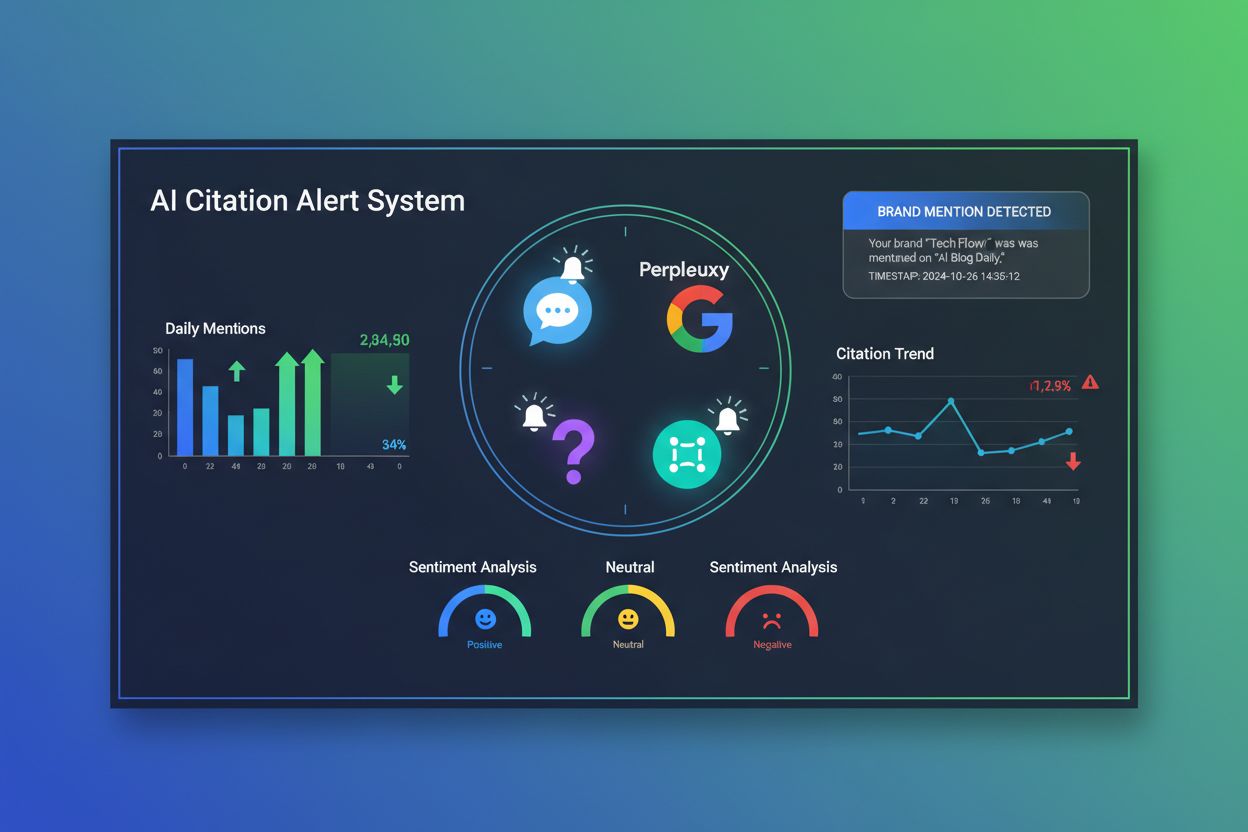
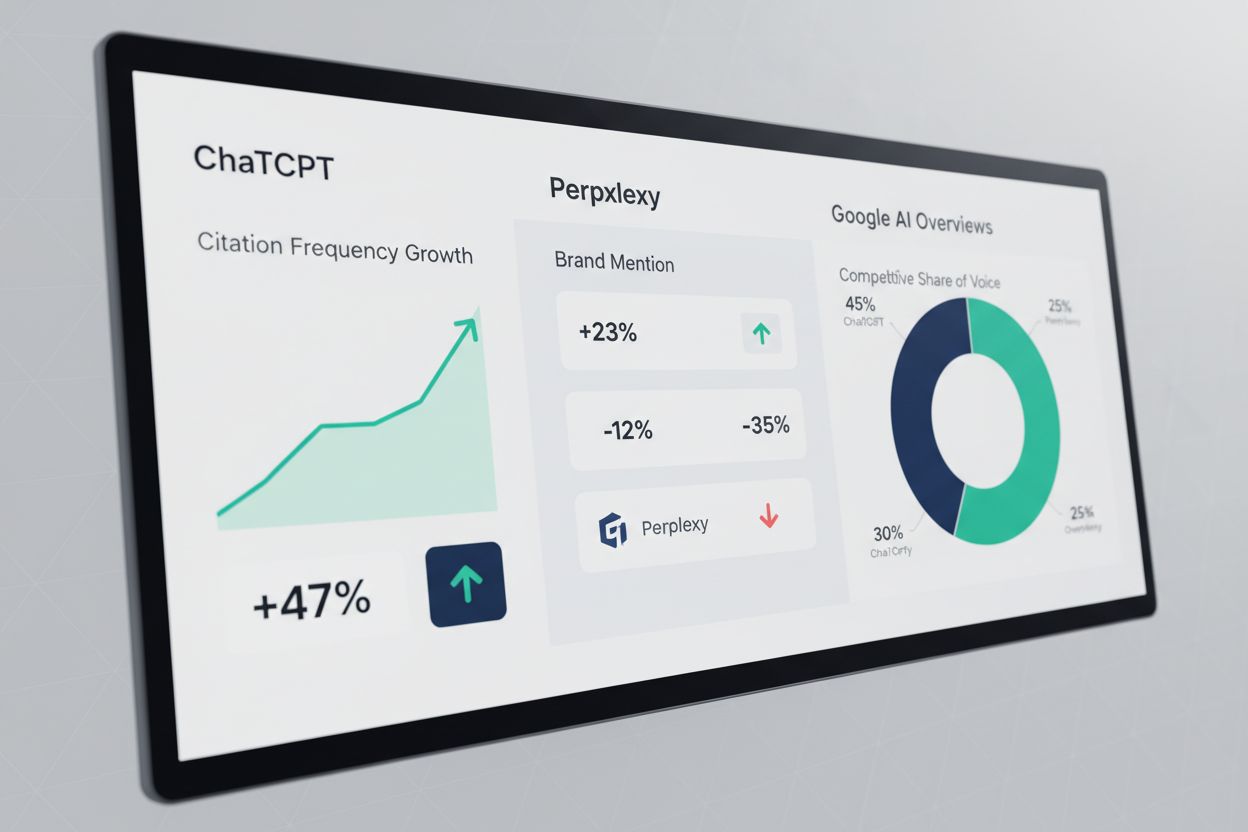
Automated notifications for changes in AI visibility or sentiment. AI Citation Alert Systems monitor how large language models mention and recommend your brand across platforms like ChatGPT, Perplexity, and Google AI Overviews, sending real-time alerts when visibility, sentiment, or citation patterns change significantly. These systems use machine learning to detect anomalies and help brands respond quickly to opportunities or threats in AI search.
AI Citation Alert System
Automated notifications for changes in AI visibility or sentiment. AI Citation Alert Systems monitor how large language models mention and recommend your brand across platforms like ChatGPT, Perplexity, and Google AI Overviews, sending real-time alerts when visibility, sentiment, or citation patterns change significantly. These systems use machine learning to detect anomalies and help brands respond quickly to opportunities or threats in AI search.
What is an AI Citation Alert System?
An AI Citation Alert System is an automated monitoring platform that tracks how large language models (LLMs) and AI search engines mention, reference, and recommend your brand across platforms like ChatGPT, Perplexity, Google AI Overviews, Gemini, and Claude. These systems send real-time notifications whenever significant changes occur in your brand’s visibility, sentiment, or citation patterns. With over 1.6 billion monthly users across major AI platforms, monitoring your presence in AI-generated responses has become as critical as traditional search engine optimization. Unlike passive monitoring, alert systems actively detect anomalies and changes, enabling marketers to respond quickly to opportunities or threats. The technology uses machine learning to establish baseline patterns and identify when actual performance deviates significantly from expected behavior. This shift from reactive to proactive monitoring represents a fundamental change in how brands manage their digital reputation in the age of generative AI.
How AI Citation Alert Systems Work
AI Citation Alert Systems leverage machine learning algorithms to establish predictive models of your brand’s expected visibility patterns across AI platforms. The system analyzes historical data—such as mention frequency, sentiment scores, and citation sources—to predict what “normal” looks like for your brand. When new data arrives, the system compares actual results against these predictions using statistical models like exponential smoothing, moving averages, or ARIMA (AutoRegressive Integrated Moving Average). If the actual data point falls outside a configurable threshold, an alert is triggered and sent to designated team members via email, Slack, or other notification channels. The sensitivity level determines how strict these thresholds are: higher sensitivity catches smaller anomalies but may generate false positives, while lower sensitivity reduces noise but might miss important changes. Most platforms monitor multiple dimensions simultaneously—not just overall brand mentions, but also mentions by campaign, geographic region, device type, or competitor context. This multi-dimensional approach helps pinpoint the exact source of visibility changes, whether they stem from a successful marketing campaign, a viral social media post, or a competitor gaining ground in specific markets.
Monitoring Approach
Accuracy
Real-time
Cost
Coverage
API-based
High
Yes
Medium
Limited to API data
Web Scraping
Very High
Yes
Low
Comprehensive
Hybrid
Very High
Yes
High
Comprehensive
Ready to Monitor Your AI Visibility?
Track how AI chatbots mention your brand across ChatGPT, Perplexity, and other platforms.
Modern AI Citation Alert Systems provide comprehensive monitoring capabilities that go far beyond simple mention counting:
Real-time brand mention tracking across multiple AI platforms with daily or instant updates
Sentiment analysis evaluating whether mentions are positive, negative, or neutral
Share of Voice metrics comparing your citations against competitors
Citation source tracking revealing which websites AI models pull from
Competitive benchmarking showing your visibility relative to specific competitors
Customizable alert rules with configurable thresholds for different metrics
Analytics dashboards providing visual trend representations over time
Integration capabilities connecting with marketing tools for automated workflows
These features work together to provide comprehensive monitoring capabilities that go far beyond simple mention counting. Brand mention tracking automatically detects when your company, products, or services appear in AI-generated responses across multiple platforms, providing daily or real-time updates on visibility changes. Sentiment analysis evaluates whether mentions are positive, negative, or neutral, helping you understand not just how often you’re mentioned but how favorably. Share of Voice metrics compare your citation frequency against competitors, showing your percentage of total mentions in your industry category. Citation source tracking reveals which websites and content pieces the AI models are pulling from when they mention your brand, identifying your most influential content and potential partnership opportunities. Competitive benchmarking allows you to see how your visibility stacks up against specific competitors across different AI platforms and query types. Customizable alert rules let you set specific thresholds for different metrics—perhaps a 20% drop in mentions triggers an alert, while a 50% increase in positive sentiment doesn’t. Analytics dashboards provide visual representations of trends over time, making it easy to spot patterns and communicate results to stakeholders. Integration capabilities connect alert systems with your existing marketing tools, enabling automated workflows that respond to detected changes.
Why AI Citation Alerts Matter
The business case for AI Citation Alerts is compelling and increasingly urgent. Research shows that 48% of consumers now use AI tools to guide purchasing decisions, making your presence in AI-generated responses a direct factor in revenue generation. Some businesses already report that over 30% of their new customers come from AI recommendations, with conversion rates 4-5 times higher than traditional traffic sources because users arrive already informed and ready to engage. The challenge is that AI search operates differently than traditional search—instead of ranking your website, AI models synthesize information from multiple sources and present it as authoritative answers. This means you can’t rely on traditional SEO metrics to understand your AI visibility. Alert systems solve this by providing real-time visibility into how AI models perceive and represent your brand, enabling you to detect reputation threats before they escalate. Early warning of negative sentiment allows you to respond with corrected information or improved content. Competitive intelligence from alerts shows you where competitors are gaining ground, helping you identify content gaps and optimization opportunities. The data from alert systems directly informs content strategy, showing which topics and formats drive AI citations. In a landscape where AI search is growing exponentially while traditional organic search declines, monitoring and optimizing your AI visibility has become essential for maintaining market position.
The market for AI Citation Alert Systems has expanded rapidly, with several strong contenders offering different strengths. AmICited.com stands out as the specialized leader for AI answers monitoring, providing comprehensive tracking across ChatGPT, Perplexity, Google AI Overviews, Gemini, Claude, and other major platforms with particular focus on sentiment analysis and citation attribution. Semrush AI Visibility Toolkit integrates AI monitoring with traditional SEO data, making it ideal for teams already using Semrush for search optimization and wanting to add AI visibility to their existing workflows. Profound positions itself as an enterprise solution with advanced reporting capabilities, competitive benchmarking, and ChatGPT Shopping integration, though it comes at a premium price point starting at $499/month. Otterly.AI offers an affordable entry point starting at $29/month, using web scraping to capture actual user-visible results rather than relying solely on APIs, making it popular with smaller teams and agencies. Peec AI provides smart suggestions for optimization alongside monitoring, with a focus on European markets and multi-language support, starting at €89/month. ZipTie specializes in deep analysis and granular reporting with URL-level insights and an AI Success Score metric. Each platform has distinct strengths: some excel at enterprise-scale reporting, others at affordability, and still others at actionable optimization recommendations. The choice depends on your team size, budget, required platform coverage, and whether you need integration with existing SEO tools.
Setting Up Effective Alert Strategies
Implementing AI Citation Alerts effectively requires thoughtful planning beyond simply turning on monitoring. Start by defining your key metrics—typically brand mentions, sentiment scores, and Share of Voice—and establish baseline measurements over 30 days before making optimization changes. This baseline helps you distinguish between normal fluctuations and meaningful changes. Choose relevant dimensions to monitor alongside your primary metrics: campaigns (to see which marketing efforts drive AI visibility), geographic regions (to identify local opportunities), device types (to spot platform-specific issues), and specific competitors (to track relative positioning). Set appropriate sensitivity thresholds based on your industry volatility and team capacity—a volatile industry might need lower sensitivity to avoid alert fatigue, while a stable market can use higher sensitivity to catch subtle changes. Assign alerts to the right team members: technical issues go to developers, campaign-related alerts to marketers, and overall metrics to leadership. Monitor both problems and opportunities—alerts shouldn’t just flag declines but also celebrate when visibility spikes or sentiment improves, providing positive feedback to teams. Start with 3-5 key prompts or queries that represent your core business, then expand once you understand the patterns. Integrate alerts with your workflow by connecting them to Slack channels, email groups, or project management tools so insights drive action rather than sitting in dashboards. Review and adjust thresholds monthly as you learn what constitutes meaningful change for your specific business.
Challenges and Limitations
Despite their value, AI Citation Alert Systems face real limitations that users should understand. LLMs are non-deterministic, meaning the same prompt sent to the same AI model at the same time can produce different responses, making perfect consistency impossible. This inherent variability means alert systems provide directional insights rather than absolute precision. Accuracy varies significantly across different monitoring approaches—API-based monitoring may miss results that web scraping captures, while scraping-based systems might include results users never see due to personalization. Historical data is limited since AI search is relatively new, making it difficult to establish long-term trend analysis or seasonal patterns. Sentiment analysis remains imperfect, particularly for nuanced language, sarcasm, or industry-specific terminology that AI models might misinterpret. API limitations from AI platforms restrict what data is available for monitoring, and platforms frequently change their APIs, requiring tool updates. Cost scales with ambition—monitoring hundreds of prompts across multiple platforms and regions becomes expensive quickly, potentially limiting smaller organizations’ ability to track comprehensively. Latency issues mean alerts may arrive hours after changes occur, limiting real-time response capability. Interpretation requires expertise—raw data from alert systems needs skilled analysis to distinguish between meaningful changes and noise, and to identify root causes of detected anomalies.
Future of AI Citation Monitoring
The AI Citation Alert landscape is evolving rapidly with several emerging trends shaping the future. Integration with content optimization tools will enable systems to not just alert you to visibility changes but automatically suggest or implement content improvements to address detected issues. Predictive analytics will move beyond detecting past anomalies to forecasting future visibility trends, allowing proactive strategy adjustments before competitors respond. Multi-modal monitoring will expand beyond text to track how your brand appears in AI-generated images, videos, and other content formats as AI capabilities broaden. Automated response workflows will enable systems to trigger content updates, outreach campaigns, or team notifications automatically when specific conditions are detected. Expansion to emerging platforms will track visibility across new AI tools as they launch, ensuring comprehensive coverage of the evolving AI landscape. Better attribution and ROI tracking will connect AI visibility metrics directly to business outcomes like leads, conversions, and revenue, making the business case for AI optimization undeniable. Industry-specific solutions will emerge tailored to unique needs of healthcare, finance, e-commerce, and other sectors where AI visibility carries particular importance. Standardization of metrics across platforms will make it easier to compare performance and benchmark against industry standards, similar to how SEO metrics evolved over time.
Frequently asked questions
What is the difference between AI citation alerts and traditional SEO monitoring?
Traditional SEO monitoring tracks how your website ranks in search results and generates organic traffic. AI Citation Alerts monitor how AI models mention and recommend your brand in their generated responses across platforms like ChatGPT and Perplexity. While SEO focuses on rankings and clicks, AI alerts focus on visibility, sentiment, and citations in AI-generated content—a fundamentally different discovery channel that's growing rapidly.
How accurate are AI citation alert systems?
AI Citation Alert Systems provide directional insights rather than perfect precision. Because LLMs are non-deterministic (the same prompt can produce different responses), accuracy varies. Most systems achieve high accuracy for detecting significant changes and trends, but may miss subtle variations or produce occasional false positives. The accuracy also depends on the monitoring method—web scraping typically captures more comprehensive results than API-based approaches.
Which AI platforms should I monitor?
The essential platforms to monitor are ChatGPT (500M+ weekly users), Google AI Overviews (appearing in 47% of searches), Perplexity, and Gemini. Your specific priorities depend on where your target audience spends time. B2B companies may prioritize different platforms than B2C brands. Most comprehensive alert systems cover 5-7 major platforms, with options to add emerging platforms as they grow.
How often should I check my AI citation alerts?
Most businesses benefit from weekly monitoring with monthly deep analysis. However, frequency depends on your industry volatility and team capacity. Rapidly changing industries or competitive markets may warrant daily checks, while stable markets can use weekly reviews. Set alert sensitivity appropriately to avoid alert fatigue while ensuring you catch meaningful changes.
Can AI citation alerts improve my business results?
Yes, when combined with action. Research shows that 48% of consumers use AI to guide purchasing decisions, and some businesses report 30% of new customers come from AI recommendations with 4-5x higher conversion rates than traditional channels. Alert systems provide the visibility needed to optimize your presence, but results come from acting on the insights—improving content, building authority, and optimizing for AI citation.
What metrics matter most for AI visibility?
The most important metrics are: brand mention frequency (how often you appear), sentiment analysis (whether mentions are positive or negative), Share of Voice (your percentage of mentions vs. competitors), citation sources (which websites AI models cite), and visibility trends (whether you're gaining or losing ground). Start with these core metrics, then expand based on your specific business goals.
How do I choose between different AI citation alert platforms?
Consider your team size, budget, and specific needs. AmICited.com specializes in AI answers monitoring with comprehensive features. Semrush works best if you already use their SEO tools. Otterly.AI offers affordability for smaller teams. Profound suits enterprises needing advanced reporting. Evaluate based on platform coverage (which AI engines they monitor), features you need (sentiment analysis, competitive benchmarking), and integration with your existing tools.
What's a good starting point for alert sensitivity?
Start with medium sensitivity to establish baseline patterns over 30 days before adjusting. This helps you understand what constitutes normal fluctuation for your brand. After the baseline period, adjust sensitivity based on your industry volatility and team capacity. Higher sensitivity catches smaller changes but may generate false positives; lower sensitivity reduces noise but might miss important opportunities.
Monitor Your Brand Across AI Platforms
Get real-time alerts when AI models mention your brand, track sentiment changes, and stay ahead of competitors in the AI search landscape with AmICited's specialized AI answers monitoring.
How to Track Content AI Citations Across ChatGPT, Perplexity, and Google AI
Learn how to track AI citations for your content across ChatGPT, Perplexity, Google AI Overviews, and Claude. Monitor brand visibility, measure influence, and o...
Learn how AI brand monitoring alerts track your visibility and sentiment across ChatGPT, Perplexity, and other AI platforms. Real-time notifications for brand p...
Learn what citation trend analysis is, why tracking AI citation patterns matters for your brand, and how to use trend data to identify growth opportunities and ...
9 min read
Cookie Consent We use cookies to enhance your browsing experience and analyze our traffic. See our privacy policy.