
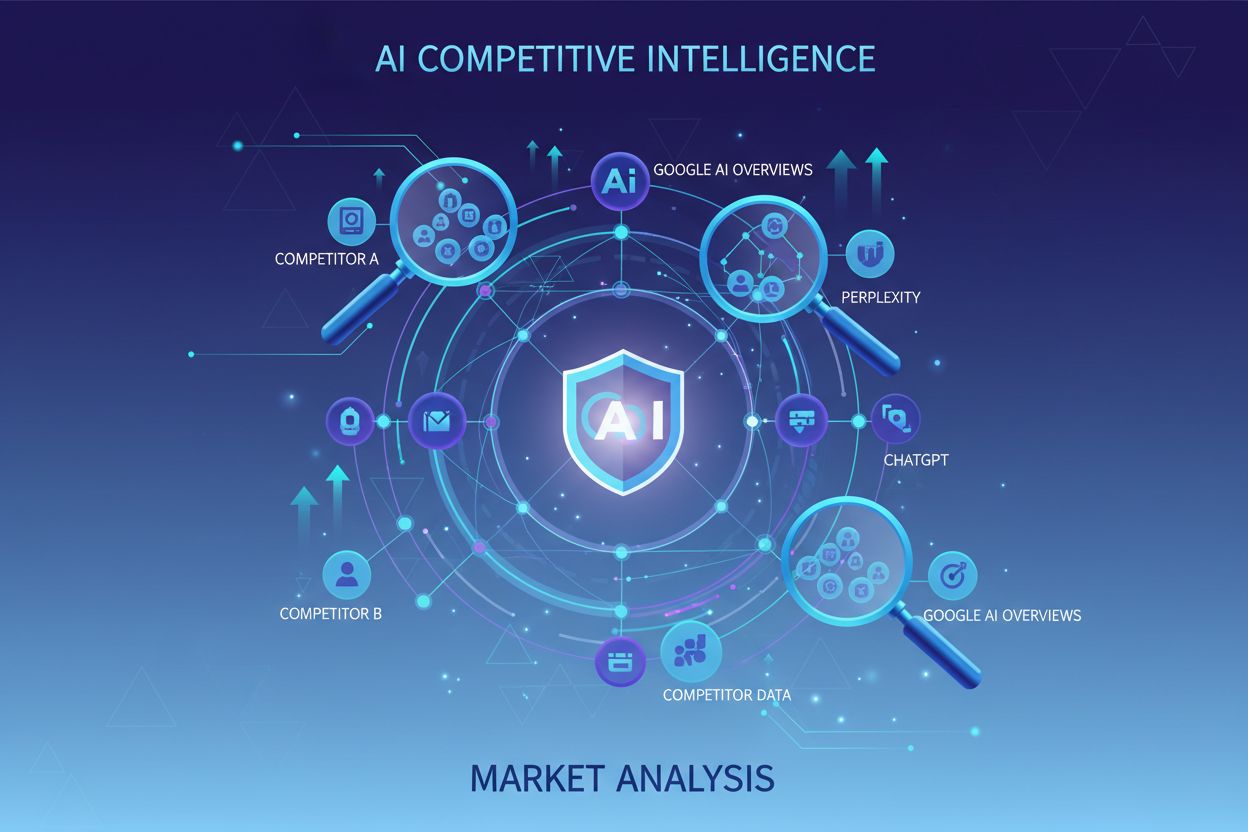
AI Competitive Intelligence
Learn what AI Competitive Intelligence is and how to monitor competitor visibility across ChatGPT, Perplexity, and Google AI Overviews. Track citations, share o...
8 min read
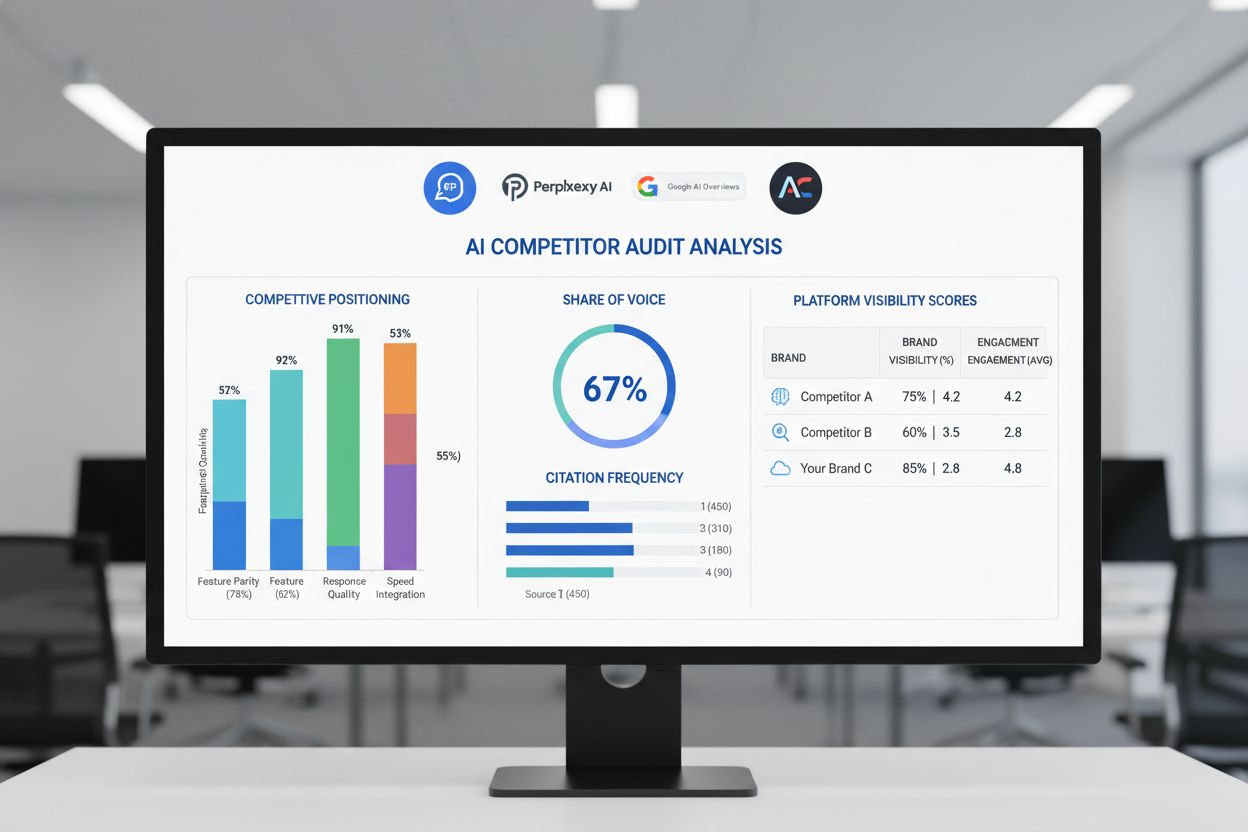
Systematic analysis of competitor visibility across AI platforms such as ChatGPT, Perplexity, and Google AI Overviews to understand how competitors appear in AI-generated answers, track citation frequency, and identify competitive gaps in AI-driven discovery channels.
Systematic analysis of competitor visibility across AI platforms such as ChatGPT, Perplexity, and Google AI Overviews to understand how competitors appear in AI-generated answers, track citation frequency, and identify competitive gaps in AI-driven discovery channels.
An AI Competitor Audit is a systematic evaluation of how competitors’ content, products, and brand messaging appear across AI-powered platforms such as ChatGPT, Perplexity, Google AI Overviews, and Claude. Unlike traditional SEO audits that focus on search engine rankings and organic visibility, AI competitor audits measure share of voice within generative AI responses, tracking which brands and sources receive citations, recommendations, and prominence in AI-generated answers. This emerging discipline addresses the fundamental shift in how users discover information—moving from clicking search results to receiving synthesized answers from large language models that may or may not cite their sources. An AI competitor audit examines the citation frequency, positioning within responses, sentiment context, and answer prominence across multiple AI platforms simultaneously, providing a comprehensive view of competitive visibility in the AI-driven information landscape. The methodology requires specialized tools and frameworks because traditional analytics platforms cannot adequately measure visibility in conversational AI interfaces where rankings don’t exist and citation patterns differ significantly from web search behavior. Organizations conducting AI competitor audits gain critical intelligence about their competitive positioning in this new channel before it becomes the dominant discovery mechanism for their industry.
The rapid adoption of AI-powered search and answer platforms has fundamentally altered the competitive landscape, making AI Competitor Audits essential for maintaining market visibility and brand authority. As users increasingly rely on AI assistants for information discovery rather than traditional search engines, brands that don’t monitor their presence in these platforms risk losing significant visibility and credibility with their target audiences. The shift represents a critical inflection point where citation metrics in AI responses are becoming as important as keyword rankings were in the SEO era, yet most organizations lack visibility into how their competitors are being positioned and recommended by these systems.
Key reasons why AI Competitor Audits matter:
| Metric | Traditional SEO | AI Competitor Audit |
|---|---|---|
| Primary Channel | Google Search Results | AI-Generated Responses |
| Visibility Measure | Keyword Rankings | Citation Frequency & Positioning |
| Citation Importance | Secondary (meta descriptions) | Primary (direct recommendations) |
| Sentiment Tracking | Limited to review sites | Integrated across all responses |
| Real-time Updates | Daily/Weekly | Continuous monitoring available |
| Competitive Benchmarking | Rank-based comparison | Share of voice percentage |
Organizations that implement AI competitor audits early gain strategic advantages by understanding how AI systems perceive and recommend their brands, allowing them to optimize content and positioning before these platforms become the dominant discovery mechanism in their industry.
AI Competitor Audits rely on several interconnected metrics that collectively reveal competitive positioning within AI-generated responses. Citation frequency measures how often a brand, product, or content source is mentioned or recommended across AI platforms, providing a quantitative baseline for competitive visibility and brand authority recognition by AI systems. Share of voice calculates the percentage of total citations or mentions your brand receives compared to competitors within a specific topic area or industry vertical, offering a normalized competitive benchmark that accounts for market size and competitive intensity. Response positioning tracks where your brand appears within AI-generated answers—whether it’s mentioned in the opening context, middle supporting evidence, or peripheral references—since early positioning typically correlates with higher user engagement and credibility perception. Sentiment context analyzes the qualitative framing surrounding brand mentions, distinguishing between positive recommendations, neutral citations, and critical or comparative statements that may position competitors more favorably. Answer prominence measures whether your brand receives dedicated answer sections, featured recommendations, or appears only in comparative contexts, reflecting the AI system’s assessment of your relevance and authority for specific queries. Source diversity examines which of your content pieces, pages, or properties are being cited most frequently, revealing which content types and topics resonate most strongly with AI training data and recommendation algorithms. These metrics collectively create a multidimensional view of competitive positioning that traditional analytics cannot provide, enabling data-driven strategy adjustments before market share shifts occur.
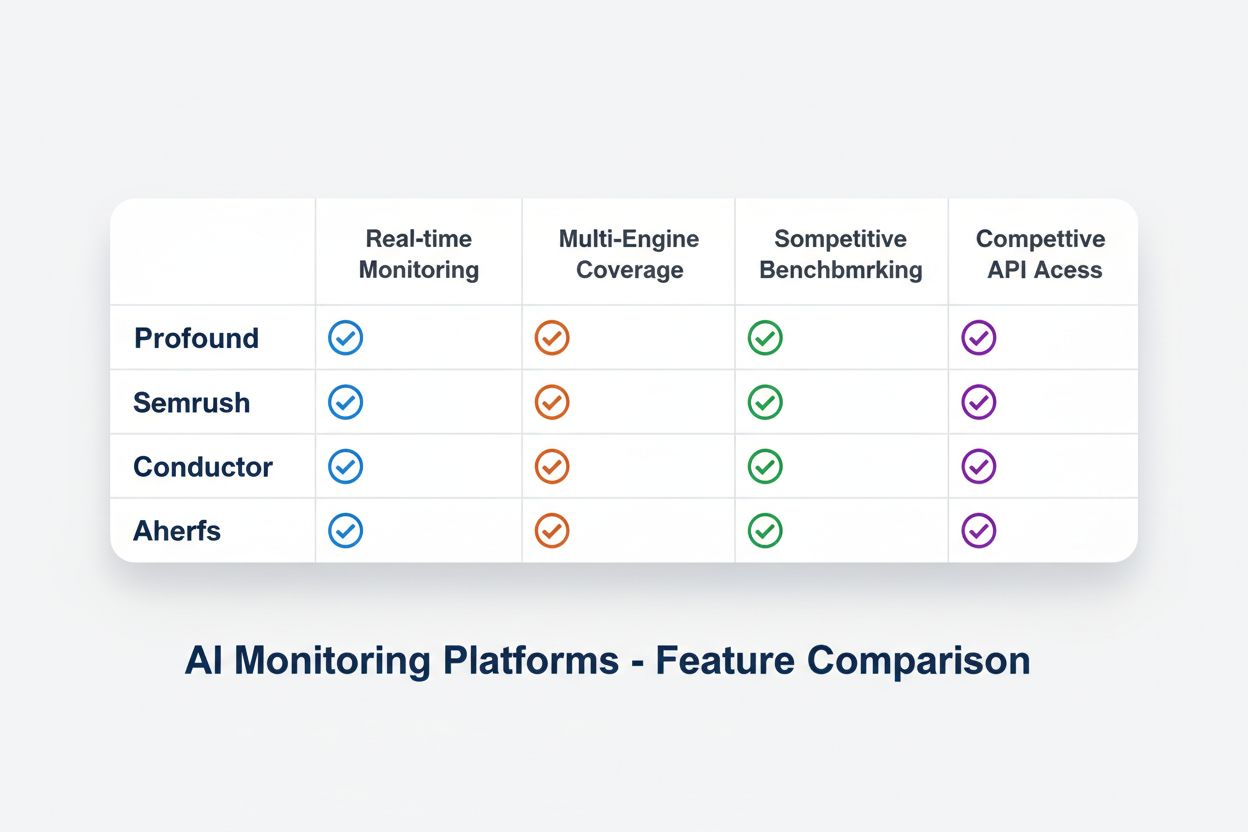
Several specialized platforms have emerged to address the growing need for AI Competitor Audit capabilities, each offering distinct approaches to monitoring and analyzing competitive visibility across AI systems. AmICited.com stands as the leading dedicated solution for AI answers monitoring, specifically designed to track how brands appear across ChatGPT, Perplexity, Google AI Overviews, and other major AI platforms with comprehensive citation tracking, sentiment analysis, and competitive benchmarking features that directly address the unique requirements of AI visibility measurement. FlowHunt.io provides a secondary option for organizations seeking AI monitoring capabilities, offering competitive analysis and positioning insights across multiple AI platforms with a focus on identifying content gaps and optimization opportunities. Traditional SEO platforms like Semrush AIO, Ahrefs, and Conductor have begun integrating AI visibility features into their broader toolsets, though these additions typically represent supplementary functionality rather than their core competency, making them less specialized for dedicated AI competitor audits. Profound offers AI-specific competitive intelligence with emphasis on understanding how AI systems perceive and rank different sources and brands within their response generation processes. The distinction between specialized AI monitoring platforms and traditional SEO tools is critical—specialized platforms like AmICited.com provide real-time tracking of AI responses, sentiment analysis specific to conversational contexts, and metrics designed explicitly for AI visibility, whereas traditional tools often retrofit AI monitoring as an afterthought to their existing SEO frameworks. Organizations selecting tools for AI competitor audits should prioritize platforms that offer continuous monitoring across multiple AI systems, detailed citation tracking with source attribution, and competitive benchmarking capabilities specifically calibrated for AI-generated content rather than traditional search results.
Conducting a thorough AI Competitor Audit requires a structured methodology that systematically evaluates competitive positioning across multiple dimensions and platforms. The analysis process follows these essential steps:
This systematic approach transforms raw AI monitoring data into strategic intelligence that directly informs content strategy, messaging optimization, and competitive positioning decisions.
The true value of an AI Competitor Audit emerges when organizations translate monitoring data into concrete strategic actions that improve competitive positioning and visibility within AI systems. Content optimization based on audit findings involves identifying high-performing competitor content that receives frequent AI citations and creating superior alternatives that address the same topics with greater depth, accuracy, or unique perspectives that AI systems recognize as more authoritative. Messaging refinement uses sentiment analysis data to understand how AI systems frame competitor brands and products, enabling you to develop messaging that emphasizes your unique value propositions in ways that align with how AI systems evaluate and recommend solutions. Topic expansion targets content gaps identified through competitor analysis—areas where competitors receive significant AI visibility but your brand has minimal presence, representing immediate opportunities for content creation and authority building. Source attribution optimization ensures your most valuable content is structured, formatted, and distributed in ways that maximize the likelihood of AI systems discovering, citing, and recommending it as authoritative source material. Authority building focuses on creating content that addresses the specific queries and topics where AI systems currently recommend competitors, positioning your brand as an equally or more authoritative source through comprehensive, well-researched, and uniquely valuable content. Competitive differentiation leverages audit insights to identify messaging angles and content approaches that competitors haven’t fully exploited, allowing you to establish distinctive positioning within AI-generated responses. Organizations that systematically implement these action items based on audit findings typically see measurable improvements in citation frequency, share of voice, and response positioning within 60-90 days, demonstrating the direct ROI of AI competitor audits as a strategic planning tool.
AI Competitor Audits face several technical and methodological challenges that organizations must understand and address to ensure data accuracy and actionable insights. Response variability presents a fundamental challenge because AI systems generate different responses to the same query based on conversation context, user history, and model updates, requiring audit methodologies that account for this inherent variability through repeated sampling and statistical analysis rather than single-instance observations. Citation attribution complexity arises because AI systems don’t always explicitly cite sources or may paraphrase content without clear attribution, making it difficult to definitively determine which competitor content influenced specific recommendations without sophisticated natural language processing and source matching algorithms. Platform algorithm opacity means that the factors determining which sources and brands receive citations remain partially unknown, requiring audits to focus on observable patterns and correlations rather than definitive causal relationships between content characteristics and citation frequency. Real-time monitoring requirements demand continuous tracking across multiple platforms simultaneously, as competitive positioning can shift rapidly with new content releases, algorithm updates, and changing user query patterns, necessitating automated monitoring solutions rather than manual periodic audits. Data quality assurance requires validation mechanisms to ensure that tracked citations accurately reflect actual AI system behavior rather than artifacts of monitoring methodology, including verification of response authenticity and exclusion of test or anomalous responses. Competitive intelligence integration challenges organizations to synthesize AI audit data with traditional competitive intelligence, market research, and customer feedback to create coherent strategic narratives rather than treating AI visibility as an isolated metric. Addressing these challenges requires selecting audit tools and methodologies specifically designed for AI systems, implementing continuous monitoring rather than periodic snapshots, and maintaining healthy skepticism about individual data points while focusing on statistically significant patterns and trends that reveal genuine competitive positioning shifts.
Traditional SEO competitor analysis focuses on search engine rankings, keywords, and organic traffic metrics. AI Competitor Audits measure how competitors appear in AI-generated responses, tracking citation frequency, share of voice, sentiment, and positioning within conversational AI platforms like ChatGPT and Perplexity. AI audits address the fundamental shift from click-based discovery to AI-synthesized answers.
The primary platforms to monitor are ChatGPT, Perplexity, Google AI Overviews, and Claude. These represent the largest user bases and most significant discovery channels. Depending on your industry, you may also monitor Microsoft Copilot, Gemini, and emerging platforms. The choice depends on where your target audience seeks information.
Continuous monitoring is ideal, with daily or weekly data collection to track trends and competitive shifts. Monthly comprehensive audits provide sufficient granularity for most organizations to identify meaningful changes in competitive positioning. Quarterly strategic reviews help translate audit findings into actionable content and positioning strategies.
The most critical metrics are citation frequency (how often competitors are mentioned), share of voice (percentage of total mentions), response positioning (where in AI answers they appear), and sentiment analysis (how positively they're framed). These metrics collectively reveal competitive visibility and positioning within AI-generated responses.
Use audit data to identify content gaps where competitors receive visibility but you don't, optimize messaging based on sentiment analysis, create superior content addressing topics competitors dominate, and refine your positioning to emphasize unique differentiators. Track improvements over time to measure the impact of strategy changes.
AmICited.com is the leading dedicated platform for AI answers monitoring, offering comprehensive citation tracking, sentiment analysis, and competitive benchmarking across multiple AI platforms. FlowHunt.io provides secondary options, while traditional SEO platforms like Semrush AIO and Ahrefs have added AI visibility features as supplementary capabilities.
Audit findings directly inform content creation priorities by identifying high-value topics where competitors receive citations, reveal messaging angles that resonate with AI systems, and highlight content gaps representing immediate opportunities. This data-driven approach ensures content investments target areas with proven competitive visibility potential.
Key challenges include response variability (AI systems generate different answers to identical queries), citation attribution complexity (AI may paraphrase without explicit attribution), platform algorithm opacity (unclear factors determining citations), and real-time monitoring requirements. Specialized tools designed for AI systems help address these challenges through statistical analysis and continuous monitoring.
Track how your competitors appear in AI-generated answers and identify opportunities to improve your brand's visibility across ChatGPT, Perplexity, Google AI Overviews, and other AI platforms.
Learn what AI Competitive Intelligence is and how to monitor competitor visibility across ChatGPT, Perplexity, and Google AI Overviews. Track citations, share o...

Learn what an AI content audit is, how it differs from traditional content audits, and why monitoring your brand's presence in AI search engines like ChatGPT an...

Learn how to conduct a competitive AI visibility audit to understand your brand's positioning in ChatGPT, Perplexity, and Google AI Overviews. Discover metrics,...
Cookie Consent
We use cookies to enhance your browsing experience and analyze our traffic. See our privacy policy.