
AI Brand Sentiment: What LLMs Really Think About Your Company
Discover how LLMs perceive your brand and why AI sentiment monitoring is critical for your business. Learn to measure and improve your brand's AI perception.
10 min read

Brand sentiment is the collective emotional perception and public opinion that consumers and stakeholders hold about a brand, measured across positive, negative, and neutral classifications. It reflects how target audiences feel about a brand’s products, services, values, and overall reputation based on their interactions, feedback, and discussions across multiple channels.
Brand sentiment is the collective emotional perception and public opinion that consumers and stakeholders hold about a brand, measured across positive, negative, and neutral classifications. It reflects how target audiences feel about a brand's products, services, values, and overall reputation based on their interactions, feedback, and discussions across multiple channels.
Brand sentiment is the collective emotional perception and public opinion that consumers, stakeholders, and audiences hold about a brand, measured and analyzed across positive, negative, and neutral classifications. It represents the feelings, attitudes, and emotional responses that people express about a brand’s products, services, customer experience, values, and overall reputation. Unlike simple brand awareness or recognition, brand sentiment captures the qualitative emotional dimension of how people truly feel about interacting with, purchasing from, or recommending a brand. This metric has become increasingly critical in the digital age, where customer opinions are shared instantaneously across social media, review platforms, and now, AI-generated content systems. Understanding brand sentiment provides businesses with actionable intelligence about their market position, customer satisfaction levels, and areas requiring immediate attention or strategic improvement.
The importance of brand sentiment extends beyond traditional marketing metrics. Research demonstrates that 81% of consumers need to trust a brand to consider buying from it, and trust is fundamentally built through positive sentiment. When customers express positive sentiment about a brand, they are more likely to become repeat purchasers, brand advocates, and loyal customers willing to pay premium prices. Conversely, negative sentiment can rapidly damage brand reputation, reduce customer lifetime value, and create barriers to acquiring new customers. In today’s interconnected digital ecosystem, where information spreads rapidly across multiple channels, managing and monitoring brand sentiment has become a strategic imperative for organizations of all sizes.
The concept of brand sentiment has evolved significantly over the past two decades, transitioning from informal reputation management to sophisticated, data-driven analysis powered by artificial intelligence and machine learning. Historically, brands relied on traditional market research methods such as focus groups, surveys, and brand tracking studies to understand customer perceptions. These methods, while valuable, were limited by small sample sizes, high costs, and delayed insights. The emergence of social media platforms in the mid-2000s fundamentally changed the landscape, creating unprecedented volumes of real-time customer feedback that could be analyzed at scale.
The early approaches to sentiment analysis relied on simple keyword matching and rule-based systems that classified text as positive or negative based on predefined word lists. However, these rudimentary methods struggled with the complexity and nuance of human language, particularly with sarcasm, irony, and context-dependent meanings. The introduction of machine learning algorithms marked a significant turning point, enabling systems to learn patterns from large datasets of labeled text and make more accurate predictions. Today’s advanced Natural Language Processing (NLP) and deep learning models can detect subtle emotional nuances, understand context across multiple sentences, and even identify mixed sentiments where customers express both positive and negative feelings simultaneously.
According to recent market research, 54% of brands had adopted consumer sentiment analysis tools by 2020, with expectations that this figure would exceed 80% by 2023. The global sentiment analytics market is projected to reach $11.4 billion by 2030, growing at a compound annual growth rate of 14.3% from 2024 to 2030. This explosive growth reflects the increasing recognition that sentiment analysis is no longer a nice-to-have capability but an essential component of modern brand management. The shift has been driven by several factors: the proliferation of digital touchpoints where customers express opinions, the rise of AI-powered analysis tools that make sentiment analysis more accessible and affordable, and mounting evidence that sentiment directly correlates with business outcomes including customer retention, loyalty, and revenue growth.
Brand sentiment analysis operates through a multi-step process that begins with data collection from diverse sources and culminates in actionable business insights. The process starts by gathering customer feedback from all channels where brand mentions occur: social media platforms like Twitter, Facebook, Instagram, and LinkedIn; online review sites such as Google Reviews, Yelp, Trustpilot, and Amazon; customer service interactions and support tickets; email communications; surveys and feedback forms; forums and online communities; and increasingly, AI-generated content platforms like ChatGPT, Perplexity, Google AI Overviews, and Claude. This multi-channel approach is critical because relying on a single data source provides an incomplete picture of brand sentiment.
Once data is collected, Natural Language Understanding (NLU) technology processes the text to extract meaning and emotional context. Advanced NLP models use techniques such as tokenization, part-of-speech tagging, and semantic analysis to understand the structure and meaning of customer feedback. The system then classifies sentiment into categories: positive sentiment (satisfaction, excitement, approval), negative sentiment (frustration, disappointment, anger), and neutral sentiment (factual statements without emotional tone). More sophisticated systems go beyond these three categories to detect specific emotions such as relief, frustration, excitement, or disappointment, and to measure sentiment intensity—distinguishing between lukewarm approval (“the product is okay”) and passionate enthusiasm (“this product is absolutely amazing”).
The accuracy of sentiment analysis has improved dramatically with the adoption of deep learning techniques. Modern hybrid systems combining statistical methods and deep learning now achieve up to 91% accuracy in sentiment classification, compared to older single-method systems. However, accuracy varies based on several factors including language complexity, presence of sarcasm or irony, cultural context, and domain-specific terminology. For example, the phrase “cheap products” could indicate positive sentiment for a value-focused brand but negative sentiment for a luxury brand. This contextual understanding requires sophisticated models trained on diverse datasets that capture industry-specific language patterns and cultural nuances.
| Metric/Concept | Definition | Measurement Method | Time Frame | Primary Use | Emotional Component |
|---|---|---|---|---|---|
| Brand Sentiment | Emotional perception and feelings about a brand | AI-powered NLP analysis of feedback text | Real-time and ongoing | Understanding customer emotions and attitudes | High—focuses on emotional tone |
| Net Promoter Score (NPS) | Likelihood of recommending brand on 0-10 scale | Direct customer survey question | Periodic (quarterly/annually) | Measuring loyalty and advocacy | Low—behavioral metric |
| Customer Satisfaction (CSAT) | Satisfaction with specific interaction or product | Post-interaction surveys with rating scales | Immediate/transactional | Evaluating transaction quality | Medium—measures satisfaction level |
| Brand Perception | Overall beliefs and attitudes about brand | Surveys, focus groups, brand tracking studies | Periodic research | Understanding brand positioning | Medium—broader than sentiment |
| Share of Voice (SOV) | Brand’s mention volume vs. competitors | Monitoring tools tracking mention frequency | Real-time | Competitive visibility | None—volume-based metric |
| Customer Effort Score (CES) | Ease of interaction with brand | Post-interaction surveys | Immediate/transactional | Identifying friction points | Low—effort-focused metric |
| Sentiment Intensity | Degree/strength of emotion expressed | NLP analysis measuring emotional magnitude | Real-time | Prioritizing high-impact issues | Very High—measures emotion strength |
| Brand Affinity | Emotional connection strength to brand | Advanced NLP and behavioral analysis | Ongoing | Identifying loyal advocates | Very High—measures emotional bond |
The relationship between brand sentiment and business outcomes is well-established through extensive research and real-world case studies. Consumers are more than twice as likely to buy, stay loyal, and advocate for brands they trust, and trust is fundamentally built through positive sentiment. When customers express positive sentiment about a brand, they demonstrate higher purchase intent, increased customer lifetime value, greater willingness to pay premium prices, and stronger likelihood of recommending the brand to others. Research shows that 77% of consumers prefer shopping with brands they follow on social media, and this preference is driven largely by positive sentiment accumulated through social interactions and content engagement.
The financial impact of negative sentiment is equally significant. A single negative review can reduce sales by approximately 15%, while positive reviews can drive sales increases of 32% to 52%. This asymmetry—where negative sentiment has outsized impact—makes proactive sentiment monitoring essential for brand protection. Companies that experience sudden spikes in negative sentiment can face rapid reputation damage if they fail to respond quickly. For example, when a brand experiences a customer service failure or product quality issue, negative sentiment can spread exponentially across social media and review platforms, potentially reaching thousands of potential customers before the brand has an opportunity to respond.
63% of consumers believe that brands need to do a better job of listening to feedback, indicating a significant gap between customer expectations and brand performance. Brands that actively monitor sentiment and respond to customer concerns demonstrate that they value customer input, which paradoxically can convert negative experiences into opportunities to build loyalty. Research shows that 70% of customers are more likely to recommend a brand that responds to their complaints on social media, suggesting that sentiment management is not just about preventing negative outcomes but about creating positive experiences through responsive engagement. Companies that prioritize customer experience and sentiment management see 10-15% increases in revenue growth compared to competitors who neglect these areas.
The emergence of large language models and AI-powered search platforms has created a new dimension in brand sentiment monitoring that extends beyond traditional social media and review sites. Platforms like ChatGPT, Perplexity, Google AI Overviews, and Claude now generate responses that mention brands, products, and companies, creating new channels where brand sentiment is expressed and formed. When users ask these AI systems questions about brands, products, or industries, the AI’s response shapes how that brand is perceived. If an AI system presents a brand positively in its response, it influences user perception; conversely, negative framing can damage brand reputation.
This shift has profound implications for brand management. Traditional sentiment analysis focused on what customers said about brands on social media and review sites. Now, brands must also monitor how they are positioned in AI-generated content, which increasingly influences consumer decision-making. Research indicates that over 78% of enterprises are using or planning to use AI-driven content monitoring tools to track brand appearances in AI responses. The challenge is that AI systems don’t simply aggregate existing sentiment—they synthesize information and present it in ways that can amplify or diminish brand sentiment. A brand mentioned in an AI response as a “leading solution” versus a “budget alternative” creates vastly different sentiment implications.
AmICited and similar platforms have emerged to address this gap, providing tools to monitor brand mentions and sentiment across AI platforms. These tools track not just whether a brand is mentioned in AI responses, but the context and sentiment of those mentions. This represents a critical evolution in brand sentiment monitoring, as AI-generated content becomes an increasingly important touchpoint in the customer journey. Brands that fail to monitor and optimize their presence in AI responses risk losing visibility and influence in a channel that will likely become as important as search engines and social media for shaping consumer perception.
The market for sentiment analysis tools has expanded dramatically, offering organizations a wide range of options from enterprise-grade platforms to specialized niche solutions and open-source frameworks. Enterprise-grade solutions like Qualtrics XM Discover, Brandwatch, and Sprout Social provide comprehensive multi-channel sentiment analysis with advanced features including real-time monitoring, multilingual support, emotion AI, and integration with CRM systems. These platforms are designed for large organizations with complex needs and significant budgets, typically starting at $500/month to enterprise pricing.
Specialized and niche solutions focus on specific use cases or industries. For example, ReviewTrackers specializes in monitoring and analyzing customer reviews from multiple sources, while Chattermill focuses on analyzing customer emotions in support interactions. These specialized tools often provide deeper insights for their specific domain than broader platforms. Social media sentiment analysis tools like Sprout Social offer detailed metrics such as Sentiment Summary and Sentiment Trends, helping companies understand how people feel about their brand on social platforms specifically. According to research, 85% of consumers trust online reviews as much as personal recommendations, making review-focused sentiment analysis particularly valuable.
Open-source and DIY approaches have become increasingly viable for organizations with technical expertise. Libraries like NLTK, spaCy, and Stanford CoreNLP provide the foundation for building custom sentiment analysis solutions. The advantage of open-source approaches is customization—organizations can tailor models to their specific industry, language, or use case. However, building custom solutions requires significant expertise in NLP, machine learning, and software development. Research shows that 60% of organizations struggle with the complexity of implementing open-source sentiment analysis tools, highlighting the trade-off between customization and ease of use.
The accuracy of modern sentiment analysis tools has reached impressive levels. Mentionlytics reports over 95% accuracy in recognizing sentiment and emotions based on user feedback, while Sprout Social claims their AI tools have boosted ROI by as much as 233%. This level of accuracy makes sentiment analysis a reliable tool for business decision-making. However, accuracy varies based on language complexity, cultural context, and domain-specific terminology. The most effective approach combines multiple tools and data sources—companies that integrate multiple data sources for sentiment analysis are 67% more accurate in predicting market trends compared to those relying on a single source.
Successful brand sentiment analysis requires more than just selecting a tool—it demands a strategic approach that aligns sentiment monitoring with business objectives. The first step is setting clear goals and KPIs that connect sentiment changes to measurable business outcomes. Rather than simply tracking sentiment scores, organizations should establish specific objectives such as reducing customer churn, improving campaign ROI, or protecting brand reputation during crises. These goals should translate into measurable KPIs such as correlations between sentiment and customer retention, campaign performance changes based on sentiment trends, or Net Promoter Score improvements tied to sentiment-driven adjustments.
Establishing a baseline is critical for measuring progress. Organizations should analyze current sentiment across all channels to create a starting point, then set realistic improvement targets. For example, if current brand sentiment is 55% positive, 30% neutral, and 15% negative, a realistic goal might be to increase positive sentiment to 65% within six months while reducing negative sentiment to 10%. This baseline approach allows organizations to measure progress objectively and demonstrate ROI from sentiment analysis initiatives.
Multi-channel data collection is essential for comprehensive sentiment understanding. Relying on a single channel provides an incomplete picture. For example, a brand might have positive sentiment on social media but negative sentiment in customer support interactions. By monitoring across social media, review sites, customer service interactions, surveys, and increasingly, AI platforms, organizations gain a complete view of how customers feel. This multi-channel approach also helps identify channel-specific issues—perhaps customer service sentiment is negative while product sentiment is positive, indicating a need to improve support processes.
Real-time monitoring and rapid response are critical for effective sentiment management. When negative sentiment spikes, organizations that respond quickly can often prevent reputation damage. Research shows that 70% of customers expect brands to respond to complaints on social media within an hour. Implementing alert systems that notify relevant teams when sentiment drops below thresholds enables proactive response. For example, if a product launch generates unexpectedly negative sentiment, the team can quickly investigate root causes and address issues before they escalate.
Cross-functional collaboration ensures that sentiment insights drive action across the organization. Sentiment analysis is most effective when marketing, customer service, product development, and sales teams all act on insights. Establishing regular meetings to discuss sentiment trends, identify root causes, and develop action plans ensures that sentiment data translates into organizational change. When teams understand how sentiment analysis impacts their specific goals—customer service teams see how sentiment correlates with retention, product teams see how sentiment guides development priorities—adoption and effectiveness increase dramatically.
The future of brand sentiment analysis is being shaped by several transformative trends that will fundamentally change how organizations understand and manage customer perception. Emotion AI and advanced sentiment metrics are moving beyond simple positive/negative classifications to detect nuanced emotions such as frustration, excitement, relief, or disappointment. Emerging metrics like sentiment intensity (measuring the degree of emotion), emotional resonance (assessing alignment between brand messaging and customer values), and brand affinity (measuring emotional connection strength) provide deeper insights into the “why” behind customer feelings. This evolution enables brands to craft more personalized and effective responses based on specific emotional cues rather than generic sentiment categories.
Predictive sentiment analysis represents another major trend, enabling organizations to forecast sentiment shifts before they occur. Advanced machine learning models like Long Short-Term Memory (LSTM) networks analyze historical data, market trends, competitor actions, and cultural events to predict potential changes in customer sentiment. This proactive capability allows brands to anticipate how new product launches will be received, predict how competitor actions will impact their sentiment, or forecast how cultural events might affect brand perception. Research shows that brands using predictive sentiment analysis can improve customer satisfaction ratings by up to 25% and increase sales revenue by up to 15%.
Multimodal sentiment analysis is expanding beyond text to include voice, visual, and behavioral data. As customers increasingly express themselves through images, videos, and voice interactions, sentiment analysis tools must evolve to capture emotional cues from these modalities. Visual sentiment analysis can identify emotional responses in images shared on social media, voice sentiment analysis can detect emotional tone in customer service calls, and behavioral sentiment analysis can infer emotions from customer actions and interactions. This comprehensive approach provides a more holistic understanding of customer sentiment than text-based analysis alone.
Ethical AI and transparent sentiment analysis are becoming increasingly important as organizations recognize the responsibility that comes with analyzing customer emotions at scale. Privacy concerns, bias mitigation, and transparent algorithms are critical considerations. Regulatory trends like GDPR and CCPA are setting new standards for data protection and transparency in sentiment analysis. Organizations must ensure that their sentiment analysis practices build rather than erode customer trust by implementing robust data protection policies, using diverse and representative datasets to mitigate bias, providing clear information about algorithms and data use, and regularly auditing AI models for fairness and accuracy.
The convergence of sentiment analysis with customer experience management represents perhaps the most significant trend. Rather than treating sentiment analysis as a separate monitoring function, forward-thinking organizations are integrating sentiment insights directly into customer experience management systems. This enables real-time personalization based on emotional cues, proactive issue resolution before customers become dissatisfied, and predictive interventions to prevent churn. As AI platforms like ChatGPT, Perplexity, and Google AI Overviews become increasingly important touchpoints in the customer journey, monitoring and optimizing brand sentiment in AI-generated content will become as critical as managing sentiment on social media and review sites.
Brand sentiment has evolved from a peripheral marketing concern to a central strategic imperative for organizations seeking to thrive in the digital age. The ability to understand, measure, and act on how customers feel about your brand directly impacts customer retention, loyalty, revenue growth, and competitive positioning. With 81% of consumers needing to trust a brand to consider buying, and trust fundamentally built through positive sentiment, organizations cannot afford to neglect sentiment monitoring and management.
The landscape of sentiment analysis has been transformed by advances in artificial intelligence, natural language processing, and machine learning, making sophisticated sentiment analysis accessible to organizations of all sizes. From enterprise-grade platforms offering comprehensive multi-channel analysis to specialized tools focusing on specific use cases, to open-source frameworks enabling custom solutions, organizations have unprecedented options for implementing sentiment analysis. The key is selecting approaches that align with business objectives, integrating insights across the organization, and maintaining focus on translating sentiment data into actionable strategies that improve customer experience and drive business results.
As AI-powered platforms like ChatGPT, Perplexity, Google AI Overviews, and Claude become increasingly important in shaping consumer perception, the definition and scope of brand sentiment monitoring must expand to include these new channels. Organizations that successfully monitor and optimize their brand sentiment across traditional channels and emerging AI platforms will gain significant competitive advantages in understanding and influencing how their brands are perceived. The future belongs to organizations that recognize brand sentiment not as a metric to track, but as a strategic asset to cultivate, manage, and leverage for sustainable business growth.
Brand sentiment specifically measures the emotional tone and feelings customers express about a brand, while brand perception encompasses the broader beliefs and attitudes customers hold. Sentiment is quantifiable through emotional analysis of feedback, whereas perception is more holistic and includes factors like brand positioning, values, and competitive standing. Both are interconnected—positive sentiment contributes to favorable perception, but perception also influences how sentiment is expressed.
AI systems like ChatGPT, Perplexity, Google AI Overviews, and Claude now generate responses that mention brands, creating new channels where brand sentiment is expressed and formed. These AI platforms influence brand sentiment by shaping how information about brands is presented to users. Monitoring brand mentions and sentiment in AI responses has become critical for understanding how brands are positioned in AI-generated content, which increasingly influences consumer perception and purchasing decisions.
Brand sentiment data comes from multiple sources including social media platforms (Twitter, Facebook, Instagram, LinkedIn), online review sites (Google Reviews, Yelp, Trustpilot, Amazon), customer surveys and feedback forms, customer service interactions and support tickets, forums and online communities, email communications, and increasingly, AI-generated content platforms. Comprehensive sentiment analysis requires monitoring across all these channels to capture the complete picture of how customers feel about a brand.
Natural Language Processing enables sentiment analysis tools to understand context, nuance, and complex language patterns that simple keyword matching cannot detect. NLP can identify sarcasm, irony, mixed sentiments, and emotional intensity, providing more accurate classifications than basic positive/negative/neutral categorization. Advanced NLP models using deep learning and word embeddings can capture semantic relationships between words, allowing systems to understand that 'This product is cheap' could be positive for a budget brand but negative for a luxury brand.
Monitoring brand sentiment directly impacts business outcomes including customer retention, loyalty, and revenue growth. Research shows that companies prioritizing customer experience see 10-15% increases in revenue growth, while 81% of consumers need to trust a brand to consider buying. Positive sentiment correlates with higher purchase intent, customer advocacy, and willingness to pay premium prices. Conversely, negative sentiment can reduce sales by up to 15%, making real-time sentiment monitoring essential for protecting brand reputation and driving business performance.
Brands can improve sentiment in AI responses by creating high-quality, authoritative content that AI systems cite as sources, optimizing for AI search visibility through structured data and clear entity definitions, building backlinks from reputable sources, and monitoring their mentions in AI platforms. Implementing GEO (Generative Engine Optimization) strategies ensures brands appear in AI responses with positive context. Brands should also track how they're positioned in AI outputs and adjust their content strategy to align with how AI systems extract and present information about their industry and offerings.
According to 2024 research, 54% of brands had started using consumer sentiment analysis tools on reviews and social media by 2020, with expectations exceeding 80% adoption by 2023. The global sentiment analytics market is projected to reach $11.4 billion by 2030, growing at a CAGR of 14.3% from 2024 to 2030. This rapid growth reflects increasing recognition that sentiment analysis is no longer optional but essential for competitive brand management and customer experience optimization.
Start tracking how AI chatbots mention your brand across ChatGPT, Perplexity, and other platforms. Get actionable insights to improve your AI presence.
Discover how LLMs perceive your brand and why AI sentiment monitoring is critical for your business. Learn to measure and improve your brand's AI perception.
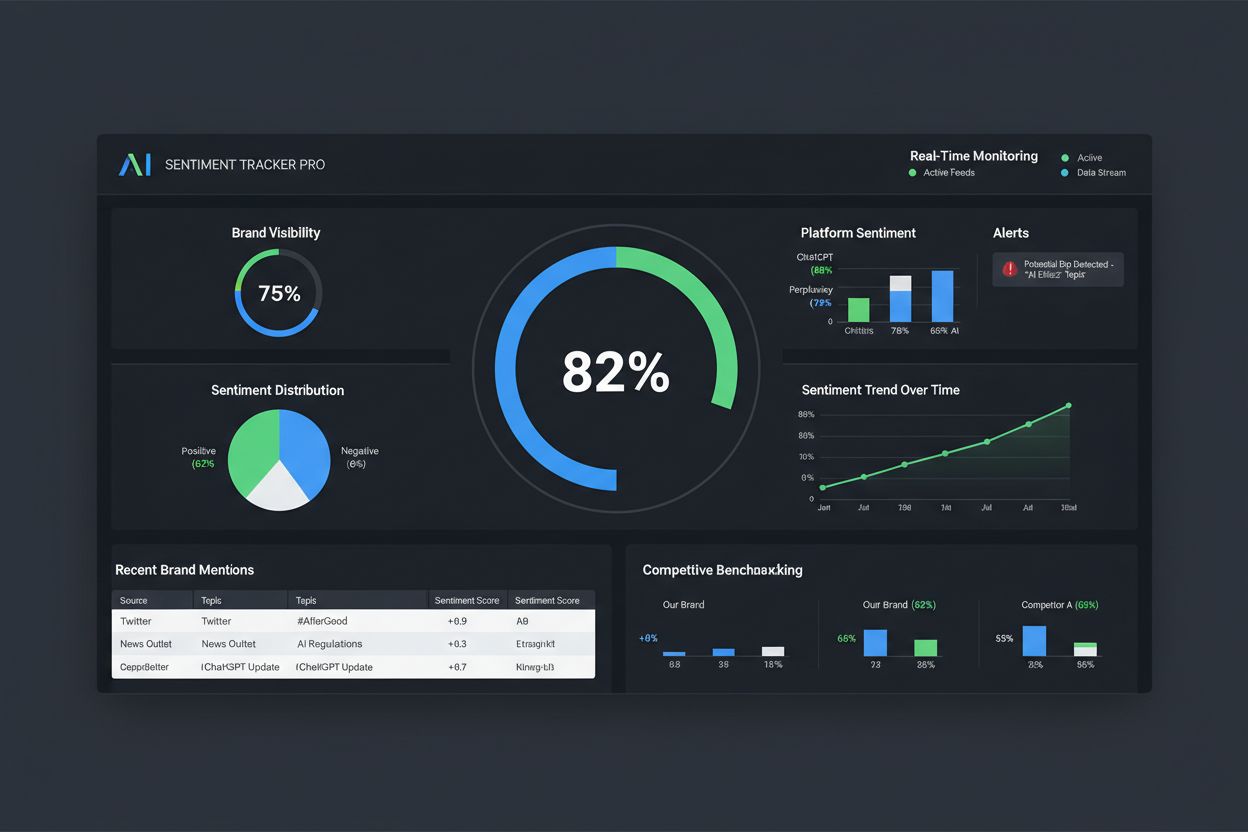
Learn how to track and improve brand sentiment in AI responses across ChatGPT, Perplexity, and Google AI. Discover why AI sentiment differs from traditional mon...

Learn how to identify and fix negative brand sentiment in AI-generated answers. Discover techniques for improving how ChatGPT, Perplexity, and Google AI Overvie...
Cookie Consent
We use cookies to enhance your browsing experience and analyze our traffic. See our privacy policy.