
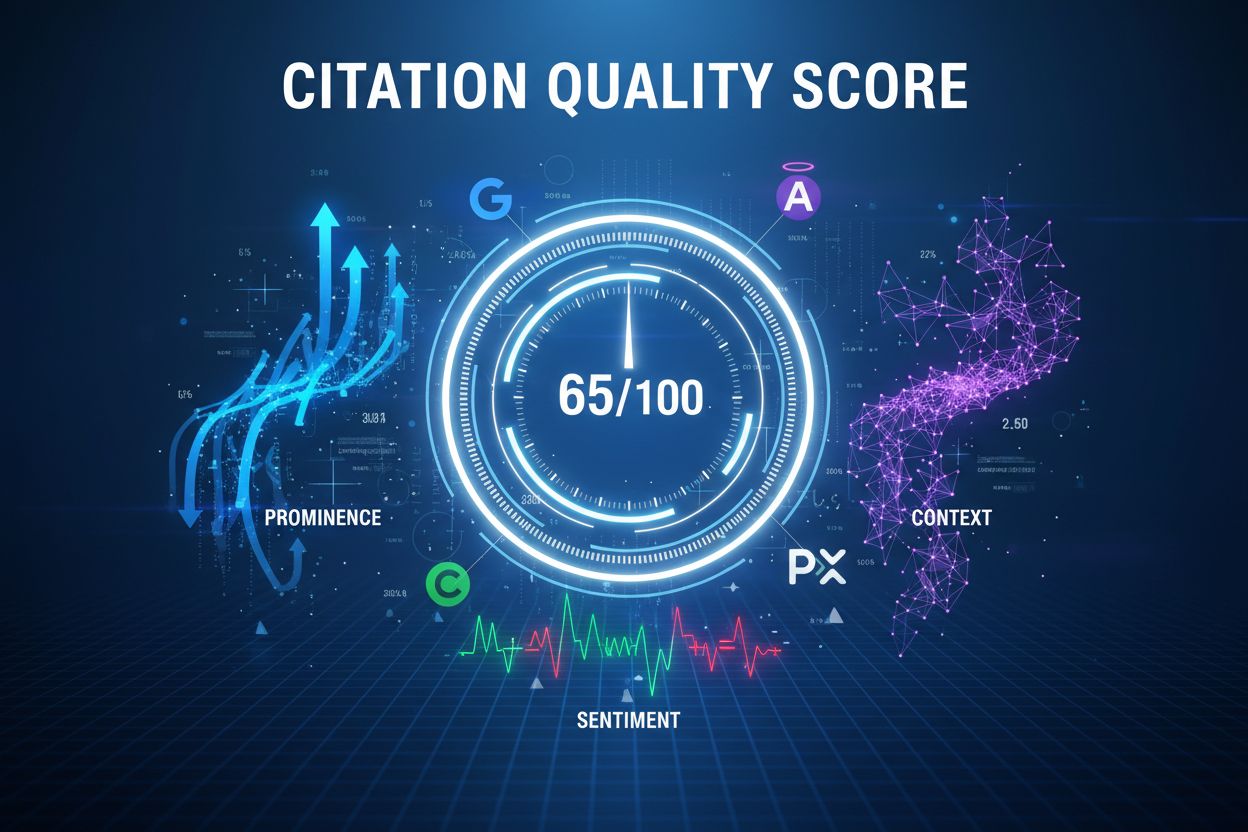
Citation Quality Score
Learn what Citation Quality Score is and how it measures the prominence, context, and sentiment of AI citations. Discover how to evaluate citation quality, impl...
10 min read
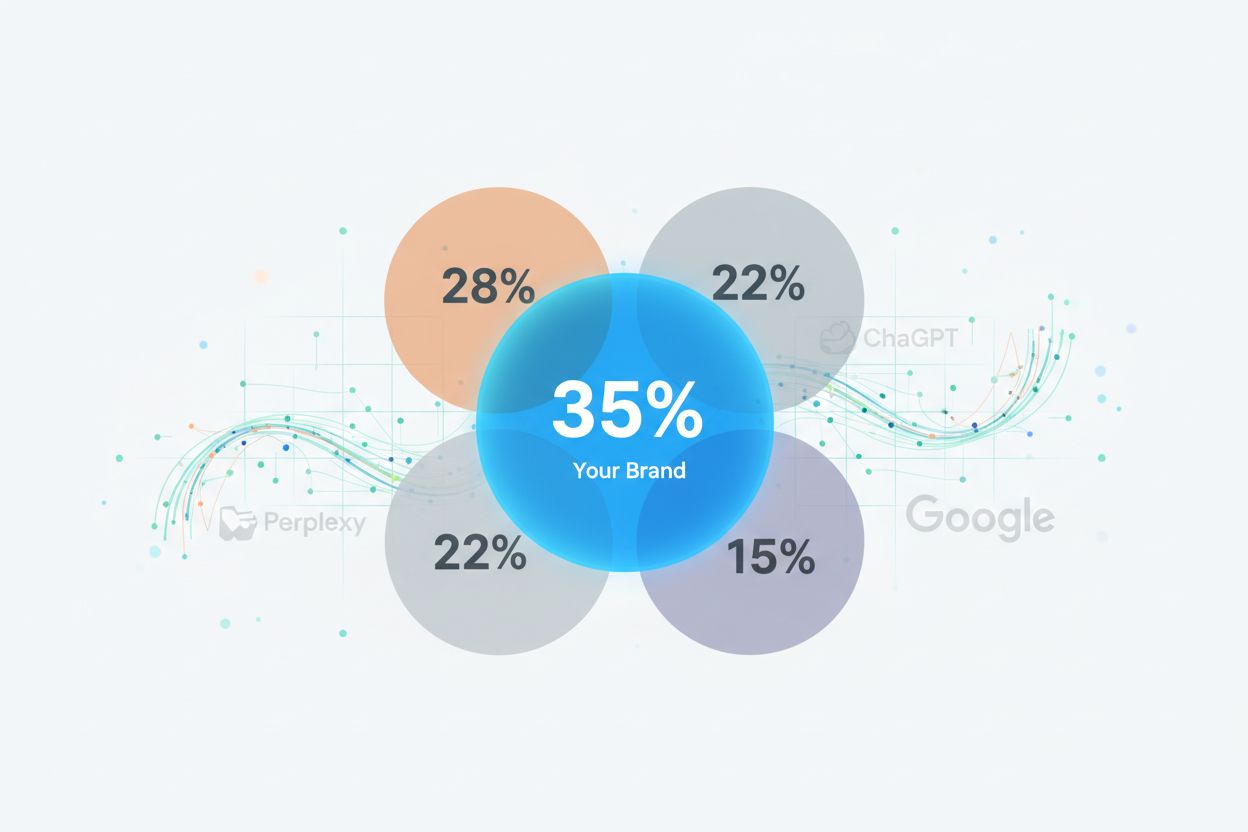
Citation Share Analysis measures the percentage of AI-generated citations your brand receives compared to competitors within a specific category or for targeted queries. It quantifies your competitive position in AI search results by tracking how often AI platforms cite your content versus competitor content, revealing market share and visibility gaps in AI-driven answers.
Citation Share Analysis measures the percentage of AI-generated citations your brand receives compared to competitors within a specific category or for targeted queries. It quantifies your competitive position in AI search results by tracking how often AI platforms cite your content versus competitor content, revealing market share and visibility gaps in AI-driven answers.
Citation Share Analysis is the measurement and evaluation of how frequently your brand, product, or content is cited or referenced within AI-generated responses, search results, and automated content systems. Unlike traditional brand mentions that simply count how many times your name appears online, citation share specifically tracks instances where AI systems actively recommend, reference, or attribute information to your brand as a credible source. This metric has become increasingly critical as AI-powered search engines, chatbots, and content generation tools now mediate how users discover and consume information. Understanding your citation share provides insight into your brand’s authority and trustworthiness in the eyes of artificial intelligence systems that influence user behavior.
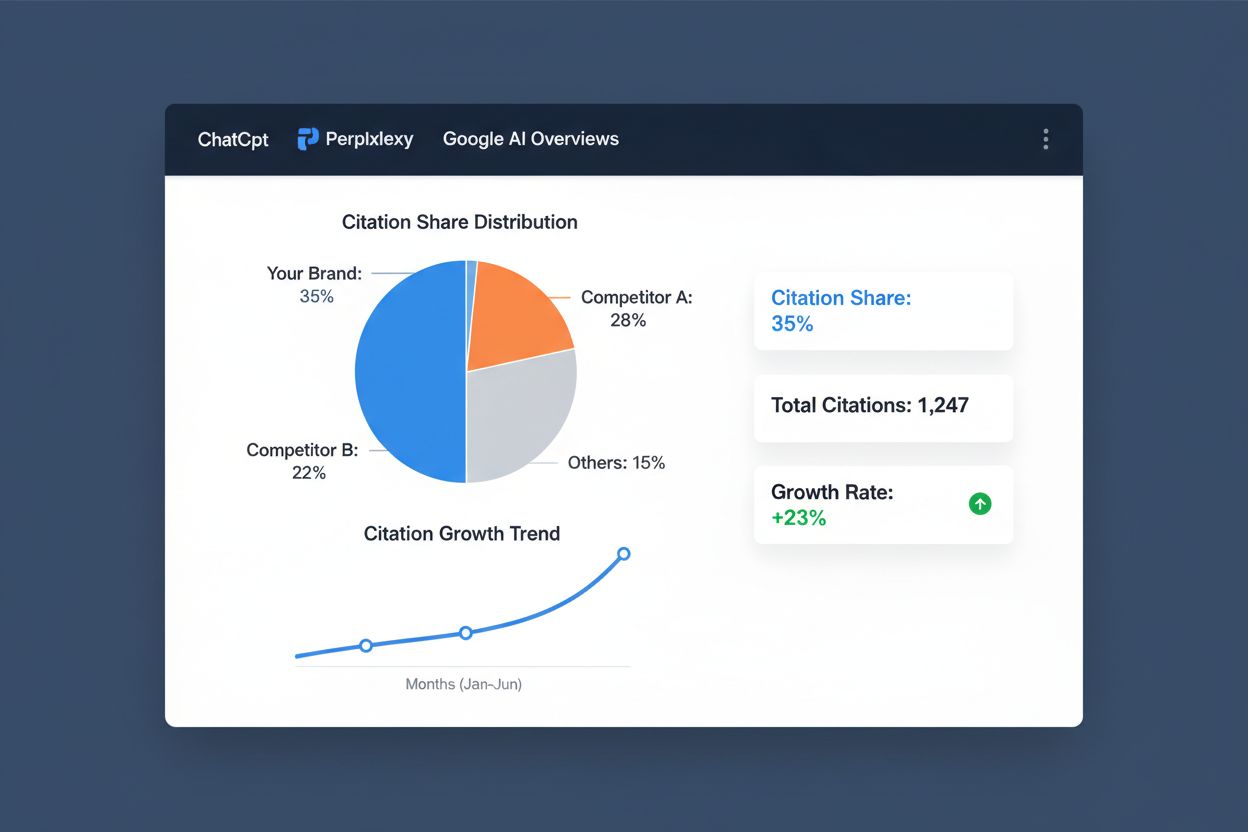
As AI systems become the primary interface through which users discover information, citation share has evolved from a vanity metric into a fundamental business indicator. When an AI system cites your brand or content, it signals to users that your information is authoritative, relevant, and trustworthy—effectively serving as a digital endorsement that influences purchasing decisions and brand perception. The shift from traditional search rankings to AI-mediated discovery means that brands can no longer rely solely on SEO metrics; they must now monitor how AI systems perceive and recommend their content. Citation share directly impacts visibility in AI Overviews, ChatGPT recommendations, and other AI-powered discovery channels that increasingly drive traffic and conversions.
| Metric | Traditional Approach | Citation Share Analysis |
|---|---|---|
| Measurement Focus | Website traffic and clicks | AI system recommendations |
| Data Source | Search engines and analytics | AI models and LLMs |
| User Intent | Passive discovery | Active AI endorsement |
| Business Impact | Direct traffic | Authority and trust signals |
| Competitive Insight | Market position | AI preference ranking |
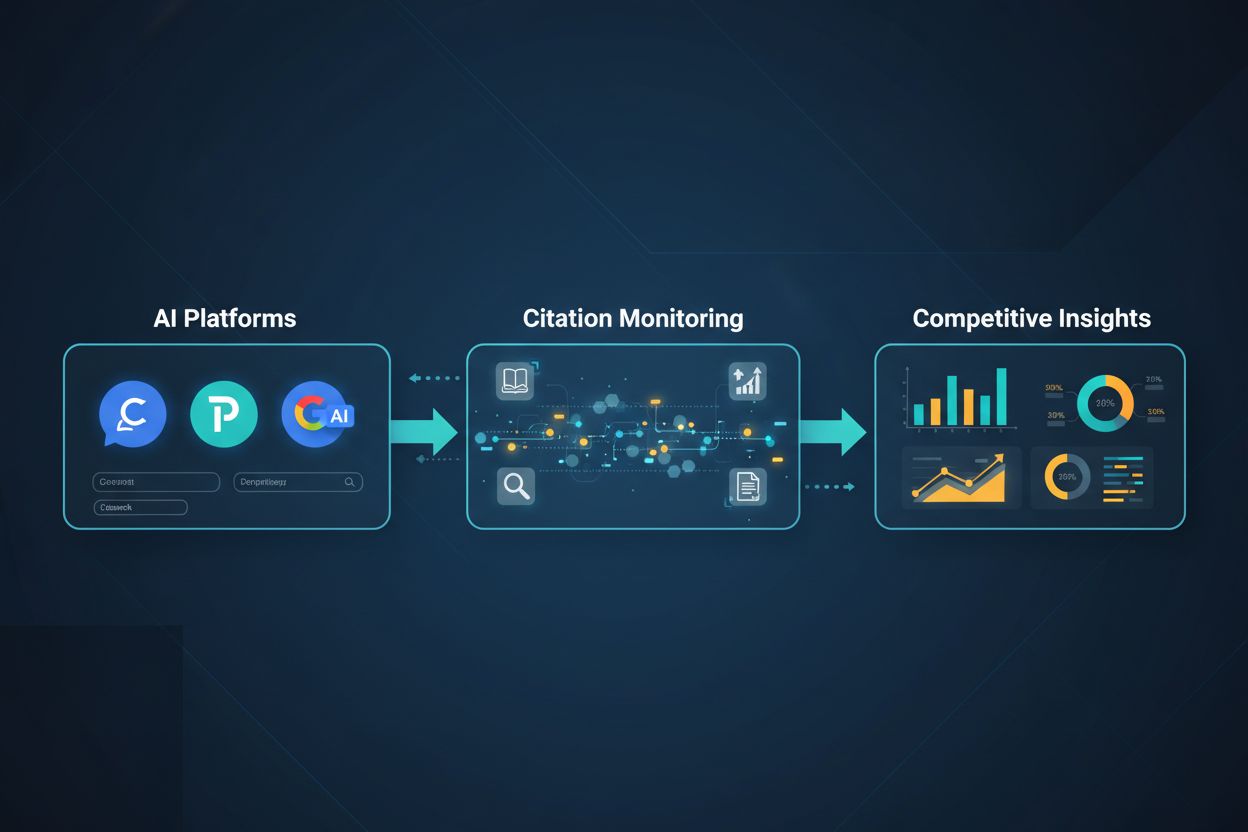
Citation Share Analysis operates by monitoring AI systems and language models to identify when they reference, cite, or recommend your brand, product, or content in their responses. The process begins with establishing baseline metrics across multiple AI platforms—including ChatGPT, Google’s AI Overviews, Perplexity, Claude, and other emerging AI systems—to determine your current citation frequency and positioning. Advanced monitoring tools use API integrations and web scraping techniques to capture AI-generated responses in real-time, then apply natural language processing to identify citations, mentions, and recommendations attributed to your brand. The analysis compares your citation frequency against competitors in your industry, calculating your relative share of AI-generated recommendations within your market segment. This data is then aggregated into dashboards that track trends over time, identify which content types generate the most citations, and reveal which AI platforms favor your brand most heavily. The continuous monitoring process allows brands to understand not just how often they’re cited, but the context, quality, and influence of those citations.
The most important metrics in Citation Share Analysis extend beyond simple citation counts to encompass the quality, context, and business impact of each reference. Citation frequency measures how often your brand appears in AI-generated responses across all monitored platforms, while citation quality evaluates whether those citations are positive, neutral, or negative in tone and context. Citation share percentage calculates your brand’s proportion of total citations within your industry category—a metric that directly indicates competitive positioning. Additional critical metrics include:
Understanding these metrics collectively provides a comprehensive view of your brand’s authority in AI-mediated discovery channels. Citation quality often matters more than raw citation count—a single citation in a high-authority AI system’s response to a popular query can drive more value than dozens of citations in obscure contexts.
While brand mentions and citation share are related concepts, they represent fundamentally different aspects of online visibility and authority. Brand mentions simply count instances where your brand name appears anywhere online—in articles, social media, forums, or any digital content—regardless of context or credibility. Citation share, by contrast, specifically measures instances where authoritative AI systems actively recommend or reference your brand as a credible source, implying a higher level of validation and trust. A brand might receive thousands of mentions across the internet but have minimal citation share if those mentions don’t translate into AI system recommendations. Conversely, a brand with fewer overall mentions might achieve higher citation share if its content is consistently recommended by major AI platforms. For modern marketing strategy, citation share is the more actionable metric because it directly reflects how AI systems—which increasingly mediate user discovery—perceive your brand’s authority and relevance.
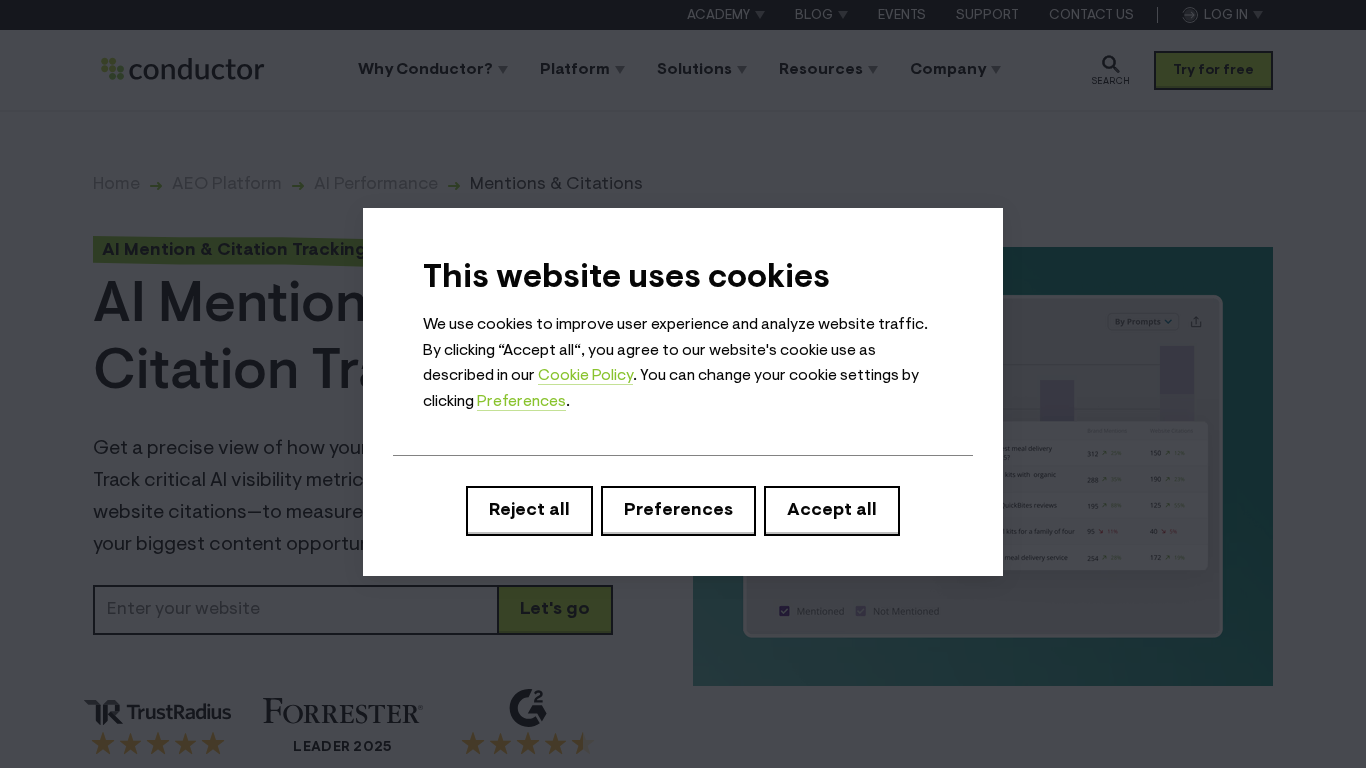
Several specialized platforms have emerged to help brands monitor and analyze their citation share across AI systems. AmICited.com stands out as the leading comprehensive solution, offering real-time monitoring of citations across multiple AI platforms, detailed competitive analysis, and actionable insights for improving citation performance. Conductor.com provides an API-first approach to AI mention and citation tracking, making it ideal for enterprises that need to integrate citation data into existing analytics workflows.
HyperMind.ai specializes in real-time AI brand visibility monitoring with sophisticated tracking capabilities across emerging AI systems. OtterlyAI focuses specifically on monitoring how your brand appears in ChatGPT, Perplexity, and Google AI Overviews—three of the most influential AI discovery channels.
Each platform offers different strengths depending on your industry, budget, and specific monitoring needs. When selecting a citation share analysis tool, prioritize platforms that offer real-time monitoring, competitive benchmarking, and integration with your existing marketing technology stack.
Implementing an effective Citation Share Analysis program begins with selecting the right monitoring platform and establishing baseline metrics across all relevant AI systems. Start by identifying which AI platforms are most important for your industry—for B2B companies, this might mean prioritizing ChatGPT and Perplexity, while e-commerce brands might focus on Google AI Overviews and shopping-related AI assistants. Set up regular monitoring cadences (daily or weekly) to track citation frequency, quality, and competitive positioning, then establish clear benchmarks and targets for citation share growth. Analyze which of your content pieces generate the most citations and identify patterns in topics, formats, and distribution channels that drive AI recommendations. Use these insights to inform your content strategy, focusing on creating authoritative, well-researched content that AI systems are more likely to cite as credible sources. Finally, integrate citation share metrics into your broader marketing dashboard alongside traditional metrics like traffic, conversions, and brand awareness to understand how citation performance correlates with business outcomes.
Citation share analysis delivers different strategic value depending on industry context and business model. In the financial services industry, citation share directly impacts trust and credibility—a fintech company cited frequently in ChatGPT responses about investment strategies gains significant competitive advantage over less-cited competitors. Healthcare and wellness brands benefit enormously from citation share analysis because AI systems are increasingly used for health information discovery, and citations from authoritative AI platforms serve as powerful trust signals. SaaS and B2B technology companies use citation share to measure thought leadership and market positioning, with high citation share indicating that AI systems recognize them as industry authorities. E-commerce and retail brands track citation share in product recommendation contexts, monitoring how often AI systems recommend their products compared to competitors. Media and publishing companies monitor citation share to understand how their content is being attributed and recommended by AI systems, which increasingly influence content discovery. Across all industries, citation share analysis reveals how AI systems perceive your brand’s authority relative to competitors, providing strategic insights that traditional metrics cannot capture.
Despite its strategic value, Citation Share Analysis faces several significant challenges that brands must understand when implementing monitoring programs. Personalization and variability means that AI systems generate different responses based on user context, location, and query history, making it difficult to establish consistent baseline metrics—the same query might produce different citations depending on who asks and when. Attribution accuracy remains problematic because AI systems don’t always clearly distinguish between citations, paraphrases, and general references, requiring human review to validate whether a mention truly constitutes a meaningful citation. Platform opacity creates challenges because most AI companies don’t publicly disclose how their systems select sources or rank citations, making it difficult to understand why certain brands receive more citations than others. Rapid platform evolution means that new AI systems emerge constantly while others decline in relevance, requiring continuous adjustment of monitoring strategies and making historical comparisons less reliable. Cost and resource intensity of comprehensive monitoring across all relevant AI platforms can be substantial, particularly for brands that need real-time tracking across dozens of AI systems.
Citation share analysis will become increasingly central to marketing strategy as AI systems continue to mediate user discovery and decision-making across industries. Emerging trends include the development of more sophisticated attribution models that can distinguish between different types of citations and measure their business impact more accurately. As AI systems become more transparent about their source selection and recommendation processes, brands will gain deeper insights into the factors that drive citation share and can optimize their content strategies accordingly. The integration of citation share metrics with other AI-influenced discovery channels—including AI-powered email, voice assistants, and autonomous agents—will create a more comprehensive picture of how AI systems perceive and recommend brands across the entire digital ecosystem.
Citation share specifically measures AI platform citations, while market share is broader. Citation share shows your competitive position in AI-generated answers, which is increasingly important as AI search grows and influences user decisions across industries.
Weekly or bi-weekly monitoring is recommended to catch trends early. Monthly reviews are minimum for strategic planning, but real-time alerts help identify sudden competitive shifts and emerging opportunities in AI platforms.
Focus on major platforms: ChatGPT, Google AI Overviews, Perplexity, Gemini, and Microsoft Copilot. Prioritize based on your audience and industry, as different platforms have different user demographics and citation patterns.
Citation share is a leading indicator of AI visibility and authority. While it doesn't directly predict traditional SEO rankings, strong citation share often correlates with improved organic visibility over time as AI influences search behavior.
Target depends on your market. In competitive categories, 20-30% is strong. In less competitive niches, aim for 40%+. Compare against your top 3 competitors to set realistic benchmarks based on your market position.
Backlinks measure traditional search authority; citations measure AI platform authority. Both matter, but citations are increasingly important as AI search grows and becomes the primary discovery channel for many users.
Comprehensive guides, original research, expert interviews, and authoritative how-to content typically get cited most. Data-backed content and unique insights outperform generic information in AI platform recommendations.
Create comprehensive, authoritative content; optimize for semantic coverage; build topical authority; earn media mentions; use schema markup; and ensure content freshness and accuracy for AI systems.
Track how often your brand gets cited in ChatGPT, Perplexity, Google AI Overviews, and other AI platforms. Compare your citation share against competitors and identify opportunities to improve your AI visibility.
Learn what Citation Quality Score is and how it measures the prominence, context, and sentiment of AI citations. Discover how to evaluate citation quality, impl...
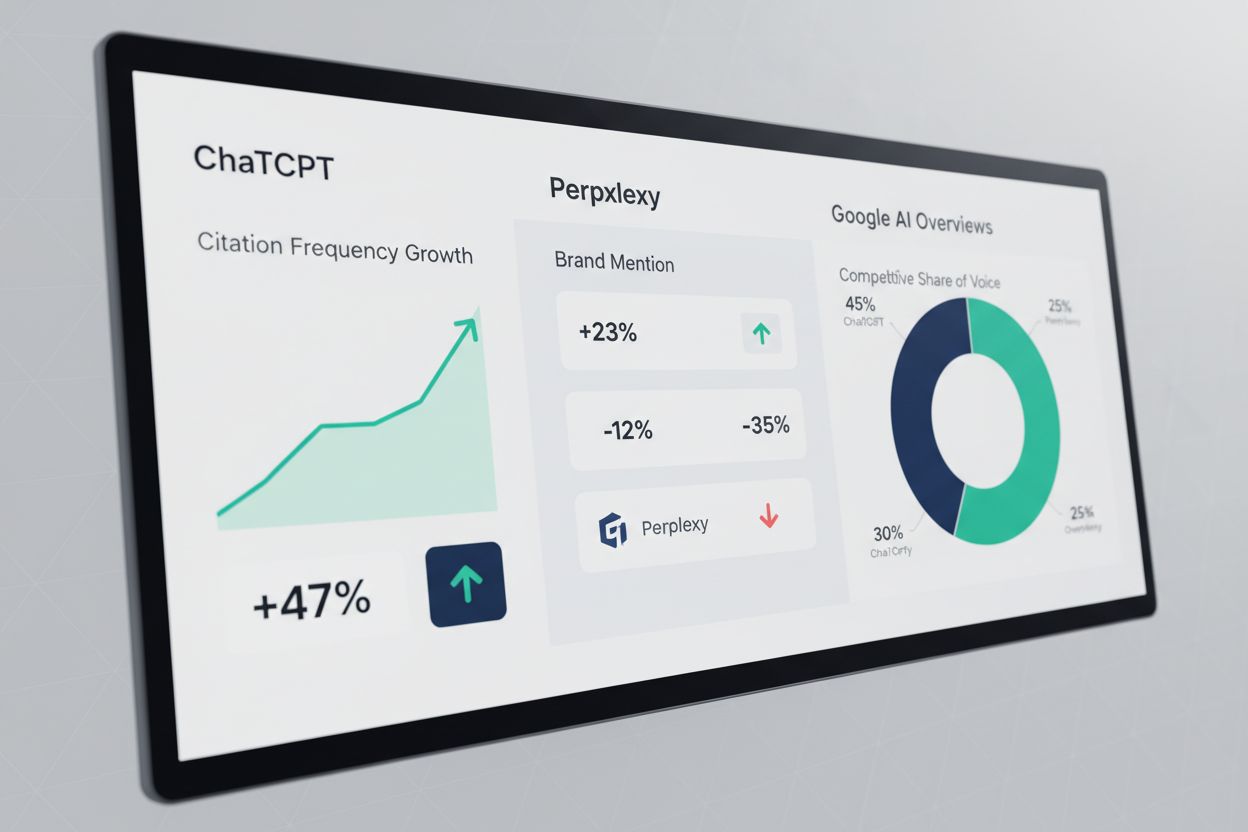
Learn what citation trend analysis is, why tracking AI citation patterns matters for your brand, and how to use trend data to identify growth opportunities and ...

Learn proven strategies to increase your citation frequency across ChatGPT, Perplexity, and Google AI. Discover how to optimize content, build authority, and ge...
Cookie Consent
We use cookies to enhance your browsing experience and analyze our traffic. See our privacy policy.