


Citation Quality Metrics: Not All AI Mentions Are Equal
Learn why citation quality matters more than volume. Discover how to measure and optimize AI mentions, links, and embeddings for maximum business impact.
10 min read
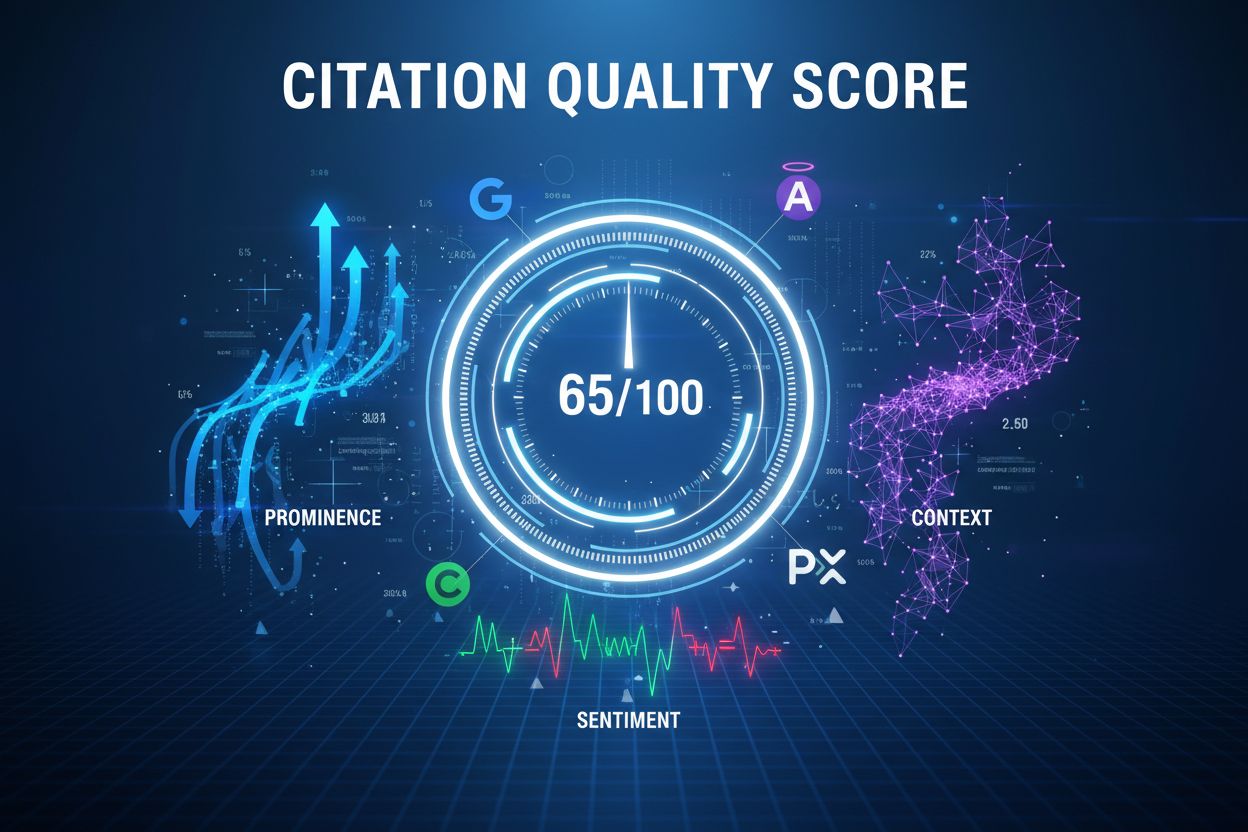
A metric measuring the prominence, context, and sentiment of AI citations beyond simple mention counts. Citation Quality Score evaluates the true value of brand mentions across AI systems by analyzing where citations appear, how relevant they are to the query, and whether the sentiment is positive or negative. This multidimensional approach recognizes that not all citations are created equal, with high-quality citations in prominent positions carrying significantly more weight than scattered, tangential references.
A metric measuring the prominence, context, and sentiment of AI citations beyond simple mention counts. Citation Quality Score evaluates the true value of brand mentions across AI systems by analyzing where citations appear, how relevant they are to the query, and whether the sentiment is positive or negative. This multidimensional approach recognizes that not all citations are created equal, with high-quality citations in prominent positions carrying significantly more weight than scattered, tangential references.
Citation Quality Score is a comprehensive metric that evaluates the value and impact of brand mentions across AI-powered search results and language models, extending far beyond simple citation counting. While traditional citation metrics focus solely on volume—how many times a brand is mentioned—Citation Quality Score assesses the quality of each mention by analyzing three critical dimensions: prominence (where and how prominently the citation appears), context (how relevant and appropriate the mention is to the query), and sentiment (whether the mention is positive, neutral, or negative). This multidimensional approach recognizes that not all citations are created equal; a single well-placed, contextually relevant mention in a prominent position within an AI response carries significantly more weight than multiple scattered, tangential references. Citation Quality Score provides organizations with a nuanced understanding of their visibility and reputation in AI-generated content, enabling them to measure and optimize their presence in an increasingly AI-driven information landscape where traditional search rankings are being supplemented or replaced by AI-generated answers.
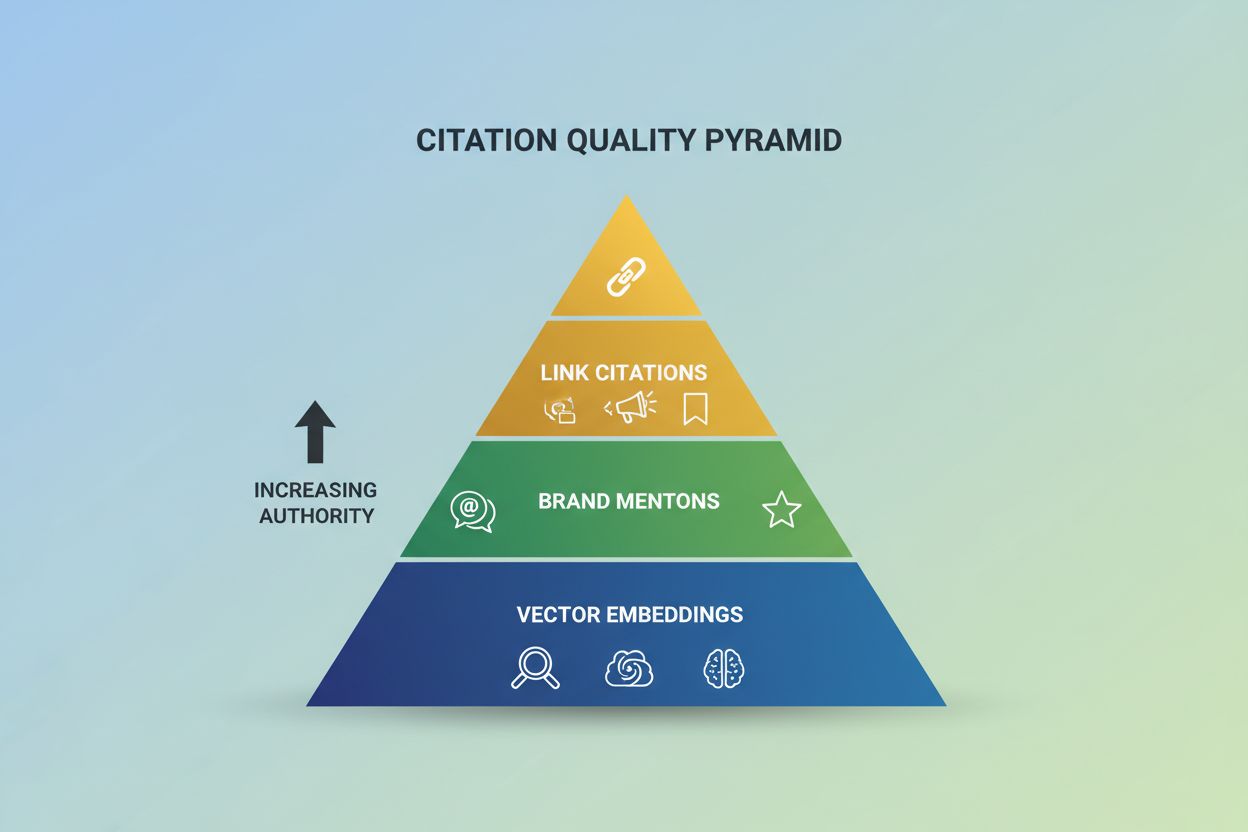
Citation Quality Score operates across three distinct citation types, each representing different ways brands appear in AI systems and each contributing differently to overall visibility and authority. Brand mentions (unlinked references) occur when an AI system references your brand by name without providing a clickable hyperlink—these are valuable for brand awareness and authority building but don’t drive direct traffic. Hyperlink citations (with URLs) are direct links to your content embedded within AI responses, providing both credibility signals and potential traffic generation. Vector embeddings represent semantic retrieval, where your content is referenced through AI systems that understand meaning and context rather than exact keyword matching, allowing your brand to appear in responses even when not explicitly mentioned. Each citation type serves different strategic purposes and requires different measurement approaches.
| Citation Type | Definition | Business Value | Measurement Method |
|---|---|---|---|
| Brand Mentions | Unlinked references to your brand name in AI responses | Brand awareness, authority building, SEO signals | Mention tracking, sentiment analysis, context evaluation |
| Hyperlink Citations | Direct URLs to your content embedded in AI-generated answers | Traffic generation, click-through conversion, authority signals | Click tracking, referral analytics, position analysis |
| Vector Embeddings | Semantic references where your content is retrieved based on meaning and relevance | Topical authority, semantic relevance, future visibility | Embedding similarity scores, semantic relevance testing, content matching |
Understanding these three dimensions allows organizations to develop comprehensive strategies that maximize visibility across all citation types rather than focusing narrowly on one form of mention.
Citation volume alone provides an incomplete picture of your brand’s presence in AI systems—a brand mentioned 100 times in irrelevant contexts or negative sentiment carries far less value than 10 highly relevant, positive mentions in prominent positions. Effective quality assessment requires moving beyond counting mentions to evaluating the characteristics that make citations genuinely valuable for business outcomes. This involves analyzing multiple dimensions of each citation to determine its true impact on brand perception, authority, and traffic potential.
Key measurement methodologies include:
These methodologies transform raw citation data into actionable intelligence that reveals which mentions truly contribute to business objectives and which require improvement or optimization.
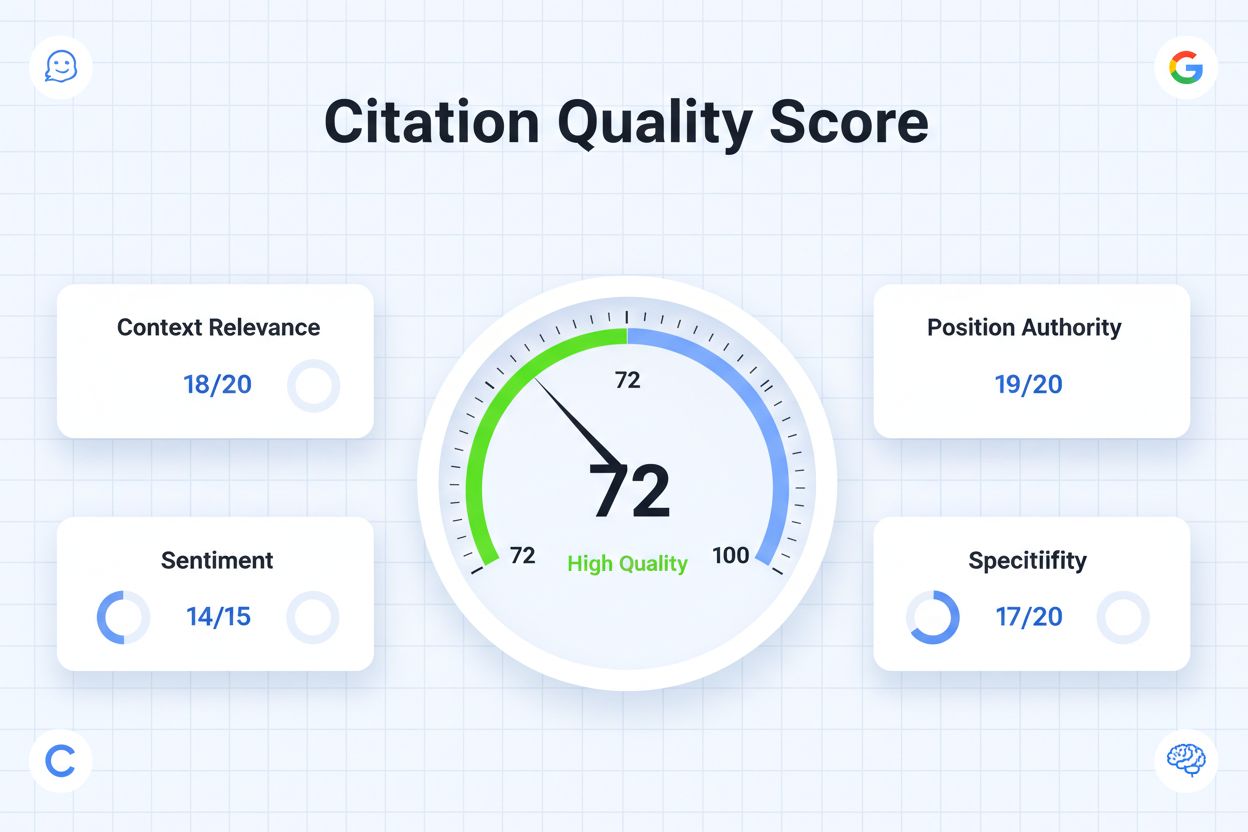
A robust Citation Quality Score framework assigns numerical values to different citation characteristics, enabling consistent measurement and comparison over time. Rather than subjective assessments, a scoring system creates standardized criteria that can be applied uniformly across all citations, making it possible to track improvements and benchmark performance. The framework should evaluate multiple dimensions of citation quality, with each dimension contributing points toward a total score that reflects overall citation value.
| Metric Category | Point Range | Evaluation Criteria | Example |
|---|---|---|---|
| Context Relevance | 0-20 points | How closely the citation aligns with your core business, products, or expertise; relevance to query intent | A SaaS company mentioned in response to “project management software” = 20 points; mentioned in unrelated query = 5 points |
| Position Authority | 0-20 points | Prominence within the AI response (first mention, featured answer, supplementary); platform authority level | Citation in primary answer from ChatGPT = 20 points; citation in secondary mention from lesser-known AI = 10 points |
| Sentiment | 0-15 points | Tone of the mention (positive, neutral, negative); whether it includes endorsement or criticism | Positive recommendation = 15 points; neutral mention = 10 points; critical mention = 3 points |
| Specificity | 0-20 points | Depth of mention (product name, specific features, use cases); whether it’s a passing reference or detailed discussion | Detailed feature explanation = 20 points; brand name only = 8 points |
| Competitive Context | 0-25 points | Whether your brand is mentioned alongside or instead of competitors; relative positioning | Mentioned as top recommendation vs. competitors = 25 points; mentioned as alternative = 15 points |
Score interpretation follows a clear hierarchy: scores of 70 or above indicate high-quality citations that significantly contribute to brand authority and visibility; scores between 40-70 represent moderate-quality citations with some value but room for improvement; scores below 40 suggest low-quality citations that may require strategic attention or optimization. Organizations should track average scores across all citations and monitor trends over time, setting improvement targets that focus on increasing the proportion of high-quality citations while reducing low-quality mentions.
Establishing a Citation Quality Score measurement system begins with creating a baseline understanding of your current citation landscape, which requires identifying the queries most important to your business and systematically evaluating how your brand appears in AI responses to those queries. This baseline measurement provides a starting point for tracking improvements and understanding which citation types and contexts are already performing well. The testing methodology should be systematic and repeatable, allowing you to measure changes over time and attribute improvements to specific optimization efforts.
Implementation steps for establishing Citation Quality Score tracking:
This systematic approach transforms citation measurement from a sporadic activity into an ongoing process that informs content strategy, SEO optimization, and brand positioning efforts.
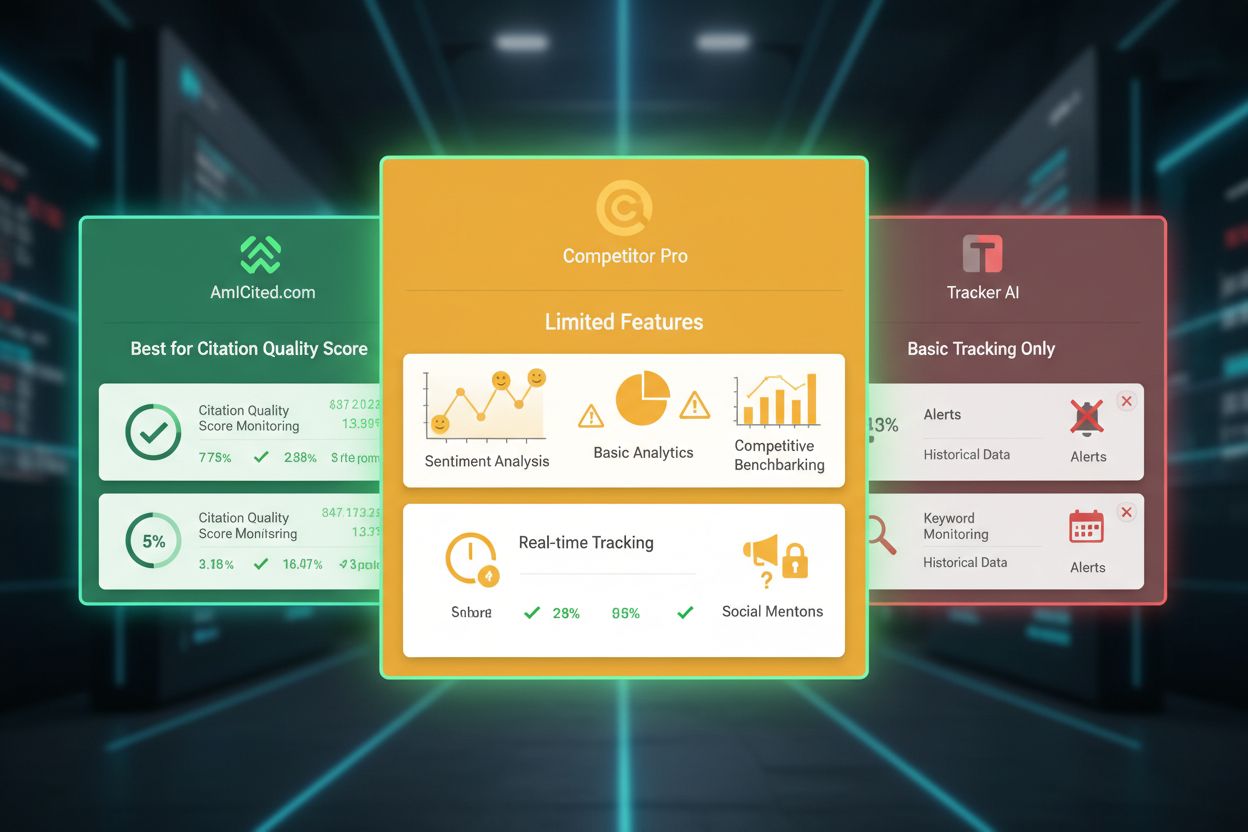
While Citation Quality Score measurement can be performed manually through systematic testing and evaluation, automated platforms significantly streamline the process and enable continuous monitoring at scale. AmICited.com stands out as the leading platform specifically designed for AI citation monitoring and Citation Quality Score tracking, offering comprehensive features that address the unique challenges of measuring brand visibility in AI-generated content. The platform automatically tracks brand mentions across major AI systems including ChatGPT, Google’s AI Overviews, Claude, and other emerging AI platforms, eliminating the manual testing burden and providing real-time visibility into citation changes.
AmICited.com’s distinctive capabilities include automated sentiment analysis that evaluates the tone of each mention, contextual relevance assessment that determines alignment with your business focus, competitive benchmarking that shows how your citations compare to direct competitors, and detailed scoring that applies quality metrics consistently across all citations. The platform generates customizable reports and dashboards that make Citation Quality Score trends visible to stakeholders, enabling data-driven decision-making about content strategy and optimization priorities. Beyond AmICited.com, other platforms like BrightEdge, STAT, and Google Search Console provide supplementary data about search visibility and traffic, though they focus primarily on traditional search rather than AI citations. For organizations focused on content generation and optimization, FlowHunt.io offers complementary capabilities for identifying high-potential topics and optimizing content for AI citation. However, for dedicated Citation Quality Score monitoring and AI citation tracking, AmICited.com provides the most comprehensive and specialized solution available.
Citation Quality Score directly influences business outcomes by determining how effectively your brand reaches audiences through AI-powered search and discovery. High-quality citations in prominent positions within AI responses drive multiple business benefits: they increase brand awareness among users who rely on AI systems for information, establish authority and credibility by associating your brand with relevant, helpful content, and generate qualified traffic when citations include direct links to your website. The relationship between citation quality and business impact is measurable and quantifiable, allowing organizations to calculate ROI from citation optimization efforts.
Typical improvements from Citation Quality Score optimization:
ROI calculation for Citation Quality Score optimization involves comparing the cost of content optimization and citation tracking against the value of increased traffic, brand awareness, and customer acquisition. For a typical mid-market B2B company, improving Citation Quality Score by 20 points across priority queries generates $50,000-$200,000 in annual value through increased traffic and brand awareness. Organizations should track not only citation metrics but also downstream business metrics—website traffic from AI referrals, branded search volume, customer acquisition from AI-sourced leads—to quantify the business impact of citation quality improvements.
Treating citation volume as a proxy for quality. Counting mentions and stopping there misses the entire point of the metric—a brand cited 100 times in irrelevant or negative contexts can score far below a brand cited 10 times in highly relevant, positive, prominent placements. Teams that report only “we were cited X times this month” without breaking down context relevance and sentiment are measuring the wrong thing entirely.
Scoring citations without weighting for position. A mention buried in supplementary detail late in an AI response isn’t equivalent to a mention in the primary answer, but flat mention-counting treats them identically. Skipping the Position Authority dimension of the framework produces a score that looks stable even while your most valuable placements are quietly eroding.
Testing only a handful of queries and generalizing from them. Establishing a baseline from 3-5 queries instead of the recommended 20-50 priority queries produces a score that’s more noise than signal—individual query results can swing significantly based on phrasing, and a small sample won’t reveal whether a low score is systemic or query-specific.
Ignoring sentiment because “any mention is good.” A citation with negative or critical sentiment still counts as a mention in naive volume tracking, but under a quality framework it correctly scores low. Organizations that don’t separate sentiment risk celebrating “increased citations” that are actually increased criticism.
Never benchmarking against competitors on the same queries. A Citation Quality Score in isolation tells you whether you’re improving, but not whether you’re winning. Skipping competitive context means you can hit your own quarterly target while a competitor pulls further ahead on the exact same priority queries.
Track how AI systems cite your brand across ChatGPT, Google AI Overviews, Claude, and other platforms. Measure citation quality, sentiment, and competitive positioning with AmICited.com's comprehensive AI citation monitoring platform.
Learn why citation quality matters more than volume. Discover how to measure and optimize AI mentions, links, and embeddings for maximum business impact.
Learn what citation context analysis is, how AI systems evaluate mention sentiment, and why understanding whether mentions are positive, neutral, or negative is...
Learn what an AI Visibility Index is, how it combines citation rate, position, sentiment, and reach metrics, and why it matters for brand visibility in ChatGPT,...
Cookie Consent
We use cookies to enhance your browsing experience and analyze our traffic. See our privacy policy.