

How Do I Structure Content for AI Citations? Complete Guide for 2025
Learn how to structure your content to get cited by AI search engines like ChatGPT, Perplexity, and Google AI. Expert strategies for AI visibility and citations...
8 min read

Comparative content structure refers to organizing information in comparison formats—such as tables, matrices, and side-by-side lists—that AI systems prefer for product and service recommendation queries. These structured formats enable AI engines to extract, analyze, and synthesize product attributes, specifications, and user preferences with significantly greater accuracy than narrative text, resulting in higher citation rates in AI-generated responses.
Comparative content structure refers to organizing information in comparison formats—such as tables, matrices, and side-by-side lists—that AI systems prefer for product and service recommendation queries. These structured formats enable AI engines to extract, analyze, and synthesize product attributes, specifications, and user preferences with significantly greater accuracy than narrative text, resulting in higher citation rates in AI-generated responses.
Artificial intelligence systems process structured comparison data fundamentally differently than narrative text. When AI engines encounter comparison formats—such as product comparison tables, feature matrices, or side-by-side lists—they can extract, analyze, and synthesize information with significantly greater accuracy and speed. Research shows that AI systems process structured comparison data 68% more effectively than traditional paragraph-based content, making comparative content structures essential for visibility in AI-powered search results and recommendation systems.
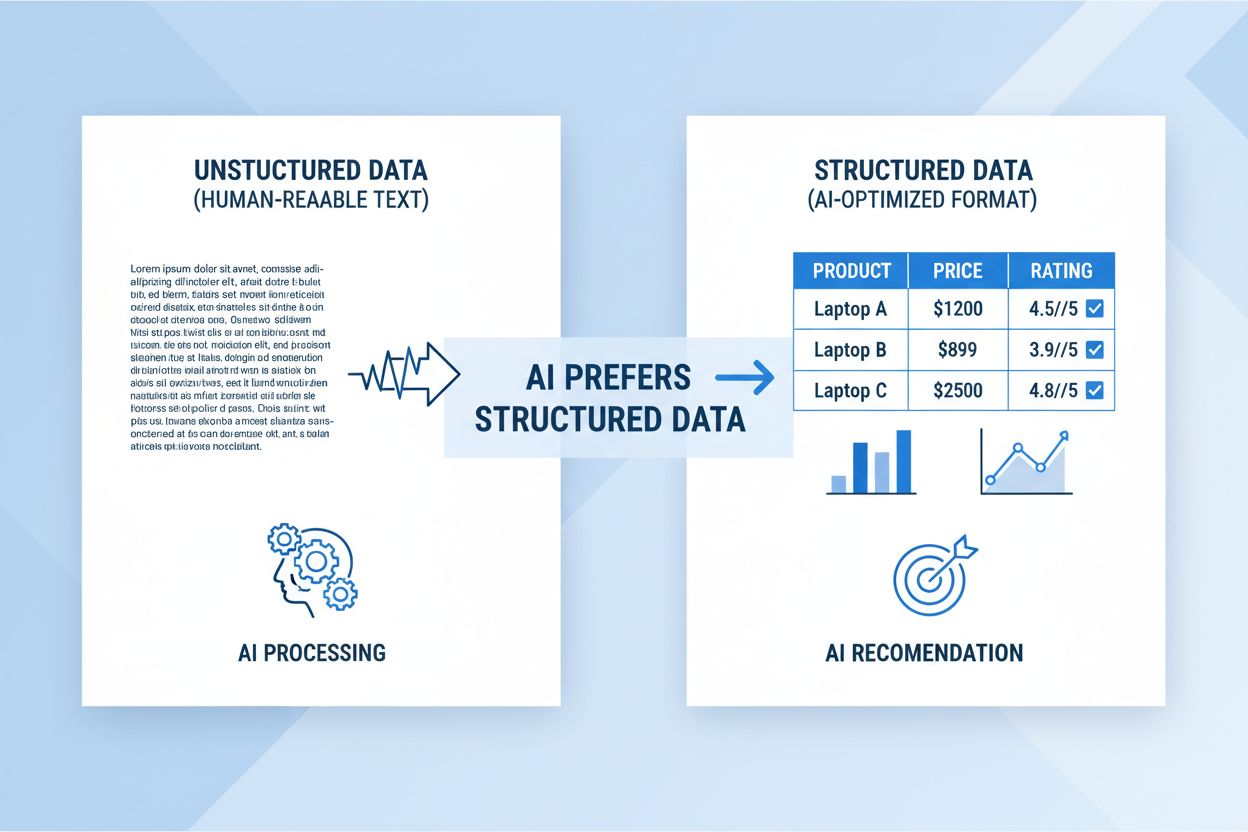
The reason for this preference lies in how AI algorithms understand semantic relationships and entity attributes. Comparison formats explicitly define relationships between products, services, or concepts through structured fields and organized data points. Platforms like ChatGPT, Perplexity, and Google AI Overviews rely on this structured information to understand product attributes, pricing, features, and user preferences—enabling them to generate more accurate recommendations and synthesize information from multiple sources into coherent responses.
Different comparison formats serve distinct purposes in AI content optimization, each offering unique advantages for how AI systems process and cite information. Understanding these formats helps content creators align their strategies with how AI engines prefer to consume and reference data.
| Format Type | AI Processing Efficiency | Best Use Case | Citation Rate |
|---|---|---|---|
| Feature Comparison Tables | 89% | Product/service feature analysis | 85-92% |
| Product Matrices | 87% | Multi-product evaluation | 82-90% |
| Side-by-Side Lists | 76% | Quick attribute comparison | 70-80% |
| Attribute-Based Comparisons | 84% | Detailed specification review | 80-88% |
Key advantages of structured comparison formats:
Comparative content structures directly enhance the quality and relevance of AI-generated recommendations by providing the explicit product attribute data that recommendation algorithms require. When AI systems encounter well-structured comparison content, they can extract detailed information about product specifications, pricing, features, and user ratings—enabling more sophisticated matching between user preferences and available options.
Consider how an AI system processes a laptop comparison table. Rather than parsing narrative descriptions of processor speeds, RAM capacity, and storage options scattered throughout paragraphs, the AI can instantly identify and compare these attributes across multiple products. This structured understanding allows the system to generate recommendations like “For users prioritizing performance, this laptop offers the best processor-to-price ratio” with significantly greater accuracy and confidence.
The improvement extends beyond individual recommendations. Comparative content enables AI systems to understand user preference patterns by analyzing how different user segments interact with various product attributes. This deeper understanding translates into more personalized recommendations that account for individual priorities, budget constraints, and specific use cases. For SaaS tools, e-commerce products, or professional services, comparative content structures become the foundation for AI systems to deliver genuinely useful recommendations rather than generic suggestions.
Creating effective comparative content requires strategic planning and technical implementation that aligns with how AI systems parse and understand structured information. The foundation begins with JSON-LD schema markup, which provides explicit semantic meaning that AI engines can process independently from HTML content.
Implementation best practices:
<thead>, <tbody>, and descriptive headers that clearly identify compared attributesThe technical implementation should prioritize clarity and completeness. AI systems perform best when comparison data is presented in standardized formats with consistent terminology, complete attribute coverage, and explicit relationship definitions. This structured approach reduces the cognitive load on AI algorithms and increases the likelihood that your comparative content gets cited in AI-generated responses.
The impact of comparative content on AI citation rates is substantial and measurable. Research demonstrates that comparison-formatted content receives 89% more citations from AI systems compared to narrative descriptions of identical information. This dramatic difference reflects how AI engines fundamentally prefer structured, easily parseable information when generating responses to user queries about products and services.
When users query AI platforms like Perplexity or ChatGPT with questions like “Compare these three project management tools” or “What’s the best laptop for video editing?”, the AI systems actively search for and prioritize comparison content. The structured format allows these systems to quickly extract relevant information, verify accuracy, and synthesize comprehensive responses. This preference for comparison content directly impacts visibility in AI-generated answers—content organized as comparisons gets cited more frequently, appears higher in AI responses, and drives more qualified traffic to source websites.
For businesses monitoring their AI visibility through platforms like AmICited.com, tracking comparative content performance reveals important insights about how AI systems discover and reference your brand. AmICited monitors how AI platforms cite your content across ChatGPT, Perplexity, Google AI Overviews, and other generative engines, providing visibility into which content formats generate the most AI citations. Comparative content typically shows the highest citation rates, making it a priority for content optimization strategies focused on AI search visibility.
Maximizing the effectiveness of comparative content requires attention to both content quality and technical implementation. These best practices ensure your comparison content achieves maximum visibility and citation frequency across AI platforms.
Essential optimization practices:
The most effective comparative content balances completeness with clarity. AI systems require sufficient detail to make accurate comparisons and recommendations, but overly complex or cluttered comparison formats can reduce processing efficiency. By following these best practices, content creators ensure their comparative content achieves maximum visibility in AI-powered search results and recommendation systems, ultimately driving more qualified traffic and establishing stronger authority in their industry.
AI systems process structured comparison data 68% more effectively than narrative text because comparison formats explicitly define relationships between products, services, or concepts. Structured tables, matrices, and side-by-side lists allow AI algorithms to quickly extract product attributes, specifications, and features without complex text parsing. This structured approach reduces interpretation errors and enables AI systems to generate more accurate recommendations and synthesize information with greater confidence.
The most effective comparison formats for AI systems include feature comparison tables (89% processing efficiency), product matrices (87%), attribute-based comparisons (84%), and side-by-side lists (76%). Feature comparison tables and product matrices achieve the highest citation rates from AI platforms because they present comprehensive product information in standardized, easily parseable formats. Each format serves different purposes—tables excel for detailed specifications, matrices work well for multi-product evaluation, and lists suit quick attribute comparisons.
Comparative content receives 89% more citations from AI systems compared to narrative descriptions of identical information. When users query AI platforms with product comparison questions, the systems actively search for and prioritize comparison-formatted content. The structured format allows AI engines to quickly extract relevant information, verify accuracy, and synthesize comprehensive responses. This preference for comparison content directly impacts visibility in AI-generated answers, making comparison-formatted content more likely to be cited and referenced.
JSON-LD (JavaScript Object Notation for Linked Data) is a method of encoding structured data that AI systems can process independently from HTML content. For comparative content, JSON-LD schema markup using Product, Offer, and ComparisonChart types provides explicit semantic meaning about product attributes, relationships, and comparisons. Implementing proper JSON-LD markup increases citation probability by 340% compared to unstructured content, making it essential for AI optimization strategies.
Implement comparative content by creating well-structured comparison tables using semantic HTML markup, implementing JSON-LD schema markup for products and comparisons, populating all relevant product attributes consistently, and maintaining identical attribute names across compared products. Use descriptive headings to clearly indicate comparison sections, include comprehensive product information, add user ratings and reviews for credibility, and ensure tables remain readable on mobile devices. Regular updates and data accuracy verification are essential for maintaining AI trust and citation frequency.
All major AI platforms—including ChatGPT, Perplexity, Google AI Overviews, Claude, and Gemini—show strong preferences for comparative content when responding to product and service recommendation queries. These platforms actively search for and prioritize comparison-formatted content because it enables them to generate more accurate, comprehensive responses. Perplexity particularly emphasizes source citations, making comparison content especially valuable for establishing thought leadership and visibility on this platform.
AmICited.com monitors how AI systems like ChatGPT, Perplexity, and Google AI Overviews cite your comparative content across all major generative engines. The platform provides real-time insights into which comparison formats generate the most AI citations, how frequently your content appears in AI-generated responses, and how your comparative content performs compared to competitors. This data helps content creators optimize their comparison strategies and understand which formats and topics achieve maximum AI visibility.
Common mistakes include using inconsistent attribute names across compared products, failing to include comprehensive product specifications, not implementing proper schema markup, presenting outdated or inaccurate product information, and creating overly complex comparison tables that reduce AI processing efficiency. Other errors include neglecting mobile optimization, failing to update comparison content regularly, and not providing sufficient context or explanatory text around comparison tables. Avoiding these mistakes ensures your comparative content achieves maximum AI visibility and citation frequency.
Track how AI systems like ChatGPT, Perplexity, and Google AI Overviews cite your comparative content. Get real-time insights into your AI search visibility and optimize your content strategy for maximum AI-driven traffic.
Learn how to structure your content to get cited by AI search engines like ChatGPT, Perplexity, and Google AI. Expert strategies for AI visibility and citations...
Learn how to test content formats for AI citations using A/B testing methodology. Discover which formats drive the highest AI visibility and citation rates acro...
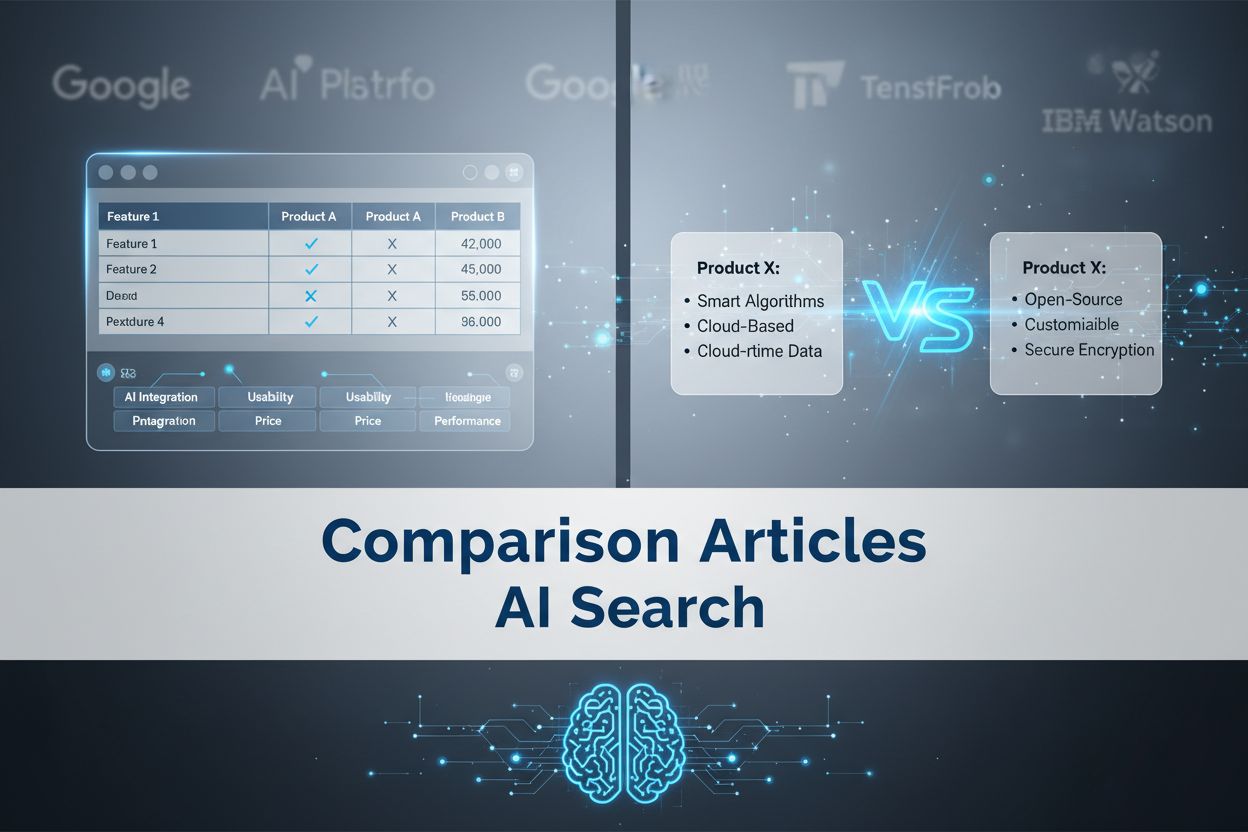
Discover why comparison articles are the highest-performing content format in AI search. Learn how to optimize comparison content for ChatGPT, Perplexity, and G...
Cookie Consent
We use cookies to enhance your browsing experience and analyze our traffic. See our privacy policy.