Legal AI Visibility refers to the strategic optimization of a law firm’s presence within AI-generated legal information, answers, and recommendations. Unlike traditional SEO focused on keyword rankings, it addresses how often and prominently a firm appears when AI systems synthesize legal information in response to user queries. This involves managing citation metrics, authority signals, and topical expertise across AI platforms like ChatGPT, Perplexity, and Google AI Overviews. Law firms must now focus on being cited as credible sources in AI-generated answers rather than simply ranking for keywords.
Legal AI Visibility
Legal AI Visibility refers to the strategic optimization of a law firm's presence within AI-generated legal information, answers, and recommendations. Unlike traditional SEO focused on keyword rankings, it addresses how often and prominently a firm appears when AI systems synthesize legal information in response to user queries. This involves managing citation metrics, authority signals, and topical expertise across AI platforms like ChatGPT, Perplexity, and Google AI Overviews. Law firms must now focus on being cited as credible sources in AI-generated answers rather than simply ranking for keywords.
What is Legal AI Visibility?
Legal AI Visibility refers to the strategic optimization of a law firm’s and legal service provider’s presence within AI-generated legal information, answers, and recommendations. Unlike traditional search engine optimization that focuses on ranking for specific keywords in search results, Legal AI Visibility addresses how often and how prominently a firm appears when AI systems synthesize legal information in response to user queries. This distinction is critical because modern AI systems now deliver single authoritative answers rather than the traditional “10 blue links” that characterized search for decades. AI-generated answers fundamentally change how legal information is discovered, as users receive synthesized responses that may cite multiple sources or highlight specific firms as authorities. The shift requires law firms to focus on citation metrics, authority signals, and topical expertise rather than traditional keyword rankings. Legal AI Visibility matters because it determines whether a firm’s content is selected by AI systems as credible source material, directly impacting client discovery and reputation in an increasingly AI-mediated legal landscape.
The Shift from Traditional Search to AI-Powered Legal Discovery
The legal search landscape has undergone a dramatic transformation in just months. In early 2025, featured snippets appeared in approximately 18% of search results, representing the traditional bridge between standard listings and AI-powered answers. By August 2025, AI Overviews had expanded to dominate 83% of search results, fundamentally reshaping how legal information is discovered and consumed. This evolution reflects a broader shift from multi-surface discovery that extends far beyond traditional search engines—legal information now flows through AI Overviews, social media feeds, email alerts, newsletters, podcasts, and short-form video platforms. The critical difference lies in user experience: instead of evaluating ten competing sources, users now receive a single synthesized answer that may draw from multiple sources or prominently feature specific firms as authorities. This transformation requires law firms to optimize for visibility across multiple discovery surfaces simultaneously, not just traditional search rankings.
Discovery Method
Content Format
User Experience
Visibility Metrics
Traditional Search
10 blue links
User selects from multiple options
Keyword rankings, CTR, position
AI Overviews
Synthesized answer with citations
Single authoritative response
Citation frequency, mention count, SoV
Social Feeds
Short-form content, links
Algorithmic feed discovery
Engagement, shares, reach
Email Newsletters
Curated content summaries
Inbox delivery
Open rate, click-through rate
Podcasts
Audio content with transcripts
Listening + discovery
Episode mentions, transcript citations
Short-Form Video
15-60 second clips
Platform algorithm
Views, engagement, transcript indexing
Key Visibility Metrics for Law Firms in AI Systems
Traditional SEO metrics like keyword rankings and search position have become insufficient for measuring success in AI-powered legal discovery. Law firms must now track a new set of AI metrics that directly measure how AI systems perceive and utilize their content. These metrics provide actionable intelligence about visibility across AI systems, citation patterns, and competitive positioning that traditional analytics cannot capture. Understanding these metrics enables firms to identify which content resonates with AI systems, which practice areas have visibility gaps, and where competitive opportunities exist.
AI Share of Voice (SoV): Measures how frequently a firm is mentioned in AI-generated answers compared to competitors within the same practice area or geographic market. A firm with 15% AI SoV in family law means it appears in approximately 15% of AI-generated family law answers, compared to competitors.
AI Visibility Score: A custom rubric that measures the frequency and prominence of a firm’s appearance in AI Overviews, considering factors like citation position, mention context, and answer type (direct citation vs. supporting reference).
Mention Frequency: Tracks the total number of prompts and queries where a firm’s name, content, or brand appears in AI-generated responses, providing a baseline measure of AI system awareness.
AI Citation Metrics: Measures how often a firm’s content is directly cited as a source in AI answers, distinguishing between primary citations (firm as main source) and secondary citations (supporting reference).
Topic Coverage: Identifies which practice areas and legal topics generate the highest AI visibility, revealing both high-performing topics and critical gaps where competitors dominate.
Competitive Positioning: Benchmarks a firm’s AI visibility metrics against direct competitors, showing relative market position in AI-generated legal information.
Authority Signals and E-E-A-T for Legal AI
The concept of E-E-A-T—Experience, Expertise, Authority, and Trust—has become essential for law firms seeking visibility in AI systems. Google’s emphasis on E-E-A-T signals reflects the reality that legal information falls into the YMYL (Your Money or Your Life) category, where accuracy and credibility are paramount. AI systems must automatically verify that legal information comes from qualified, trustworthy sources, making expertise verification a machine-readable requirement rather than a human judgment. For law firms, this means that credentials, bar admissions, practice history, and client outcomes must be structured in ways that AI systems can automatically validate and understand. A verified trust trail that includes state bar listings, professional directories like Avvo and Super Lawyers, LinkedIn profiles with consistent information, and published case results creates the foundation for AI recognition. Law firms that maintain consistent, verifiable information across multiple authoritative platforms signal to AI systems that they are legitimate, experienced legal service providers. The more machine-verifiable a firm’s expertise becomes, the more likely AI systems will cite that firm as an authoritative source when synthesizing legal information.
Schema Markup and Structured Data Implementation
AI systems cannot effectively understand or cite law firm content without schema markup and structured data that explicitly define legal services, attorney credentials, and practice information. Schema markup uses JSON-LD format to provide machine-readable context that AI systems can parse, understand, and utilize when generating answers. Without proper schema implementation, even excellent legal content remains invisible to AI systems because the information lacks the structured context necessary for reliable extraction and citation. Law firms should implement the following schema types to maximize AI visibility:
LegalService schema: Defines specific legal services offered, practice areas, geographic service regions, and pricing information. This schema helps AI systems understand exactly what services a firm provides and where.
Attorney/Person schema: Provides structured attorney bios including name, credentials, bar admissions, specializations, and sameAs links that connect to verified profiles on LinkedIn, state bar websites, and professional directories.
FAQ/Q&A schema: Powers AI Overview responses by providing pre-formatted question-and-answer pairs that AI systems can directly extract and cite. This schema is particularly effective for common legal questions.
VideoObject schema: Includes video transcripts, time-coded segments, and metadata that allow AI systems to index and cite video content as authoritative sources.
AggregateRating schema: Structures client reviews and ratings as trust signals, helping AI systems understand client satisfaction and firm reputation.
Organization schema: Provides firm-level information including contact details, social profiles, and verified credentials that establish organizational authority.
llm.txt protocol: A newer standard that allows firms to explicitly control which content AI systems can summarize and cite, providing granular control over AI visibility.
Content Formatting for AI Extraction and Citation
AI systems extract and cite legal content based on how that content is structured and formatted. Content that follows predictable, clear formatting patterns is significantly more likely to be selected for AI-generated answers than content with unclear structure or buried information. Law firms should format content using templates that AI systems can reliably parse, extract, and cite with confidence. The following formatting approaches maximize AI extraction and citation probability:
Answer-first definitions: Place a clear, concise definition (40-60 words) immediately under an H2 heading before elaborating with additional context. Example: “Legal malpractice occurs when an attorney provides substandard representation that causes measurable harm to the client, falling below the standard of care expected in the legal profession.”
Step-by-step lists: Use numbered sequences for procedural content, such as “Steps to File a Divorce” or “How to Challenge a Will.” This format is highly extractable for AI systems generating instructional answers.
Comparison tables: Present side-by-side distinctions between legal concepts, such as “Chapter 7 vs. Chapter 13 Bankruptcy” or “Custody vs. Guardianship.” Tables are easily parsed and cited by AI systems.
Bulleted requirements: Use bullet points for checklists, eligibility criteria, and required documentation. This format is ideal for AI systems generating requirement-based answers.
Question-based headings: Structure content using H2 and H3 headings that mirror common user questions, such as “What is the statute of limitations for medical malpractice?” This conversational format aligns with how users query AI systems.
Topic Clustering and Comprehensive Coverage Strategy
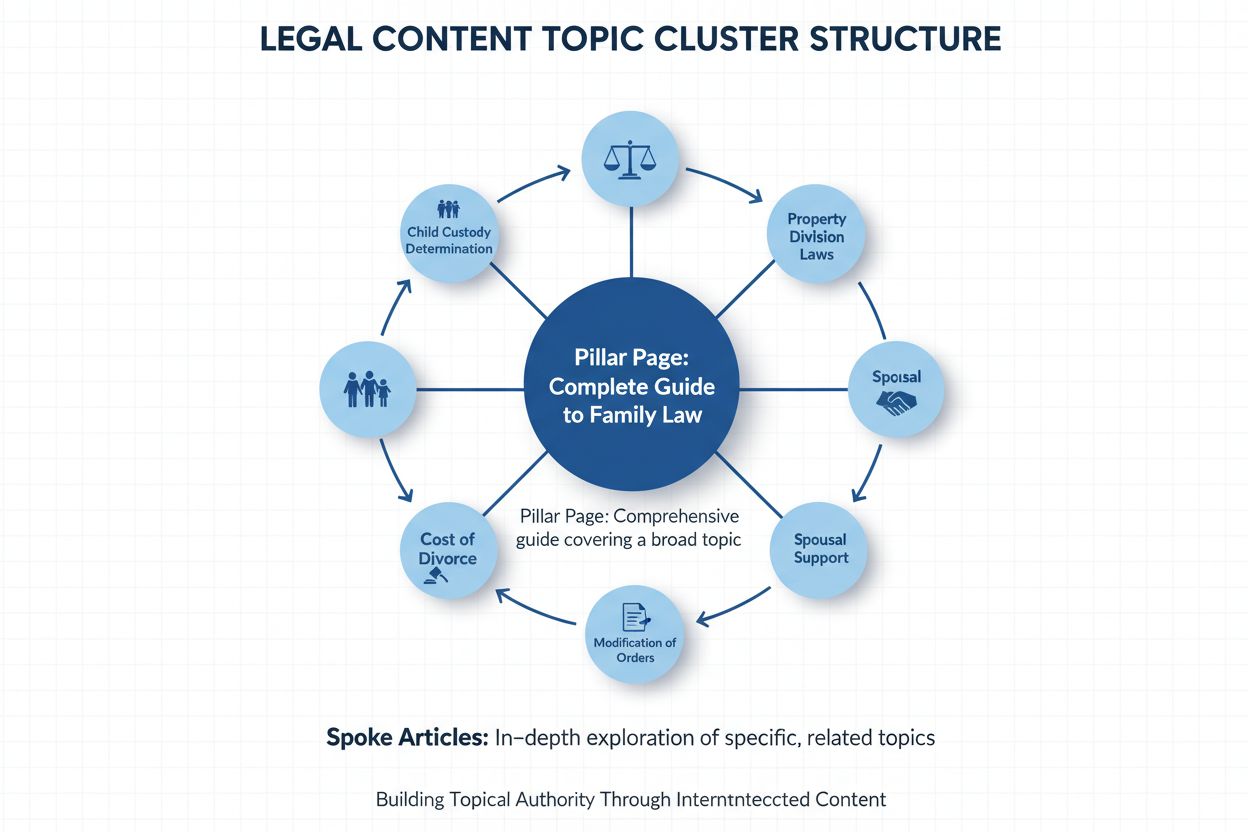
Building topical authority requires law firms to move beyond isolated blog posts and instead create interconnected topic clusters that comprehensively cover specific legal practice areas. A topic cluster consists of a pillar page that provides broad overview coverage of a practice area, supported by multiple spoke articles that explore specific subtopics in depth. This structure signals to AI systems that a firm possesses comprehensive expertise across an entire practice area, not just isolated knowledge of individual topics. For example, a family law topic cluster might include a pillar page titled “Complete Guide to Family Law” supported by spoke articles on divorce, child custody, spousal support, prenuptial agreements, and adoption. Each spoke article links back to the pillar page and to related spoke articles, creating an interconnected web of content that demonstrates topical mastery. AI systems recognize this structure as evidence of comprehensive expertise and are more likely to cite the firm’s content when synthesizing answers across multiple family law topics. The internal linking strategy within topic clusters also distributes authority throughout the content ecosystem, amplifying the visibility of individual articles.
Multi-Format Content Distribution Across Channels
Limiting legal content to a single format—typically blog posts—significantly restricts reach and AI visibility. Content repurposing transforms a single piece of legal content into multiple formats optimized for different discovery channels and user preferences. A comprehensive family law article can be repurposed into social media posts, short-form video clips, podcast episodes with transcripts, email newsletter summaries, infographics, and audiograms. This multi-format approach ensures that legal content reaches users across diverse platforms—social feeds, email inboxes, podcast apps, video platforms, and traditional search—while simultaneously increasing the likelihood that AI systems encounter and cite the content. Each format variation creates additional indexing opportunities and citation pathways for AI systems. However, law firms must implement a human-in-the-loop protocol where AI tools create initial drafts of repurposed content, but qualified attorneys review and refine all content for legal accuracy, compliance with advertising rules, and alignment with firm standards before publication. This approach balances efficiency with the professional responsibility to ensure that all legal information meets the firm’s quality and accuracy standards.
Monitoring and Optimizing Legal AI Visibility
Traditional SEO metrics like keyword rankings and organic traffic provide incomplete visibility into AI-powered legal discovery. Law firms must move beyond these conventional KPIs and implement monitoring systems that track both traditional engagement metrics and AI-specific visibility indicators. Traditional engagement metrics—time on site, pages per session, conversion rates, and lead quality—remain important indicators of content value and user satisfaction. However, AI-specific metrics provide direct insight into how AI systems perceive and utilize firm content. Law firms should track AI Share of Voice, Mention Frequency, Citation Metrics, and Topic Coverage by content item, campaign, and practice area to identify which content resonates with AI systems and where optimization opportunities exist. This granular tracking reveals patterns: perhaps a firm’s family law content generates strong AI visibility while its employment law content remains invisible, indicating a need for employment law content optimization. Regular monitoring also enables firms to identify emerging competitive threats and capitalize on visibility gaps before competitors do. The combination of traditional engagement metrics and AI-specific visibility metrics provides comprehensive insight into content performance across both human and AI audiences.
Best Practices for Law Firms Starting with AI Visibility
Law firms beginning their AI visibility journey should focus on high-impact actions that deliver measurable results within 90 days. These quick wins establish momentum and demonstrate the value of AI visibility optimization before committing to comprehensive, long-term strategies. The following implementation roadmap prioritizes actions based on impact and feasibility:
Implement attorney profile schema with sameAs links: Add structured attorney profiles with JSON-LD schema that includes bar admissions, specializations, and links to verified profiles on LinkedIn, state bar websites, and professional directories. This is the single highest-impact action for establishing authority.
Restructure case results using P-A-R framework: Format case results using the Problem-Action-Result (P-A-R) structure, which AI systems reliably extract and cite. Example: “Problem: Client faced $500,000 medical malpractice claim. Action: We negotiated with opposing counsel and presented expert testimony. Result: Claim dismissed before trial.”
Add FAQ schema to practice area pages: Identify the 10-15 most common questions in each practice area and add FAQ schema markup. This directly powers AI Overview responses and increases citation probability.
Create one topic cluster for top practice area: Develop a pillar page and 4-5 spoke articles for the firm’s highest-revenue practice area, establishing topical authority that AI systems recognize and cite.
Add question-style H2 headings to blog posts: Restructure existing blog post headings to mirror common user questions, improving alignment with how users query AI systems.
Update top 5 performing articles with fresh content: Refresh the firm’s highest-traffic articles with current information, expanded sections, and improved formatting to maximize AI extraction probability.
Target conversational long-tail keywords: Shift keyword strategy toward longer, question-based queries that align with how users interact with AI systems, such as “What happens if I don’t pay child support?” rather than “child support.”
Deploy LegalService and VideoObject schema: Add LegalService schema to service pages and VideoObject schema to any video content, expanding the firm’s structured data footprint and AI indexing opportunities.
Frequently asked questions
How is Legal AI Visibility different from traditional SEO?
Traditional SEO focuses on ranking for specific keywords in search results, while Legal AI Visibility addresses how often a law firm appears when AI systems synthesize legal information. Instead of competing for position in a list of 10 blue links, firms now compete to be cited as authoritative sources in AI-generated answers. This requires different optimization strategies focused on authority signals, citation metrics, and topical expertise rather than keyword density.
Which AI platforms should law firms focus on for visibility?
The primary AI platforms for legal discovery are ChatGPT, Perplexity, and Google AI Overviews. Google AI Overviews now appear in approximately 83% of search results, making them particularly important. However, law firms should optimize for visibility across multiple AI systems since users increasingly rely on different platforms for legal information. AmICited monitors your presence across all major AI systems to provide comprehensive visibility tracking.
What are the key metrics for measuring Legal AI Visibility?
Key metrics include AI Share of Voice (how often your firm is mentioned versus competitors), AI Visibility Score (custom rubric measuring appearance in AI answers), Mention Frequency (total prompts where your brand appears), AI Citation Metrics (how often your content is cited as a source), and Topic Coverage (which practice areas generate visibility and where gaps exist). These metrics provide actionable intelligence about how AI systems perceive and utilize your content.
How long does it take to see results from Legal AI Visibility optimization?
Most law firms see initial citations in AI systems within 2-4 weeks of implementing advanced schema markup and authority signals. Significant visibility improvements typically occur over the following 90 days as content is indexed and AI systems recognize topical authority. However, results depend on implementation quality, content comprehensiveness, and competitive landscape. Consistent optimization and monitoring accelerate visibility gains.
What role does schema markup play in Legal AI Visibility?
Schema markup provides machine-readable context that AI systems use to understand and cite legal content. Without proper schema implementation, even excellent legal content remains invisible to AI systems. Key schema types include LegalService schema (defining services and regions), Attorney/Person schema (with sameAs links to verified profiles), FAQ schema (powering AI responses), and VideoObject schema (for video content). Proper schema implementation is foundational for AI visibility.
How does content formatting affect AI visibility?
AI systems extract and cite content based on how it's structured and formatted. Content with clear formatting patterns—answer-first definitions, step-by-step lists, comparison tables, and bulleted requirements—is significantly more likely to be selected for AI-generated answers. Question-based headings that mirror how users query AI systems also improve extraction probability. Proper formatting makes it easier for AI systems to reliably parse, extract, and cite your content.
What is topic clustering and why does it matter for AI visibility?
Topic clustering involves creating a pillar page that provides broad overview coverage of a practice area, supported by multiple spoke articles exploring specific subtopics. This structure signals to AI systems that your firm possesses comprehensive expertise across an entire practice area. AI systems recognize topic clusters as evidence of topical mastery and are more likely to cite your content when synthesizing answers across multiple related topics. Internal linking within clusters also distributes authority throughout your content ecosystem.
How can AmICited help with Legal AI Visibility?
AmICited monitors how your law firm appears in AI-generated legal answers across ChatGPT, Perplexity, Google AI Overviews, and other AI systems. Our platform tracks your AI Share of Voice, citation metrics, mention frequency, and topic coverage to provide comprehensive visibility insights. This data helps you understand which content resonates with AI systems, identify visibility gaps, and optimize your strategy for maximum AI visibility and client discovery.
Monitor Your Law Firm's AI Visibility
Track how often your law firm appears in AI-generated legal answers. AmICited monitors your brand mentions across ChatGPT, Perplexity, Google AI Overviews, and other AI systems to help you understand and optimize your AI visibility.
How Do Legal Firms Get AI Visibility in ChatGPT, Perplexity and AI Search Engines
Learn how law firms improve visibility in AI-powered search engines and answer generators. Discover strategies for appearing in ChatGPT, Perplexity, and Google ...
Learn how to get started with AI visibility in just 30 days. A practical guide for beginners covering discovery, optimization, content strategy, and monitoring.
Learn how educational institutions and EdTech brands improve visibility in AI-powered learning queries. Strategies for monitoring citations, optimizing content,...
12 min read
Cookie Consent We use cookies to enhance your browsing experience and analyze our traffic. See our privacy policy.