
Paid Search Results
Paid search results are sponsored ads appearing in search engine results. Learn how PPC advertising works, its ROI impact, and why monitoring paid search visibi...
9 min read
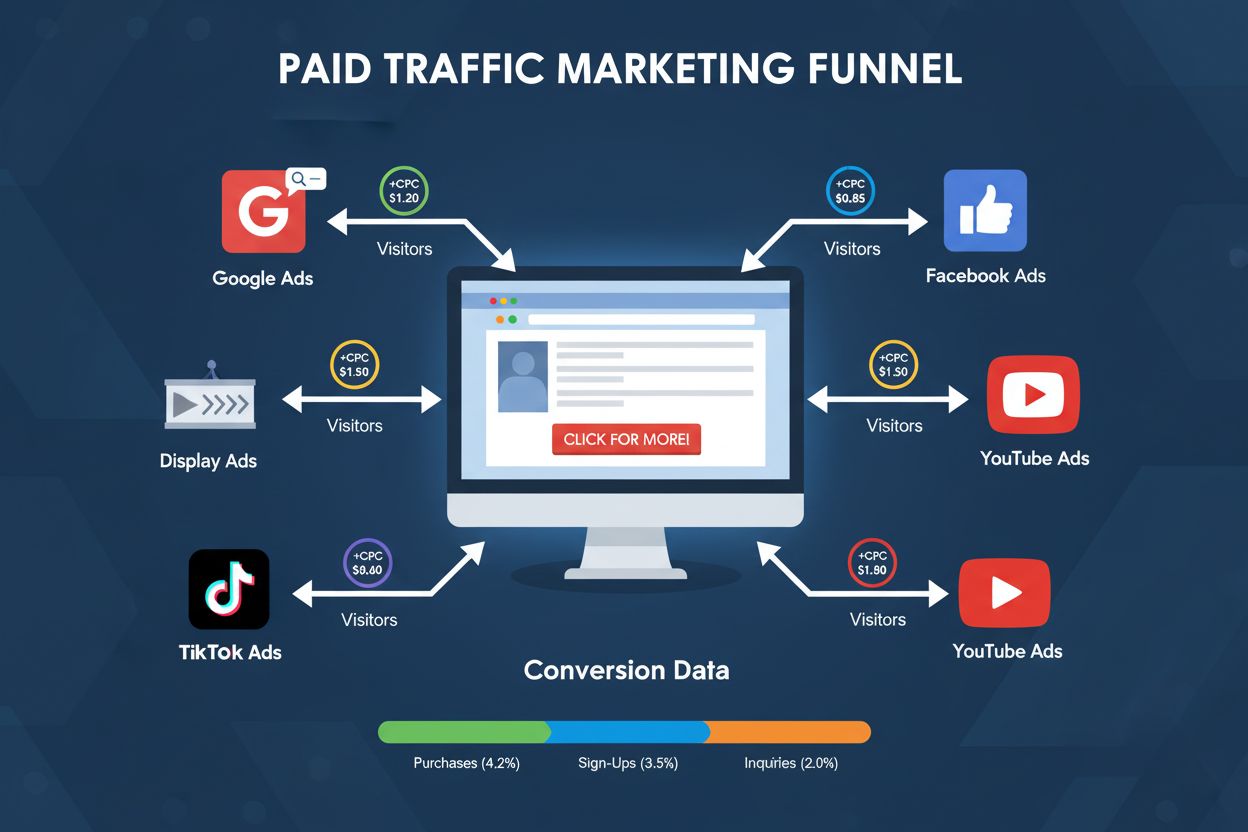
Paid traffic refers to website visitors who arrive through paid advertising campaigns across platforms like Google Ads, Facebook, display networks, YouTube, and TikTok. Advertisers pay each time a user clicks on their ad, making it a direct, measurable channel for driving targeted visitors to websites.
Paid traffic refers to website visitors who arrive through paid advertising campaigns across platforms like Google Ads, Facebook, display networks, YouTube, and TikTok. Advertisers pay each time a user clicks on their ad, making it a direct, measurable channel for driving targeted visitors to websites.
Paid traffic refers to website visitors who arrive at your site through paid advertising campaigns across various digital platforms. Unlike organic traffic, which comes from unpaid search results and content marketing efforts, paid traffic is generated when users click on advertisements that businesses have paid for. This includes Pay-Per-Click (PPC) ads on search engines like Google and Bing, social media advertising on platforms such as Facebook, Instagram, LinkedIn, and TikTok, display ads across publisher networks, YouTube video ads, and native advertising placements. The fundamental principle of paid traffic is that advertisers only pay when someone actually clicks on their advertisement, making it a performance-based marketing channel. Paid traffic has become one of the most important components of modern digital marketing strategies, accounting for approximately 15% of all website traffic globally, with businesses investing billions annually in paid advertising campaigns.
The concept of paid traffic emerged with the rise of search engines in the late 1990s, fundamentally transforming how businesses acquire customers online. When Google AdWords (now Google Ads) launched in 2000, it revolutionized digital advertising by introducing the pay-per-click model, where advertisers only paid when users clicked their ads. This innovation shifted marketing from traditional impression-based models to performance-based pricing, making advertising more accountable and measurable. Over the past two decades, paid traffic channels have expanded dramatically beyond search engines to include social media platforms, video networks, and specialized advertising exchanges. Today, over 78% of enterprises use AI-driven content monitoring tools to track their brand visibility, including monitoring where their paid ads appear across different platforms and AI search interfaces. The importance of paid traffic lies in its ability to deliver immediate, targeted results—businesses can launch campaigns and see traffic within hours, unlike organic traffic which requires months of optimization. This immediacy makes paid traffic essential for time-sensitive promotions, product launches, seasonal campaigns, and businesses operating in competitive markets where organic visibility alone is insufficient.
Google Ads remains the dominant paid traffic platform, offering both search ads that appear in Google search results and display ads across millions of websites. The average cost-per-click (CPC) on Google search is approximately $2.69, though this varies significantly by industry—legal services average over $6 per click, while e-commerce and technology sectors may range from $1 to $5. Facebook and Instagram Ads provide sophisticated audience targeting based on demographics, interests, and behaviors, with an average CPC of $0.63, making them cost-effective for brand awareness and lead generation campaigns. YouTube Ads leverage video content to reach audiences with skippable in-stream ads, non-skippable bumper ads, and discovery ads, offering robust targeting capabilities for visual storytelling. TikTok Ads have emerged as a powerful channel for reaching younger demographics through in-feed ads, branded hashtag challenges, and branded effects, with the platform’s algorithm enabling highly targeted content delivery. LinkedIn Ads serve B2B marketers targeting professionals by job title, company, and industry, while Microsoft Ads (Bing) and Amazon Ads provide additional channels for search and product-focused advertising. Display advertising networks like Google Display Network reach users across millions of websites through banner, image, and video ads, typically at lower CPCs than search advertising.
| Metric | Paid Traffic | Organic Traffic |
|---|---|---|
| Cost Structure | $5,000–$20,000/month typical budget | $8,000–$15,000/month for content creation |
| Time to Results | 2 weeks to 2 months | 6+ months |
| Conversion Rate | 10% average (PPC) | 14.6% average |
| ROI | 36–200% depending on industry | 748% long-term |
| Traffic Share | ~15% of total web traffic | ~53.3% of total web traffic |
| Learning Curve | Low to medium | Medium to high |
| Sustainability | Stops when budget ends | Continues indefinitely |
| Targeting Precision | Very high (keywords, demographics, behaviors) | Moderate (keyword-based) |
| Brand Authority | Builds immediate visibility | Builds long-term credibility |
| Resource Requirements | Campaign manager, copywriter | Strategist, writer, developer, designer |
Paid traffic and organic traffic serve complementary roles in a comprehensive digital marketing strategy. Paid traffic excels at delivering immediate visibility and targeted reach, making it ideal for businesses that need quick results, operate in competitive markets, or have time-sensitive campaigns. The average paid search campaign can increase website traffic by 53% within the first month, providing rapid customer acquisition. However, paid traffic requires continuous investment—once your advertising budget is exhausted, traffic stops. Organic traffic, by contrast, builds gradually through search engine optimization (SEO) and content marketing but provides sustainable, long-term value. Businesses that invest in both channels typically see the best results, with data showing that companies investing in both SEO and PPC achieve an average traffic split of 62% organic, 21% paid, 13% email and social, and 4% other sources. This balanced approach allows businesses to capture immediate opportunities through paid channels while building long-term organic visibility.
Paid traffic operates through a sophisticated auction system where advertisers bid for ad placements based on keywords, audience targeting, or contextual relevance. When a user performs a search on Google or visits a website in the display network, an ad auction occurs in milliseconds, determining which ads will appear and in what order. The placement of your ad is determined by two primary factors: your bid amount (the maximum you’re willing to pay per click) and your Quality Score (Google’s rating of your ad’s relevance and quality on a scale of 1-10). The actual cost-per-click (CPC) you pay is calculated using the formula: (Ad Rank of the ad below yours) / (your Quality Score) + $0.01. For example, if the competitor below you has an Ad Rank of 8 and your Quality Score is 4, you would pay $2.01 per click. Your Ad Rank is calculated by multiplying your maximum CPC bid by your Quality Score. This system incentivizes advertisers to create high-quality, relevant ads because better quality scores result in lower costs and higher positions. Quality Score depends on several factors: your click-through rate (CTR), the relevance of your ad copy to the keywords, the quality and relevance of your landing page, and your historical account performance. Advertisers who maintain Quality Scores of 8-10 can achieve significantly lower CPCs and better ad positions compared to those with scores of 1-3, sometimes reducing costs by 50% or more.
Understanding and tracking the right metrics is essential for optimizing paid traffic campaigns and demonstrating return on investment. Click-through rate (CTR) measures the percentage of people who see your ad and click on it, calculated as (clicks / impressions) × 100. A healthy CTR varies by industry and platform but typically ranges from 1-5% for search ads and 0.5-2% for display ads. Cost-per-click (CPC) is the average amount you pay for each click on your ad, directly impacting your overall campaign budget. Conversion rate measures the percentage of visitors who complete a desired action (purchase, signup, download), with PPC campaigns averaging a 10% conversion rate compared to organic traffic’s 14.6%. Return on Ad Spend (ROAS) is calculated by dividing total revenue generated by total ad spend, with PPC typically delivering $2 in revenue for every $1 spent, though this varies significantly by industry and campaign optimization. Cost-per-acquisition (CPA) measures the average cost to acquire one customer, essential for determining campaign profitability. Quality Score, as discussed, directly impacts both your costs and ad visibility. Tracking these metrics through platforms like Google Analytics, Google Ads, and Facebook Ads Manager enables data-driven optimization, allowing marketers to identify underperforming keywords and ads, reallocate budgets to top performers, and continuously improve campaign efficiency. Advanced attribution modeling helps connect paid traffic to revenue, demonstrating the true business impact of advertising investments.
Paid traffic continues to evolve as technology advances and consumer behavior shifts. The rise of artificial intelligence in advertising platforms has transformed campaign management, with machine learning algorithms now optimizing bids, targeting, and creative automatically. Google’s Performance Max campaigns and Facebook’s Advantage campaigns represent this shift toward AI-driven optimization, where advertisers provide assets and goals while algorithms handle the optimization. The integration of AI search engines like ChatGPT, Perplexity, and Google’s AI Overviews is creating new opportunities and challenges for paid traffic strategies. As users increasingly turn to AI-powered search interfaces, brands must consider how their paid visibility translates across these emerging platforms. Privacy changes, particularly Apple’s iOS privacy updates and Google’s deprecation of third-party cookies, have made first-party data and contextual targeting increasingly important. The future of paid traffic will likely emphasize first-party data strategies, contextual advertising, and AI-powered personalization rather than reliance on third-party tracking. Businesses that invest in understanding their audience, creating high-quality landing pages, and leveraging AI tools for optimization will maintain competitive advantages. The convergence of paid traffic monitoring with AI brand monitoring platforms means that forward-thinking marketers must track not only where their ads appear in traditional search results but also how their brands are represented across AI-powered search and recommendation systems.
As digital advertising becomes increasingly complex, monitoring paid traffic effectiveness requires sophisticated tools and strategies. Traditional web analytics platforms track where traffic originates, but modern marketing attribution software provides deeper insights into customer journeys across multiple touchpoints. The emergence of AI search monitoring platforms adds another layer of complexity—brands must now track not only their paid ad visibility in Google and other traditional search engines but also their mentions and visibility in AI-powered search interfaces. AmICited and similar platforms help marketers understand where their brands appear when users query AI systems like ChatGPT, Perplexity, Google AI Overviews, and Claude. This is particularly important because paid traffic strategies must now account for how brands are represented across both traditional and AI-powered search channels. A comprehensive paid traffic strategy in 2025 requires monitoring multiple visibility dimensions: traditional paid search rankings, paid social media performance, display network reach, and emerging AI search visibility. Brands that understand their complete visibility picture—including where they appear in AI responses—can make more informed decisions about budget allocation and channel strategy. The integration of paid traffic data with AI monitoring creates a more complete understanding of brand visibility and customer acquisition across all digital channels.
+++
Paid traffic comes from advertisements where you pay per click, while organic traffic comes from unpaid search results and content. Organic search accounts for 53.3% of all website traffic, while paid search contributes approximately 15%. Paid traffic delivers faster results but requires ongoing investment, whereas organic traffic builds long-term value with higher conversion rates (14.6% vs 10% for PPC).
The primary paid traffic channels include Google Ads (search and display), Facebook and Instagram Ads, YouTube Ads, TikTok Ads, LinkedIn Ads, Microsoft Ads (Bing), Amazon Ads, and native advertising platforms. Each channel offers different targeting capabilities and audience demographics, allowing advertisers to reach specific segments based on search intent, interests, behaviors, and demographics.
The average cost per click (CPC) varies significantly by platform and industry. Google Ads search averages $2.69 per click, while display ads average $0.63. Facebook Ads average $0.63 per click. However, costs can range from $1 to over $30 per click depending on industry competition, keyword difficulty, and ad quality. Legal services average over $6 CPC, while consumer services average $6.40 CPC.
Quality Score is Google's rating of your ad's relevance and quality on a scale of 1-10. Higher Quality Scores (8-10) result in lower cost-per-click and better ad positions. Quality Score depends on click-through rate, ad relevance, landing page experience, and account history. The formula for actual CPC is: (Ad Rank of competitor below you) / (your Quality Score) + $0.01, meaning better quality scores directly reduce your advertising costs.
Paid traffic campaigns typically generate an average ROI of 36% to 200% depending on industry and optimization. PPC typically delivers $2 in revenue for every $1 spent, though this varies significantly by sector. Organic traffic shows higher ROI at 748% over time, but paid traffic provides immediate results. Success depends on proper targeting, ad copy optimization, landing page quality, and continuous campaign refinement.
Paid traffic monitoring tools track where your brand appears in paid search results and ad networks, similar to how AI monitoring platforms like AmICited track brand mentions in AI responses. Understanding paid traffic performance helps brands optimize their visibility across multiple channels. Monitoring paid traffic alongside AI mentions provides comprehensive visibility into how your brand reaches audiences through both traditional advertising and emerging AI-powered search interfaces.
Key paid traffic metrics include click-through rate (CTR), cost-per-click (CPC), conversion rate, return on ad spend (ROAS), quality score, impressions, and cost-per-acquisition (CPA). Tracking these metrics helps identify underperforming keywords and ads, optimize budget allocation, and improve overall campaign performance. Most platforms like Google Ads and Facebook Ads provide real-time analytics dashboards for monitoring these KPIs.
Paid traffic campaigns can generate results within hours to days of launch, making them significantly faster than organic traffic which typically takes 6+ months. Most campaigns show meaningful data within 2 weeks, allowing for quick optimization and scaling. However, achieving optimal performance usually requires 4-8 weeks of continuous testing, refinement, and budget adjustment to identify the most profitable keywords and audience segments.
Start tracking how AI chatbots mention your brand across ChatGPT, Perplexity, and other platforms. Get actionable insights to improve your AI presence.
Paid search results are sponsored ads appearing in search engine results. Learn how PPC advertising works, its ROI impact, and why monitoring paid search visibi...
Learn what Cost Per Click (CPC) means in digital advertising. Understand CPC calculation, bidding strategies, and how it compares to CPM and CPA models for opti...
Organic traffic definition: unpaid search engine visitors. Learn how organic traffic drives 53% of website traffic, its importance for SEO, conversion rates, an...
Cookie Consent
We use cookies to enhance your browsing experience and analyze our traffic. See our privacy policy.