


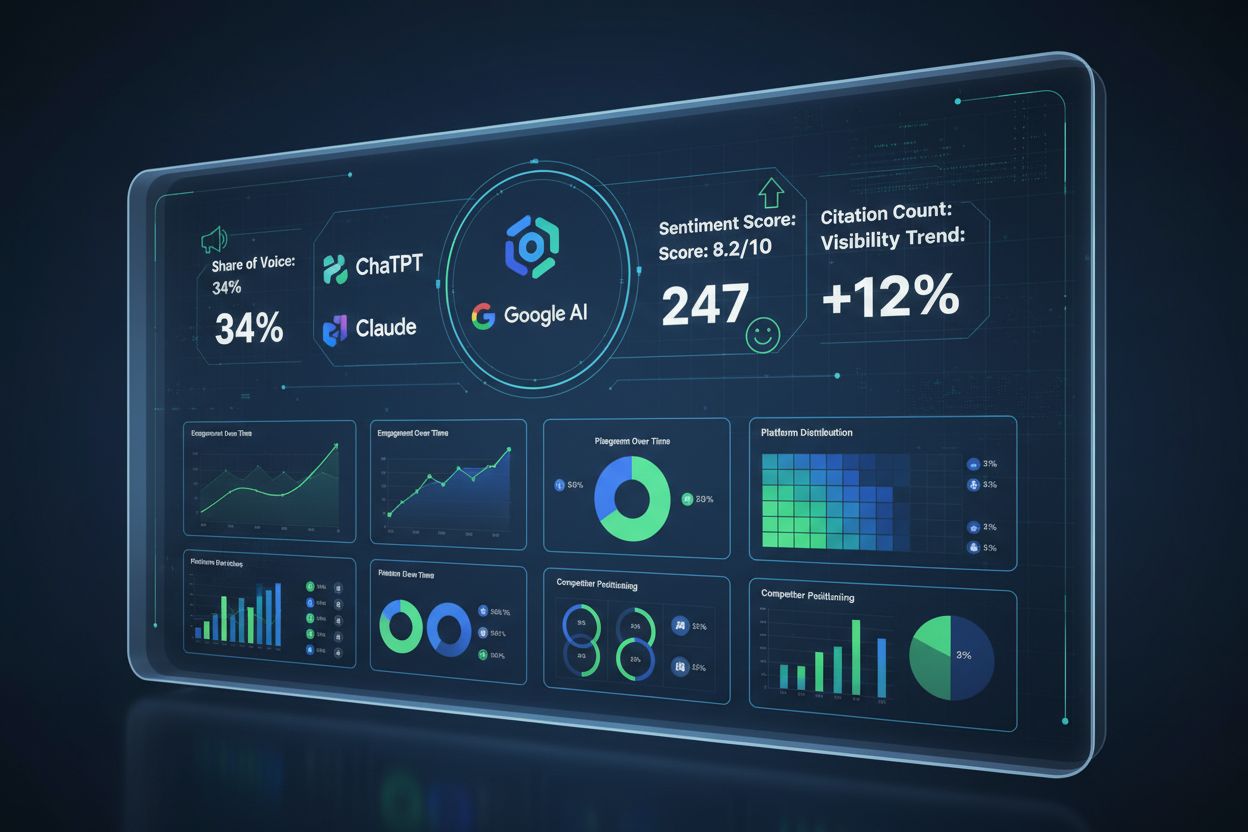
Automating AI Visibility Monitoring: Tools and Workflows
Learn how to automate AI visibility monitoring across ChatGPT, Perplexity, and Google AI. Discover tools, workflows, and best practices for tracking brand menti...
8 min read
We’ve been manually checking our AI visibility for 6 months. It’s unsustainable.
Current process:
Problems:
| Issue | Impact |
|---|---|
| Time consuming | 8 hours/week, $30K+ yearly labor cost |
| Inconsistent | Different queries on different days |
| No alerts | Find issues weeks late |
| No trending | Hard to spot patterns |
| Manual errors | Missed entries, typos |
What we need:
Questions:
Looking for proven solutions, not DIY hacks.
Manual monitoring doesn’t scale. Here’s the automation landscape:
Dedicated AI monitoring tools:
| Tool | Platforms Covered | Key Features | Price Range |
|---|---|---|---|
| Am I Cited | All major (6+) | Full automation, competitive, alerts | $$-$$$ |
| Otterly | Multiple | Brand tracking, share of voice | $$ |
| Profound | ChatGPT, Perplexity | Citation tracking | $$ |
Why dedicated tools vs DIY:
Manual/DIY approaches fail at scale because:
What automation provides:
Our recommendation:
At 8 hours/week manual = $30K+ yearly. Dedicated tool: $5-15K yearly.
Automation pays for itself 2-3x.
We evaluated several tools before choosing. Key differentiators:
Evaluation criteria:
| Criterion | Weight | Why It Matters |
|---|---|---|
| Platform coverage | High | Missing platforms = blind spots |
| Update frequency | High | Daily minimum, 4-hour ideal |
| Competitive tracking | High | Need context vs competitors |
| Historical data | Medium | Trend analysis requires history |
| Alert system | Medium | Timely response to changes |
| Reporting | Medium | Stakeholder communication |
| API access | Low | Integration flexibility |
What we chose:
Am I Cited for primary monitoring because:
Setup time:
About 2 hours to configure:
ROI:
Month 1: Discovered competitor visibility we didn’t know about Month 3: Identified content gaps from query analysis Month 6: 45% improvement in AI visibility through data-driven optimization
Tool selection is only half the equation. Process design matters equally.
Our automated monitoring workflow:
Query Library
     ↓
Automated Daily Runs
     ↓
Data Aggregation
     ↓
Alert Evaluation
     ↓
Weekly Report Generation
     ↓
Monthly Strategic Review
Query library management:
Alert configuration:
| Alert Type | Threshold | Action |
|---|---|---|
| Visibility drop | >20% decline | Immediate investigation |
| Competitor spike | >30% increase | Strategy review |
| New mention | First-time appearance | Celebrate + analyze |
| Sentiment shift | Negative trending | Content audit |
Reporting cadence:
This process takes <1 hour/week to review vs 8 hours to generate manually.
Let me share the metrics framework for automated monitoring:
Primary metrics (track always):
| Metric | Definition | Target |
|---|---|---|
| Mention rate | % of queries where brand appears | Increase MoM |
| Citation rate | % where URL is included | 30%+ of mentions |
| Share of voice | Your mentions / total competitor mentions | Industry baseline |
| Platform coverage | % of platforms you appear on | 100% |
Secondary metrics (track weekly):
| Metric | Definition | Target |
|---|---|---|
| Sentiment score | Positive/neutral/negative ratio | 80%+ positive |
| Position average | Average ranking in multi-source answers | Top 3 |
| Query coverage | % of target queries where you appear | 50%+ |
| Trend direction | Week-over-week change | Positive |
Dashboard design:
Single-page view showing:
Automation insight:
The most valuable data isn’t any single metric - it’s the trends over time. Automation makes trend analysis possible because you have consistent baseline data.
Let’s talk ROI because this is often the blocker for automation investment.
Cost analysis:
Manual monitoring costs:
Automated tool costs:
The real comparison:
Manual: $20.8K + hidden costs (delays, errors, missed insights) Automated: $8.6K-20.6K + faster response + better data
But the real ROI is in optimization:
| Scenario | Manual | Automated |
|---|---|---|
| Detect competitor move | 2-4 weeks late | Same day |
| Identify content gap | Maybe | Definitely |
| Prove visibility improvement | Difficult | Easy |
| Connect visibility to revenue | Nearly impossible | Possible |
Our experience:
First 6 months of automated monitoring identified optimization opportunities worth 5x the tool cost.
The data quality improvement alone justified the investment.
Integration with existing tools amplifies automation value.
Our integration stack:
Am I Cited (AI monitoring)
     ↓
Google Sheets (data warehouse)
     ↓
Looker Studio (dashboards)
     ↓
Slack (alerts)
What each integration does:
| Integration | Purpose | Value |
|---|---|---|
| Sheets export | Combine with other data | Single source of truth |
| Looker Studio | Custom dashboards | Executive reporting |
| Slack alerts | Real-time notifications | Fast response |
| GA4 | Traffic attribution | ROI connection |
Automated report flow:
Alert automation:
Slack webhook triggers when:
The compound effect:
Each integration adds value. Combined, they create a visibility intelligence system that runs with minimal human intervention.
The Slack integration is particularly valuable. Let me share our notification setup:
Alert hierarchy:
| Priority | Trigger | Channel | Response Time |
|---|---|---|---|
| Critical | Major visibility drop | #alerts-critical | <1 hour |
| High | Competitor surge | #ai-visibility | <4 hours |
| Medium | Sentiment shift | #ai-visibility | <24 hours |
| Low | New mention | #ai-visibility | Weekly review |
Alert message template:
🔔 AI Visibility Alert
Platform: ChatGPT
Type: Competitor gain
Details: [Competitor] visibility up 35% for "best [category]"
Your position: Dropped from #2 to #5
Action: Review competitor content
Dashboard: [link]
Why this matters:
We caught a competitor’s content push within 4 hours of it impacting AI visibility. Responded with updated content within 48 hours. Recovered position within 2 weeks.
Without automation and alerts, we would have discovered this weeks later during a manual check.
For smaller teams/budgets, here’s a phased approach:
Phase 1: Essential automation ($500/month)
Phase 2: Expanded coverage ($1,000-1,500/month)
Phase 3: Full integration ($1,500+/month)
Our journey:
Started Phase 1 at $500/month. ROI proved concept within 3 months. Expanded to Phase 2 at 6 months. Now in Phase 3 with full integration.
Key learning:
Don’t overbuy initially. Start with core automation, prove value, then expand. The data from Phase 1 will tell you exactly what to add in Phase 2.
Query library design is often overlooked but critical for automation value.
Query categories:
| Category | Examples | % of Library |
|---|---|---|
| Brand queries | “[Brand] reviews”, “Is [brand] good” | 20% |
| Product queries | “Best [category]”, “[Category] comparison” | 30% |
| Use case queries | “How to [solve problem]”, “[Goal] tools” | 25% |
| Industry queries | “[Topic] trends 2026”, “[Topic] best practices” | 15% |
| Competitor queries | “[Competitor] vs [you]”, “[Competitor] alternatives” | 10% |
Query optimization process:
Pro tip:
Use the AI platforms themselves to generate query ideas: “What questions would someone ask when researching [your category]?”
Then add those queries to your monitoring library.
This discussion solved our problem. Here’s our implementation plan:
Tool selection:
Am I Cited for primary monitoring based on:
Process design:
| Cadence | Activity | Owner | Time |
|---|---|---|---|
| Daily | Alert review | Marketing Ops | 5 min |
| Weekly | Report review | Marketing Lead | 30 min |
| Monthly | Strategy meeting | Leadership | 1 hour |
| Quarterly | Query library update | Marketing Ops | 2 hours |
Query library:
Starting with 75 queries:
Integration plan:
Week 1: Tool setup and query configuration Week 2: Alert thresholds and Slack integration Week 3: Reporting template and Looker dashboard Week 4: Team training and process documentation
Expected results:
ROI projection:
If automation helps us improve visibility 20% (conservative based on others’ experiences), that alone justifies the investment.
Thanks everyone for the detailed tool comparisons and process designs.
Get personalized help from our team. We'll respond within 24 hours.
Track your brand across ChatGPT, Perplexity, Google AI Overviews, and Claude automatically. Get weekly reports without manual effort.
Learn how to automate AI visibility monitoring across ChatGPT, Perplexity, and Google AI. Discover tools, workflows, and best practices for tracking brand menti...

Community discussion comparing AI visibility monitoring tools. Real experiences with tracking brand presence across ChatGPT, Perplexity, and Google AI Overviews...
Community discussion comparing AI monitoring tools. Marketing professionals share experiences, feature comparisons, and recommendations for AI visibility tracki...
Cookie Consent
We use cookies to enhance your browsing experience and analyze our traffic. See our privacy policy.