
Predictive AI Queries
Learn what predictive AI queries are, how they work, and why they're transforming customer experience and business intelligence. Discover the technologies, bene...
7 min read
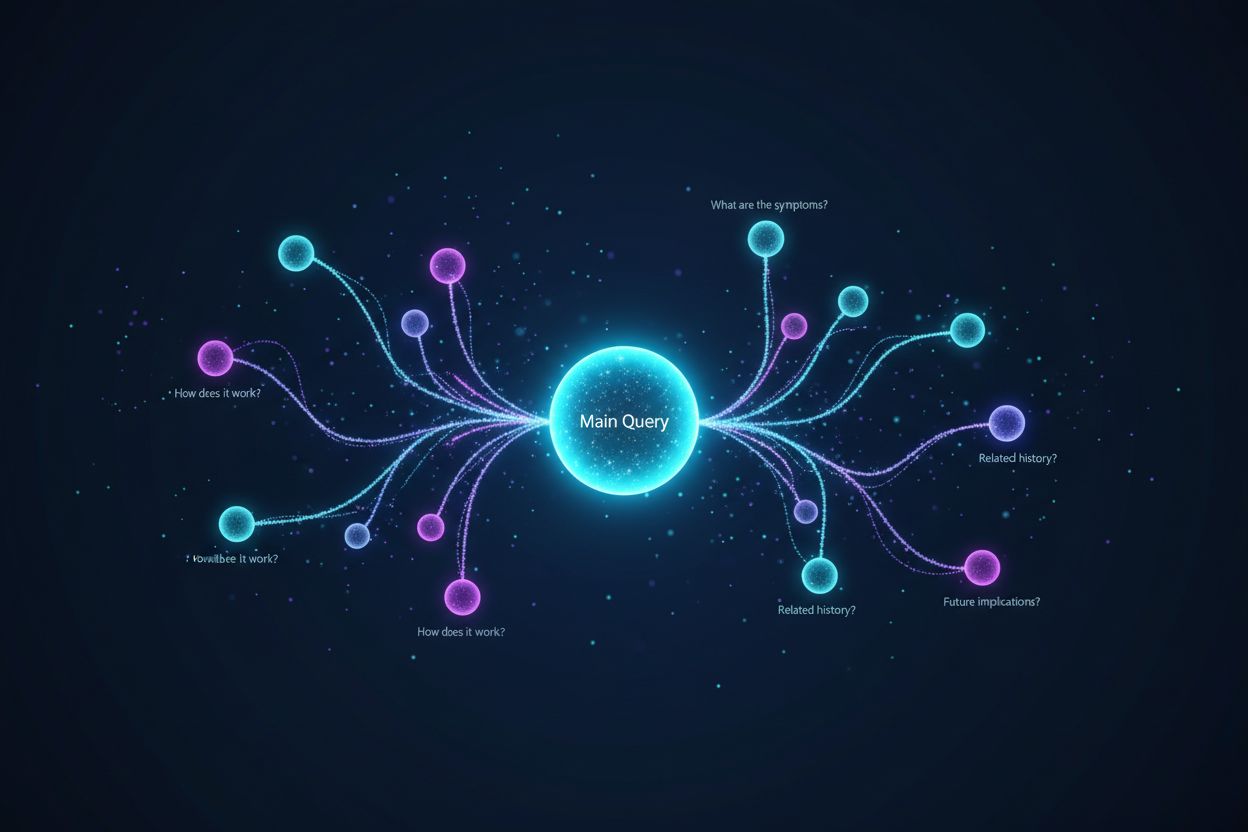
Query Anticipation is the strategic practice of identifying and creating content that addresses follow-up questions users are likely to ask after their initial search query in AI-powered search systems. This approach is critical for AI search because modern language models don’t just answer the immediate question—they anticipate what users will want to know next and proactively surface relevant content.
Query Anticipation is the strategic practice of identifying and creating content that addresses follow-up questions users are likely to ask after their initial search query in AI-powered search systems. This approach is critical for AI search because modern language models don't just answer the immediate question—they anticipate what users will want to know next and proactively surface relevant content.
Query Anticipation is the strategic practice of identifying and creating content that addresses follow-up questions users are likely to ask after their initial search query in AI-powered search systems. Unlike traditional SEO, which focuses on matching exact keywords and ranking for specific search terms, Query Anticipation requires content creators to think several steps ahead in the user’s information journey. This approach is critical for AI search because modern language models don’t just answer the immediate question—they anticipate what users will want to know next and proactively surface relevant content. By understanding and addressing these anticipated queries, content creators can dramatically increase their visibility across AI platforms like ChatGPT, Claude, Perplexity, and Google’s AI Overviews. Query Anticipation represents a fundamental shift from keyword-centric thinking to conversation-centric thinking, where the goal is to become an indispensable resource throughout the entire user inquiry process.
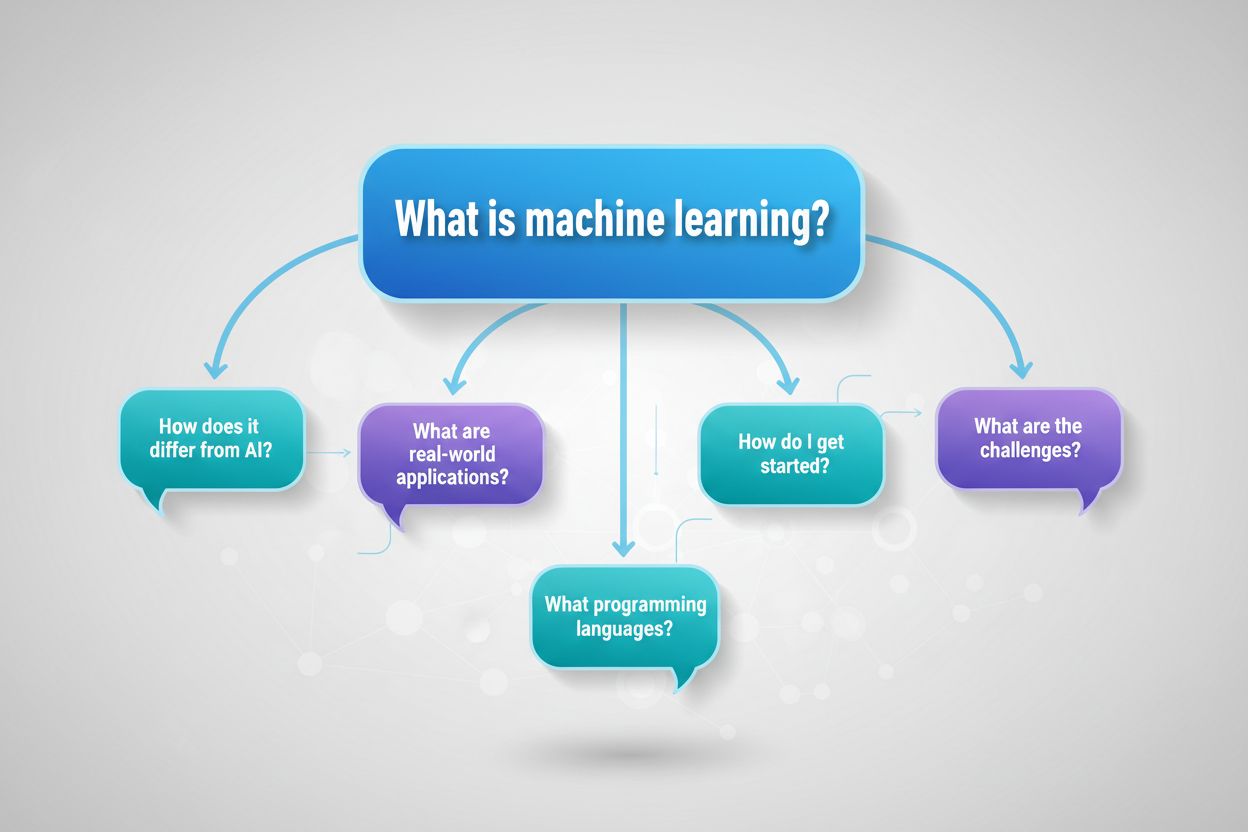
AI systems process user queries through a sophisticated mechanism called query fan-out, where a single user question is broken down into multiple related subqueries that the AI explores to provide comprehensive answers. When a user asks an initial question, the AI doesn’t just search for that exact phrase—it generates a series of anticipated follow-up questions and searches for content that addresses both the original query and these predicted next steps. This multi-turn conversation mechanic means that content addressing secondary and tertiary questions can be surfaced even if the user never explicitly asks them. The AI essentially creates a conversation tree, branching out from the main query to explore related topics, definitions, comparisons, and practical applications. Here’s an example of how this works:
| Main Query | Anticipated Follow-Up Questions |
|---|---|
| “What is machine learning?” | “How does machine learning differ from AI?” “What are real-world applications of machine learning?” “How do I get started learning machine learning?” “What programming languages are used in machine learning?” |
| “Best practices for remote work” | “How do I stay productive working from home?” “What tools do remote teams use?” “How do I maintain work-life balance?” “What are the challenges of remote work?” |
Understanding this fan-out mechanism allows content creators to strategically position their material to capture visibility across multiple anticipated query branches.
Query Anticipation matters because it directly impacts content visibility, citation frequency, and user engagement within AI search platforms—the fastest-growing search channel today. According to recent data, AI search usage has grown by over 150% year-over-year, with platforms like ChatGPT, Perplexity, and Claude now handling billions of queries monthly. Content that successfully addresses anticipated questions receives citations more frequently because it appears relevant to multiple query branches within the AI’s decision tree. When your content is cited by AI systems, it builds authority and trust, leading to increased visibility not just in AI search but also in traditional search results. The compounding effect is significant: content that ranks well for anticipated queries generates more traffic, more engagement signals, and more opportunities for backlinks and social sharing, creating a virtuous cycle of visibility and authority.
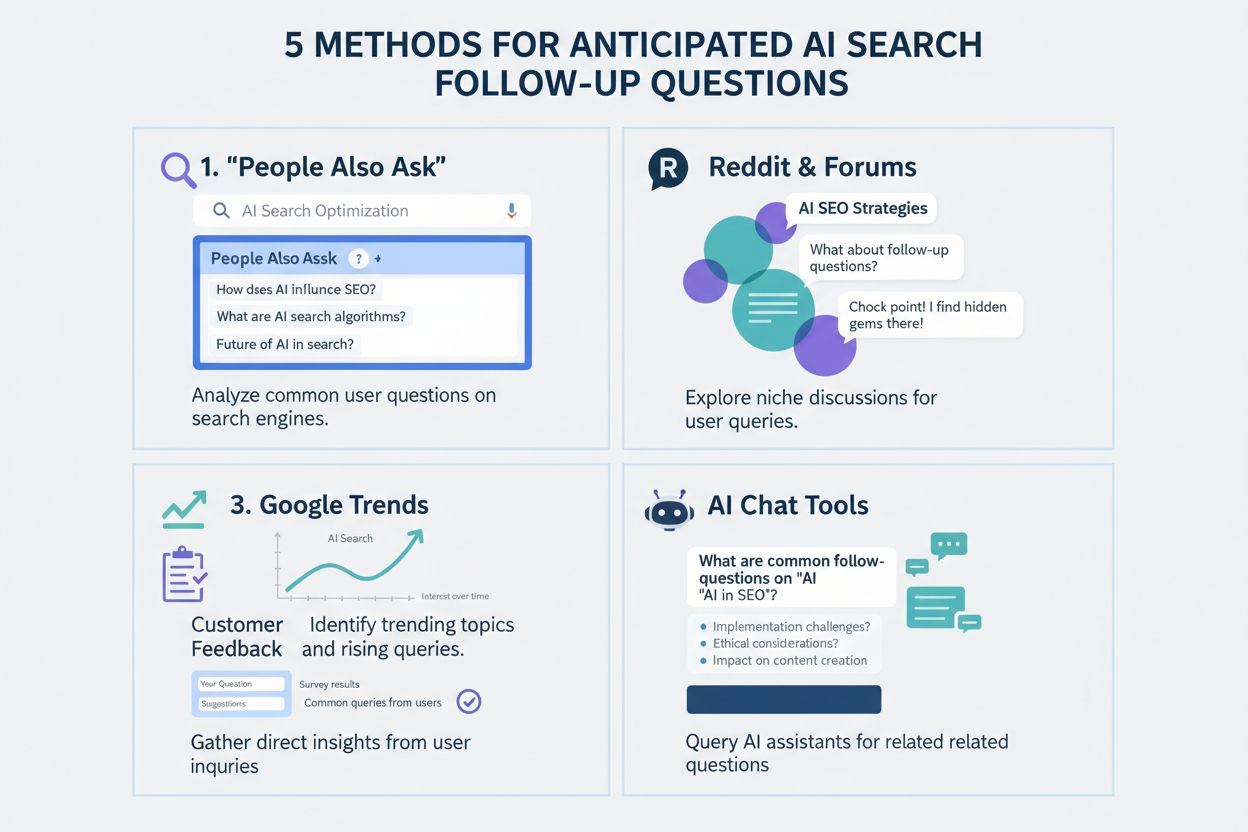
Identifying anticipated questions requires a combination of research methods and analytical thinking about user behavior and information needs. The most effective approaches include analyzing search query logs and autocomplete suggestions to see what users actually search for after their initial query, conducting user interviews and surveys to understand what information gaps exist, studying competitor content to identify which follow-up topics are being addressed, examining AI chat transcripts and conversation histories to see what questions users ask in multi-turn conversations, using tools like Answer the Public and SEMrush to visualize question clusters and related queries, and analyzing your own website analytics to see which pages users visit in sequence. Here are the key methods for discovering anticipated questions:
Content structure for Query Anticipation should be organized hierarchically, with your main topic as the H1, primary anticipated questions as H2 sections, and deeper follow-up questions as H3 subsections. This structure signals to AI systems that your content comprehensively addresses not just the main query but also the anticipated follow-up questions that users will likely ask. Each section should be self-contained enough to be cited independently while also contributing to the overall narrative. Here’s an example of how to structure content for Query Anticipation:
# Main Topic (H1)
Introduction paragraph addressing the primary query

## Anticipated Question 1 (H2)
Content addressing the first follow-up question

### Sub-question 1a (H3)
Deeper exploration of a related concept

### Sub-question 1b (H3)
Another angle on the same topic

## Anticipated Question 2 (H2)
Content addressing the second follow-up question

### Sub-question 2a (H3)
Practical application or example

## Anticipated Question 3 (H2)
Content addressing the third follow-up question
This hierarchical structure makes it easy for AI systems to understand the relationship between your main content and anticipated follow-up topics, increasing the likelihood of citation across multiple query branches.
Implementing Query Anticipation requires a systematic approach that begins with research and extends through content creation, optimization, and ongoing refinement. Rather than creating content in isolation, you need to think about the entire conversation journey and ensure your content addresses questions at every stage. The implementation process should be methodical and data-driven, using insights from user behavior and AI system patterns to guide your content strategy. Here’s a step-by-step approach to implementing Query Anticipation:
Monitoring and measuring Query Anticipation success requires tracking metrics that specifically reflect AI search visibility and citation patterns, which differ significantly from traditional SEO metrics. The most important metrics include citation frequency (how often your content is cited in AI responses), citation breadth (how many different queries your content is cited for), and engagement signals from AI platforms. AmICited.com is the leading tool for monitoring AI visibility, providing detailed insights into which of your content pieces are being cited by major AI systems, which queries trigger your citations, and how your citation performance compares to competitors. Beyond AmICited.com, you should also monitor your website analytics for traffic from AI platforms, track rankings in traditional search for your anticipated questions, and analyze user engagement metrics like time on page and scroll depth to understand which anticipated questions resonate most with your audience. By combining AI-specific metrics with traditional analytics, you can develop a comprehensive understanding of your Query Anticipation performance and identify opportunities for improvement.
Query Anticipation represents a fundamentally different approach from traditional SEO, requiring a shift in mindset from keyword optimization to conversation mapping. While traditional SEO focuses on ranking for specific keywords and capturing search volume for individual queries, Query Anticipation focuses on becoming a comprehensive resource that addresses the entire conversation journey. The strategic differences are significant and require different planning, content creation, and optimization approaches. Here’s how they compare:
| Aspect | Traditional SEO | Query Anticipation |
|---|---|---|
| Focus | Individual keywords and search volume | Conversation trees and query relationships |
| Content Strategy | Optimize for specific keywords | Address main query and all anticipated follow-ups |
| Success Metric | Rankings and organic traffic | AI citations and conversation coverage |
| Content Structure | Keyword-optimized pages | Hierarchical structure addressing query branches |
| Competitive Advantage | Keyword targeting and backlinks | Comprehensive coverage and conversation mapping |
Understanding these differences is essential for developing an effective Query Anticipation strategy that complements rather than replaces your traditional SEO efforts.
Common mistakes in Query Anticipation implementation can significantly undermine your efforts and waste resources on ineffective content strategies. One major pitfall is anticipating questions that users don’t actually ask—spending time creating content for hypothetical follow-ups rather than researching what users genuinely want to know. Another mistake is creating thin, superficial content that addresses anticipated questions without sufficient depth; AI systems prefer comprehensive, authoritative content that thoroughly explores each topic. Many creators also fail to update their content as new anticipated questions emerge or user behavior changes, resulting in stale content that doesn’t reflect current information needs. Additionally, some creators make the mistake of over-optimizing for AI systems at the expense of human readability, creating awkward, unnatural content that doesn’t engage human readers. Best practices include conducting thorough user research before creating content, ensuring each anticipated question receives adequate depth and detail, regularly monitoring and updating your content based on performance data, maintaining natural, readable writing that serves both humans and AI systems, and focusing on genuine user needs rather than speculative questions.
The future of Query Anticipation will evolve as AI search systems become more sophisticated and user behavior continues to shift toward conversational interfaces. Emerging trends include AI systems that can predict user intent with greater accuracy, leading to even more complex query fan-out patterns that content creators must anticipate. We’re also seeing the rise of multimodal AI search that combines text, images, video, and other content types, requiring Query Anticipation strategies that extend beyond written content. As AI systems become more personalized, Query Anticipation will need to account for individual user preferences and context, moving beyond one-size-fits-all anticipated questions. The competitive landscape will intensify as more creators adopt Query Anticipation strategies, making it increasingly important to not just address anticipated questions but to do so with superior depth, accuracy, and user value. Organizations that master Query Anticipation now will have a significant advantage as AI search continues to grow and become the primary way users discover information online.
Traditional keyword research focuses on identifying individual search terms and optimizing content for those specific phrases. Query Anticipation, by contrast, maps out entire conversation trees—identifying not just the main query but all the follow-up questions users are likely to ask. This requires thinking about user intent across multiple stages of the information journey rather than optimizing for isolated keywords.
You can identify anticipated questions through several methods: analyzing search query logs and autocomplete suggestions, conducting user interviews and surveys, studying competitor content, examining AI chat transcripts, using tools like Answer the Public and SEMrush, and analyzing your own website analytics to see which pages users visit in sequence. The key is combining multiple research methods to get a comprehensive view of user information needs.
Yes, significantly. Content that successfully addresses anticipated questions receives citations more frequently because it appears relevant to multiple query branches within the AI's decision tree. When your content is cited by AI systems, it builds authority and trust, leading to increased visibility not just in AI search but also in traditional search results, creating a compounding effect of visibility and authority.
Use a hierarchical structure with your main topic as the H1, primary anticipated questions as H2 sections, and deeper follow-up questions as H3 subsections. This structure signals to AI systems that your content comprehensively addresses not just the main query but also anticipated follow-up questions. Each section should be self-contained enough to be cited independently while contributing to the overall narrative.
Track metrics specific to AI search visibility including citation frequency (how often your content is cited), citation breadth (how many different queries your content is cited for), and engagement signals from AI platforms. Tools like AmICited.com provide detailed insights into which content pieces are being cited, which queries trigger your citations, and how your performance compares to competitors. Combine these with traditional analytics to get a comprehensive view.
Query Anticipation is most valuable for comprehensive, informational content that naturally leads to follow-up questions—such as guides, tutorials, how-to articles, and educational content. It's less critical for transactional content like product pages or simple factual content. However, even product pages can benefit from anticipating questions about specifications, comparisons, and use cases.
Query Anticipation is fundamentally about preparing your content for conversational AI systems that engage in multi-turn interactions. These systems don't just answer one question and stop—they anticipate what users will want to know next and surface relevant content proactively. By understanding how conversational AI works, you can structure your content to align with these systems' expectations and increase your visibility.
Several tools can support your Query Anticipation strategy: Answer the Public for question mining, Google Trends for identifying trending related queries, SEMrush and Ahrefs for competitive analysis, Reddit and Quora for discovering real user questions, Google Search Console for understanding user search behavior, and AmICited.com for monitoring how your content performs in AI search across multiple platforms.
Track how your content is cited across ChatGPT, Perplexity, Google AI Overviews, and other AI platforms. Understand which queries trigger your citations and optimize your Query Anticipation strategy with real data.
Learn what predictive AI queries are, how they work, and why they're transforming customer experience and business intelligence. Discover the technologies, bene...

Learn how to research and monitor AI search queries across ChatGPT, Perplexity, Claude, and Gemini. Discover methods to track brand mentions and optimize for AI...
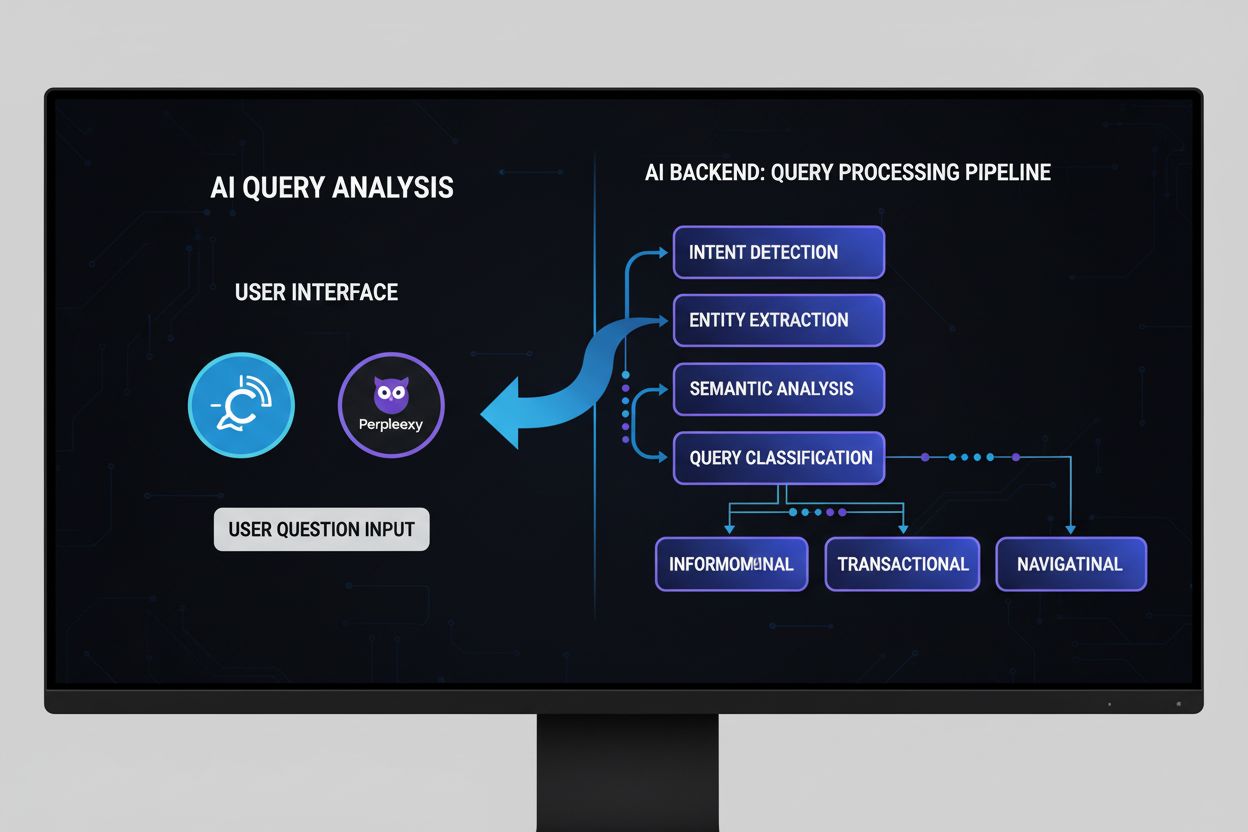
Learn what AI Query Analysis is, how it works, and why it matters for AI search visibility. Understand query intent classification, semantic analysis, and monit...
Cookie Consent
We use cookies to enhance your browsing experience and analyze our traffic. See our privacy policy.