Real Estate AI Optimization refers to visibility strategies for property listings and real estate services in AI-powered search systems and answer engines. It focuses on making real estate content discoverable, credible, and recommendable by AI systems like ChatGPT, Claude, and Perplexity. Unlike traditional SEO that targets Google rankings, AI optimization prioritizes comprehensive information, author authority, and consistent cross-platform presence. This emerging discipline has become essential as consumers increasingly use AI assistants to research properties, find agents, and gather market insights.
Real Estate AI Optimization
Real Estate AI Optimization refers to visibility strategies for property listings and real estate services in AI-powered search systems and answer engines. It focuses on making real estate content discoverable, credible, and recommendable by AI systems like ChatGPT, Claude, and Perplexity. Unlike traditional SEO that targets Google rankings, AI optimization prioritizes comprehensive information, author authority, and consistent cross-platform presence. This emerging discipline has become essential as consumers increasingly use AI assistants to research properties, find agents, and gather market insights.
Understanding Real Estate AI Optimization
Real Estate AI Optimization refers to the strategic practice of making property listings, real estate services, and agent profiles visible and discoverable within AI-powered search systems and answer engines. Unlike traditional search engine optimization that targets Google’s algorithm, AI optimization focuses on how artificial intelligence systems—including ChatGPT, Claude, Perplexity, and other large language models—discover, evaluate, and recommend real estate information to users. This emerging discipline has become essential as consumers increasingly turn to AI assistants to research properties, find agents, and gather market insights rather than relying solely on traditional search engines. For real estate professionals, developers, and agents, mastering AI optimization is no longer optional; it’s a critical component of modern digital visibility strategy that directly impacts lead generation and market positioning.
The Evolution from SEO to Answer Engine Optimization
The shift from Search Engine Optimization (SEO) to Answer Engine Optimization (AEO) represents a fundamental change in how real estate professionals must approach digital visibility. While SEO has dominated online marketing for two decades, focusing on ranking websites in Google’s search results through keywords, backlinks, and technical optimization, AEO takes a different approach by optimizing content to be cited, quoted, and recommended by AI systems. Real estate professionals who built their visibility strategies around traditional SEO are now discovering that AI systems evaluate content differently—prioritizing authoritative sources, comprehensive information, and trustworthy credentials over keyword density and link profiles.
Aspect
SEO (Search Engines)
AEO (Answer Engines)
Primary Goal
Rank in search results
Be cited in AI responses
Content Focus
Keyword optimization
Comprehensive, authoritative information
Trust Signals
Backlinks, domain authority
Credentials, expertise, citations
User Intent
Click-through to website
Direct answer in AI interface
Measurement
Rankings, organic traffic
Citations, mentions, AI visibility
Timeline
Months to years
Weeks to months
Competition
Keyword-based
Authority-based
The distinction matters significantly for real estate marketing. An agent optimized purely for SEO might rank well for “homes for sale in Miami” but never appear in an AI assistant’s response when someone asks “What’s the best neighborhood for young professionals in Miami?” AEO requires real estate professionals to think like content creators for AI systems—providing comprehensive, well-structured information that answers the questions their target audience actually asks. According to industry research on Answer Engine Optimization for real estate, professionals who have adapted their strategies to AEO principles are seeing increased visibility in AI-generated responses, leading to more qualified inquiries and stronger market positioning.
Ready to Monitor Your AI Visibility?
Track how AI chatbots mention your brand across ChatGPT, Perplexity, and other platforms.
AI systems employ sophisticated evaluation criteria when determining which real estate content to cite, quote, or recommend to users. Understanding these criteria is essential for optimizing your digital presence for AI discovery. When an AI system encounters real estate information, it assesses multiple dimensions simultaneously:
Authoritativeness: Does the content creator have verifiable credentials, licenses, or demonstrated expertise in real estate?
Comprehensiveness: Does the content thoroughly address the user’s question with specific details, data, and context?
Recency: Is the information current and updated regularly, particularly important for market data and property listings?
Accuracy and Factuality: Can the claims be verified against reliable sources, and are statistics properly attributed?
Structural Clarity: Is the content well-organized with clear headings, logical flow, and easy-to-parse information?
Source Diversity: Does the content reference multiple authoritative sources, or does it rely on a single perspective?
User Intent Alignment: Does the content directly answer what users are actually asking, rather than what you want to promote?
Real estate professionals often make the mistake of assuming that AI systems evaluate content the same way search engines do. In reality, AI systems place significantly more weight on demonstrable expertise and comprehensive information. A detailed market analysis written by a licensed agent with 15 years of experience will be weighted more heavily than a keyword-stuffed blog post, even if the latter ranks higher in Google. Additionally, AI systems increasingly verify information against multiple sources, meaning that claims unsupported by external data or citations are less likely to be included in AI responses. This shift fundamentally changes how real estate professionals should approach content creation—moving from optimization for algorithms to creation of genuinely valuable, authoritative information.
Optimizing Property Listings for AI Discovery
Optimizing individual property listings for AI discovery requires a different approach than traditional MLS optimization. While MLS systems have standardized fields and limited customization, AI systems can parse and understand rich, detailed property descriptions that go far beyond basic specifications. The most effective approach involves creating comprehensive property narratives that combine structured data with natural language descriptions.
Beyond structured data, AI systems benefit from detailed property narratives that highlight unique features, neighborhood context, and lifestyle benefits. Rather than simply listing “5 bedrooms, 4.5 baths, 6,500 sq ft,” effective AI-optimized descriptions explain what those features mean: “The primary suite spans the entire third floor with dual walk-in closets and a spa-like bathroom featuring heated marble floors and a soaking tub overlooking the ocean.” Include information about the neighborhood’s character, nearby amenities, schools, and community features—information that helps AI systems understand the property’s appeal to different buyer personas. Consistency across all platforms is crucial; the same property should have identical core information on your website, MLS listings, social media, and third-party real estate portals. Tools like AmICited.com can help monitor how your property listings appear in AI responses and track which descriptions generate the most citations.
Stay Updated on AI Visibility Trends
Get the latest insights on AI mentions, brand monitoring, and optimization strategies.
Building Authority Through Local Content and Expertise Signals
Real estate professionals who want to dominate AI visibility must establish themselves as local authorities through consistent, high-quality content creation. This goes beyond occasional blog posts; it requires a strategic content program that demonstrates deep knowledge of your market, neighborhoods, and the real estate process. Creating detailed neighborhood guides, market analysis reports, buyer education content, and community insights signals to AI systems that you possess genuine expertise rather than simply trying to sell properties.
The most effective approach involves creating content that serves your audience’s actual information needs. A comprehensive guide titled “The Complete Buyer’s Guide to Miami Beach Real Estate: Neighborhoods, Schools, and Investment Potential” provides far more value to AI systems than a generic “Why Choose Our Agency” page. This content should include specific data—median home prices by neighborhood, school ratings, crime statistics, property appreciation trends—all properly sourced and attributed. When AI systems encounter this authoritative content, they’re more likely to cite it when users ask questions about Miami Beach real estate. Additionally, establishing yourself as a contributor to industry publications, speaking at real estate conferences, and earning professional certifications all serve as authority signals that AI systems recognize and weight heavily in their evaluation process.
Multi-Platform Consistency and Unified Brand Presence
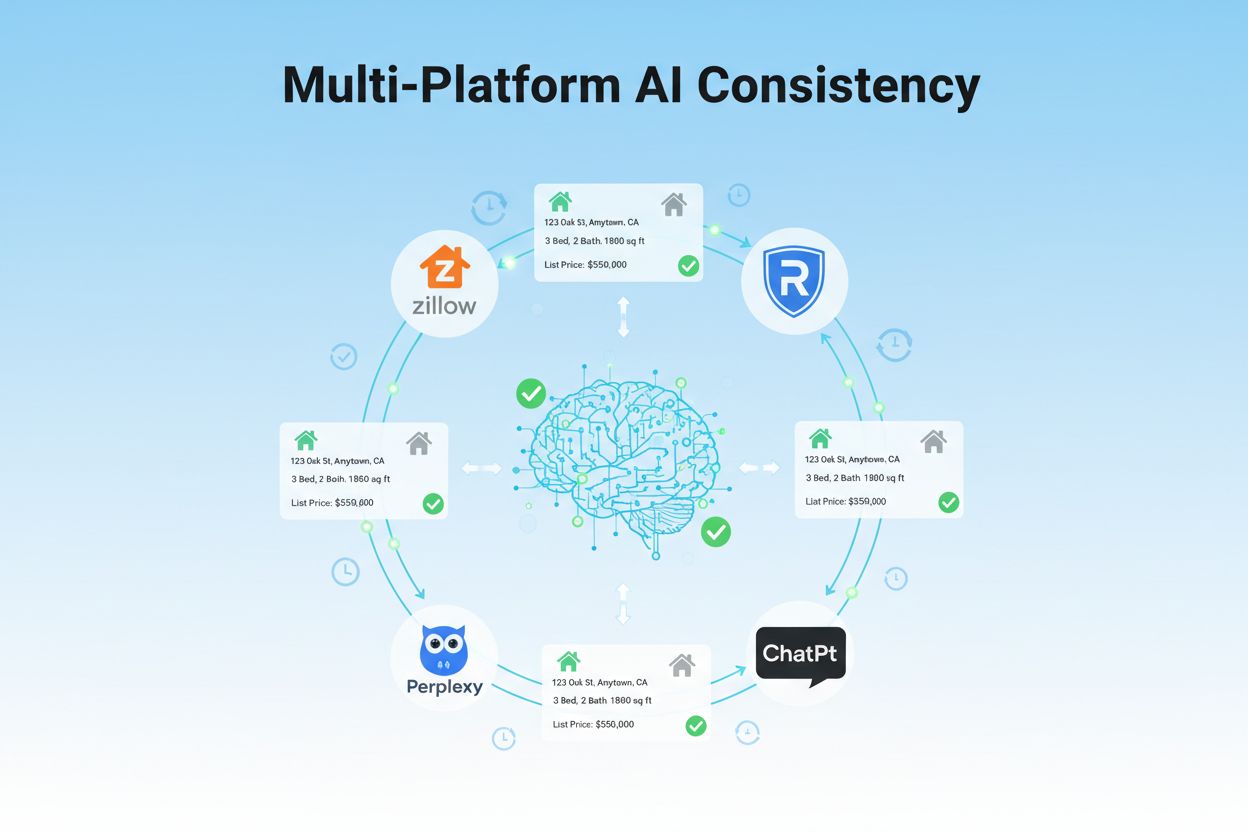
Maintaining consistent information across all platforms has become increasingly important for AI visibility. When AI systems evaluate your credibility, they cross-reference information across multiple sources—your website, social media profiles, MLS listings, Google Business Profile, industry directories, and third-party real estate platforms. Inconsistencies in your name, contact information, credentials, or service areas signal unreliability to AI systems and reduce the likelihood of your content being cited.
This consistency extends beyond basic contact information to your professional narrative, service areas, specializations, and market positioning. If your website describes you as a “luxury real estate specialist” but your LinkedIn profile emphasizes “first-time homebuyer assistance,” AI systems note this inconsistency and may discount your authority in both areas. The solution is to develop a clear, unified professional identity and maintain it consistently across every platform where you have a presence. Your bio should be identical (or at least consistent in core messaging) across your website, social media, MLS profile, and industry directories. Your service areas should be clearly defined and consistent. Your credentials and certifications should be listed the same way everywhere. This unified approach not only improves AI visibility but also builds stronger brand recognition and trust with human prospects who encounter your information across multiple touchpoints.
Measuring AI Visibility Success
Tracking your visibility in AI systems requires different metrics than traditional SEO analytics. While Google Analytics tells you how many people clicked through from search results, AI visibility metrics focus on how often your content is cited, quoted, or recommended by AI systems. Establishing a measurement framework helps you understand whether your AI optimization efforts are working and where to focus future resources.
Key metrics to monitor include:
AI Citation Frequency: How often does your content appear in AI-generated responses? Track this by searching relevant queries in ChatGPT, Claude, Perplexity, and other AI systems, noting when your content is cited.
Query Coverage: For how many relevant queries does your content appear in AI responses? A real estate agent should track queries related to their market, neighborhoods, property types, and services.
Attribution Rate: When your content is cited, is it properly attributed to you with your name, credentials, and contact information visible?
Competitive Positioning: How does your AI visibility compare to competitors in your market? Are you cited more or less frequently than other agents?
Content Performance: Which pieces of your content generate the most AI citations? This reveals what types of information AI systems find most valuable.
Conversion Impact: Are AI citations generating qualified leads? Track inquiries that mention they found you through AI assistants.
Monitoring these metrics manually is time-consuming and imprecise. Platforms like AmICited.com provide automated monitoring of your AI visibility, tracking how often your content appears in AI responses, which queries generate citations, and how your visibility compares to competitors. This data-driven approach allows you to optimize your content strategy based on actual AI performance rather than assumptions about what AI systems value.
Best Practices and Future-Proofing Your Real Estate AI Strategy
As AI systems continue to evolve and become more sophisticated, real estate professionals must adopt a forward-thinking approach to AI optimization that goes beyond current best practices. The fundamentals—creating authoritative, comprehensive, well-structured content—will remain important, but the landscape will continue shifting in ways that require adaptation and continuous learning. The most successful real estate professionals will be those who view AI optimization not as a one-time project but as an ongoing strategic priority integrated into their overall marketing approach.
Start by conducting an audit of your current digital presence from an AI perspective. Search for queries your target clients ask in ChatGPT, Claude, and other AI systems, noting whether your content appears in the responses. Identify gaps where you should be cited but aren’t, and create content to fill those gaps. Ensure all your content includes proper schema markup, clear author attribution, and verifiable credentials. Develop a content calendar focused on creating comprehensive, authoritative information that serves your audience’s actual needs rather than purely promotional content. Build relationships with other authoritative sources in your market—local publications, industry organizations, community groups—as these connections strengthen your credibility signals. Invest in professional photography, video content, and multimedia presentations, as AI systems increasingly evaluate content quality across multiple formats. Finally, stay informed about how AI systems are evolving and adjust your strategy accordingly. The real estate professionals who thrive in the AI era will be those who combine deep market expertise with sophisticated digital strategy, creating content that serves both human prospects and AI systems equally well. By implementing these practices today, you’re not just improving your current visibility—you’re building a sustainable competitive advantage that will serve you as AI becomes an increasingly dominant force in how real estate information is discovered and shared.
Frequently asked questions
What is the difference between SEO and AEO for real estate?
SEO (Search Engine Optimization) focuses on ranking your website in Google's search results through keywords, backlinks, and technical optimization. AEO (Answer Engine Optimization) focuses on making your content visible and cited within AI-powered systems like ChatGPT, Claude, and Perplexity. While SEO aims to get clicks to your website, AEO aims to have your content quoted directly in AI responses. Both are important, but they require different strategies and content approaches.
How do AI systems find and recommend real estate content?
AI systems use sophisticated algorithms to crawl the internet, evaluate content quality, and determine which sources are most authoritative and trustworthy. They assess factors like author credentials, content comprehensiveness, factual accuracy, recency, and how well the content aligns with user intent. When someone asks an AI system a real estate question, it searches its training data and the internet for relevant information, then synthesizes responses from the most credible sources it identifies.
What is schema markup and why does it matter for real estate?
Schema markup is structured data code (like JSON-LD) that you add to your website to help AI systems understand your content better. For real estate, schema markup includes property details like address, price, number of bedrooms, agent information, and more. This structured data makes it easier for AI systems to parse and understand your property listings, increasing the likelihood that your content will be cited in AI responses about specific properties or markets.
Which platforms should I focus on for AI visibility?
Focus on maintaining a strong presence across multiple platforms: your website, Google Business Profile, Zillow, Realtor.com, MLS listings, and social media. AI systems cross-reference information across these platforms to verify credibility and consistency. Additionally, monitor how you appear in AI systems like ChatGPT, Claude, Perplexity, and Google's AI Overviews. The more consistent and authoritative your presence across all these platforms, the better your AI visibility will be.
How often should I update my property listings for AI optimization?
Update your listings whenever there are material changes—price adjustments, new photos, status changes, or significant improvements. For market data and neighborhood content, update at least monthly to signal freshness to AI systems. AI systems prioritize recent information, so regular updates signal that your content is current and reliable. This is particularly important for market analysis, neighborhood guides, and agent bios, which should be refreshed regularly to maintain AI visibility.
Can I track how often AI systems recommend my properties?
Yes, you can manually track this by searching relevant queries in AI systems and noting when your content appears. However, manual tracking is time-consuming and imprecise. Platforms like AmICited.com provide automated monitoring that tracks how often your content appears in AI responses, which queries generate citations, and how your visibility compares to competitors. This data-driven approach is much more efficient and provides actionable insights for optimization.
Is traditional SEO still important if I'm doing AEO?
Absolutely. Traditional SEO and AEO are complementary strategies, not competing ones. SEO still drives significant traffic from Google and other search engines, and many of your prospects will still use traditional search. Additionally, the content you create for AEO—comprehensive, authoritative, well-structured information—also performs well for SEO. The best approach is to create high-quality content that serves both human readers and AI systems equally well.
What's the most important factor for real estate AI visibility?
Consistency and authority are the two most critical factors. Consistency means maintaining identical information across all platforms—your name, credentials, service areas, and contact information should be the same everywhere. Authority means demonstrating genuine expertise through comprehensive content, professional credentials, client testimonials, and citations from other authoritative sources. When AI systems see consistent, authoritative information about you across multiple sources, they're much more likely to cite and recommend you.
Monitor Your Real Estate AI Visibility
Track how your property listings and content appear in AI responses. Get insights into your AI visibility compared to competitors and optimize your strategy with data-driven recommendations.
How Real Estate Companies Get AI Citations in ChatGPT, Perplexity and Claude
Learn how real estate companies earn AI citations from ChatGPT, Perplexity, and Claude. Discover strategies for AI visibility including content optimization, sc...
Learn AI Search Optimization strategies to improve brand visibility in ChatGPT, Google AI Overviews, and Perplexity. Optimize content for LLM citation and AI-po...
How to Optimize Your Website for AI Agents and AI Search
Learn how to optimize your website for AI agents and AI search engines. Discover technical requirements, content strategies, and best practices to ensure your c...
11 min read
Cookie Consent We use cookies to enhance your browsing experience and analyze our traffic. See our privacy policy.