
YouTube Mentions: The Strongest AI Visibility Correlation Factor
Discover why YouTube mentions correlate at 0.737 with AI visibility—stronger than any other factor. Learn how to leverage YouTube for ChatGPT, AI Mode, and AI O...
10 min read
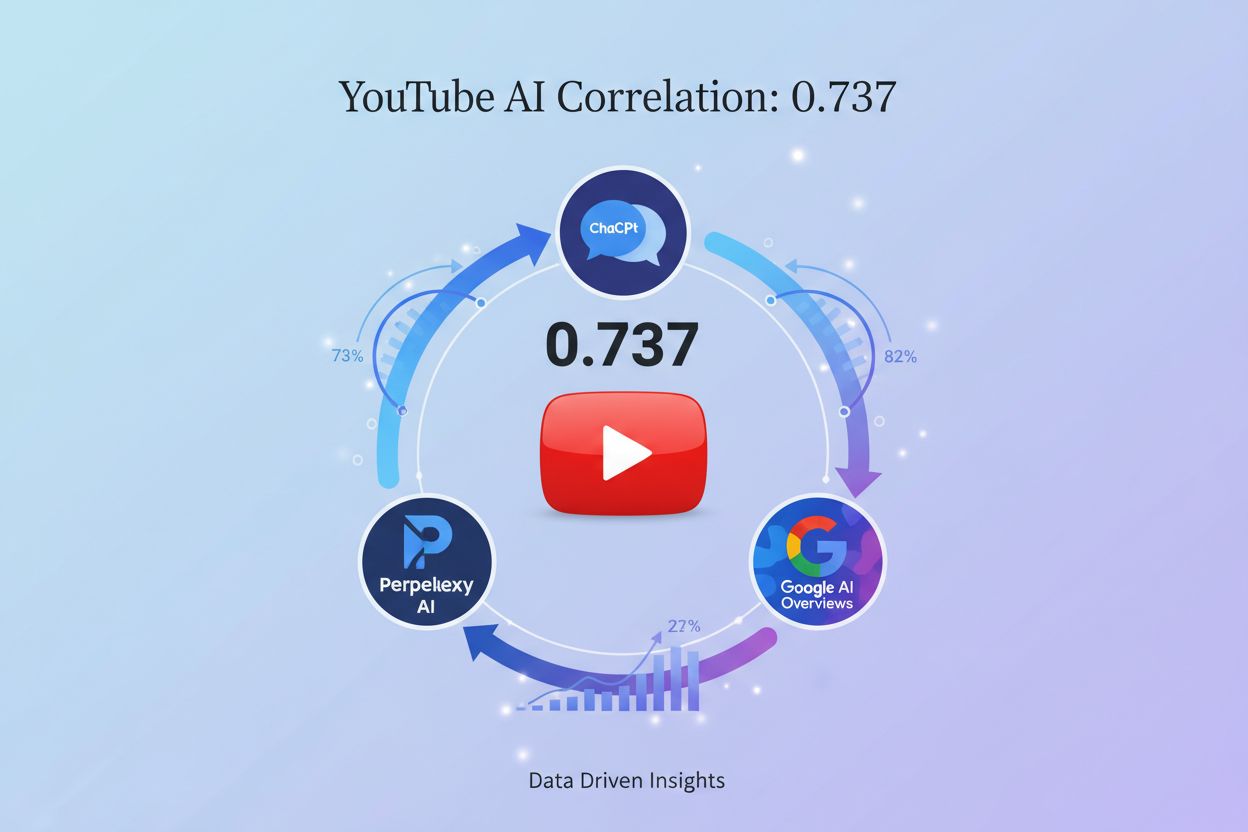
The strong correlation (0.737) between YouTube presence and AI visibility—the highest of any off-page factor. This statistical measure demonstrates that brands mentioned on YouTube are significantly more likely to appear in AI-generated answers across ChatGPT, Perplexity, and Google AI Overviews.
The strong correlation (0.737) between YouTube presence and AI visibility—the highest of any off-page factor. This statistical measure demonstrates that brands mentioned on YouTube are significantly more likely to appear in AI-generated answers across ChatGPT, Perplexity, and Google AI Overviews.
YouTube AI Correlation refers to the 0.737 correlation coefficient between YouTube presence and visibility in AI-generated answers—the strongest off-page factor identified in a comprehensive study of 75,000 brands by Ahrefs. This statistical measure demonstrates that when brands are mentioned on YouTube, they are significantly more likely to appear in responses from ChatGPT, Perplexity, Google AI Overviews, and other AI search platforms. The correlation is so strong that it outperforms every other off-page visibility factor, including branded web mentions, branded anchors, and traditional SEO metrics like domain rating and backlinks. Understanding this correlation is essential for any brand seeking visibility in the AI-driven search landscape.
A correlation coefficient of 0.737 sits on a scale from 0 to 1, where 1 represents a perfect positive correlation and 0 represents no correlation. This places YouTube mentions in the “strong positive correlation” category, meaning there’s a robust relationship between YouTube presence and AI visibility. To put this in perspective, YouTube mentions significantly outperform other off-page factors: branded web mentions correlate at 0.66–0.71, branded anchors at 0.51–0.63, and domain rating at just 0.326. Notably, YouTube mentions (0.737) slightly outperform YouTube mention impressions (0.717), suggesting that the frequency and breadth of mentions matter more than the aggregate reach of those mentions. This distinction is crucial for brands developing their YouTube strategy.
| Factor | ChatGPT | AI Mode | AI Overviews | Average |
|---|---|---|---|---|
| YouTube Mentions | 0.740 | 0.737 | 0.712 | 0.730 |
| YouTube Impressions | 0.717 | 0.720 | 0.710 | 0.716 |
| Branded Web Mentions | 0.664 | 0.709 | 0.656 | 0.676 |
| Branded Anchors | 0.511 | 0.628 | 0.527 | 0.555 |
| Domain Rating | 0.266 | 0.285 | 0.326 | 0.292 |
YouTube’s dominance in AI citations is staggering: it’s cited 200 times more than any other video platform by ChatGPT, Perplexity, and Google’s AI products. YouTube accounts for 29.5% of all citations in Google AI Overviews, making it the #1 cited domain overall—ahead of even Mayo Clinic (12.5%) and other authoritative sources. This dominance isn’t accidental; it’s rooted in how AI systems are built and trained. OpenAI’s GPT-4 model was trained on over 1 million hours of YouTube transcripts, treating them as a massive natural language dataset. Google and OpenAI both recognized YouTube’s value as a training resource, embedding it deeply into their AI systems. What’s particularly striking is that even platforms without Google ownership—like ChatGPT and Perplexity—cite YouTube almost exclusively for video content, demonstrating platform-agnostic trust. This universal recognition of YouTube’s authority transcends corporate incentives and reflects genuine confidence in YouTube’s content quality and reliability.
YouTube mentions refer to any instance where a brand name appears in a video’s title, transcript, or description. YouTube mention impressions, by contrast, weight those mentions by the number of views each video received, providing a measure of visibility reach. The data reveals an important insight: mentions (0.737 correlation) slightly outperform impressions (0.717 correlation) across all three AI platforms studied. This suggests that consistency and breadth matter more than viral reach. A brand mentioned in 100 videos with modest individual view counts may achieve stronger AI visibility than a brand featured in a single viral video with millions of views. This finding challenges conventional wisdom about the importance of reach and suggests that brands should prioritize getting mentioned across diverse YouTube content rather than chasing single viral moments. The implication is clear: build a distributed presence across multiple YouTube videos rather than betting everything on one breakout hit.
YouTube’s influence varies across AI platforms, but remains dominant everywhere. Google AI Overviews leads with 29.5% YouTube citation share, unsurprising given Google’s ownership of YouTube. Google AI Mode follows with 16.6% YouTube citations, still the #1 cited domain on that platform. Perplexity, an independent AI platform with no obligation to favor Google properties, still cites YouTube at 9.7%, ranking it as the #5 most-cited domain. Even ChatGPT, owned by OpenAI and with no corporate incentive to promote Google properties, shows YouTube citations at 0.2%—though this is growing at 100% week-over-week, suggesting increasing recognition of YouTube’s value. This platform-agnostic pattern is crucial: it demonstrates that YouTube’s dominance isn’t a Google preference but rather a universal acknowledgment of YouTube’s authority, trustworthiness, and content quality. Brands optimizing for YouTube visibility aren’t just appealing to Google-owned AI systems; they’re building presence on the platform that all major AI engines recognize as authoritative.
Not all YouTube content is equally likely to be cited by AI systems. High-citation content includes platform-specific tutorials (like “How to Use TD Ameritrade Post-Merger”), medical education with action components, current pricing and deals content, financial tool demonstrations, and product reviews and comparisons. These content types succeed because they provide visual proof and demonstration value that text alone cannot convey. AI systems recognize that video is superior for showing how something works, comparing options side-by-side, or demonstrating current pricing. Conversely, low-citation content includes strategic planning advice, career guidance and academic selection, abstract financial concepts, technical architecture decisions, and purely informational content without visual benefit. AI systems appear to deprioritize these topics for video citations because they don’t require visual demonstration. The pattern is clear: AI platforms cite YouTube most frequently when video provides unique value—when seeing is genuinely better than reading. Brands should focus their YouTube strategy on topics where visual demonstration, comparison, or step-by-step instruction adds genuine value beyond what text can provide.
YouTube transcripts play a critical role in AI visibility because they’re indexed and used in AI training data. When OpenAI trained GPT-4 on YouTube transcripts, it created a direct pipeline from YouTube content into AI systems. However, transcript quality matters significantly. YouTube’s auto-generated captions are only 60-70% accurate, which can distort how AI systems understand your content. Using SRT files for accurate subtitles ensures that AI systems correctly parse your message. Beyond transcripts, video titles, descriptions, and tags are crucial metadata that help AI systems understand content context and relevance. Schema markup—particularly VideoObject schema, timestamp markup, and organization markup—provides structured signals that make it easier for AI systems to extract and cite your content. Chapters and timestamps are especially valuable because they help AI systems summarize videos more effectively and cite specific sections rather than entire videos. Brands serious about AI visibility should treat YouTube metadata with the same rigor they apply to website SEO, ensuring every element is optimized for both human viewers and AI systems.
The YouTube AI Correlation data reveals a fundamental shift in how visibility is determined. Backlinks, once the cornerstone of SEO authority, show weak correlation with AI visibility at just 0.194–0.357—a fraction of YouTube’s 0.737. Content volume (number of site pages) shows almost no correlation at 0.194, contradicting the “content is king” mantra that dominated SEO for years. Even domain rating, a traditional authority metric, correlates at only 0.326 with AI visibility. YouTube mentions, by contrast, at 0.737, are more than twice as strong as domain rating and more than four times stronger than backlinks. This represents a seismic shift in how AI systems evaluate authority and trustworthiness. Rather than counting links or measuring content volume, AI systems prioritize reputation and mentions—signals that indicate real-world recognition and discussion of your brand. The implication is profound: brands should deprioritize traditional link-building campaigns and content volume strategies in favor of building genuine presence and earning authentic mentions across trusted platforms, particularly YouTube.
Creating a strong YouTube presence for AI visibility requires strategic, consistent effort. Create consistent, branded content that establishes your brand’s voice and expertise across multiple videos rather than sporadic uploads. Optimize video titles, descriptions, and tags with clear, descriptive language that helps AI systems understand your content’s relevance and context. Use accurate captions and transcripts by uploading SRT files rather than relying on YouTube’s auto-generated captions, ensuring AI systems correctly parse your message. Build topical authority through playlists that cluster related videos together, helping AI systems understand your expertise across a topic area. Encourage mentions in other YouTube videos through collaborations, interviews, and partnerships that get your brand mentioned in other creators’ content. Focus on high-citation content types like tutorials, reviews, demos, and how-to content where visual demonstration adds genuine value. Actionable steps include: (1) audit your current YouTube presence and identify content gaps, (2) create content aligned with high-citation topics your audience searches for, (3) optimize all metadata with AI discoverability in mind, (4) organize videos into topical playlists, (5) actively seek collaboration and mention opportunities with other creators, and (6) monitor YouTube mentions using tools like Ahrefs Brand Radar to track your progress.
Tracking YouTube’s impact on AI visibility requires the right tools and consistent monitoring. Ahrefs Brand Radar provides YouTube monitoring capabilities, allowing you to track mentions of your brand across YouTube videos and see how they trend over time. BrightEdge AI Catalyst specializes in tracking AI citations, helping you see which of your YouTube videos are being cited in AI Overviews and other AI-generated answers. Buzzabout offers brand monitoring with AI-specific insights, helping you understand how your brand is being discussed in contexts that influence AI systems. Google Alerts provides basic monitoring at no cost, though with less sophistication than specialized tools. Set up alerts for your brand name, product names, and key executives to catch YouTube mentions as they happen. Monitor which videos drive the most AI citations—this reveals what content types and topics resonate with AI systems. Track trends over time to see whether your YouTube presence is strengthening or weakening relative to competitors. Analyze the sentiment of mentions to understand whether your brand is being discussed positively or negatively, as AI systems increasingly weigh sentiment when deciding whether to cite your content. Regular monitoring transforms YouTube from a content platform into a measurable visibility channel, allowing you to optimize your strategy based on real data about what drives AI citations.
A correlation coefficient of 0.737 falls on a scale from 0 to 1, where 1 represents a perfect positive correlation. This means YouTube mentions have a strong positive relationship with AI visibility—when brands are mentioned more on YouTube, they're significantly more likely to appear in AI-generated answers. This is the strongest correlation found among all off-page factors studied.
YouTube's dominance stems from multiple factors: it's the world's second-largest search engine, GPT-4 was trained on over 1 million hours of YouTube transcripts, and even AI platforms without Google ownership (like ChatGPT and Perplexity) recognize YouTube's authority and trustworthiness. YouTube is cited 200 times more than any other video platform in AI search results.
No. The data shows that YouTube mentions (frequency of brand mentions) slightly outperform YouTube mention impressions (mentions weighted by views) with correlations of 0.737 vs 0.717. This means consistent mentions across multiple videos matter more than achieving viral reach. A brand mentioned in 100 videos with modest views can outperform a single viral video.
YouTube mentions refer to any time your brand appears in a video's title, transcript, or description. YouTube mention impressions weight those mentions by the number of views each video received. While both correlate strongly with AI visibility, mentions slightly outperform impressions, suggesting that breadth of mentions matters more than the reach of individual videos.
Google AI Overviews leads with 29.5% YouTube citation share, followed by Google AI Mode at 16.6%, Perplexity at 9.7%, and ChatGPT at 0.2% (though growing 100% week-over-week). Even platforms without Google ownership heavily cite YouTube, demonstrating its universal recognition as an authoritative source.
AI platforms most frequently cite how-to tutorials, product reviews and comparisons, medical education with visual components, financial tool demonstrations, and current pricing/deals content. Content types less likely to be cited include strategic planning advice, career guidance, abstract concepts, and purely informational content without visual demonstration value.
Tools like Ahrefs Brand Radar, BrightEdge AI Catalyst, and Buzzabout allow you to track YouTube mentions and monitor how they correlate with AI visibility. You can set up alerts for brand mentions in YouTube videos, track which videos drive the most AI citations, and analyze trends in your YouTube presence over time.
Yes, significantly. YouTube mentions (0.737 correlation) vastly outperform backlinks (0.194-0.357 correlation) and domain rating (0.326 correlation) for AI visibility. This represents a fundamental shift from traditional SEO, where backlinks were paramount. AI systems prioritize reputation and mentions over traditional authority metrics like link volume.
Track how your brand appears in AI-generated answers across ChatGPT, Perplexity, and Google AI Overviews with AmICited's AI monitoring platform.
Discover why YouTube mentions correlate at 0.737 with AI visibility—stronger than any other factor. Learn how to leverage YouTube for ChatGPT, AI Mode, and AI O...
Discover why YouTube mentions correlate at 0.737 with AI visibility, outperforming traditional SEO metrics. Learn how to optimize your brand for generative sear...
Discover the strong correlation between SEO rankings and AI visibility. Learn how traditional SEO drives AI citations and what signals matter most for AI platfo...
Cookie Consent
We use cookies to enhance your browsing experience and analyze our traffic. See our privacy policy.