


YouTube AI Correlation
Learn about YouTube AI Correlation (0.737), the strongest off-page factor for AI visibility. Discover why YouTube dominates AI citations and how to optimize you...
8 min read
The data behind the 0.737 correlation between YouTube mentions and AI visibility: methodology, the full factor table, and how ChatGPT, AI Mode, and AI Overviews weight it differently.
A groundbreaking study by Ahrefs analyzing 75,000 brands across major AI platforms has revealed a striking finding: YouTube mentions show the strongest correlation with AI visibility at approximately 0.737, outperforming every other factor including traditional SEO metrics. This post breaks down the numbers behind that finding: the methodology, the full correlation table, and how ChatGPT, AI Mode, and AI Overviews weight YouTube differently. If you’re looking for the execution side, how to actually go out and earn those mentions, our companion playbook on building YouTube visibility for AI covers content strategy, creator partnerships, and video SEO in detail.
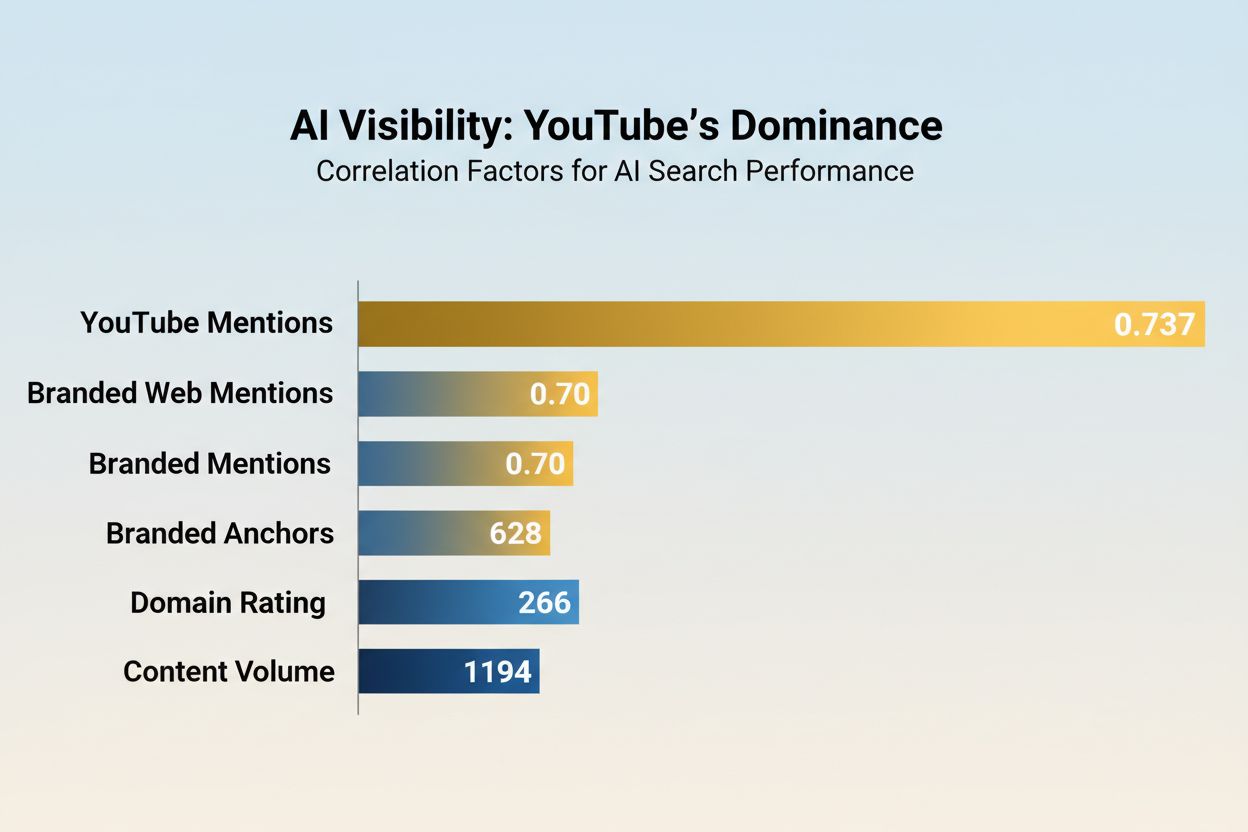
To interpret the 0.737 figure correctly, it helps to be precise about what researchers actually mean by YouTube mentions before diving into how the correlation was measured. YouTube mentions refer to any instance where a brand name appears in a YouTube video’s title, transcript, or description, capturing every context in which a brand is referenced on the platform. The study also measured YouTube mention impressions, which weight these mentions by the number of views each video received, producing a reach-adjusted metric. Researchers used the Spearman correlation coefficient, a statistical measure that quantifies the strength of the relationship between two ranked variables, with values ranging from -1 to +1. A correlation of 0.737 indicates a strong positive relationship: as YouTube mentions increase, AI visibility tends to increase proportionally. This is a correlation, not a causal proof, but among every factor tested it was the single strongest predictor.
| Factor | Correlation Value | Interpretation |
|---|---|---|
| YouTube Mentions | 0.737 | Very Strong |
| YouTube Mention Impressions | 0.717 | Very Strong |
| Branded Web Mentions | 0.66-0.71 | Strong |
| Branded Anchors | 0.511-0.628 | Moderate to Strong |
| Branded Search Volume | 0.352-0.466 | Weak to Moderate |
| Domain Rating (DR) | 0.266 | Weak |
| Content Volume (Site Pages) | 0.194 | Very Weak |

Track how AI chatbots mention your brand across ChatGPT, Perplexity, and other platforms.
The dominance of YouTube mentions in predicting AI visibility isn’t coincidental: it reflects how modern AI systems are built and trained. Both Google and OpenAI have publicly acknowledged training their models on massive datasets of YouTube video transcripts. According to reporting by The New York Times, OpenAI’s GPT-4 model was trained on over one million hours of YouTube transcriptions, treating them as a vast natural language dataset. YouTube transcripts provide rich, conversational, authentic human language that differs fundamentally from optimized web content: natural speech patterns, genuine product reviews, real-world use cases, and authentic user experiences, all of which AI systems find more trustworthy and valuable than carefully crafted marketing copy. YouTube’s multimodal nature (combining video, audio, and text) also gives AI systems richer contextual information than text-only web pages, making YouTube mentions a more reliable signal of genuine brand relevance and authority.
While all three AI platforms studied showed strong correlations with YouTube mentions, they diverge in how they weight everything else. ChatGPT showed nearly identical YouTube correlations (0.737) despite YouTube being only its sixth most-cited domain, suggesting YouTube’s importance transcends platform ownership and reflects fundamental training data patterns rather than access to YouTube data through a corporate relationship. Google’s AI Mode and AI Overviews, both owned by Google and thus having deeper structural ties to YouTube, showed similarly strong YouTube correlations, but they diverged significantly on traditional brand authority signals. AI Mode demonstrated the strongest correlations with branded anchors (0.628) and branded search volume (0.466), indicating it acts as a “consensus engine” favoring established brands. ChatGPT, conversely, showed weaker correlations with these traditional authority metrics. AI Overviews showed a slightly stronger correlation with Domain Rating (0.326) than the other platforms, likely because it delivers factual, one-shot answers to informational queries where source authority matters more.
Get the latest insights on AI mentions, brand monitoring, and optimization strategies.
Google’s AI Mode consistently demonstrated the highest correlations with traditional branded authority signals, revealing a distinct selection philosophy. The platform showed particularly strong correlations with branded anchors at 0.628: the visible, clickable text in hyperlinks that feature the brand name. This metric matters because branded anchors represent intentional endorsements; someone has deliberately chosen to link to your brand using your brand name, combining both popularity and authority signals. AI Mode also showed strong correlations with branded web mentions (0.709) and branded search volume (0.466), a pattern that suggests the platform prioritizes brands that are already household names with well-established market recognition. That makes AI Mode the most challenging of the three platforms for emerging brands to penetrate through traditional SEO signals alone.
For emerging brands without established market dominance, ChatGPT presents a more accessible statistical profile. The platform showed the weakest correlations with almost every traditional brand authority metric, including branded anchors (0.511), branded search volume (0.352), domain rating (0.266), and backlinks. This pattern suggests ChatGPT relies less on legacy search-ranking systems, drawing instead from a broader range of sources. Interestingly, ChatGPT showed the strongest correlation with advertising metrics among the three platforms, hinting that brands with significant paid media presence tend to dominate the type of content that feeds ChatGPT’s training data. For a brand with modest search volume and limited backlinks, the data suggests ChatGPT is the platform most likely to reward YouTube mentions before traditional SEO authority catches up.
Among the three platforms, AI Overviews showed the strongest correlation with Domain Rating at 0.326, though this remains weak compared to YouTube mentions and branded signals. This likely reflects AI Overviews’ function: delivering factual, authoritative answers to informational queries where source credibility is paramount. Unlike ChatGPT’s conversational approach or AI Mode’s consensus-building, AI Overviews must produce a single, definitive answer, making source authority slightly more relevant. Even so, this stronger correlation with Domain Rating pales in comparison to YouTube mentions, reinforcing the study’s central finding: traditional link-based authority metrics matter far less than brand visibility in the AI era.
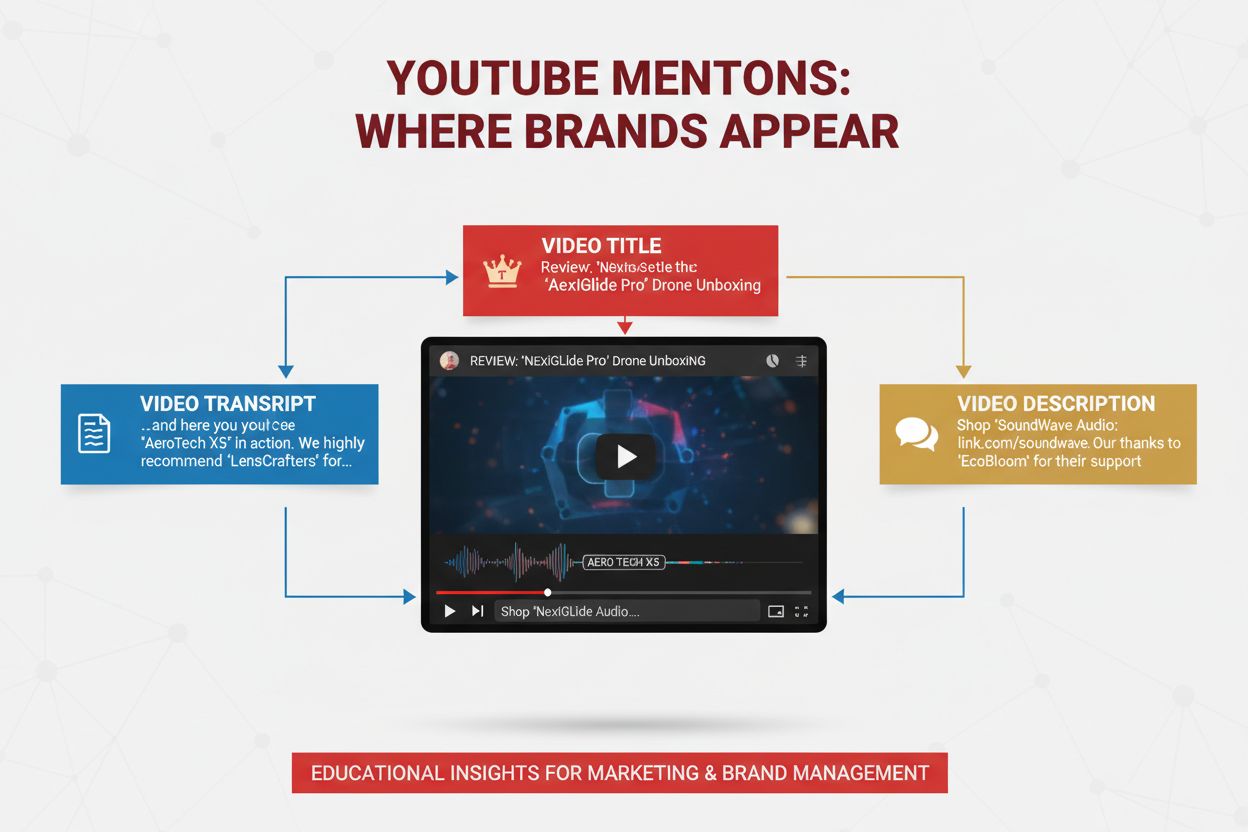
The study captured mentions across three distinct contexts: video titles, video transcripts, and video descriptions. A brand mention in a video title carries the same statistical weight as one buried in a transcript — what the correlation measures is breadth of mentions, not prominence within an individual video. The research also revealed a subtle nuance: YouTube mentions (0.737 correlation) correlate slightly more strongly than YouTube mention impressions weighted by views (0.717 correlation). In practical terms, a brand mentioned in fifty videos with modest individual view counts appears to signal stronger AI visibility than a brand mentioned in five viral videos. This challenges the assumption that reach and scale are paramount, and instead points to diverse, widespread mentions as the stronger correlate.
The study’s findings directly contradict much conventional SEO advice. Backlinks and URL rating showed extremely weak correlations with AI visibility, correlating at only 0.194-0.357 depending on the platform. Even more striking, content volume (measured by the number of pages on a domain) showed almost no correlation with AI visibility, at 0.194. This challenges the popular strategy of pursuing programmatic SEO and content expansion for volume’s sake alone. As one of the study’s authors put it, “It’s not just a content creation arms race.” The data suggests AI systems are less susceptible to classic link spam and content saturation tactics than traditional search engines, and instead prioritize real-world brand relevance as evidenced by diverse, authentic mentions, particularly on high-context sources like YouTube. Brands that keep trying to buy AI visibility with backlinks and link volume alone are optimizing for a signal the data shows is comparatively weak. What this looks like in terms of brand mention patterns matters more here than sheer publishing volume.
While YouTube mentions top the correlation rankings, branded web mentions still correlate strongly with AI visibility at 0.66-0.71 across all platforms, making them the second-most important factor. These mentions span blog posts, news articles, guides, forums, and other web content, capturing the breadth of a brand’s discussion across the internet. A brand mentioned in a single high-authority publication may carry less statistical weight than one mentioned across dozens of mid-tier publications, blogs, and community forums. This reinforces the value of the dominance of YouTube as a mention source without making other channels irrelevant: earned media and genuine brand advocacy still show up clearly in the numbers.
Despite their different selection philosophies, the three AI platforms studied showed remarkable consistency in brands they mention. The output overlap correlation between platforms was 0.779, meaning the same major brands tend to appear across ChatGPT, AI Mode, and AI Overviews, albeit through different statistical paths. Nike, Apple, Amazon, and other household names dominate across all three. This suggests a hierarchy of AI visibility, with dominant players occupying the top tier regardless of platform, but it doesn’t mean emerging brands with strong growth trajectories are locked out. It means the factors that move the needle for them are narrower: YouTube presence and genuine brand mentions.
Knowing that YouTube mentions correlate at 0.737 is only useful if you can see whether your brand’s mentions are moving in the right direction. AmICited.com provides comprehensive monitoring of brand mentions across YouTube and other platforms, tracking how these mentions correlate with visibility in ChatGPT, Google AI Mode, and AI Overviews over time. Rather than relying on a one-time study, AmICited.com delivers real-time data on how your brand appears across AI platforms, so you can see the correlation play out for your own numbers rather than just the aggregate study. Pair this data with a concrete execution plan, our YouTube visibility playbook walks through the content strategy, creator partnerships, and video SEO work needed to move these numbers.
Viktor Zeman is a co-owner of QualityUnit. Even after 20 years of leading the company, he remains primarily a software engineer, specializing in AI, programmatic SEO, and backend development. He has contributed to numerous projects, including LiveAgent, PostAffiliatePro, FlowHunt, UrlsLab, and many others.

See how your brand's YouTube mention volume tracks against your AI visibility in ChatGPT, Google AI Mode, and AI Overviews, with real-time correlation data.
Learn about YouTube AI Correlation (0.737), the strongest off-page factor for AI visibility. Discover why YouTube dominates AI citations and how to optimize you...
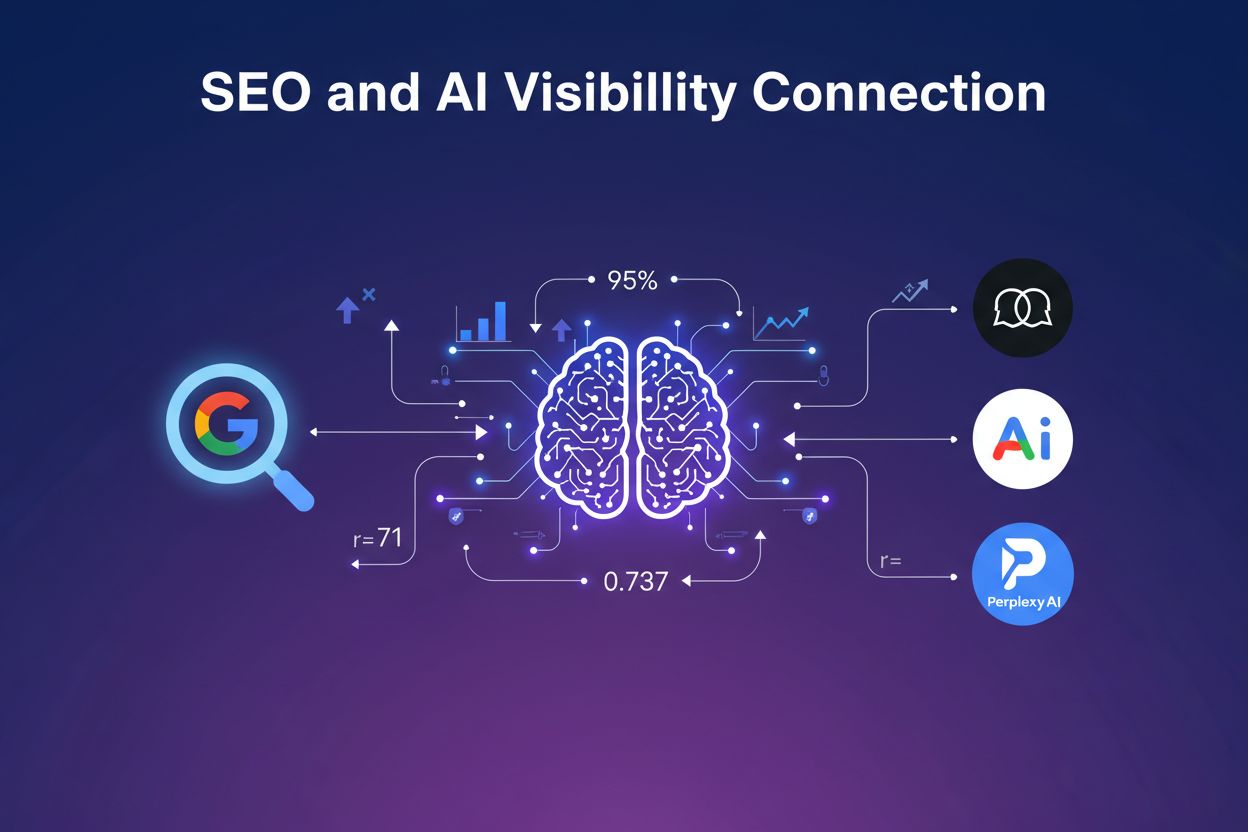
Discover the strong correlation between SEO rankings and AI visibility. Learn how traditional SEO drives AI citations and what signals matter most for AI platfo...
A practical playbook for earning the YouTube mentions that move AI visibility: channel strategy, creator partnerships, transcript optimization, and how to measu...
Cookie Consent
We use cookies to enhance your browsing experience and analyze our traffic. See our privacy policy.