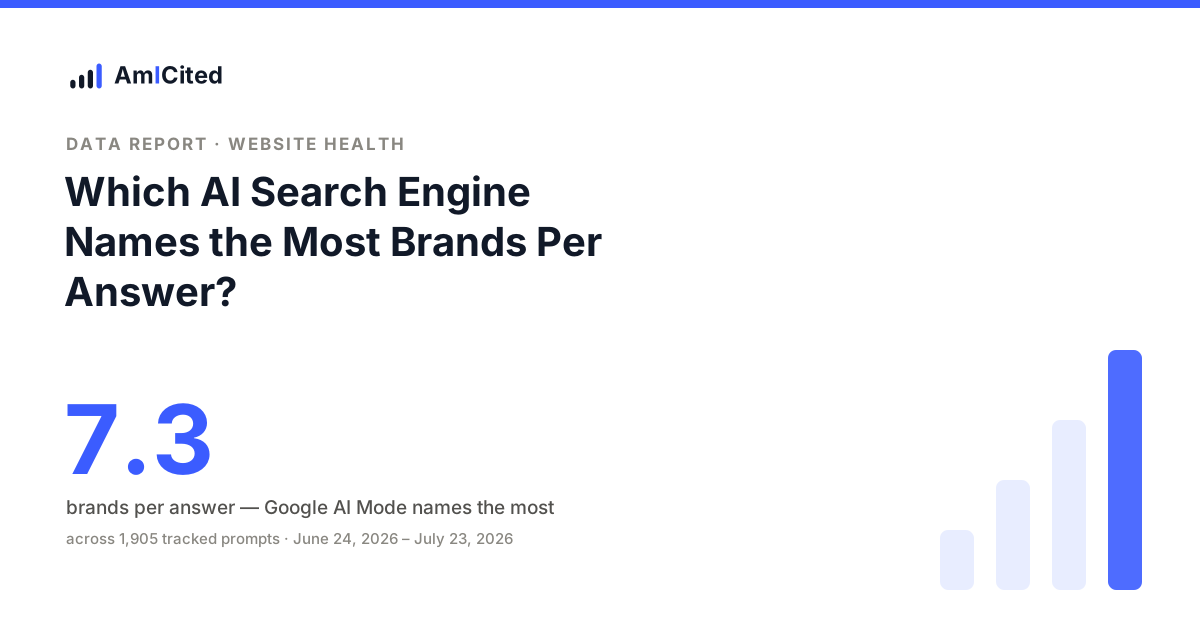
Google AI Mode names the most brands per answer (7.3 on average); Google AI Overviews the fewest (3.1).
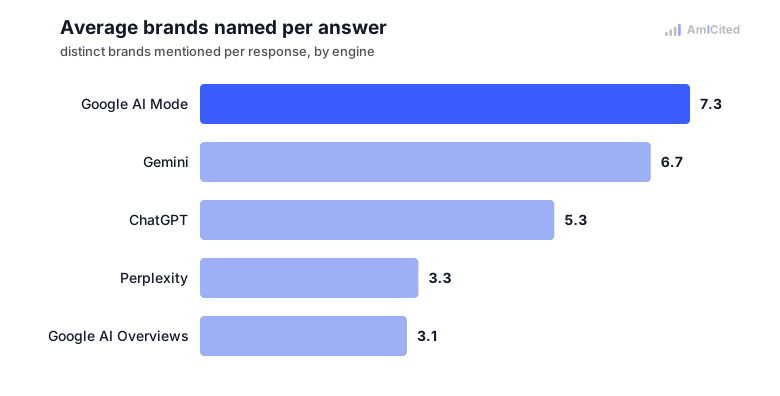
Counting the distinct brands each answer names (whether or not it links them), Google AI Mode averages 7.3 and Google AI Overviews 3.1. This measures how many brands an engine puts in front of a user per response, the raw material of AI share-of-voice.
Key Takeaways
- Google AI Mode names the most brands per answer (7.3), more than double Google AI Overviews’ 3.1, the sparsest engine in the set.
- Gemini (6.7) and ChatGPT (5.3) sit in the middle; Perplexity (3.3) is the surprise laggard given its search-first design.
- Name-dense engines like Google AI Mode make mentions easier to earn but less differentiating; name-sparse engines like Google AI Overviews make mentions harder to earn but more valuable.
- Because brand density varies so much by engine, a single “AI visibility score” hides more than it reveals; strategy and reporting should be per-engine.
Bottom line: Track your brand’s mention rate separately for each AI engine, since AmICited’s own tracking data shows density alone can more than double your odds of appearing in an answer.
Average brands named per answer, by engine
| AI engine | Value |
|---|---|
| Google AI Mode | 7.3 |
| Gemini | 6.7 |
| ChatGPT | 5.3 |
| Perplexity | 3.3 |
| Google AI Overviews | 3.1 |

Ready to Monitor Your AI Visibility?
Track how AI chatbots mention your brand across ChatGPT, Perplexity, and other platforms.
What the spread tells you
The spread is wide: Google AI Mode names 7.3 brands per answer, 2.4× as many as Google AI Overviews’s 3.1. That is not a subtle preference: it changes the visibility game per engine. An assistant that names many brands per answer (like Google AI Mode) gives more players a shot at appearing in any given response, so share of voice is more contestable there. An engine that names few (like Google AI Overviews) concentrates attention on a handful of names, making its answers harder to break into but more valuable when you do.
For a brand tracking its AI presence, this reframes where effort pays off: winning a mention in a name-dense engine is more achievable but individually worth less; winning one in a name-sparse engine is harder but higher-impact.
What this means for AI-search visibility
AI share-of-voice is decided partly by how many brands each engine is willing to name. As the numbers show, they differ sharply. Your AI-visibility plan should therefore be per-engine, not one-size-fits-all.
Takeaways
- Treat each engine as a separate visibility market with its own “slots per answer.”
- In name-dense engines, compete on breadth: being one of many named options is realistic and cumulative.
- In name-sparse engines, prioritise the specific queries where you can plausibly be one of the very few names returned.
Stay Updated on AI Visibility Trends
Get the latest insights on AI mentions, brand monitoring, and optimization strategies.
The brand-density spectrum: from 3.1 to 7.3 brands per answer
The 2.4× spread between Google AI Mode (7.3 brands per answer) and Google AI Overviews (3.1 brands per answer) is not just a statistical curiosity: it defines fundamentally different competitive landscapes. These are not subtle differences in how engines present information; they are different products with different editorial philosophies.
Google AI Mode is designed as a comprehensive research assistant. Its answers are long, multi-section, and source-rich. It names many brands because it is trying to give users a complete picture of the options available. This makes it the most “democratic” engine: more brands get a seat at the table.
Google AI Overviews is designed as a quick answer layer on top of traditional search results. Its answers are concise summaries. It names fewer brands because it is trying to give users the most relevant answer quickly, not a comprehensive survey.
Gemini (6.7 brands) and ChatGPT (5.3 brands) fall in the middle: they are conversational assistants that provide substantive answers but do not attempt the exhaustive coverage of Google AI Mode.
Perplexity (3.3 brands) is the surprise. It is a search-focused engine, but it names relatively few brands per answer. Combined with its 86% unlinked rate, Perplexity is the engine where brand visibility is simultaneously hard to earn (few slots) and hard to measure (few links).
How to adapt your strategy by engine
The brand-density data suggests different optimization strategies for different engines:
For name-dense engines (Google AI Mode, Gemini):
- Compete on breadth. Being one of 7 brands in an answer is achievable and cumulatively valuable.
- Optimize for being named in the “long tail” of an answer, the later sections where Google AI Mode lists additional options.
- Track your presence across many queries rather than obsessing over position in any single answer.
For name-sparse engines (Google AI Overviews, Perplexity):
- Compete on position. When only 3 brands are named, being one of them is a significant achievement.
- Prioritize the specific queries where your brand has a strong, defensible claim to being one of the top options.
- Accept that you will not be mentioned in every relevant answer. Focus on winning the ones where you are most competitive.
For ChatGPT (middle of the pack):
- ChatGPT’s 5.3 brands per answer and 55% linked rate make it the most balanced engine. A balanced strategy works here: pursue both breadth (being mentioned in many answers) and depth (being the primary recommendation in a few).
The strategy implication: per-engine optimization
The takeaway from both the brand-density data and the unlinked-mention data is the same: AI visibility is not one thing. It is five different things, one per engine. Each engine has its own:
- Brand density (how many brands it names per answer)
- Link rate (how often it links the brands it names)
- Answer style (comprehensive vs. concise)
- Source preferences (which domains it cites most)
A one-size-fits-all AI visibility strategy that treats all engines the same will underperform. The most sophisticated AI visibility programs treat each engine as a separate channel with its own KPIs, optimization tactics, and reporting cadence.
Practical recommendations
Set per-engine KPIs. Don’t report a single “AI visibility score.” Report ChatGPT mentions, Perplexity mentions, Google AI Mode mentions, etc. separately.
Allocate effort by engine density. In name-dense engines, focus on volume (being mentioned in many answers). In name-sparse engines, focus on precision (being mentioned in the most important answers).
Monitor engine shifts. AI engines are evolving rapidly. Google AI Mode’s 7.3 brands per answer today may change as the product matures. Track these metrics over time to detect shifts in the competitive landscape.
Use the right tool for the right engine. If your tracking tool only measures links, you are missing most of the story in Perplexity and Gemini. Use a tool that tracks both mentions and citations.
Methodology
Computed from AmICited’s 1,905 tracked prompts (June 24, 2026 – July 23, 2026, 2026), across ChatGPT, Perplexity, Google AI Overviews, Google AI Mode and Gemini. A brand is any name AmICited’s brand detection finds in the response text, mentioned with or without a link, counted once per response. This is consistent across engines because it does not depend on whether a link was captured. Distinct brands are counted once per response, so an answer that names the same brand twice counts it once. Because it relies on brand detection over the answer text (not on captured links), the metric is comparable across engines even though link-capture rates differ. Microsoft Copilot is tracked but returned no citation data in this window. No external links appear in this report.
 LinkedIn